




Quick Answer
The Amazon affiliate program, officially called Amazon Associates, is a free program that pays website owners, app developers and creators a commission when people buy on Amazon through their tagged links. According to Amazon’s US rate table, commissions run from 0% to 10% depending on the product category, and products in categories Amazon doesn’t list earn 4%.
A shopper has 24 hours after your click to add an item to the cart and up to 89 days to check out. Amazon reviews your account after your first three qualifying sales within 180 days, and commissions are paid about 60 days after the end of the month.
Many older guides to the Amazon affiliate program quote a top commission rate twice Amazon’s real maximum, plus a simple 24-hour cookie. Neither matches Amazon’s own pages. This guide uses only the rate table, policies and help pages Amazon publishes, checked on November 2, 2026.
It covers how commissions and tracking work, how to join and get approved, when you get paid, and the rules that cost people their earnings. If you sell on Amazon yourself, there is also a section on the programs built for sellers, brands, vendors and developers.
About the Author: Gloria Anderson writes for the SellerSonar editorial team on Amazon programs, fees and policies. She checked every rate, rule and date in this guide against Amazon’s Associates, Seller Central and Amazon Ads pages, and every example against data from products SellerSonar tracks.
What is the Amazon affiliate program?
Amazon Associates is Amazon’s affiliate marketing program. You place special tagged links to Amazon products on your website, app, social media pages or Alexa skill. When a visitor clicks one and buys, Amazon pays you a share of the sale, which it calls commission income.
According to Amazon’s homepage for the program, Associates earn “up to 10%” on qualifying purchases, and that ceiling matches the rate table. The program is free to join. Amazon also warns that it has “never authorized any business to provide paid set-up or consulting services” to Associates, so be wary of anyone selling an official setup.
The program fits bloggers, review sites, publishers, app owners and creators: anyone with an audience that asks “what should I buy?”. You don’t hold stock, ship anything or handle returns. Amazon and its sellers handle that, and you earn from the traffic you send.
Amazon affiliate commission rates
US commission rates are fixed by product category in Amazon’s Standard Commission Income Statement. Here is Table 1 as it appeared on November 2, 2026.
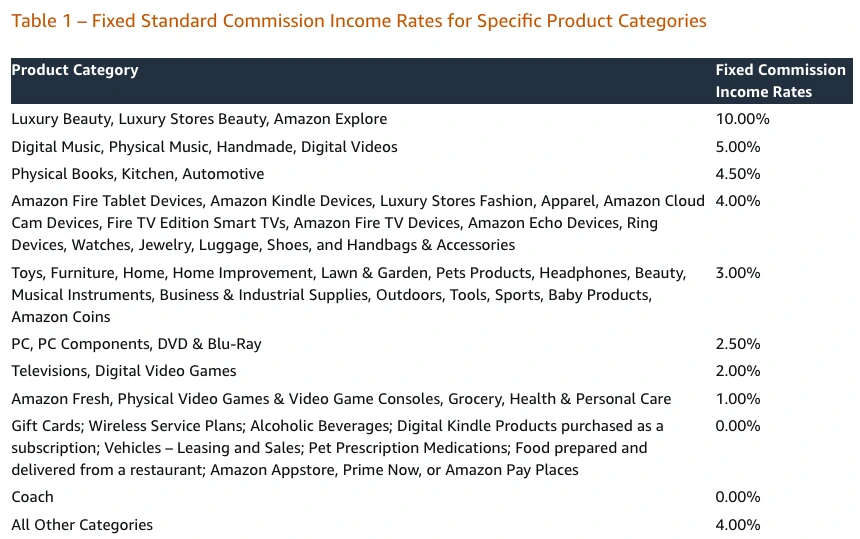
Per Amazon’s Table 1, the rates fall into a few bands:
- 10%: Luxury Beauty, Luxury Stores Beauty and Amazon Explore. This is the top rate.
- 4.5% to 5%: digital and physical music, Handmade and digital videos at 5%; physical books, Kitchen and Automotive at 4.5%.
- 4%: Amazon devices, apparel, shoes, jewelry, watches, luggage, handbags, and every category not named in the table.
- 3%: toys, furniture, home, home improvement, lawn and garden, pets, beauty, sports, tools, baby products and several more.
- 1% to 2.5%: PCs and components and DVDs at 2.5%, televisions and digital video games at 2%, and grocery, health and personal care, Amazon Fresh and physical video games at 1%.
- 0%: gift cards, wireless service plans, alcoholic beverages, Kindle subscriptions, vehicles, pet prescription medications, restaurant food, and the Amazon Appstore, Prime Now and Amazon Pay Places.
According to the same table, furniture and electronics, the “high-ticket” categories older guides oversell, pay 3% and 2% to 2.5%. They earn more per sale only because the prices are higher.
How much do Amazon affiliates make per sale?
Amazon publishes no earnings figures, and its Operating Agreement (updated October 15, 2025) says it makes no representation about “the amount of traffic or commission income you can expect.” So the honest way to answer is per sale.
Take the Cosori TurboBlaze 6 Qt air fryer, a Kitchen product paying 4.5%. According to its daily price history, it sold for $99.99 in the Buy Box from October 19 to November 1, 2026, so one sale earned about $4.50. At $119.99 on November 2, it earned about $5.40.
Commission is paid on what Amazon’s Associates Program Policies (updated April 14, 2026) call Qualifying Revenue: the amount Amazon receives, less shipping, gift wrapping, handling fees, taxes, credits and rebates. So treat any per-sale figure as “about”.
🎯 Pro Insight: Category matters more than people expect. The same $119.99 sale would pay about $12 at the 10% Luxury Beauty rate and about $1.20 at the 1% Grocery rate, according to the same rate table. To earn $1,000 a month from that air fryer alone, you’d need roughly 222 sales a month at $99.99.
You also don’t earn only on the product you linked. Amazon’s explainer on creator links says “If a shopper clicks through a creator’s link and buys additional items, the creator can earn on those purchases too.”
Bounties: flat fees for sign-ups
Besides product commissions, the same rate page lists bounties: fixed amounts paid when someone you refer signs up for an Amazon service. A few from the US table:
| Bounty event | Bounty |
|---|---|
| Prime Free Trial or Prime paid membership | $12.00 |
| Audible Standard Free Trial | $20.00 |
| Amazon Business account registration | $15.00 |
| Kindle Unlimited Free Trial | $3.00 |
| Amazon Music Unlimited Free Trial | $3.00 |
| Prime Video Free Trial | $2.00 |
Each bounty has its own eligibility rules for the customer, and the full table on Amazon’s rate page is longer. A bounty is earned by the action itself, so a free-trial sign-up pays even when the shopper buys nothing.
How Amazon affiliate tracking works: 24 hours and 89 days
The “24-hour cookie” is only half the rule. The Commission Income Statement in those same policies defines a Session that starts when a shopper clicks your link.
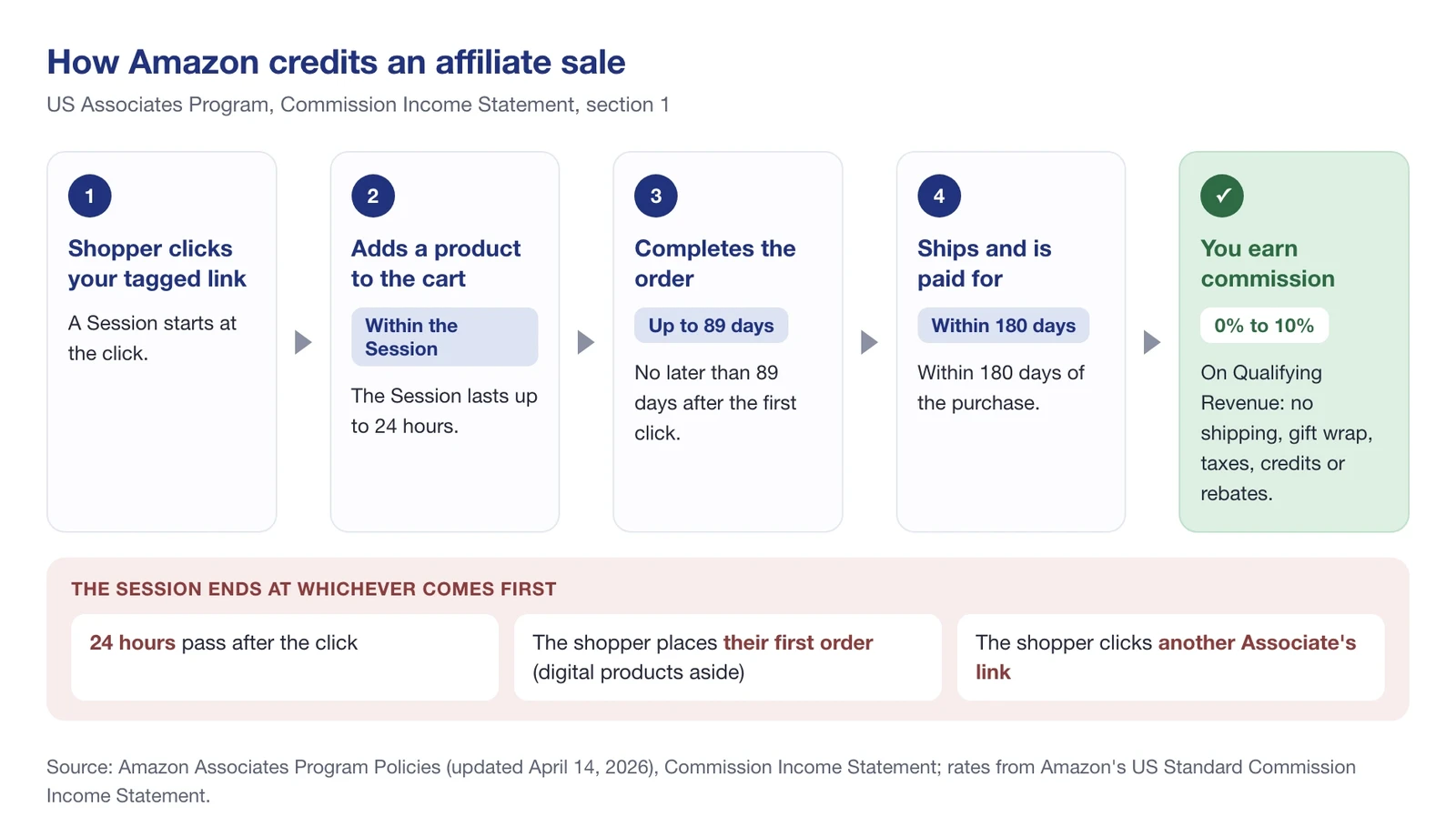
The Session ends at whichever comes first:
- 24 hours pass after the click.
- The shopper places an order (digital products such as Kindle books and Prime Video don’t end it).
- The shopper clicks another Associate’s link.
Anything the shopper buys during the Session counts. So does any product they add to the cart during the Session, as long as they complete the order no later than 89 days after the first click. The product must then be shipped and paid for within 180 days of the purchase.
Two consequences surprise new affiliates. A shopper who buys one item from your link and comes back an hour later to add a second item earns you nothing on it, because the first order ended the Session. And a fresh click on your link starts a new Session, so links in more places can matter as much as more traffic.
How to become an Amazon affiliate
Signing up takes one form, but approval comes later. Here’s the order Amazon describes:
- Sign up for the right store. Each Amazon store runs its own Associates program, and Amazon’s international programs page lists a separate sign-up for each. Join the one your audience buys from, and add others later.
- List every site you’ll use. Websites, mobile apps, social media pages and Alexa skills all count as Sites. Each must have original content and be publicly available.
- Get your tag and build links. Your special links carry an identifier such as “abcd-20”. Associates Central has linking tools that add it for you.
- Complete the tax interview and choose how to be paid. Payment options are covered below.
- Make three qualifying sales within 180 days. Amazon’s Associates team reviews your application only after that, and personal orders don’t count.
You also need to be able to sign a contract, which the Agreement explains as not being a minor. Amazon’s US pages give no other age or business requirement, so you don’t need a company or an LLC to apply.
💡 Expert Tip: Don’t sign up and then wait. The 180-day clock starts at sign-up, so publish a handful of genuinely useful posts with tagged links first, then apply. Your first three sales have to come from real readers, and asking friends or family to buy is against the rules.
What Amazon checks before approving you
Amazon’s application review page spells out the bar:
- Enough original content. “A good rule of thumb is at least 10 posts”, and Sites can’t be closed groups or behind a paywall.
- Websites: content should be recent, “generally within the last 60 days”, and you must own the website.
- Social networks: Facebook (not personal pages), Instagram, Twitter, YouTube, TikTok and Twitch.tv, with “in most cases, at least 500” organic followers. Posts and follower counts must be visible to non-followers.
- Tagged links in use: one rejection reason Amazon lists is not using your special links on the Sites you declared.
Amazon says it can’t reassess an application once it’s rejected. If you reapply, you get new tags, so you have to update the Amazon links on your Sites with the tags from the new application.
When and how Amazon pays affiliates
Amazon pays commission income “approximately 60 days following the end of each calendar month” in which it was earned. October 2026 commissions, for example, arrive around the end of December 2026.
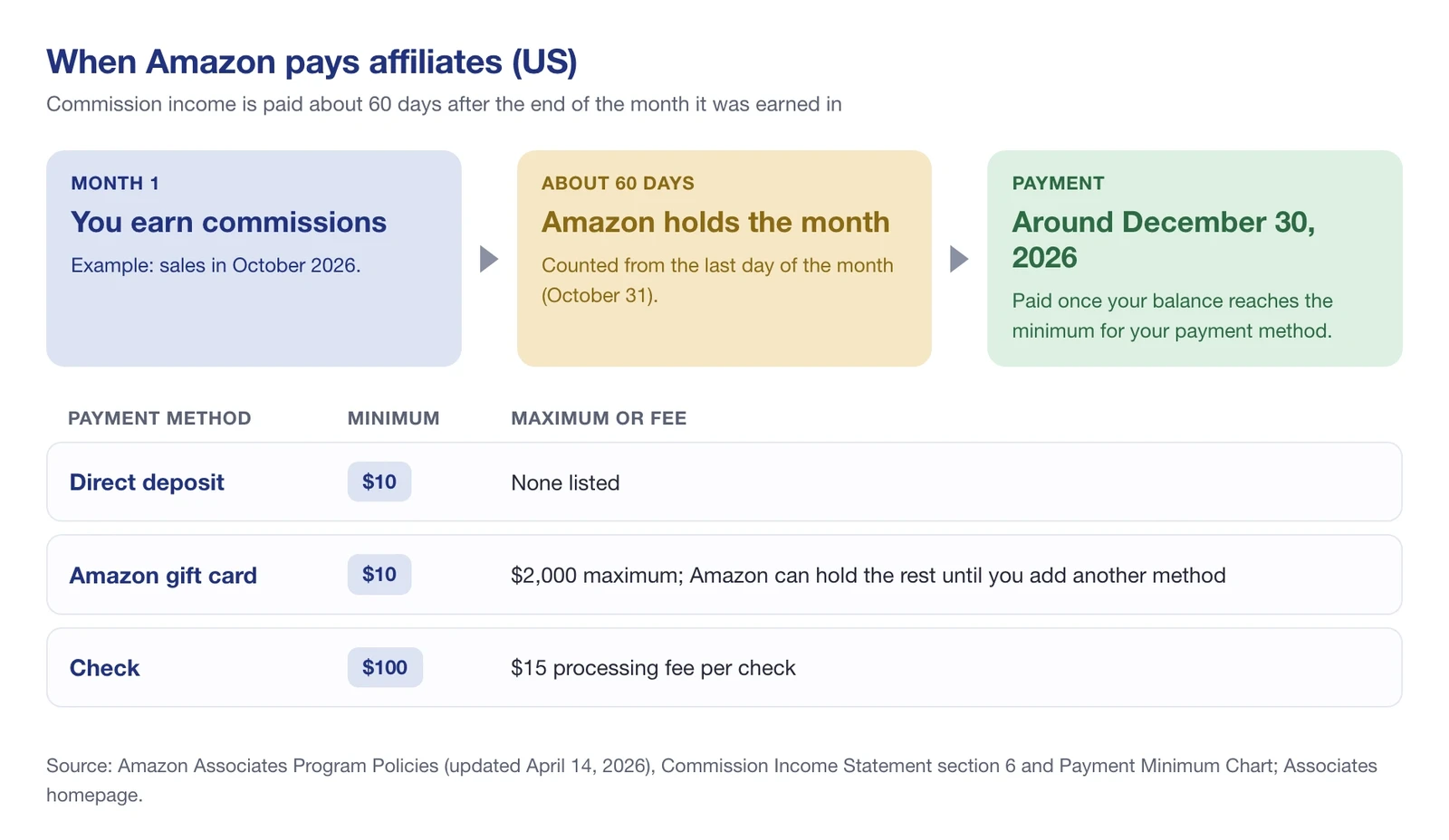
Amazon holds your balance until it reaches the minimum for your payment method. According to Amazon’s Payment Minimum Chart, direct deposit and Amazon gift cards start at $10, and gift card payments are capped at $2,000. Checks start at $100 and carry a $15 processing fee each, so direct deposit is the cheaper choice for most people.
According to the same policy, Amazon pays in the store’s default currency unless you can choose another, and after three years with no substantial activity it can withhold up to $10 of an inactive balance after seven days’ written notice. To follow your results, Associates Central has a Reports section.
Amazon Associates rules that cost people their commissions
The Operating Agreement lets Amazon stop paying “any and all commission income” if you break its terms, so the rules are worth knowing exactly. Here are the ones that matter most for affiliates and sellers:
- Disclose it, word for word. Amazon requires this sentence on your Site: “As an Amazon Associate I earn from qualifying purchases.”
- Don’t buy through your own links. You also can’t ask “friends, relatives, employees, contractors, or business relations” to buy through them.
- No rewards for clicking. No money, rebates, discounts, points or charity donations for using your links.
- No affiliate links on Amazon itself. That includes customer reviews, forums, Wish Lists and ads placed through Amazon.
- Keep “amazon” out of your names. No Amazon trademark or misspelling in your domain, tag or social media handle.
- No paid ads on “amazon” keywords. Sales that come through ads you bought on keywords containing “amazon”, “kindle” or other Amazon marks don’t qualify.
- Email only to people who opted in. Links are allowed in emails, SMS and social DMs that the recipient asked for, but not in print, eBooks, mailings or offline promotions.
- Don’t hide where a link goes. Link shorteners, buttons and cloaking are banned when they make it unclear that the link leads to Amazon.
- No misleading claims. Describe products accurately, including specifications like memory size.
- No price alerts on your Site. Unless Amazon agrees otherwise, an Associates Site can’t have price tracking or price alerting features.
Why you can’t type Amazon prices by hand
Under the Participation Requirements, your Site may show a price only if Amazon serves the link that displays it, or if you get the price through the Creators API. A price you typed into a post on Monday can be wrong by Tuesday.
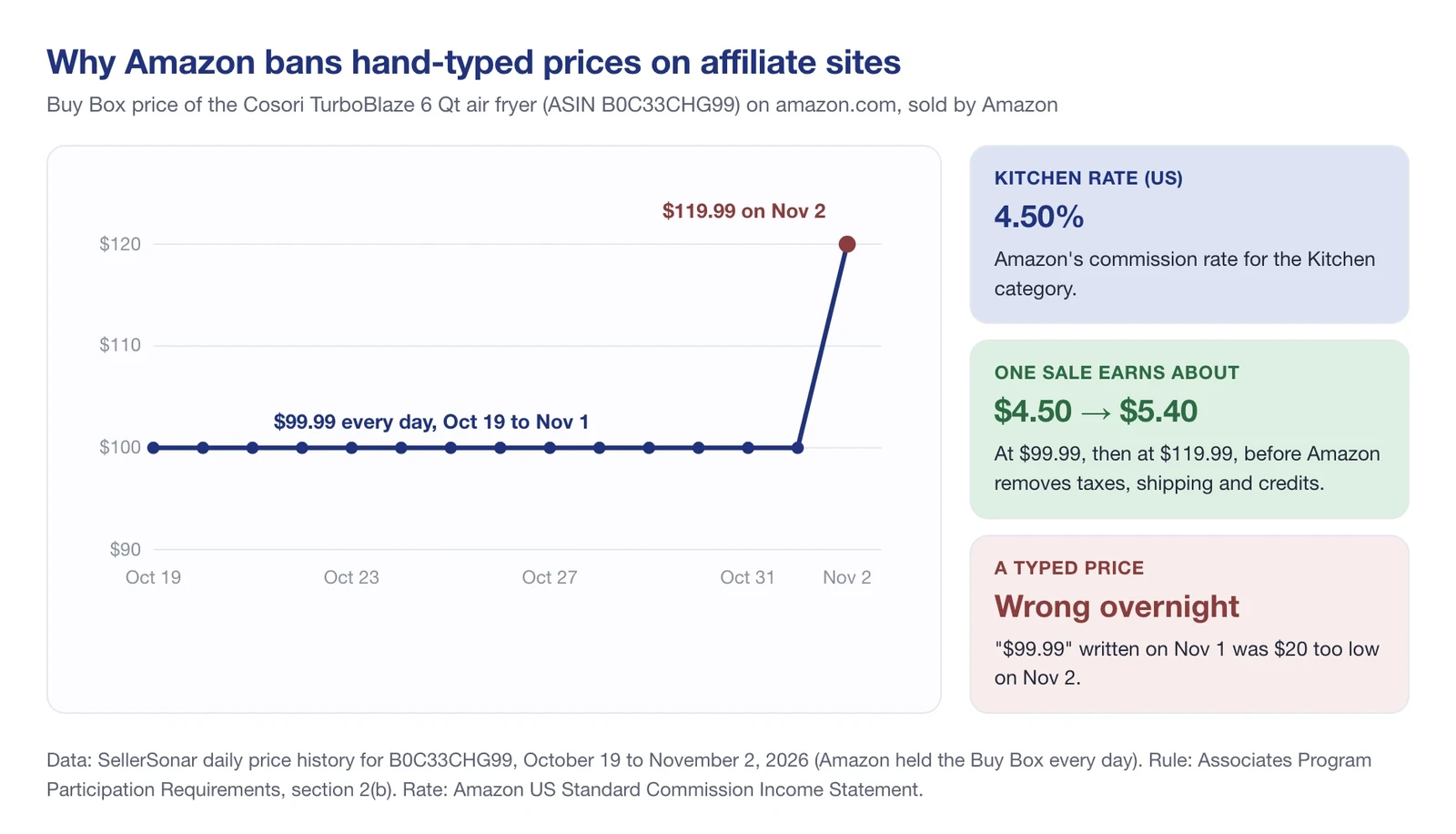
Here’s a real case from a product SellerSonar tracks. The Cosori TurboBlaze air fryer sat at $99.99 every day from October 19 to November 1, 2026, with Amazon holding the Buy Box. On November 2 it jumped to $119.99, so any post that said “$99.99” was suddenly $20 off.
If you want to check how a product’s price moved before you recommend it, our guide on how to see price history on Amazon covers the options. Just don’t publish the numbers as live prices.
Amazon Associates vs the Amazon Influencer Program
The Amazon Influencer Program is a separate track for social media creators. Amazon’s explainer, quoted above, describes it as “an extension of Amazon’s broader affiliate network” that adds a personal Amazon storefront with its own URL, Idea Lists and shoppable photos and videos.
According to the same explainer, creators apply with a TikTok, Instagram, YouTube, Pinterest or Facebook account. Amazon evaluates “content quality, engagement rate, and follower count”.
Amazon’s Associates homepage points bloggers, publishers and app owners to Associates, and influencers “with an established social media following” to the Influencer Program. Influencers earn standard commissions too, plus the storefront and the other ways to earn listed in Amazon’s explainer. For eligibility, storefront setup and how the two programs work together, see our full guide to the Amazon Influencer Program.
Amazon affiliate options for sellers, brands, vendors and developers
If you sell on Amazon, the Associates program is only one of several ways to get paid for traffic you send, and often not the best one. Which one fits depends on whether you own the brand.
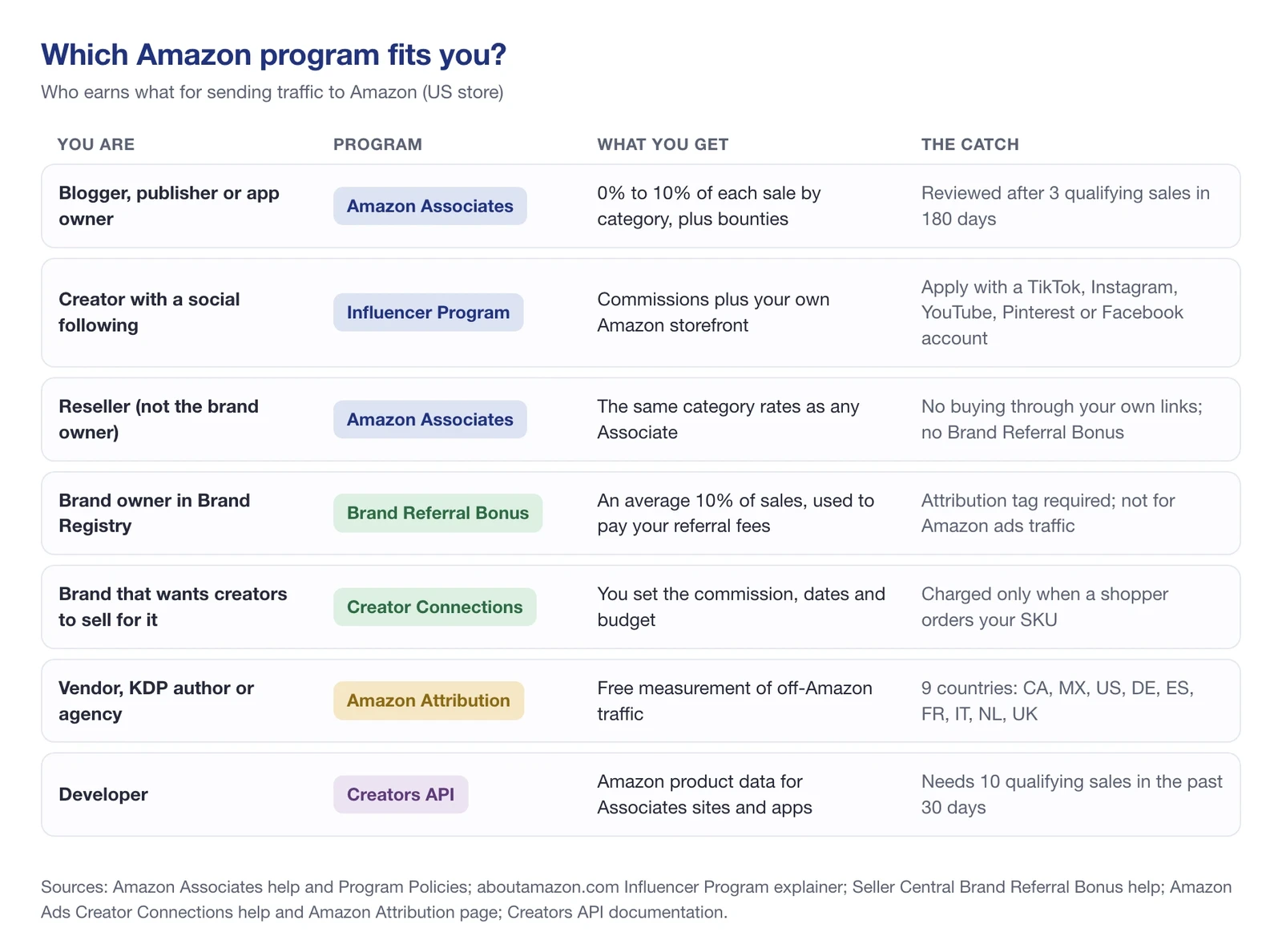
Resellers. If you resell other brands, Amazon’s own answer is Associates. Its Brand Referral Bonus help page says: “If you are a Reseller, you can join the Amazon Associates program to earn commissions from sales you generate.”
Nothing in the Operating Agreement bars linking to listings you sell on. The limits are buying through your own links, asking staff or partners to buy, and offering rebates for clicks.
Brand owners. Brand Representatives of a brand enrolled in Amazon Brand Registry and selling in the US store can earn the Brand Referral Bonus instead: an average 10% of sales from off-Amazon traffic. It’s used to pay down your referral fees, arrives after a two-month wait, and is credited on the 10th of each month.
All traffic needs an Amazon Attribution tag, and Amazon’s Brand Referral Bonus guide says it “isn’t available for Amazon advertising”. Our Brand Referral Bonus guide has the category rates.
One trap applies to brands that also hold an Associates account. The Commission Income Statement warns that Amazon may withhold commissions if you try to “claim commissions from both Amazon Associates and another program using the same traffic”. Never put your Associates tag and an Attribution tag on the same click.
Brands that want creators to sell for them. Creator Connections lets a brand pick products and set a commission rate, start and end dates, and a maximum budget. Creators from the Influencer and Associates programs (Bronze tier or higher in Creator Stars) then promote them. Amazon’s help page, updated October 26, 2026, lists who can use it:
- Brands that advertise in the US through an Amazon Ads account based in the US, China or Hong Kong.
- The brand must be in Brand Registry, with you as its brand representative or an authorized reseller.
- Sellers open it in Seller Central under Advertising, then Creator Connections; vendors use the Ads console.
There are no base or daily fees, and commission is charged on the net price after coupons. The catch is the featured offer: “If another seller takes the featured offer and a customer orders that seller’s SKU instead, that order is not attributed to your Creator Connections campaign and no commission is charged.” A creator’s click only becomes your sale while you hold the Buy Box.
📌 From Our Experience: The featured offer is the easiest part of a creator campaign to forget. If a reseller undercuts you mid-campaign, the creator’s traffic buys from them. SellerSonar’s Buy Box monitoring records who holds the Buy Box on every check, as often as every hour on Business and Enterprise plans, and sends Buy Box lost and won alerts from the Premium plan up.
Vendors, KDP authors and agencies. Amazon Attribution is a free measurement tool for professional sellers in Brand Registry, vendors, KDP authors, and agencies with clients who sell on Amazon. It measures sales from search, social, display and video ads and email, and is offered in Canada, Mexico, the US, Germany, Spain, France, Italy, the Netherlands and the UK.
Developers. Amazon’s product data for affiliate sites and apps comes from the Creators API, Amazon’s REST API for publishers, influencers and affiliate partners. You need to be an Associate for the target store with “at least 10 qualifying sales within the past 30 days”. The older Product Advertising API 5.0 has been deprecated, and calls to it return an HTTP 403 error.
Cached product data may be kept for up to 24 hours before it has to be refreshed through the API. And as with any Associates Site, your app can’t offer price tracking or price alerts unless Amazon agrees.
Pros and cons of the Amazon affiliate program
Here’s the balance sheet, with every point taken from Amazon’s own terms:
| Pros | Cons |
|---|---|
| Free to join, with no stock, shipping or returns to handle | Rates top out at 10%, and most categories pay 4% or less |
| Millions of products to recommend, so almost any niche fits | The Session lasts at most 24 hours and ends at the shopper’s first order |
| You can earn on the whole order, not just the item you linked | No review until 3 qualifying sales in 180 days, and no reassessment after a rejection |
| Bounties pay flat fees for sign-ups to Prime, Audible and other services | Payment arrives about 60 days after the month ends |
| Separate programs in each Amazon store for international audiences | A rule break can cost you all unpaid commission income |
The program works best as one income stream among several. A practical approach: pick a niche where buyers already shop on Amazon, write content worth reading without the links, and check the rate table before choosing what to cover.
Bringing it together
The Amazon affiliate program is simple to join and strict to stay in. What matters most:
- Rates are 0% to 10%. Check the category in Amazon’s table before you build content around a product.
- Tracking is 24 hours plus 89 days. The cart add must happen in the Session, and the first order ends it.
- Approval comes after three real sales. They must land within 180 days, and personal orders don’t count.
- Payment comes about 60 days after month end. Choose direct deposit to avoid the $100 check minimum and $15 fee.
- The rules are exact. Use Amazon’s disclosure sentence, never buy through your own links, and never type prices by hand.
Final Expert Recommendations:
If you’re a publisher or creator, start with Associates in the store your audience uses, and plan your first three sales before you sign up. If you’re a brand owner, the Brand Referral Bonus (an average 10% of sales, per Seller Central) usually returns more on your own traffic than an Associates tag, where most categories pay 4% or less, as long as the two programs run on separate traffic. Whichever route you take, keep the Buy Box on the products you send people to, because a lost featured offer turns your traffic into someone else’s sale.
Selling your own products and sending traffic to Amazon? Start a free 14-day SellerSonar trial (5 ASINs and 10 keywords, no credit card) and see who holds the Buy Box on the listings your campaigns point to.

