





Quick Answer
You can sell supplements on Amazon, but every product has to pass Amazon’s Dietary supplements policy, and the bar is high. The factory needs a third-party cGMP certificate, the label and listing must follow FDA rules with no disease claims, and when Amazon asks, an Amazon-authorized testing lab (TIC provider) verifies the product for you. From November 2, 2026, supplements also need USD 1 million in liability insurance, whatever your sales. With FBA, every unit needs an expiration date and enough shelf life for the full course plus 90 days.
Supplements look like a perfect Amazon product: small, light, bought again every month. That’s also why the category is crowded, and why Amazon checks it more closely than most others.
This guide walks through what Amazon requires from supplement sellers on Amazon.com as of October 2026: what counts as a supplement, the rules for labels and claims, how lab verification works now, the new insurance rule, FBA shelf-life rules, fees, and the problems that hit supplement listings most often.
About the Author: Gloria Anderson writes for the SellerSonar editorial team about Amazon policies, product compliance and selling on Amazon. She checks every rule in her articles against Seller Central help pages, and every FDA requirement against the regulation it comes from.
What Does Amazon Consider Supplements?
Amazon uses the FDA’s definition. A dietary ingredient is “a vitamin, mineral, herb, or other botanical, amino acid, or dietary substance used to supplement the diet,” or a concentrate, extract or combination of those. Supplements come as powders, pills, capsules, liquid drops and oral sprays.
What matters more for sellers is how Amazon decides your product is a supplement. According to Amazon’s Dietary supplements policy, any one of these on the listing, label or marketing can put it under the policy:
- A “Supplement Facts” panel
- A label statement such as “Dietary Supplement” or “Herbal Supplement”
- Claims about dietary ingredients like vitamins, minerals, herbs or amino acids
- Dosing language, such as “Take 2 capsules daily”
- Health benefit claims, such as “Helps maintain healthy blood sugar levels”
- Structure or function claims, such as “Supports immune health”
A product with a “Nutrition Facts” panel can still fall under the supplements policy if its listing does any of the above. So a protein bar marketed with dosing and health claims may be treated as a supplement.
Can You Sell Supplements on Amazon?
Yes. Supplements are a restricted category, not a prohibited one. But three things decide whether you actually can.
First, the product itself must be legal to sell. The FDA doesn’t approve supplements before they go on sale. Its questions and answers on dietary supplements say: “Under DSHEA, FDA does not have the authority to approve dietary supplements before they are marketed.” The company that makes or distributes the product is responsible for its safety and labeling. If it contains a new dietary ingredient, the FDA must be notified at least 75 days before it goes on sale.
Second, your account must be allowed to list it. In Seller Central, search for the product under Add Products. “Sell this product” means no approval is needed, “Apply to sell” means you need approval, and “Not Available” means you can’t list it. Approval can apply to a category, a brand or a single ASIN. Our guide to Amazon restricted products and how to get ungated covers the application itself.
Be ready for a no. In a Seller Forums post from March 12, 2025, Amazon staff wrote that for sellers not already approved, “we are not accepting applications for supplements at this time.” So check the current status of your exact product before you order inventory.
Third, the product must pass Amazon’s compliance checks. That’s the rest of this guide.
💡 Expert Tip: Run the Add Products check on your exact product, or on the closest existing listing, before you sign a manufacturing order. Approval is the one step you can’t speed up with money, and a warehouse full of supplements you can’t list is the most expensive way to find out.
Amazon Rules on Selling Supplements
Amazon requires every supplement to comply with Title 21 of the US Code of Federal Regulations, including 21 CFR 101 (food labeling) and the manufacturing rules in 21 CFR 111 or 21 CFR 117. Five higher-risk types must also meet NSF/ANSI 173-2024: bodybuilding, joint health, sexual enhancement, sports nutrition and weight management.
On top of the law, the policy sets its own rules for the listing, the images, the claims and the offer.
Detail page and images
The detail page must include the supplement’s name in the item name, the manufacturer, the brand, the ingredients list and the unit count (such as 100 tablets or 6 oz).
The images must show:
- The full product label in English, including the “Supplement Facts” or “Nutrition Facts” panel, ingredients, certification logos, directions and any warnings
- The identifying codes on the packaging, such as lot numbers, serial numbers or matrix codes
- The name and address of the brand owner, manufacturer, packer or distributor
The images must not include the FDA logo.
Claims you can’t make
This is where most supplement listings get into trouble. Under Amazon’s policy, listing text and images must not:
- Make disease claims, meaning claims to diagnose, cure, reduce, treat or prevent a disease, unless the FDA approved the statement
- Put disease names in your keywords
- Say “FDA approved” unless the product has official FDA approval
- Claim the same effects as a prescription drug or controlled substance, or use names that could be confused with one. Amazon’s examples are “GLP-1”, “Viagrex” and “TestosterX”
- Promise steroid-like effects, such as “Legal Steroids”
- Show “tester,” “not for retail sale” or “not intended for resale” on the label
- Inflate ingredient weights. Amazon’s example: stating 10,000 mg of raw herb when the actual extract is 500 mg
- Say “Non-GMO” without proof: a Non-GMO Project Verified or Nutrasource IGEN certificate, a PCR lab report from an ISO 17025-accredited lab, or a USDA Organic certificate
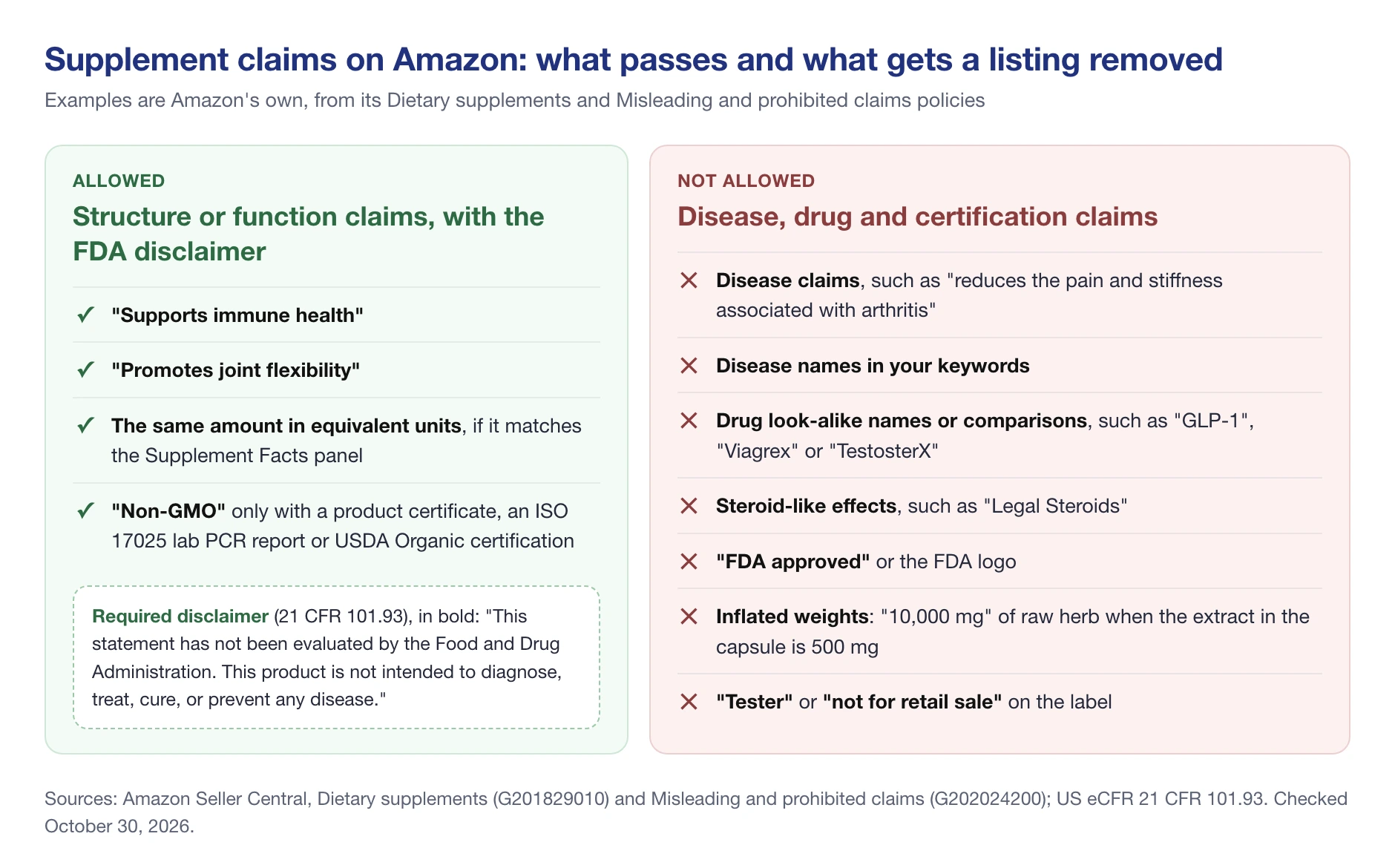
Structure or function claims, like “Supports immune health,” are allowed under US law. But the FDA’s rule 21 CFR 101.93 requires a disclaimer next to them, in bold type at least 1/16 inch tall: “This statement has not been evaluated by the Food and Drug Administration. This product is not intended to diagnose, treat, cure, or prevent any disease.” The same rule requires the company to notify the FDA no later than 30 days after it first markets a product with such a claim.
Offer condition
Supplements can only be sold as New: sealed in the original manufacturer’s packaging. Amazon’s condition guidelines for consumable products rule out anything used, damaged, or marked unsellable by a manufacturer or supplier. There is no used or open-box supplement market on Amazon.
Supplements you can’t sell at all
Some products are banned outright, whatever your documents say. Amazon’s list includes:
- Supplements named in an FDA recall, safety alert or warning letter, or by the FTC for untrue marketing claims
- Anything with a controlled substance, including CBD, or a DEA “List I” chemical
- Unapproved drug or prescription-only ingredients, such as GLP-1 receptor agonists and peptides like BPC-157, TB-500, Ipamorelin and Melanotan
- Skin patches marketed as supplements or detox products
- Products with tejocote root, or Brazil seed that may contain yellow oleander
- Pure powdered caffeine
- Ingredients from protected animals, such as sharks, whales or dolphins
- Sexual enhancement and weight loss supplements in single- or double-pill packs
How Amazon’s Supplement Testing Works in 2026
The biggest change for supplement sellers is who sends Amazon your documents. It isn’t you. Amazon now says: “You will no longer submit documents directly to Amazon. Instead, the TIC provider will submit them on your behalf.”
TIC stands for testing, inspection and certification. These are labs and certifiers that Amazon has authorized to check products for it.
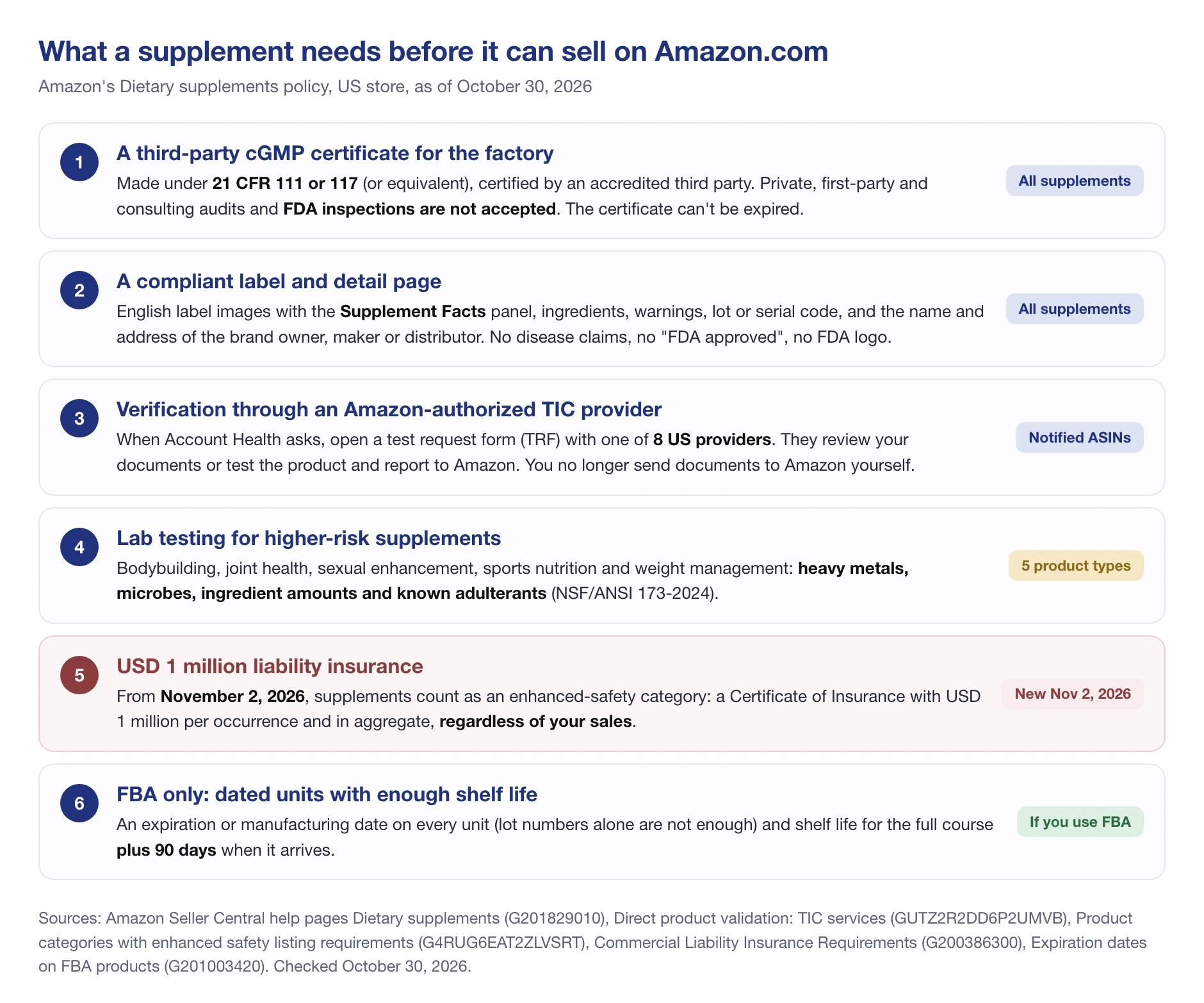
Not every step applies to every product. The certificate and the label apply to all supplements, lab testing to five product types, and TIC verification to the ASINs Amazon flags. Here is how each one works.
A third-party cGMP certificate
Every supplement must come from a facility that follows the FDA’s current Good Manufacturing Practice rules (21 CFR 111 or 117, or an equivalent). The audit must be done by an accredited third party. Amazon is explicit: “Private audits, first-party audits, consulting audits, and FDA inspections will not be accepted.” The certificate must be in good standing and not expired.
Accepted programs include NSF/ANSI 455-2, NSF 229, UL GMP 21 CFR 111, USP GMP, SGS GMP, ISO 22000, SQF edition 9, BRCGS issue 9, FSSC 22000 version 6 and IFS Food version 8, plus a Health Canada site license and some government GMP certificates from the EU and Korea.
Lab testing for five higher-risk types
Supplements for bodybuilding, joint health, sexual enhancement, sports nutrition and weight management need actual product testing:
- Heavy metals and microbial contaminants, and pesticides where the ingredients call for it
- Ingredient amounts within the tolerances in 21 CFR 101.36 and 101.9(g)
- Known adulterants listed in NSF/ANSI 173-2024
Trade press reports date the testing rule for these five types to April 2, 2024. In a Seller Forums post that also lists three verifiers “as of April 8, 2024,” Amazon staff said verification is needed “on an annual basis.”
Verification through a TIC provider
Amazon’s page on direct product validation with TIC providers lays out the process:
- Amazon sends a document request to Account Health, with an “Address issue by” date.
- Go to Account Health, open Food and product safety issues under Policy compliance, click Submit, then Verify your product.
- Pick a provider (you can compare quotes), create a test request form (TRF) and give its ID to the provider.
- Send the provider your existing documents to review, or product samples to test.
- The provider reports the result straight to Amazon.
While your TRF shows “in progress,” your listings won’t be deactivated. But if the product fails testing or the documents fail review, the listing is deactivated right away and stays down until you fix it.
The authorized providers for dietary supplements in the US store, as listed on October 30, 2026:
| Authorized TIC provider (US, dietary supplements) | Also a Compliance Fast-Track partner? |
|---|---|
| Certified Laboratories | No |
| Cotecna | No |
| Eurofins | No |
| ITS – Intertek | No |
| Mérieux NutriSciences | No |
| NSF | Yes |
| SGS | Yes |
| UL – Underwriters Laboratories | No |
Amazon updates this list monthly, so check the Select a Provider menu in Seller Central for the current one. You can use another accredited lab, but an authorized TIC provider then has to validate its results. Documents from labs on Amazon’s suspended list are refused, and every document and image must be original, unmodified and “not computer or AI-generated.”
The shortcut: Compliance Fast-Track
If your product is already certified or verified by a participating organization, Amazon’s Compliance Fast-Track program lets that organization share the result with Amazon directly, with nothing for you to upload. For dietary supplements, the partners are BSCG, Clean Label Project, GRMA, INFORMED, NSF, SGS and USP.
Joining costs nothing extra; you pay only for the certification itself. One catch from Amazon’s FAQ: the ASIN, UPC or GTIN, brand and model number must match between the certifier’s records and your listing. A mismatch is the most common reason a certified product stays suppressed.
🎯 Pro Insight: Ask your contract manufacturer which cGMP program certifies the facility before you sign, and get a copy of the certificate with its expiry date. If the answer is “we passed an FDA inspection,” that isn’t enough for Amazon. You’ll need a different factory or a third-party audit before you can list.
New From November 2, 2026: USD 1 Million Liability Insurance
Amazon’s general rule is that US sellers need commercial liability insurance within 30 days after passing USD 10,000 in gross proceeds in a month. For supplement sellers, the sales threshold goes away on November 2, 2026.
Amazon’s commercial liability insurance requirements now say: “If you sell products in categories with enhanced safety listing requirements, you must obtain an insurance policy with USD 1 million coverage per occurrence and in aggregate, regardless of your gross sales proceeds.” Amazon’s list of product categories with enhanced safety listing requirements names dietary supplements, next to ingestible OTC medication and ophthalmic drug products.
The policy has to meet Amazon’s criteria, including:
- Commercial general, umbrella or excess liability, written on an “occurrence basis”
- At least USD 1 million per occurrence and in aggregate
- A deductible of no more than $10,000
- “Amazon.com Services LLC and its affiliates and assignees” named as additional insureds
- An insurer rated A- or better by S&P or AM Best
You upload the Certificate of Insurance (COI) through Business Insurance verification in Seller Central. Our restricted products guide covers the same rule for the other enhanced-safety categories.
Supplement Labels: What the FDA Requires
Amazon checks your label images against the FDA’s labeling rules, so the label has to be right before you photograph it. The core requirements:
- Statement of identity: the product name with “dietary supplement” or an equivalent, such as “herbal supplement.”
- Net quantity of contents.
- Supplement Facts panel per 21 CFR 101.36: serving size, servings per container, the amount per serving of each dietary ingredient and its % Daily Value where one exists. Blends are listed under “Proprietary Blend” or another descriptive name.
- Other ingredients, such as capsule material and fillers.
- Name and address of the manufacturer, packer or distributor.
- The DSHEA disclaimer next to every structure or function claim.
If your label has a claim, read it the way Amazon will. Does it name a disease, or a symptom of one? Then Amazon treats it as a disease claim, which only approved drugs may make, and the listing can be removed.
Selling Supplements With FBA: Expiration Dates and Shelf Life
Amazon treats every supplement as expiry-dated, even without a date on the bottle. Its page on expiration dates on FBA products sets the rules that cost supplement sellers the most money when they get them wrong.
Shelf life at check-in. When your units arrive at the fulfillment center, they must have enough shelf life left to be used up in full, plus 90 days. Amazon’s own example: a bottle with 240 daily servings needs at least 240 + 90 = 330 days left. Amazon’s guide table also lists 730 days before expiry for herbal or mineral supplements, so check both against your product.
| FBA rule for supplements | What Amazon requires |
|---|---|
| Date on the unit | An expiration or manufacturing date on every unit. “Lot numbers alone are insufficient.” |
| Case packs and multipacks | The date on the outer packaging and on each item inside |
| Month-only dates | MM-YYYY is read as the first day of that month |
| Boxes | One expiration date per ASIN per box; different dates go in separate boxes |
| Send to Amazon | Enter the exact date printed on the item. A mismatch counts as an expiration date defect. |
| Expired on arrival | Marked for disposal, and it “cannot be returned to you” |
When you create the ASIN, set the expiration attributes correctly too: Is Expiration Dated Product, Product Expiration Type and Shelf Life. Liquid supplements of 4.2 oz (125 mL) or more with a screw, flip or pump top and no secondary seal usually need a cap seal as well.
📌 From Our Experience: The expensive FBA mistake with supplements is rarely the first shipment. It’s the reorder of a slow seller, sent from an older production run. Work out the shelf-life math for each lot before you book the shipment, not after Amazon receives it.
How to Sell Supplements on Amazon: Step by Step
Putting it together, this is the order that avoids the most rework:
- Open a Professional seller account. It costs $39.99 a month while you have active listings, with no per-item fee (the Individual plan charges $0.99 per item sold).
- Check the product’s status in Add Products. If it says “Apply to sell,” apply with the documents Amazon lists, usually purchase invoices dated within the last 180 days and clear photos of all sides of the product. Reviews take 2 to 7 business days, and “Your account does not qualify” can’t be appealed.
- Choose a manufacturer with a current third-party cGMP certificate from one of the accepted programs.
- Get the label right: Supplement Facts panel, disclaimers, lot code, expiration date, and no disease claims.
- Book testing early if your product is one of the five higher-risk types, or use a Compliance Fast-Track partner.
- Buy the insurance and upload your Certificate of Insurance before you list.
- Build the listing with the required attributes and the full label images.
- Answer every Account Health request before its “Address issue by” date, by opening a TRF with an authorized provider.
- Prep FBA shipments with dates on every unit and enough shelf life.
What it costs to sell supplements on Amazon
Supplements fall under Beauty, Health and Personal Care in Amazon’s fee schedule. The referral fee is 8% for products with a total sales price of $10.00 or less, and 15% above $10.00, with a $0.30 minimum per item. FBA fulfillment fees, storage, testing, certification and insurance come on top.
Our breakdown of Amazon seller fees explains each fee, and the free FBA calculator shows what’s left from a sale at your price.
Selling outside the US
Everything above follows Amazon’s US policy. Amazon notes that “Requirements vary by Amazon store and by policy,” and the TIC provider lists differ by store. If you sell on Amazon.co.uk, Amazon.de, Amazon.it or Amazon.in, open the Dietary supplements page in that store’s Seller Central before you ship.
Issues You May Face When Selling Supplements on Amazon
Getting approved and compliant is only the entry ticket. These are the problems that come after:
- Established competitors. The top listings for common supplements have years of reviews and repeat buyers. A new brand starts with neither.
- Expensive clicks. Ads on popular supplement keywords can be costly. Check the suggested bids for your own keywords in the ads console before you set a budget.
- Profit often depends on repeat orders. If winning a new customer costs more than you make on one bottle, you only earn it back when they reorder. That takes cash, and a product people actually buy again.
- Shoppers switch easily. A cheaper offer, a newer formula or nicer packaging can pull a customer away on their next order.
- Sudden deactivation. A failed test, an expired cGMP certificate or a claim Amazon reads as a disease claim can take a listing down right away.
- Other sellers on your listing. Resellers, sometimes with old or diverted stock, can join your ASIN and take the Buy Box. When a buyer gets an old or damaged bottle, the bad review lands on your listing.
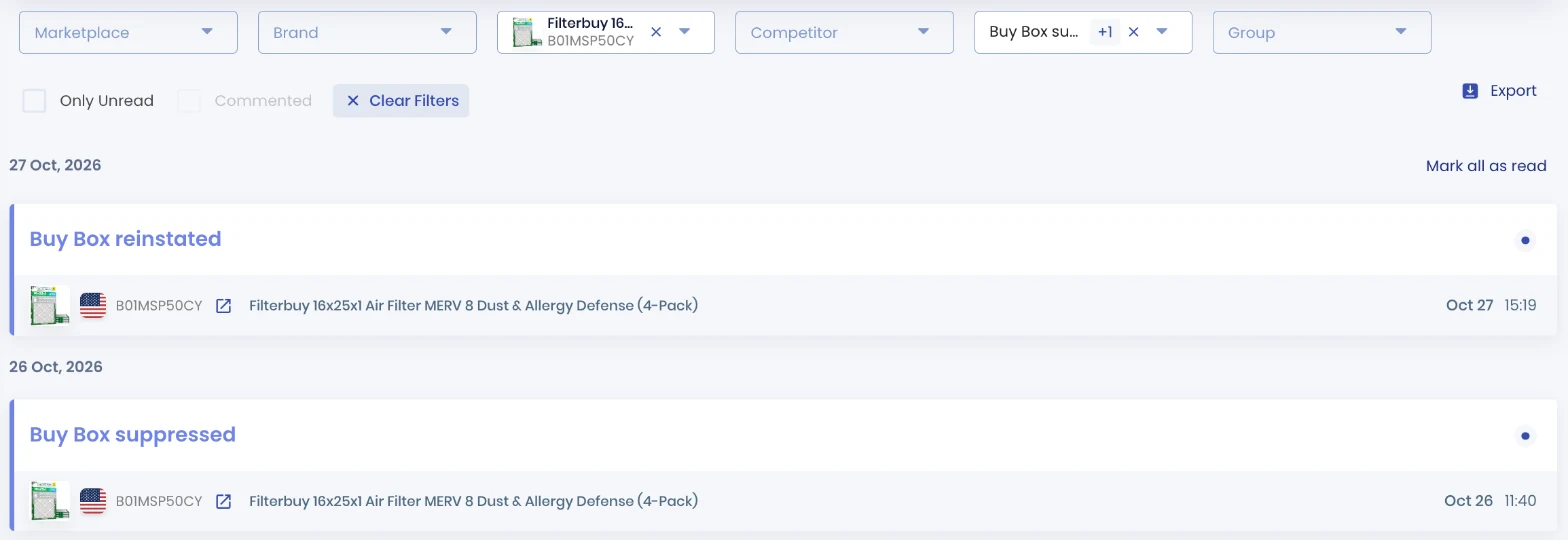
Account Health shows Amazon’s compliance requests. But nothing in Seller Central alerts you when another seller joins your listing or takes the Buy Box, and a listing that drops out of search is easy to miss until sales fall.
SellerSonar checks your listings and alerts you on the next check after something changes. Checks run every 4 hours on Pro, every 2 hours on Premium and every hour on Business and Enterprise.
- Retail Issues alerts flag Listing suppressed, Search suppressed and Buy Box suppressed, with a dated snapshot of the product page. SellerSonar can’t see why Amazon suppressed a listing, so you still check the reason in Seller Central.
- Buy Box and Pricing alerts tell you when a new seller appears on your ASIN, when a seller’s price changes, and, from the Premium plan, when you lose or win the Buy Box. These alerts are off by default: switch them on in Alerts, then Delivery Settings.
If a reseller turns out to be selling counterfeit or tampered product, our guide on how to remove an Amazon hijacker covers the steps. For suppressions, see why Amazon suppresses listings and how to fix them.
You can try it on your own supplement listings with a free 14-day trial: 5 ASINs and 10 keywords, no credit card needed.
Final Thoughts
Selling supplements on Amazon in 2026 is less about finding a product and more about paperwork done in the right order. A certified factory, a clean label, TIC verification when Amazon asks, the new USD 1 million insurance from November 2, 2026, and correct expiration dates for FBA.
Get those right before your first order, and the hard part that’s left is the one every seller faces: building a brand people buy again.
This guide is general information, not legal advice. Amazon updates its supplement policies often, so check the Seller Central pages linked above before you act.

