





Quick Answer
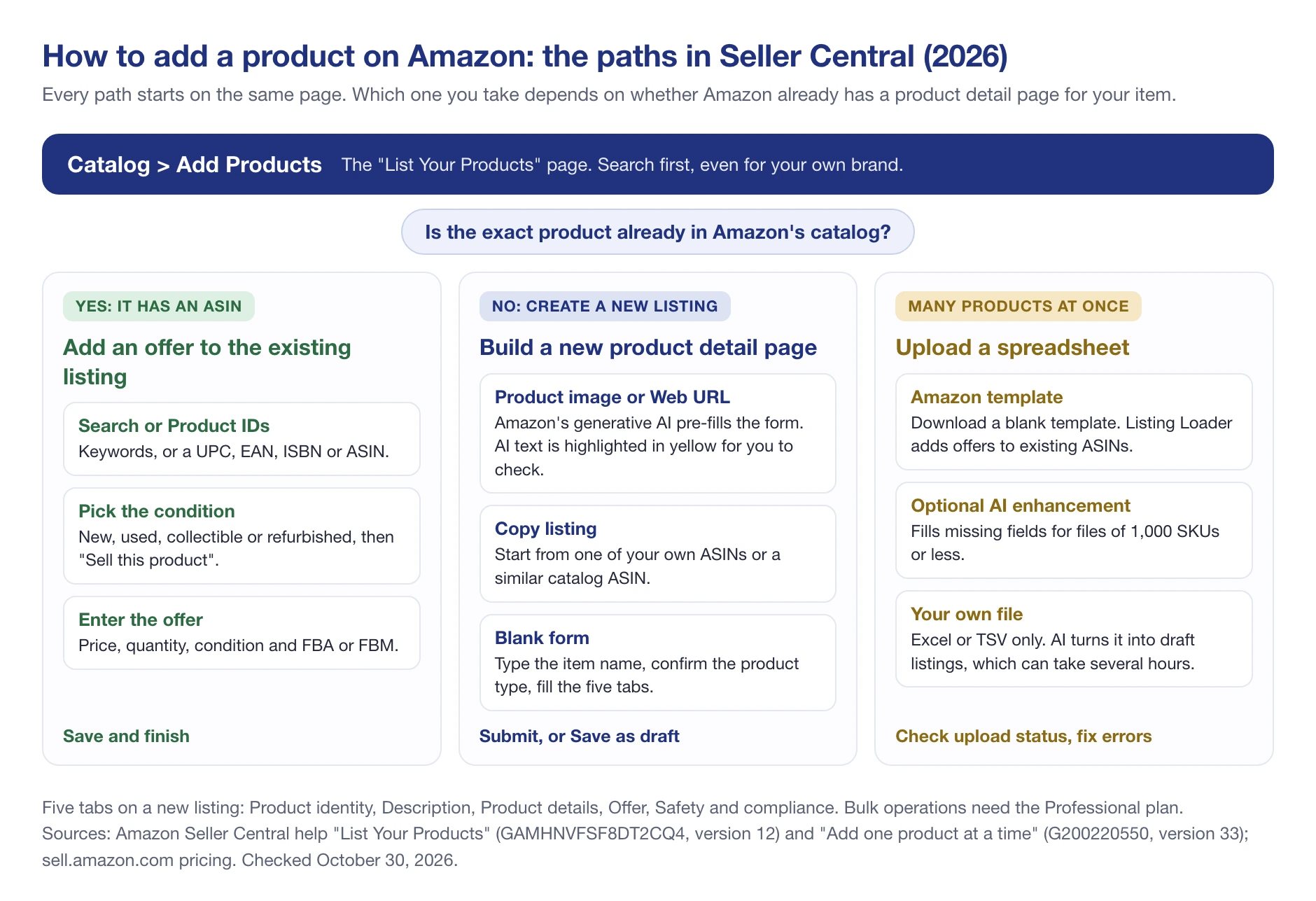
To add a product on Amazon, open Seller Central, go to Catalog > Add Products and search for your item. If Amazon already sells it, pick the condition, click “Sell this product” and enter your price, quantity and fulfillment method. If it’s new to Amazon, click “Create a new listing” and build the product page from a product image, a web URL, a copy of a listing or a blank form, then click Submit. Most categories need a UPC or other GTIN (or a GTIN exemption), and some need Amazon’s approval first.
Listing your first product is where most new sellers get stuck. The steps in older guides, including the first version of this one, describe screens Amazon has since replaced. Tabs were renamed, buttons moved, and Amazon added AI tools that fill in a listing for you.
This guide follows the Add Products page as Amazon documents it in October 2026. You’ll see which path fits your product, what to prepare, how to fill in each tab, how to list in bulk, and what to do when a listing doesn’t go live.
About the Author: Gloria Anderson writes for the SellerSonar editorial team about Amazon listings and catalog rules. She checks every step in her articles against Seller Central help, and the listing examples against live Amazon listings we track in SellerSonar.
What “Adding a Product” Means on Amazon
An Amazon listing has two parts. The product detail page (title, images, bullet points, description) is shared by every seller of that exact product. Your offer (price, quantity, condition, shipping) belongs to you alone.
So “adding a product” means one of two things:
- Adding an offer to an existing page, when the product already has an ASIN. This is how resellers, wholesalers and book sellers list.
- Creating a new product detail page, when the product isn’t on Amazon yet. This is how private label brands and makers list.
Because the page is shared, you don’t fully own its content. Amazon’s help page on product detail pages says it “chooses what information to include on the product detail page based on manufacturer and seller contributions.” Keep that in mind later, when you see your page change without your doing.
Prepare Before Adding a Product on Amazon
Five checks save you from the most common dead ends. Do them before you open the listing form.
1. Pick the selling plan that fits how you’ll list
Amazon has two plans. On Amazon’s pricing page, Individual costs $0.99 per item sold and lets you “list one product at a time.” Professional costs $39.99 a month and adds bulk operations, so you need it to upload spreadsheets. Referral fees apply on both plans.
A brand-new account may also need a short wait. Amazon notes that it “might take 90 minutes or more after registering” before you can list products.
2. Get a product ID, or a GTIN exemption
For most categories, Amazon requires a GTIN to create a new listing. In the US that’s usually a 12-digit UPC. Books use an ISBN, and Europe and Japan use 13-digit EAN and JAN codes.
Amazon checks product IDs against the GS1 database, so buy UPCs from GS1 or get them from the manufacturer. Our guide to UPC codes on Amazon covers prices and the rules most guides skip.
If your product has no barcode (private label, handmade, generic or a bundle you assemble), you can apply for a GTIN exemption. Per Amazon’s help page, a truly generic product gets an automatic approval, and branded cases are decided within 48 hours. You need a separate exemption for each store and category. Brands that Amazon treats as UPC-mandatory can’t get one at all.
3. Check whether you’re allowed to sell it
Search the product in Add Products before you buy stock. Amazon shows one of three things next to it:
- “Sell this product”: no approval needed.
- “Apply to sell”: the category, brand or ASIN needs approval.
- “Not Available”: you can’t list it.
Amazon’s page on categories and products that require approval lists what to prepare: purchase invoices dated within 180 days, photos of all sides, and sometimes brand authorization letters, safety certificates or insurance. Reviews take 2 to 7 business days. A “Your account does not qualify” answer can’t be appealed. Our guide to Amazon restricted products explains the gated categories.
4. Know whose brand it is
If the product belongs to a brand enrolled in Brand Registry, Amazon’s own guide to creating product listings says you need to be “a Brand Representative or Reseller authorized by the brand” to list it through the standard process.
If it’s your own brand, enrolling in Brand Registry is free. You need a brand name on the product or packaging and a pending or registered trademark. It gives you access to A+ Content and Amazon Vine, and Amazon says it adds protections for your brand’s product information. Whatever you choose, the brand you enter must match the name permanently printed or attached on the product or packaging; unbranded items use “generic.”
5. Prepare the content
Have these ready before you start, so the form doesn’t time out on you:
- A main image on a pure white background, plus extra images (more on the rules below)
- A title of 75 characters or less
- At least three bullet points and a short description
- Product dimensions and weight, which also drive your FBA fees
- Safety data the category asks for, such as batteries or age warnings
- Your price, starting quantity and fulfillment choice (FBA or FBM)
How to Add a Product on Amazon to an Existing Listing
If the product you want to sell already has a page on Amazon, you don’t create anything new. You attach your offer to the existing ASIN. This is the fastest path, and the only correct one: Amazon’s rules forbid creating a duplicate page for a product that already has one.
- Open Add Products. In Seller Central, go to Catalog > Add Products.
- Find the product. Search by keywords, or choose Product IDs and enter the UPC, EAN, ISBN or ASIN. An ID gives the most accurate match. If the item comes in sizes or colors, check that you picked the exact variation.
- Choose the condition. Select new, used, collectible or refurbished from the Condition menu, then click “Sell this product.” If you see “Apply to sell” instead, you need approval first.
- Enter your offer. Add your SKU, price, quantity and fulfillment channel.
- Click Save and finish. The offer appears in Manage All Inventory.
If you sell in bulk, there’s a shortcut for this path: Amazon’s Listing Loader spreadsheet template adds offers to existing products without any product details. We cover it in the bulk section below.
💡 Expert Tip: Compare the product in your hands with the detail page before you click “Sell this product.” Pack size, model year and included accessories must all match. If they don’t, the item is a different product and needs its own listing, otherwise buyers get something other than what the page shows.
How to Create an Amazon Listing for New Products
If your search finds nothing that matches, click Create a new listing. Amazon now gives you several ways to start, described in its List Your Products help page. They all lead to the same listing form.
Step 1: Choose how to start the listing
| Option | What you give Amazon | What happens | Best for |
|---|---|---|---|
| Product image | A photo, plus an optional short description | Generative AI suggests a product type and fills the title, bullets, description and other fields | A first draft in minutes |
| Web URL | A link to the product on your brand website | Amazon imports the data (up to 15 minutes) and saves a draft in Complete Your Drafts | Brands with an online store |
| Copy listing | One of your ASINs, or a catalog ASIN | The form opens pre-filled with that product’s details, ready to edit | Similar products in one line |
| Blank form | An item name | Amazon suggests a product type; you fill every field yourself | Full control from scratch |
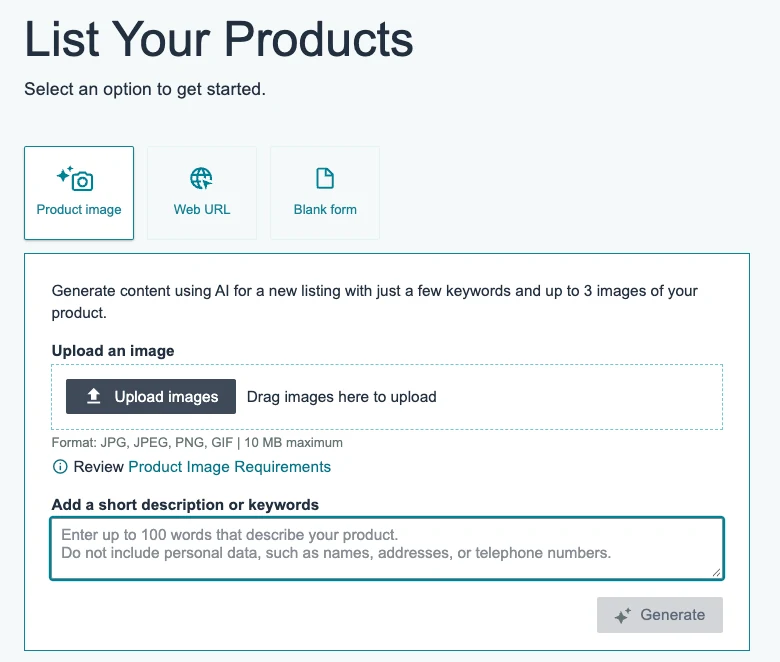
With the AI options, every field the AI filled is highlighted in yellow. Read each one. The AI works from your photo or page, so it can guess materials, sizes or claims wrong, and you’re responsible for what you submit.
Step 2: Confirm the product type
Older guides tell you to choose a category and sub-category. Today you type an item name, and Amazon suggests a product type. Click Confirm if it fits, or Select other to pick the right one. The product type decides which fields are required, so a wrong choice gives you the wrong form.
Step 3: Fill in the Product identity tab
This tab holds the item name (your title), brand, product ID and variation setting.
- Enter your UPC or other GTIN. If you have an approved exemption, tick “I don’t have a product ID.”
- Type the brand exactly as it appears on the product. For a generic item, select “This product does not have a brand name.”
- If the product comes in sizes or colors, turn on the “This product has variations” toggle. A Variations tab appears, where you pick the variation theme and add each child item. Our guide to Amazon product variations explains how parent and child ASINs work.
Step 4: Add the Description tab
Add your bullet points, product description and images here. The rules for each are in the next section. The listing form checks your main image as you upload it, and you can’t submit until any compliance problem it finds is fixed.
Step 5: Complete Product details
This tab covers attributes such as color, material, unit count, dimensions and weight. Required fields depend on the product type. Use the attributes filter on the left to show only required fields, then go back and fill the optional ones that shoppers filter by.
Your backend search terms also go here, in the Generic keyword field. Amazon’s rules ban brand names, ASINs and words like “new” or “best” in it.
Step 6: Set up your offer
The Offer tab is where the listing becomes something a customer can buy:
- SKU: your own stock code for the item. Pick a format you can read at a glance in Manage All Inventory.
- Price: your selling price. If Amazon sees the price as a possible error, it can deactivate the offer with a pricing alert.
- Quantity: for FBM, the units you can ship. Leave it empty and the listing shows as out of stock.
- Condition: new for most products you create.
- Fulfillment channel: FBA (Amazon stores, packs and ships) or FBM (you ship). For FBA, the offer can only sell once your units reach Amazon. Our guide on how to sell stuff on Amazon walks through the full process from account to first shipment.
The same tab has a “Sell in other Amazon stores” toggle. It copies your offer to other marketplaces and, where the page doesn’t exist yet, tries to translate it automatically.
Step 7: Safety and compliance, then Submit
Answer the safety questions for your product type, such as batteries, hazardous materials or choking warnings. Then choose:
- Submit if the listing is ready, or
- Save as draft to finish later. Drafts wait for you on the Complete Your Drafts page.
🎯 Pro Insight: If you sell several similar products, save time with listing preferences. Before you submit, tick “Save product details for future listings” and choose which attributes to keep. Next time you list the same product type, select the saved preference and the form fills those fields for you.
Title, Bullet and Image Rules Your New Listing Must Pass
A listing that breaks these rules can be blocked at submission, corrected by Amazon, or hidden from search later. The biggest change for new listings is the title limit.
| Element | Amazon’s rule (October 2026) |
|---|---|
| Title | 75 characters or less, including spaces, to list a product for the first time. No promotional phrases like “free shipping.” No !, $, ?, _, {, }, ^, ¬ or ¦. No word more than twice. |
| Item highlights | A new field with up to 125 more characters for details that don’t fit in the title, written as comma-separated phrases |
| Bullet points | At least three. Features and benefits, no unverifiable claims, no competitor comparisons |
| Main image | Pure white background (RGB 255, 255, 255), the product filling 85% of the frame |
| Image size | At least 500 pixels on the longest side; 1,000 pixels or more enables zoom |
| Extra images | Only one main image is required. Amazon recommends at least six more plus one video |
The title rule comes from Amazon’s product title requirements. It applies in all stores except Saudi Arabia, Egypt, Türkiye and the UAE, and not to media products such as books. The suggested order is brand, then style or flavor, product type, key attribute, color, size or pack count, and model number. For the full image specs and examples, see our guide to Amazon image requirements.
Many older guides still give a 200-character title limit. That’s out of date for new listings: a title written to the old limit won’t meet the 75-character rule. Move the extra details into Item highlights instead.
How to List Products on Amazon in Bulk (Add Products via Upload)
If you have dozens or thousands of products, use a spreadsheet instead of the form. The old “Add Products via Upload” link now lives on the same Add Products page, under Spreadsheet. Bulk listing needs the Professional plan.
There are two ways to do it:
- Use Amazon’s template. Click Download blank template and choose the template that fits your products. The Listing Loader template is the simple one: it adds offers to products already in the catalog, with no product details needed. Fill it in, then click Upload file and Submit products.
- Upload your own file. If your catalog already lives in a spreadsheet, for example an export from another store, upload it as it is. Amazon accepts Excel and TSV files only. You may be asked to confirm how your columns map to Amazon’s fields. AI then turns the rows into draft listings, which can take several hours.
With Amazon’s template, you can also switch on “Try AI-generated content” to fill missing fields, as long as the file has 1,000 SKUs or less. AI-enhanced listings are saved as drafts for your review, not published straight away.
After any upload, click Check upload status. Without AI enhancement, download the processing summary to see which rows failed and why, fix them, and upload again.
One limit to plan around: Amazon caps how many new ASINs you can create. Its ASIN creation policy states a weekly creation limit of 2,000 ASINs, and says sellers without a sales history are limited until they build one. Hit the limit and uploads fail with error 8571 until 00:00 GMT on Sunday.
After You Submit: Listing Statuses and Common Errors
Submitting doesn’t always mean selling. Check the listing in Manage All Inventory, then search for it on Amazon as a shopper would.
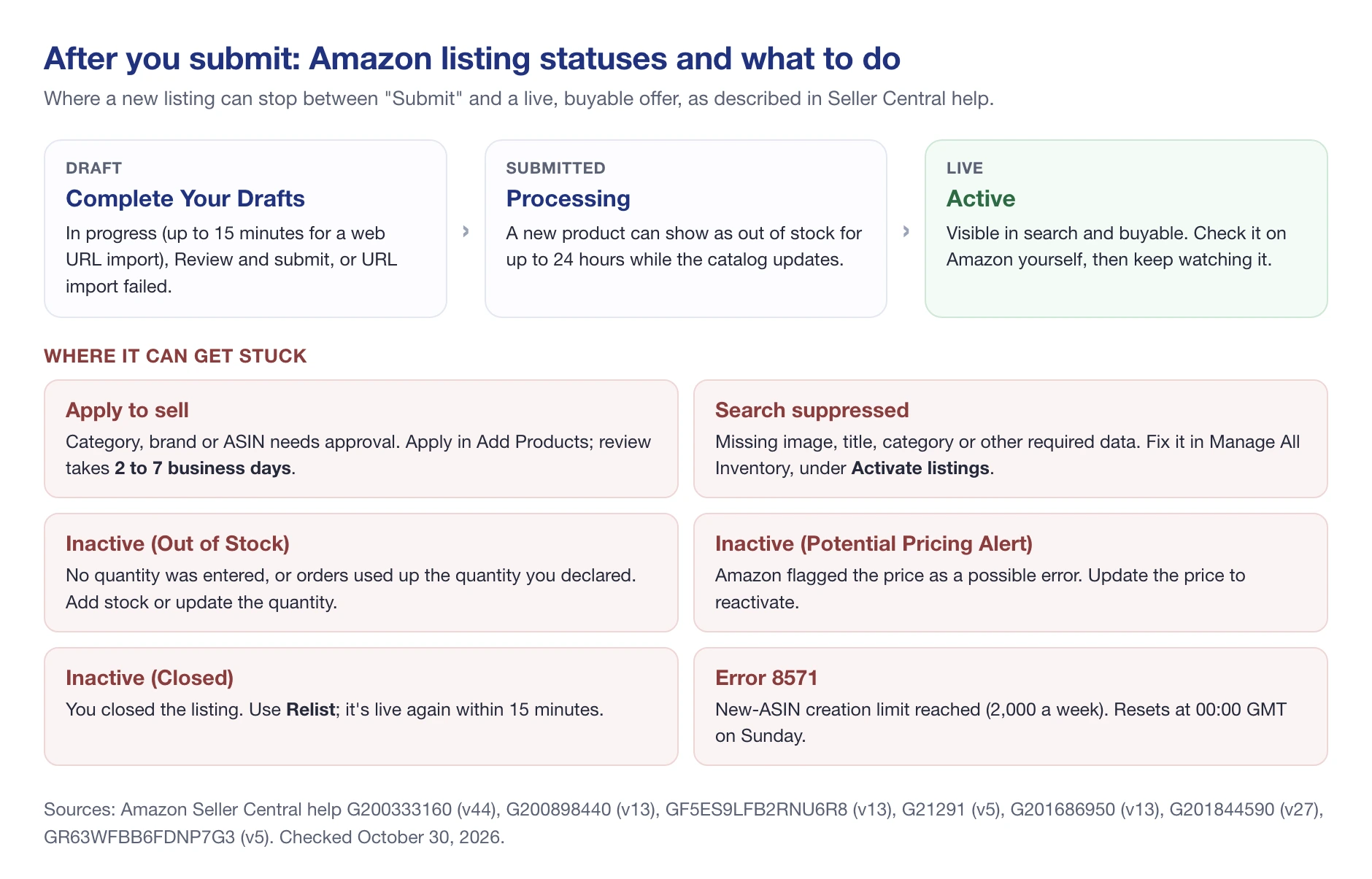
The statuses you’ll meet most often:
- Out of stock right after listing. Amazon says a newly added product can look out of stock for 24 hours while the catalog updates. If it’s still out of stock after a day, check that you entered a quantity.
- Suppressed. The listing exists but is hidden from search, usually because of a missing main image, title, category or another required value. Fix it in Manage All Inventory under Activate listings. Our guide to suppressed Amazon listings goes through each cause.
- Inactive (Potential Pricing Alert). Amazon flagged your price as a possible error. Update the price to bring the offer back.
- Inactive (Closed). You closed the listing. Amazon’s help page on relisting inactive products says a relisted product goes live within 15 minutes.
- Draft stuck “In progress” or “URL import failed.” A web URL import can take up to 15 minutes. If it fails, check the URL or start from a blank form.
Title changes and new images also take time to appear. Amazon says title updates can take 24 to 48 hours to show, and a new image up to 24 hours.
📌 From Our Experience: A listing can go wrong after it’s live, too. On amazon.es, a water bottle listing we track was search suppressed on October 21, 2026, restored on October 23, suppressed again that afternoon, and restored on October 28. Its main image had changed the evening before the first suppression. We can’t see Amazon’s reason from outside, since that lives in Seller Central, but the alerts told us exactly when to look.
After Your Listing Goes Live: Protect It with SellerSonar
Your job doesn’t end at Submit. Because the detail page is shared, it keeps changing. Amazon edits it based on contributions, other sellers can join your listing, and a missing value can hide it from search.
We see this every week in the listings we track. On October 29 and 30, 2026, the titles of two Stanley tumbler listings in Germany and the UK changed from “STANLEY 1913” to “Stanley 1913.” On October 9, a FNTCASE phone case title in the US was shortened from 72 to 62 characters. Small edits like these are easy to miss unless something is watching the page.
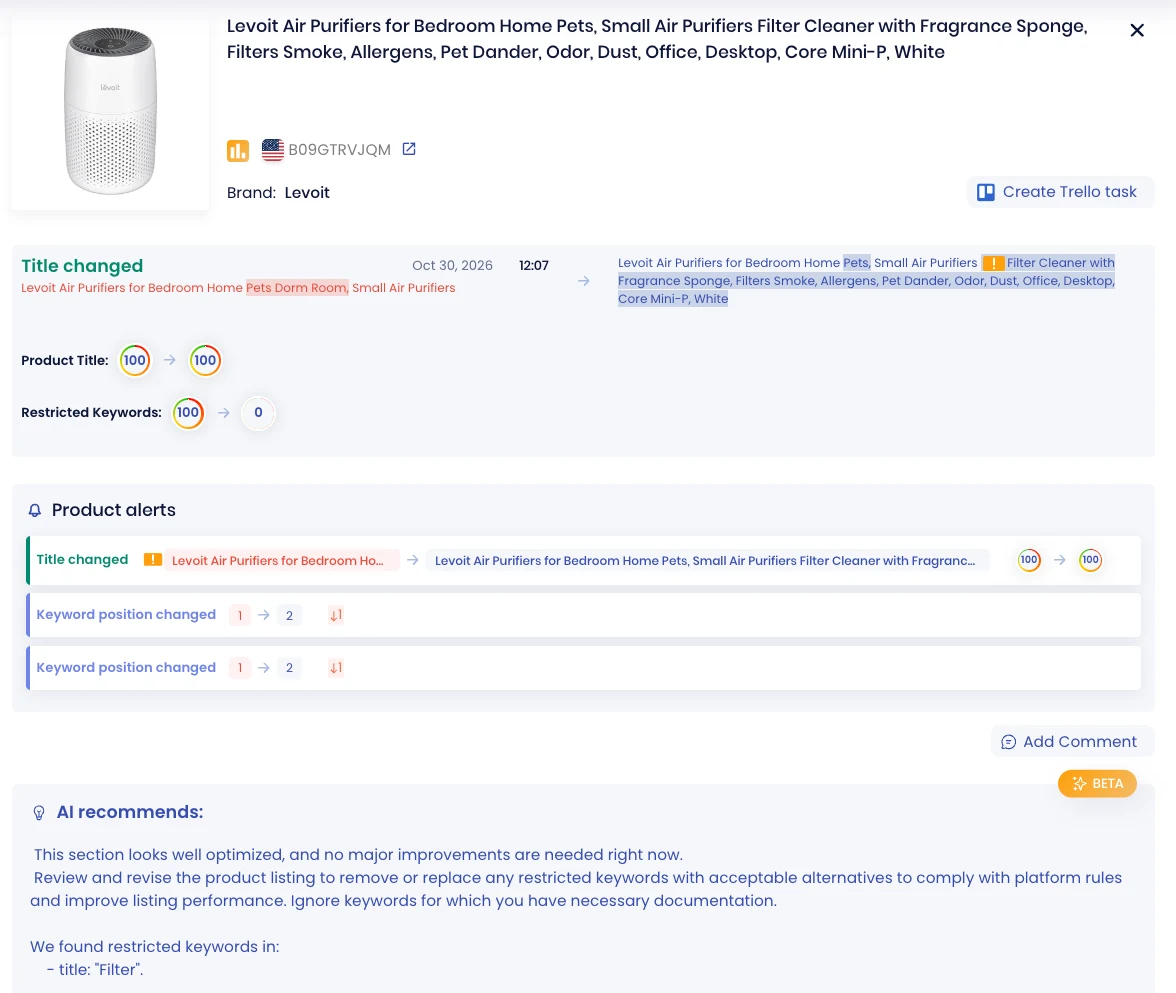
On October 30, 2026, a Levoit air purifier title we track in the US grew from a short title to a long keyword list. SellerSonar’s Title changed alert showed both versions and flagged “Filter” as a restricted keyword in the new title, a word worth checking against Amazon’s rules for claims.
This short video shows how listing tracking works in SellerSonar.
Once your product is listed, add its ASIN to SellerSonar’s product monitoring. It checks your listings every 4 hours on Pro, every 2 hours on Premium and every hour on Business and Enterprise, and sends an alert on the next check after something changes:
- Content changes: title, bullet points, description, main or other images, and brand, with the before and after.
- Suppression: listing suppressed or restored, search suppressed or restored, and Buy Box suppressed. Search and Buy Box suppression alerts include a dated snapshot of the page.
- New sellers: an alert when another seller appears on your listing, possibly a hijacker. Buy Box alerts are off by default, so switch them on in Alerts, then Delivery Settings.
SellerSonar doesn’t edit your listing or tell you Amazon’s reason for a suppression. It tells you something changed, so you can open Seller Central and fix it before it costs sales.
You can try it on your first listings with a free 14-day trial: 5 ASINs and 10 keywords, no credit card. Compare the plans to see which check frequency fits your catalog.

