





Sales tax for Amazon sellers works differently than most guides suggest: on almost every US sale you make, Amazon calculates, collects and remits it for you. That isn’t a courtesy. Marketplace facilitator laws moved the obligation from the seller to the marketplace, and Amazon complies through a programme it calls Marketplace Tax Collection.
Which leaves a more useful question than “do I owe sales tax“: what is still yours. The answer’s narrower than it used to be, and it isn’t nothing.
This is background for Amazon sellers in the United States, not tax advice. Your obligations depend on where you have nexus, what you sell and how you sell it, and a professional is worth the fee.
What marketplace facilitator laws changed
Before these laws, a seller with nexus in a state had to register there, collect tax on orders shipped there, file returns and remit. FBA made that painful. Storing inventory in a state could create nexus in it, and Amazon moves inventory without asking you.
Marketplace facilitator legislation shifted that duty to the marketplace. Amazon now calculates, collects and remits on third-party orders in the states where the legislation applies, which in practice is every US state that has a statewide sales tax. You don’t remit sales tax on those orders, and you shouldn’t try to.
What Amazon handles, and what is still yours
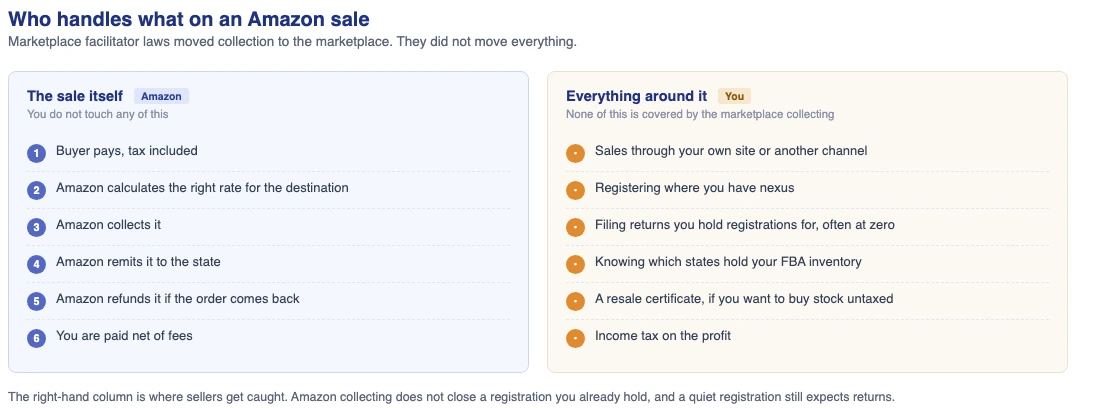
Amazon handles the sale itself; everything around it is still yours
The right-hand column is where sellers get caught. Amazon handling collection does not cancel a registration you already hold, and in several states a registered seller is expected to keep filing even when every line is zero because the marketplace collected. Stop filing and you can collect penalties on tax you never owed.
How the rate gets worked out
Amazon charges on the destination, meaning the buyer’s shipping address, not where you or your inventory sit. Two customers in the same state can pay different amounts. Most states stack a local rate on top of the state one, and those vary by city and county.
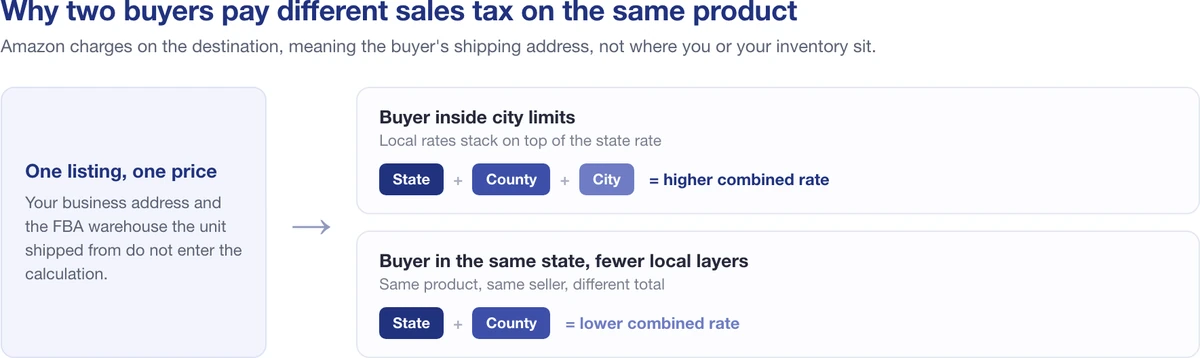
The buyer’s address sets the rate, not yours
Shipping is its own question. Some states treat delivery charges as part of the taxable sale and some don’t, which is why the tax on two identical orders going to different states can differ by more than the rate alone explains. Amazon applies each state’s rule; you don’t configure it.
The practical consequence for a seller is that the tax line on an order tells you nothing about your own obligations. It is the buyer’s rate, at the buyer’s address, collected and remitted by Amazon.
Does FBA inventory still create nexus?
This was the question that kept FBA sellers awake, and it has a different answer now than it did back in 2018.
Physical nexus means having enough presence in a state to owe it tax duties, and inventory sitting in a warehouse has always counted. FBA made that alarming because Amazon distributes your stock across fulfilment centres in states you have never visited, and the inbound placement fee now makes wide distribution the cheaper default. A seller could acquire nexus in a dozen states without making a single decision.
What changed is the consequence rather than the fact. Inventory can still create nexus. But the main obligation that nexus used to trigger, collecting and remitting sales tax on your Amazon orders, is now Amazon’s. So for a seller whose only channel is Amazon, nexus in a state often carries no practical collection duty.
It isn’t nothing, though. Depending on the state, nexus can still bring registration requirements, income or franchise tax questions, and filing duties that survive the marketplace collecting on your behalf. A handful of states have pursued sellers over exactly this. Check where your inventory actually sits, which you can pull from your Amazon inventory reports, rather than assuming it is only in the state you ship from.
Do you still need to register for sales tax?
Sometimes, and the answer turns on two things.
- Do you sell anywhere other than Amazon? Your own site, another marketplace, wholesale, a market stall. Those sales are yours to handle, and they can create an obligation on their own.
- Are you already registered? Registration comes with filing duties that do not lapse just because your marketplace sales are covered. Deregistering is a decision to make deliberately, not by ignoring the letters.
If Amazon is your only channel and you hold no registrations, many sellers have nothing to file. That’s a genuinely different position from five years ago. Confirm it with an accountant rather than assume it.
Buying your inventory without paying sales tax
This is the part of tax exemption that actually belongs to sellers. If you buy inventory to resell, you should not be paying sales tax on it: the tax is due when your customer buys, not when you do.
The mechanism is a resale certificate, issued by the state you are registered in. You give it to your supplier and they stop charging you tax on goods bought for resale. If you source on Amazon itself, the Amazon Tax Exemption Program applies the same idea: enrol, upload your certificate, and qualifying purchases come through without tax.
Two cautions. A resale certificate covers goods you intend to resell, not your printer paper, packing tape or a laptop. Using it on those is a real problem. And the certificate is tied to a state registration, so it comes with the filing duties described above.
The 1099-K, and the threshold nearly everyone has wrong
Amazon reports your gross unadjusted payments to the IRS on Form 1099-K once you cross the threshold. That threshold has moved three times in recent years. Most articles still quote a number that is no longer in force.
| Period | Threshold |
|---|---|
| Before 2021 | Over $20,000 and over 200 transactions |
| Announced under the American Rescue Plan | Over $600, no transaction minimum |
| Phase-in announced from 2024 | $5,000, then $2,500 |
| In force for 2026 | Over $20,000 and over 200 transactions |
The One Big Beautiful Bill Act, signed on 4 July 2025, reinstated the original thresholds and cancelled the $600 rule that had been trailed for years. If you read anywhere that a $600 1099-K is coming, that article predates the change.
One thing the threshold does not change: you report all your income whether a form arrives or not. The 1099-K is a reporting trigger, not the definition of taxable income. And the figure on it is gross unadjusted, before Amazon’s fees, refunds and shipping, so it will be larger than what reached your bank once Amazon’s fees are out. Reconcile it against your own records rather than treating it as revenue.
Where to find your tax numbers

Four clicks from the Seller Central menu to the reports
- Marketplace Tax Collection Report. The tax Amazon collected and remitted on your behalf. This is the one most sellers want, and the one that shows why you owe nothing on those orders.
- Sales Tax Calculation Report. Tax calculated for orders where remitting is yours rather than Amazon’s.
- Combined Sales Tax Report. Both together.
Each downloads as a transaction-level spreadsheet, so you can see the rate applied to any single order rather than a monthly total. Your 1099-K lives in the same library when Amazon issues one.
Pull these before you need them. A state asking about a period two years ago is a much shorter conversation when you already have the file.
Sales tax is not the tax you pay
These get conflated constantly, and they are unrelated obligations.
Sales tax is a tax on the buyer. Somebody collects it and passes it to the state, and on your Amazon orders that somebody is Amazon. It never belonged to you. It isn’t your money.
Income tax is a tax on your profit, and it is entirely yours. Amazon handling the first does nothing about the second. You owe income tax on what you make selling, whether a 1099-K arrives or not, and whether or not you hold a single sales tax registration.
If you are still setting the business up rather than running it, the structure questions, an EIN, a business licence, which entity type, come before either of these. Our guide to becoming an Amazon seller covers that ground.
Where sellers get caught out
- Assuming Amazon covers everything. It covers Amazon. Your own website is your problem.
- Letting registrations go quiet. Zero-dollar returns are still returns.
- Treating the 1099-K as revenue. It’s gross, before fees and refunds.
- Using a resale certificate on supplies. It covers goods for resale, and states audit this.
- Forgetting income tax. Sales tax being handled says nothing about what you owe on the profit.
When to bring in a professional
Bring in an accountant if any of this is true:
- You sell outside Amazon in any volume.
- You hold registrations in more than one or two states.
- You sell into the EU or UK, where VAT rules differ entirely.
- A state department of revenue has ever contacted you.
An hour with an accountant costs less than a late-filing penalty in a state you forgot you were registered in.
What you can do yourself is keep the records clean: know what you sold, where it shipped, what Amazon collected and what you were paid. That’s the input every one of these questions needs.
SellerSonar keeps watch on the part of your business Amazon does not report on: listing changes, Buy Box hijackers, keyword rank movements and suppressions. Start your free 14-day trial.

