





Last updated: July 2026
Quick Answer
If you sell on Amazon or run an agency and you want structured marketplace data feeding your own dashboards, alerts, and reports, the SellerSonar Amazon Monitoring API is the closest fit, because its endpoints are grouped around seller workflows like Buy Box, offers, keyword rankings, and competitor catalogs. If you mainly need broad product data, use Rainforest. For long-range price and rank history, use Keepa. For embedding Amazon data into an app or AI agent, use Canopy. For clean developer endpoints, use Axesso. For keyword and market research, use DataForSEO. And if you do not need code at all, you may only need the SellerSonar app, not the API. We explain how to tell below.
If you’re building dashboards, automation, pricing tools, or reporting around Amazon data, choosing the right API matters as much as choosing the right architecture. Some APIs specialize in historical price data, others in keyword research or structured product information, while a few are designed around ongoing seller monitoring. This guide compares the leading Amazon APIs in 2026, explains where each one fits, and helps you choose the right option for your workflow.
Do you even need an Amazon API?
Start here, because this is the question most “best Amazon API” articles skip. Plenty of sellers do not need an API at all.
If you want alerts when your Buy Box is lost, when a hijacker appears, when your price or listing changes, or when a competitor moves, the SellerSonar app and its trackers already do that without a single line of code. Amazon retail issue alerts and the built-in trackers cover most day-to-day seller needs on their own.
You need the API when you want the same kind of data flowing into something you own: a custom dashboard, a client-facing report, a BI tool, a pricing model, or an internal automation. In other words, the app is for people who want to watch Amazon. The API is for teams who want to pipe Amazon data into their own systems.
Expert Tip. Before you evaluate any API on this list, write down the exact task you want to automate and where the data needs to end up. “Alert me when I lose the Buy Box” points to the app. “Push Buy Box status for 2,000 ASINs into our internal reporting warehouse every morning” points to the API. That one sentence saves weeks of wasted evaluation.
The rest of this guide is for the second group: teams that have decided they want Amazon data in their own stack and now need to pick the right API.
What is an Amazon monitoring API?
An Amazon monitoring API lets you pull structured marketplace data from Amazon into your own dashboards, tools, reports, or automation systems. Instead of loading product pages and reading them by hand, you call an endpoint and get back clean, structured data you can store, compare over time, and act on.
A few terms, in plain language, since not every reader is a developer:
- ASIN is Amazon’s unique product ID, the code in the product URL.
- Buy Box is the “Add to Cart” box on a listing. When several sellers offer the same product, only one wins the Buy Box at a time, and that seller gets most of the sales.
- BSR, or Best Sellers Rank, is Amazon’s popularity ranking for a product inside its category.
- FBA and FBM describe fulfillment: Fulfilled by Amazon versus Fulfilled by Merchant. Buy Box outcomes often depend on which one a seller uses.
- OpenAPI 3 compliant means the API follows a widely used standard for describing endpoints, so developers get predictable schemas and faster integration.
In practice, a monitoring API supports workflows like tracking Buy Box changes, checking price movement, monitoring keyword rankings, watching competitor ASINs, checking offer changes, monitoring seller catalogs, tracking bestseller movement, and detecting listing availability or status changes.
The five kinds of “Amazon API”
This is the part that trips people up. “Amazon API” is not one category, and the tools below are built for different jobs. Sorting them this way makes the choice much easier.
Amazon monitoring API. Built around seller workflows and ongoing checks. Data is grouped the way sellers and agencies actually work: Buy Box, offers, keyword visibility, competitor catalogs, bestsellers, listing status. SellerSonar sits here.
Amazon structured product data API. Built around clean per-endpoint Amazon data. You ask for a product, a search, or a set of offers and get structured JSON back. Rainforest, Canopy, and Axesso sit here. These are excellent data sources, and some also support monitoring, but their organizing principle is the endpoint, not the workflow.
Amazon SEO and market data API. Built around keyword, market, and search data. DataForSEO sits here. Strong for research and analytics, less focused on daily seller operations.
Historical price API. Built around price and rank history over long time windows. Keepa sits here. Strong for looking backward, adjacent to monitoring rather than a full monitoring workflow.
General scraping API. Built around extraction infrastructure across many sites, with proxy networks and anti-blocking. Bright Data, Oxylabs, and ScraperAPI sit here. Powerful for large-scale, multi-site data engineering, but not organized around Amazon seller workflows.
Note that none of these is Amazon’s own official API. Amazon SP-API is a separate, official service for your own seller account operations. The tools in this guide are for external marketplace intelligence, which is a different job. More on that in the FAQ.
Quick comparison table
| API | Category | Best for |
|---|---|---|
| SellerSonar API | Amazon monitoring and marketplace intelligence API | Monitoring workflows, Buy Box and offers, keyword visibility, competitor and seller tracking, agency reporting |
| Rainforest API | Amazon structured product data API | Broad product data and competitive intelligence |
| Keepa API | Historical Amazon price and product data API | Price history, rank history, offer history, deal tracking |
| Canopy API | Amazon-native structured product data API, REST and GraphQL | Embedding Amazon data into apps and AI agents |
| Axesso | Managed Amazon data API with structured endpoints | Structured Amazon data via simple HTTP requests |
| DataForSEO Amazon API | Amazon SEO and market data API | Keyword research and market analysis |
SellerSonar Amazon Monitoring API
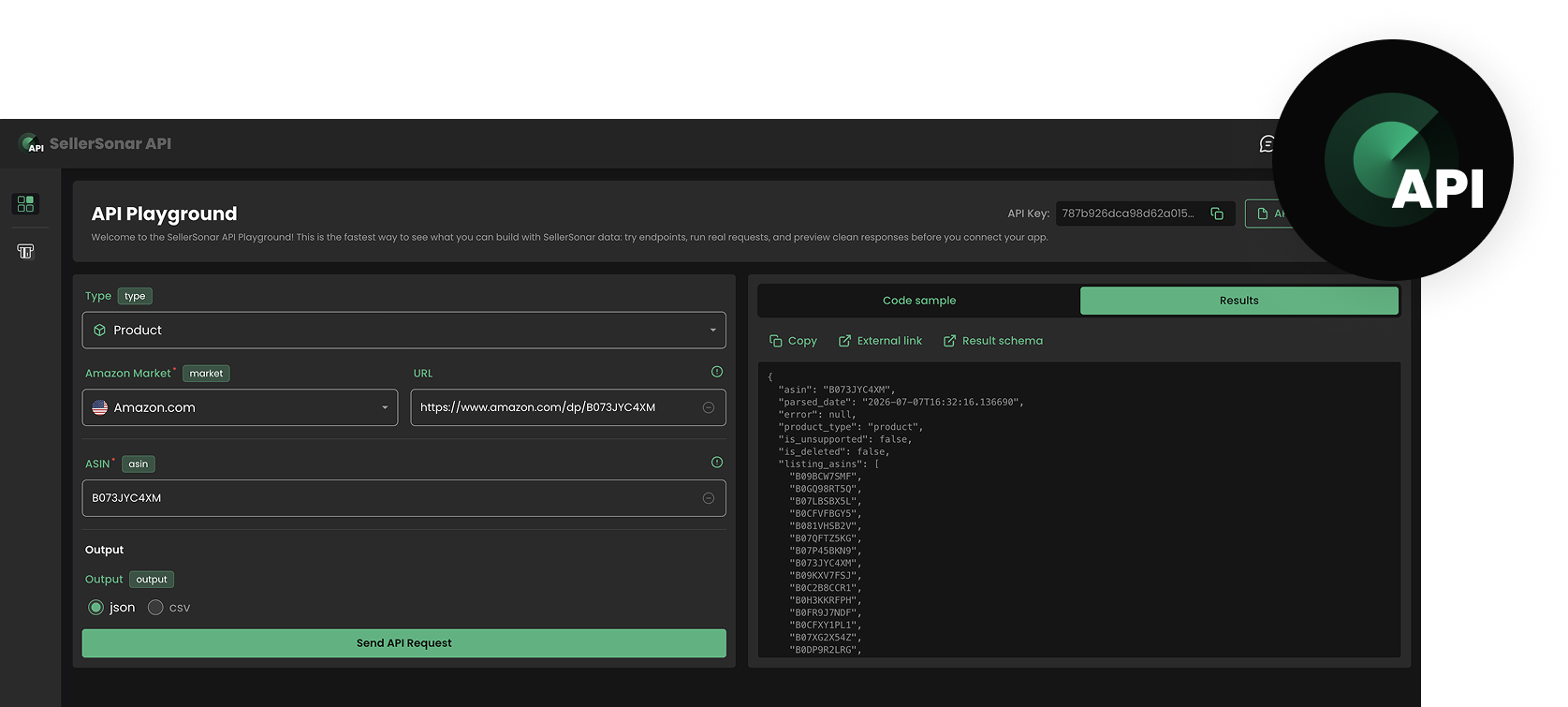
SellerSonar Amazon Product Data API
What it is. We built SellerSonar API as an Amazon monitoring and marketplace intelligence API for teams that need structured Amazon marketplace data inside their own systems. Rather than working through our standard dashboard, you connect directly to our REST API and retrieve structured marketplace data for your own dashboards, reports, automations, or internal tools. Our API follows REST standards and is fully OpenAPI 3 compliant, making integration predictable for development teams.
Who it is for. We designed the API for developers, agencies, aggregators, vendors, enterprise brands, and internal analytics teams that need Amazon data mapped to real seller workflows. Our customers use it to power BI dashboards, client reporting, pricing intelligence, competitor monitoring, internal applications, and custom automations across their organizations.
Main endpoint groups. Instead of exposing only raw product endpoints, we organize the API around common Amazon monitoring workflows:
- Product API: ASIN-level product data, price, BSR, listing status, variations, availability, and attributes.
- Search API: keyword search results, ranking positions, sponsored placements, pagination, and search visibility. This backs Amazon keyword monitoring and Amazon ranking monitoring workflows.
- Offers API: Buy Box ownership, seller competition, fulfillment type, price dynamics, and the full offer landscape, which lines up with Amazon Buy Box monitoring.
- Bestsellers API: category bestseller rankings and category movement.
- Seller Products: seller catalog monitoring and competitor assortment checks, useful for Amazon competitor monitoring.
- Brand Store API: Amazon Brand Store structure and product visibility.
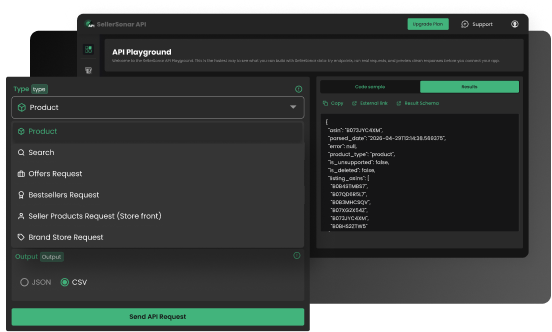
Choose the endpoint that matches the Amazon data you want to retrieve.
Example workflow. Connect SellerSonar API to your BI platform or automation tools to monitor Buy Box, offers, rankings, competitors, and listing changes without manual exports.
Best for. Amazon sellers, agencies, and developers building custom dashboards, reports, or internal workflows.
Strengths. Structured, monitoring-focused REST API with less data transformation than general scraping solutions.
Limitations. Built specifically for Amazon marketplace monitoring rather than multi-site web scraping.
Expert Tip. If your reporting lives in a BI tool or a warehouse, decide up front how often you need each data type refreshed. Buy Box and offers usually justify frequent checks, while brand store structure changes rarely. Matching check frequency to how fast each data type actually moves keeps your usage efficient.
SellerSonar API for agencies
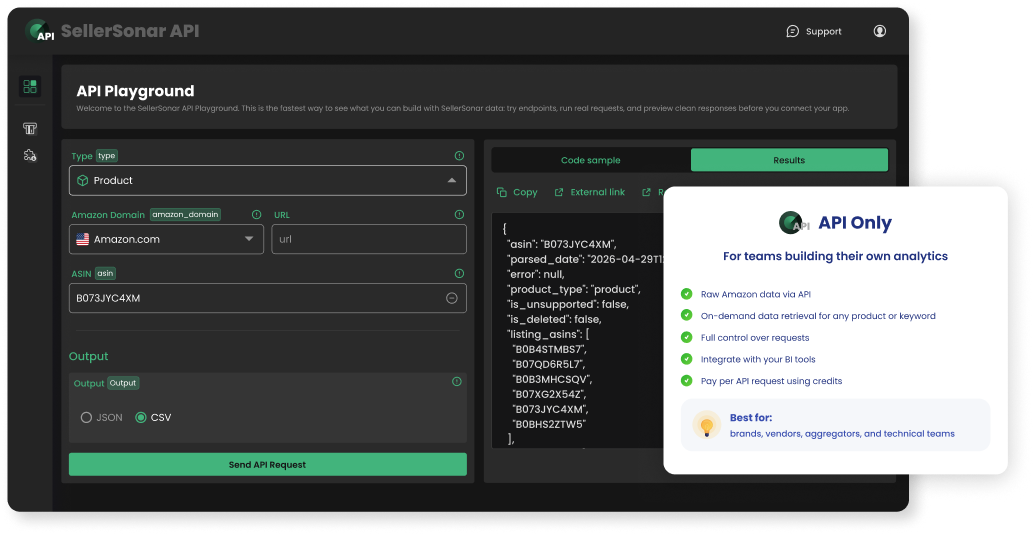
SellerSonar API Playground
SellerSonar API gives agencies structured Amazon marketplace data for dashboards, reporting, and workflow automation.
Use it to:
- Automate client reporting
- Build custom dashboards
- Monitor Buy Box, offers, keywords, and competitors
- Feed BI platforms and internal tools
- Integrate Amazon data into your own applications
Instead of building and maintaining scraping infrastructure, your team can focus on delivering insights to clients.
Rainforest API / Traject Data
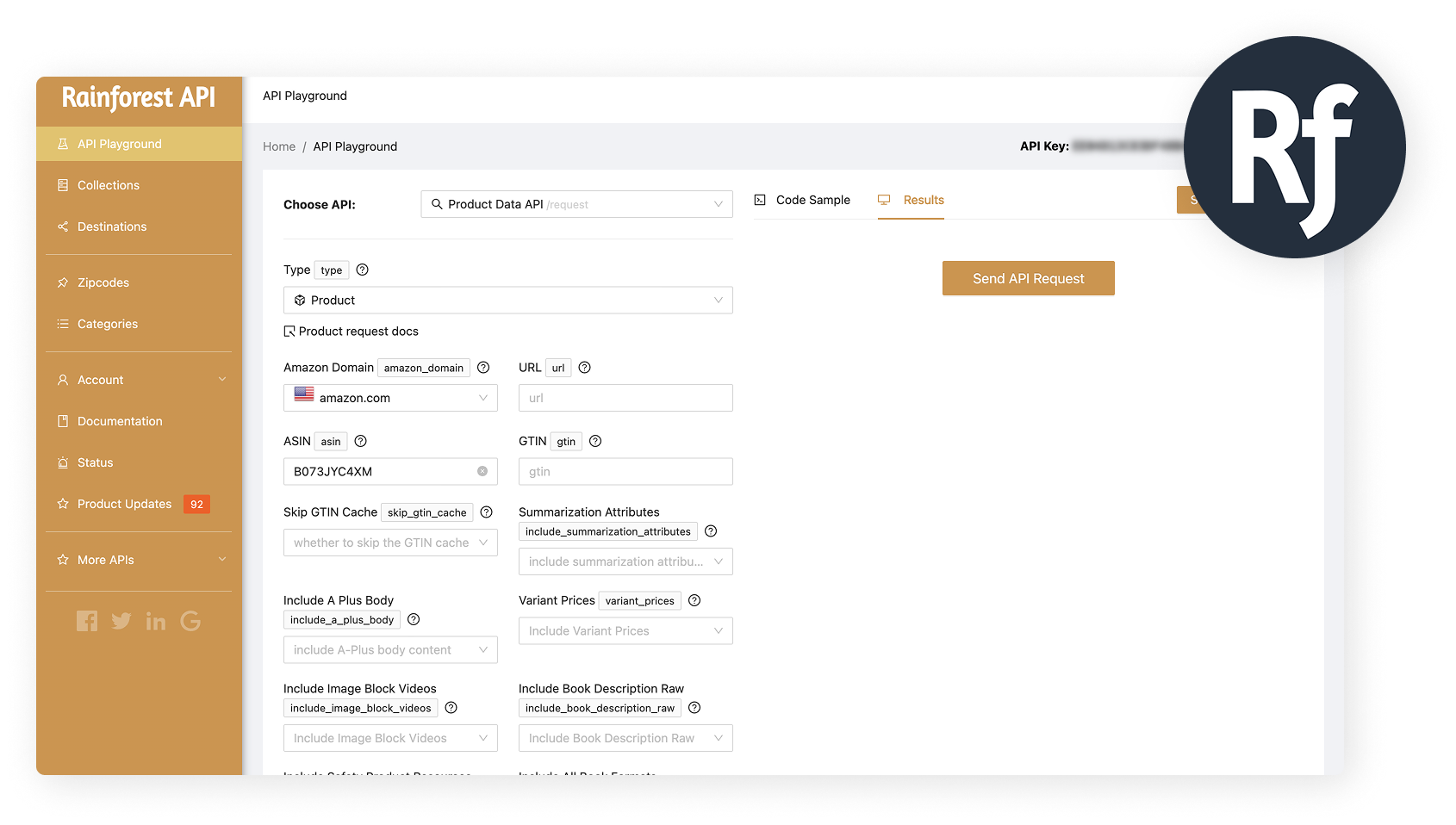
What it is. Rainforest API, part of Traject Data, is one of the closest direct alternatives in the Amazon product data category. It returns structured data across product details, pricing, reviews, Buy Box, seller and store profiles, promotional deals, and product search. That breadth makes it strong for competitive intelligence, dynamic pricing, brand protection, and product insights, and it is used by a large base of data-driven organizations.
If you want a broad Amazon product data API and you are comfortable designing your own workflows on top of clean endpoints, Rainforest is a serious option. Its organizing principle is the data endpoint, which gives you flexibility but leaves the workflow layer to you.
Keepa API
Keepa API results
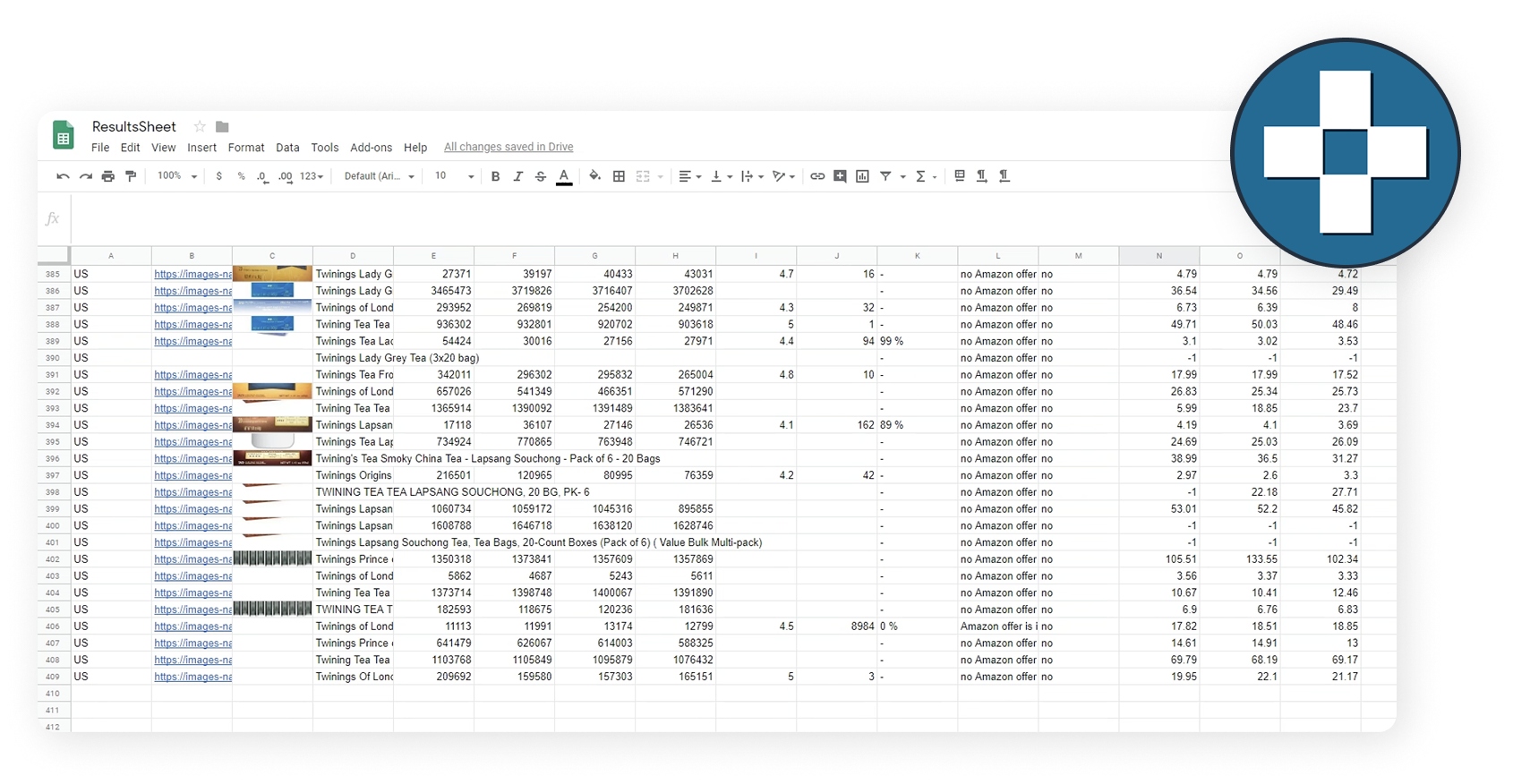
What it is. Keepa API is well known among Amazon sellers and researchers, and its strength is history. It is built around Amazon price history, sales rank history, offer history, product tracking, and deal data. If your question is “what has this product’s price and rank done over time,” Keepa is usually the strongest fit.
That historical depth is different from ongoing operational monitoring. Keepa is excellent at looking backward across long time windows, but it is not positioned as a full seller monitoring workflow API.
Canopy API
Canopy API Playground
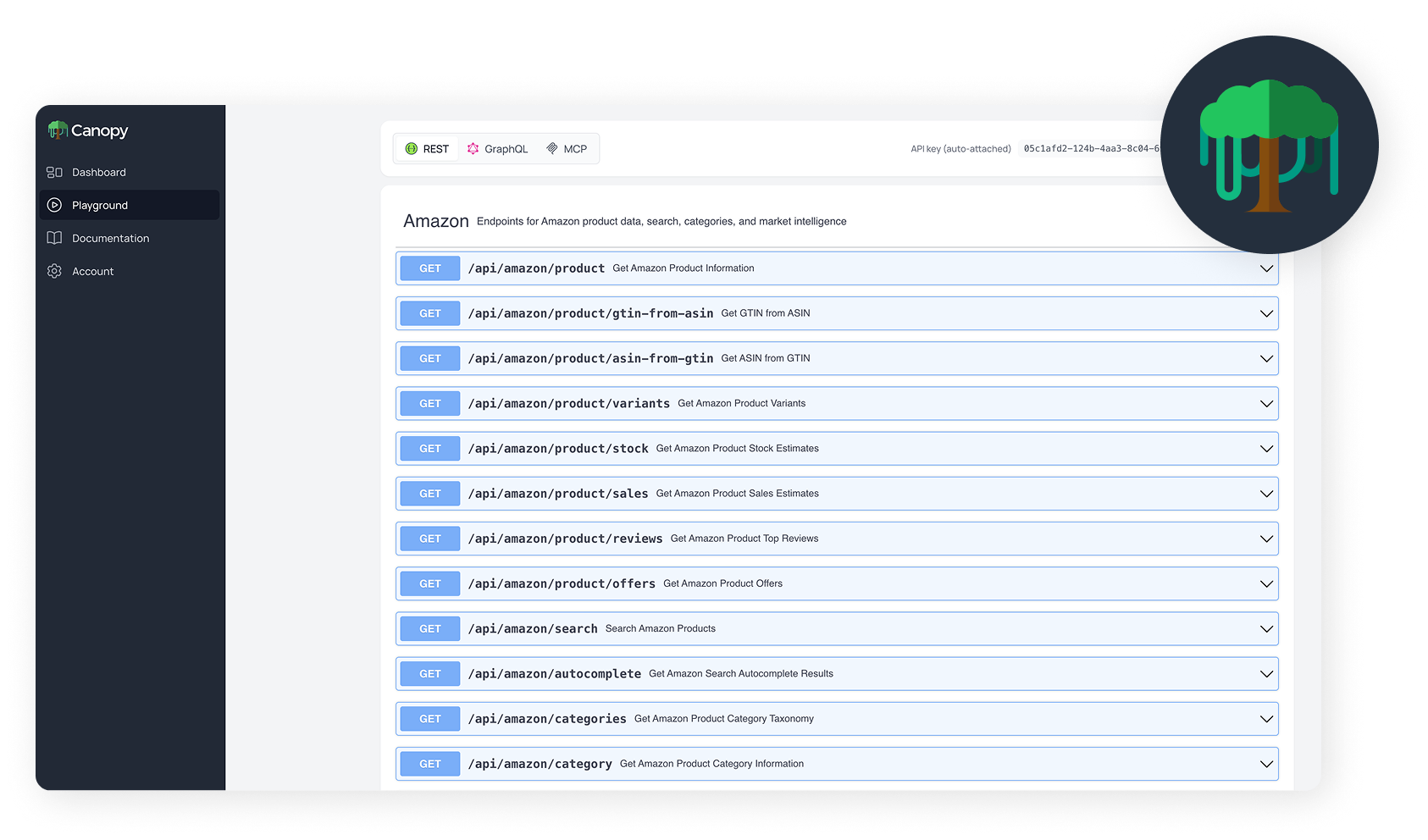
What it is. Canopy API is an Amazon-native structured product data API aimed squarely at developers. It offers product, pricing, review, search, and sales-estimate data, and it exposes that data through multiple interfaces with a single key, including REST, GraphQL, and an MCP interface for AI agent integration. Canopy positions itself as the Amazon data API for apps and AI agents.
That makes it a strong choice when the goal is to embed Amazon product data into your own application, tool, or agent workflow, especially if you want the flexibility of GraphQL queries. It is more developer-integration focused than seller-operations focused. Confirm current endpoint names, access methods, and pricing on the live page before building, since these details change.
Axesso Amazon Data API
List of Axesso Data APIs
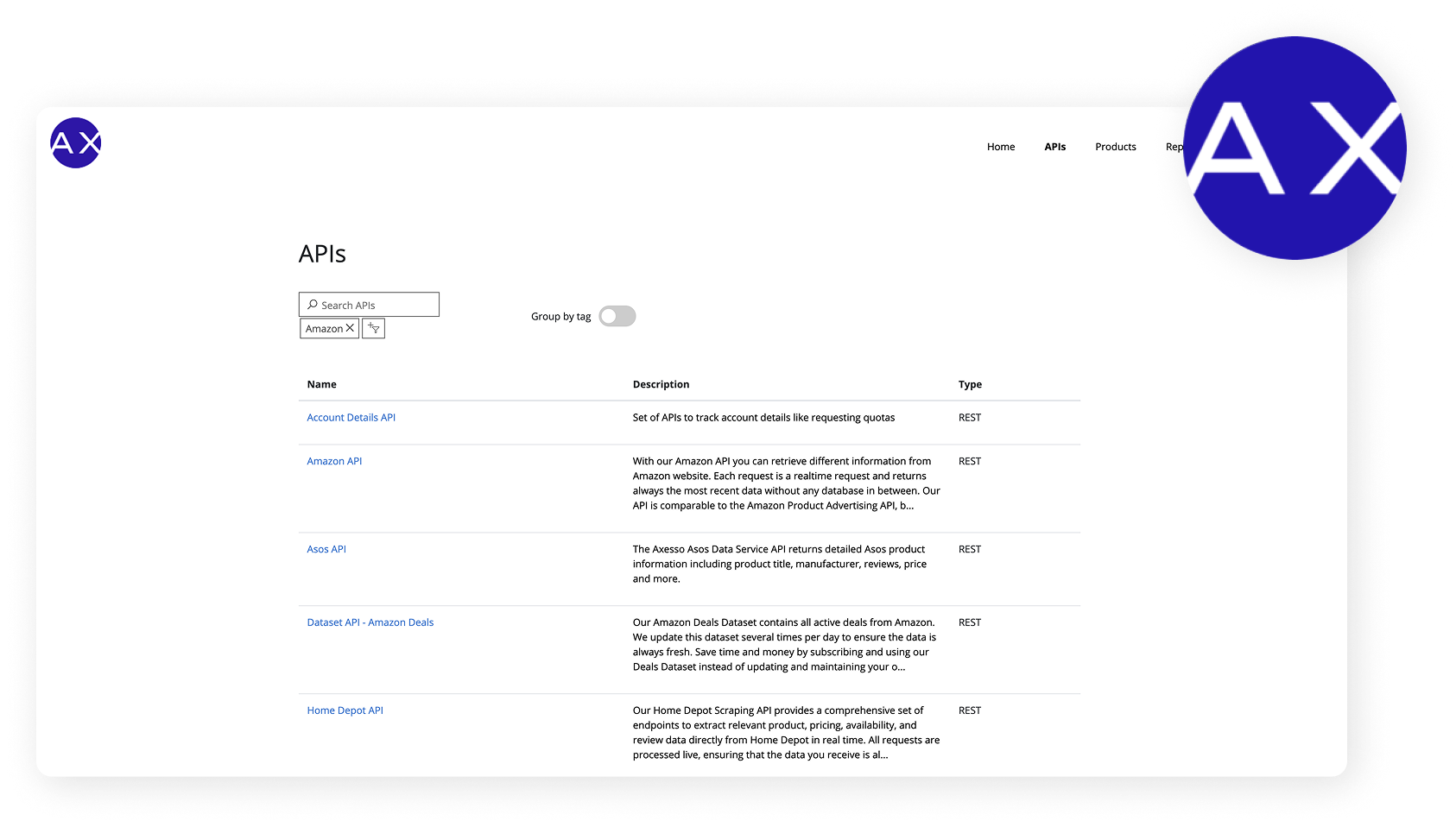
What it is. Axesso is a managed Amazon data API that returns structured JSON across a set of endpoints, including product details, search, reviews, seller offers, seller details, seller products, best seller lists, and deals. You retrieve data with a simple HTTP request and get uniform JSON back, which makes integration quick for developers. Axesso describes each request as a real-time request to the relevant Amazon page, with no intermediary database.
It is a developer-first structured data source. That is a strength if you want reliable Amazon endpoints to build on, and it is a limitation if you want a monitoring platform that already frames data around seller workflows. Confirm current endpoint names and pricing on the live page before building.
DataForSEO API
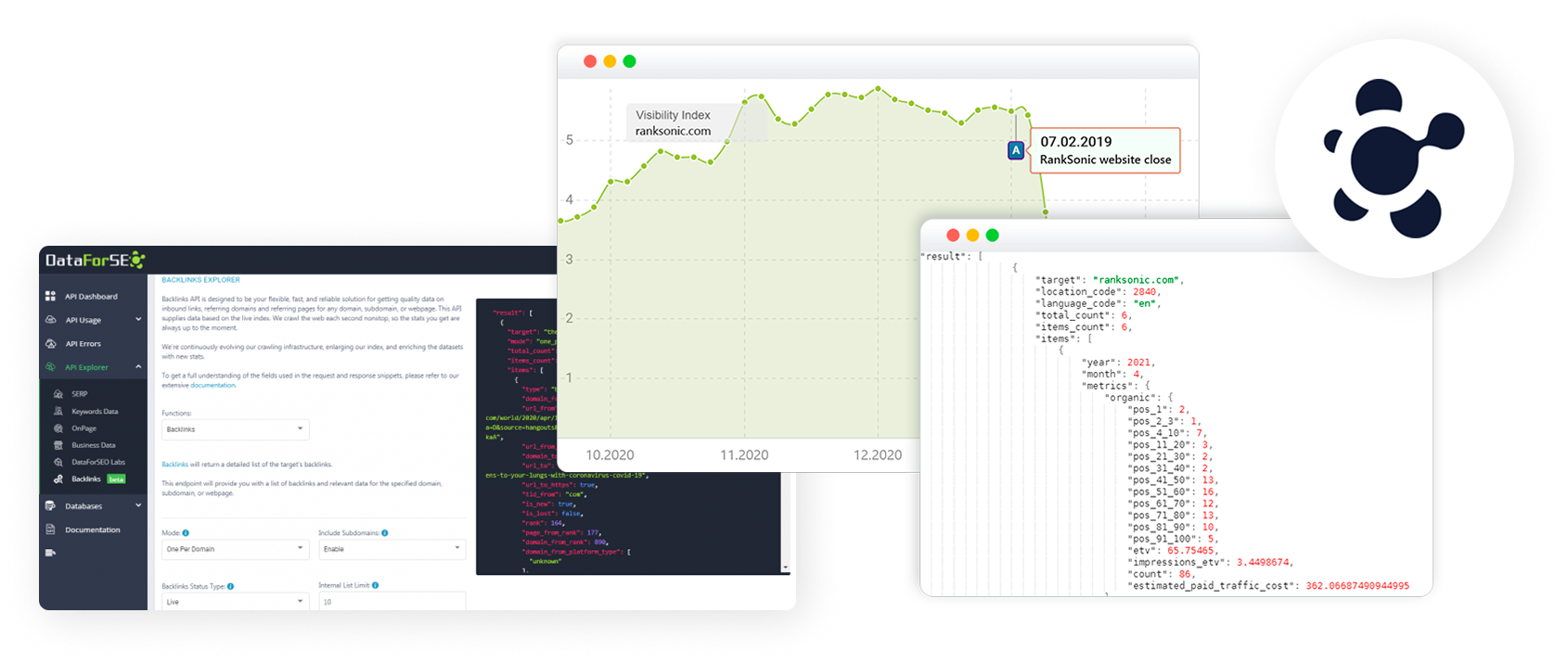
What it is. The DataForSEO Amazon API sits in the SEO and market data category. It is built for keyword research, market analysis, and competitor intelligence, returning metrics on keywords and ASINs, with bulk analysis support, inside DataForSEO’s broader suite of search and marketplace APIs.
That makes it a good fit for SEO firms, agencies, and BI or data product teams, particularly those already using DataForSEO for other channels. It is less seller-ops focused than SellerSonar, and its center of gravity is research and market data rather than day-to-day monitoring.
Scraper API
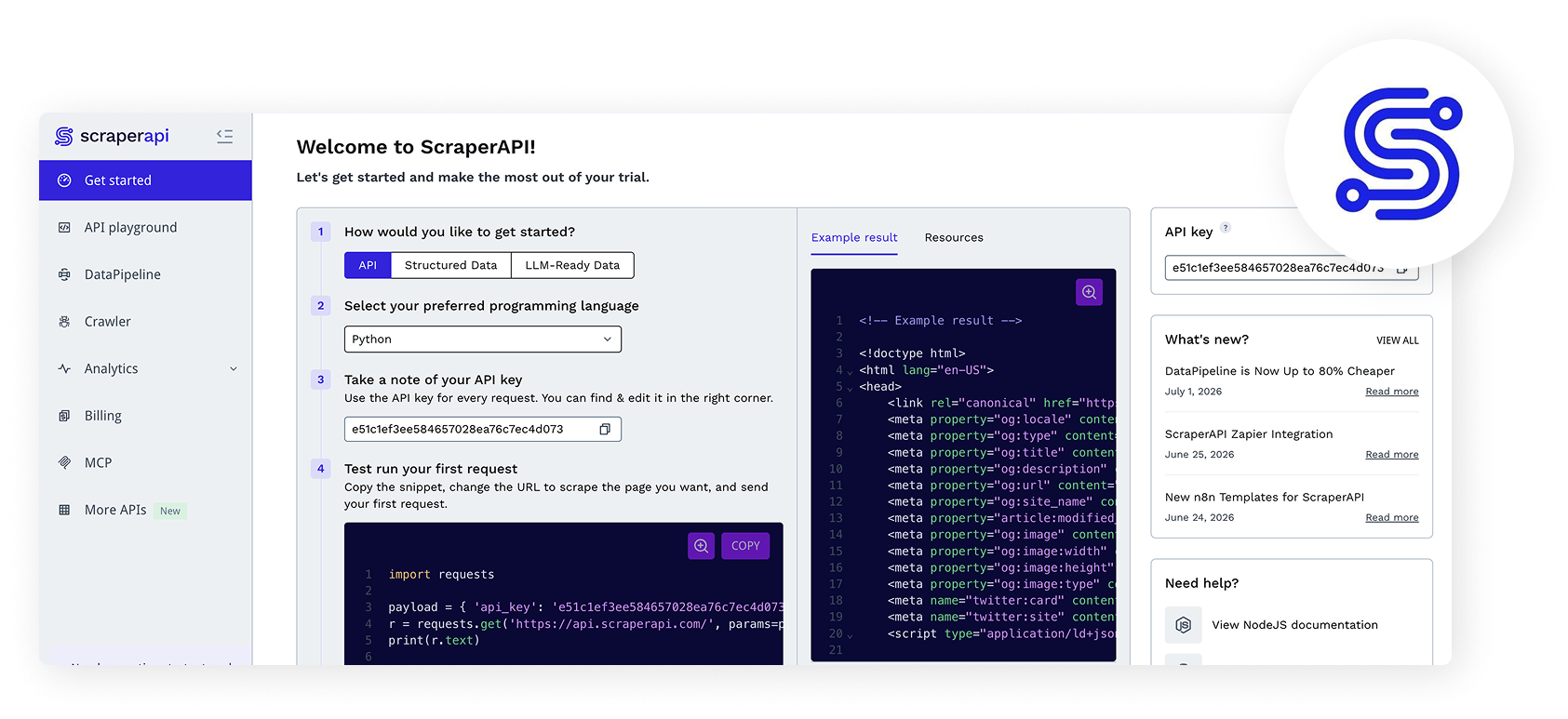
Scraper Data API Dashboard
What it is. ScraperAPI is a general-purpose web scraping platform rather than an Amazon-specific monitoring API. Instead of exposing dedicated seller workflows, it helps developers collect data from Amazon and other websites by handling proxies, IP rotation, JavaScript rendering, CAPTCHA solving, retries, and anti-bot protection behind a single API endpoint. It also offers Structured Data Endpoints (SDEs) that can return parsed JSON for supported websites, including Amazon, reducing the amount of HTML parsing developers need to write.
The platform is designed for engineering teams building custom applications. You provide the target URL, ScraperAPI retrieves the page, bypasses common anti-scraping protections, and returns either the raw HTML or structured data, depending on the endpoint used. Beyond Amazon, it supports virtually any website, making it suitable for broader web data collection projects.
Its biggest advantage is flexibility. Developers can build almost any Amazon-related workflow on top of the scraped data. The tradeoff is that ScraperAPI does not provide seller-specific monitoring logic, historical tracking, alerts, or dashboards out of the box. Those capabilities must be implemented separately by the development team. Pricing is based on API credits and scales with scraping volume, concurrency, and premium features rather than the number of monitored products.
What about general Amazon scrapers?
General scraping platforms are a different category from Amazon-native structured APIs. They give you extraction infrastructure across many sites, with proxy networks and anti-blocking, rather than Amazon data pre-organized around seller workflows.
Bright Data offers large-scale scraping infrastructure with a broad proxy network and localization for multi-site data collection. Oxylabs provides an e-commerce scraper API with strong anti-blocking aimed at high-volume extraction.
These are strong tools for large-scale, multi-site data engineering pipelines. They are less suited to seller-focused Amazon monitoring, because you still have to build and maintain the parsing, normalization, and workflow logic yourself. A structured Amazon-native API removes that layer: you get clean, consistent Amazon data without owning the scraping stack.
Build it yourself or use a structured API?
Building your own Amazon data pipeline involves more than collecting data. Whether you scrape Amazon or build on SP-API, you still need infrastructure, authentication, storage, monitoring, retries, normalization, and ongoing maintenance.
Amazon proposed a $1,400 annual SP-API subscription and usage-based fees in late 2025, then officially cancelled those charges in May 2026. While SP-API remains free to access, developers still pay for the infrastructure that powers their applications, including services such as Amazon API Gateway, storage, compute, logging, and monitoring.
For many teams, a structured API is the more predictable investment. Instead of building and maintaining data collection, normalization, Buy Box tracking, and historical comparisons, you can integrate ready-to-use endpoints and focus on dashboards, alerts, reporting, and customer-facing features.
Expert Tip. Compare the total cost of engineering and infrastructure, not just API request fees. For most sellers and agencies, maintaining a custom Amazon data pipeline costs far more than integrating an established API.
Final recommendation
For seller-focused Amazon monitoring, SellerSonar API is the strongest fit when the goal is to pull structured marketplace data into dashboards, reports, and operational workflows. Its endpoints are grouped the way sellers and agencies work, which means less reshaping between the API and the monitoring or reporting you actually run.
For broad product data, Rainforest is a close and capable alternative. For historical price and rank analysis, Keepa is usually the best pick. For embedding Amazon data into apps or AI agents, Canopy is well suited. For clean structured endpoints with a developer-first setup, Axesso fits. For keyword and market research, DataForSEO is the better tool. And for large-scale multi-site extraction, a general scraper is the right category. Many teams combine two of these, for example pairing historical data from one source with live monitoring from another.
Call to action
Not sure yet whether you need the API or just the app? Start with SellerSonar and watch your listings, Buy Box, and competitors first. When you are ready to pipe that same data into your own dashboards and reports, the SellerSonar Amazon Monitoring API is built for teams that want Amazon monitoring workflows for Buy Box monitoring, keyword visibility, competitor tracking, seller catalog checks, and agency reporting, without maintaining scraper infrastructure. Check the current plans and documentation for pricing, limits, and endpoint availability.

