





Quick Answer
Amazon Ads Agent is Amazon’s unified advertising platform: sponsored ads and what used to be Amazon DSP in one place, with a conversational AI assistant built in. Amazon gave the platform that name at unBoxed on September 29, 2026. For sellers, existing campaigns, reporting, and settings carried over, while the new campaign types and the assistant are still in beta.
Since September 29, 2026, the ads console and Amazon DSP go by one name. Amazon folded both into a single platform and gave it the name it had used for an AI assistant a year earlier: Amazon Ads Agent.
This guide sorts out what moved where, which parts are still in beta, who gets access, what the AI can change, and what it can’t see. Every Amazon claim links to Amazon’s own page.
About the Author: Gloria Anderson writes for the SellerSonar editorial team on Amazon advertising, marketplace visibility, and seller operations. She checked every Amazon fact in this guide against Amazon Ads’ announcements and FAQ pages, and every SellerSonar figure against our own keyword records, as of November 16, 2026.
What is Amazon Ads Agent, and where did the name come from?
Amazon’s Amazon Ads Agent page describes it as “bringing together the ads console and Amazon DSP into a single buying surface we call Amazon Ads Agent.”
The name is older than the platform, which is why so many articles disagree about what it means:
- November 10, 2025: Amazon’s revamped Campaign Manager brings sponsored ads and Amazon DSP “into one single ad platform solution,” starting as a beta for select advertisers.
- November 11, 2025: Amazon announces Ads Agent, “an AI agent,” on certain pages in Amazon Marketing Cloud and Amazon DSP. Its sample instruction: “pause all campaigns with return on ad spend less than 2.”
- March 24, 2026: at Connected Worlds in Mumbai, Amazon Ads introduces Campaign Manager to India, “which brings together Amazon DSP and Amazon’s advertising console into a single ad platform.”
- September 29, 2026: at unBoxed, the name moves to the whole platform. Amazon’s unBoxed 2026 recap calls Amazon Ads Agent “the unified buying experience that brings together what was formerly the DSP and Ads Console.” The assistant becomes its conversational experience.
- November 5, 2026: at unBoxed Tokyo, Amazon calls it “the new name of the unified platform, now powered by agentic AI.”
🎯 Pro Insight: When an article dated before September 29, 2026 says “Ads Agent,” it means the 2025 assistant, not the platform. Several guides that rank for the term still describe only the assistant, with access rules Amazon’s pages don’t support.
What happened to the ads console and Amazon DSP?
Amazon’s FAQ on the Ads Agent page answers both questions directly.
- The ads console: “We brought sponsored ads and Amazon DSP together into one ad platform, Amazon Ads Agent. Your existing campaigns, reporting, and settings have carried over.”
- Amazon DSP: “audience targeting, frequency management, deal IDs, and custom bidding, all live in DVA+ with advanced settings,” next to Sponsored Display and Sponsored TV.
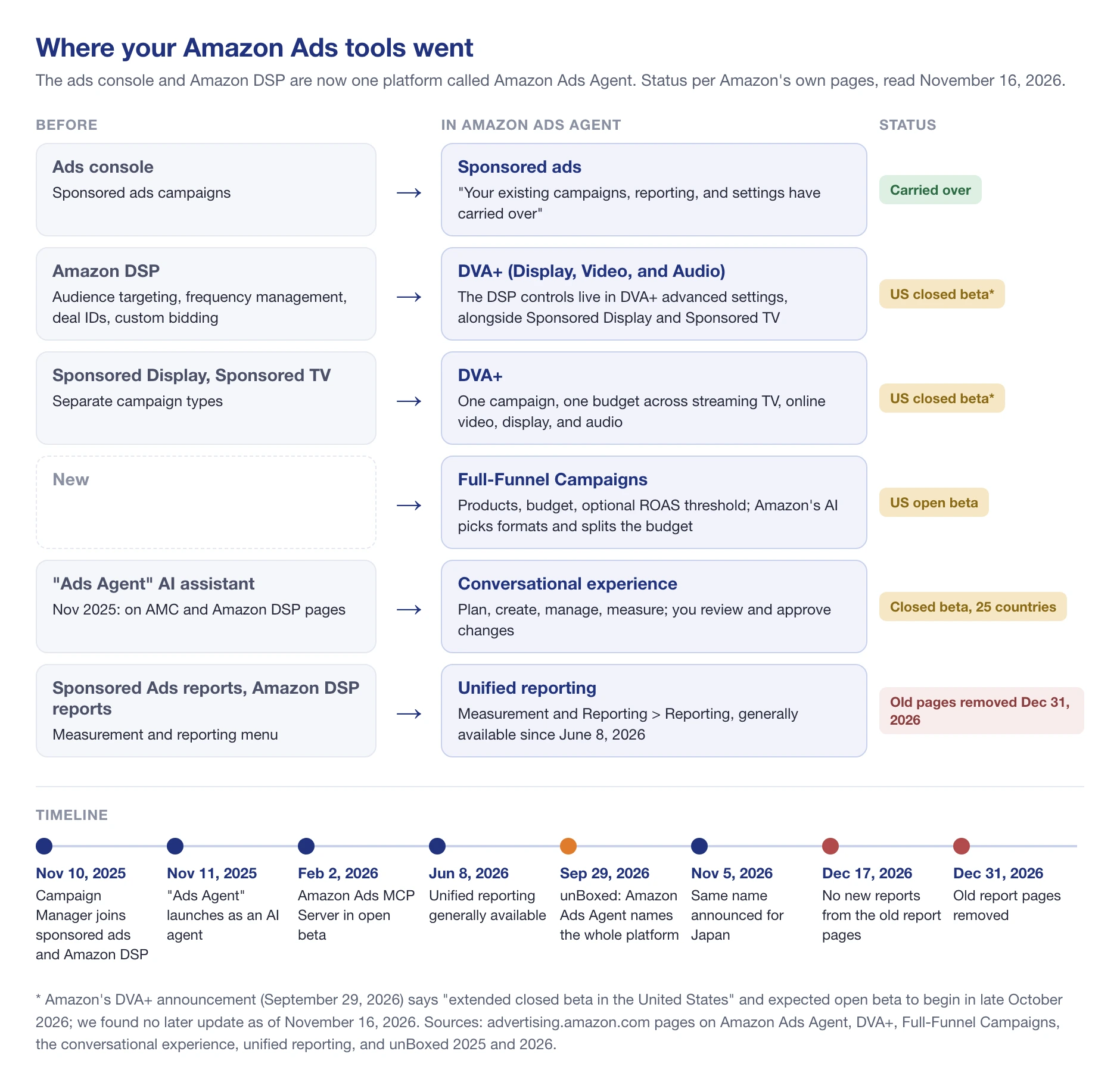
So the rename switched nothing off. What changes is where the controls sit and, by December 31, 2026, where your reports live.
What changes for your Amazon Ads reports by December 31, 2026?
This is the one change with a hard deadline. Amazon’s unified reporting announcement (June 8, 2026) made one report builder generally available under Measurement and Reporting > Reporting, covering several accounts, ad products, and countries in one report.
The same page says Amazon is “sunsetting Sponsored Ads reports (Measurement and reporting > Sponsored Ads reports) and Amazon DSP reports (Measurement and reporting > Amazon DSP reports) by December 31, 2026.” The banner Amazon shows on those pages is more specific: “Starting December 17, 2026, you won’t be able to create reports from these pages. On December 31, 2026, these pages will be removed.”
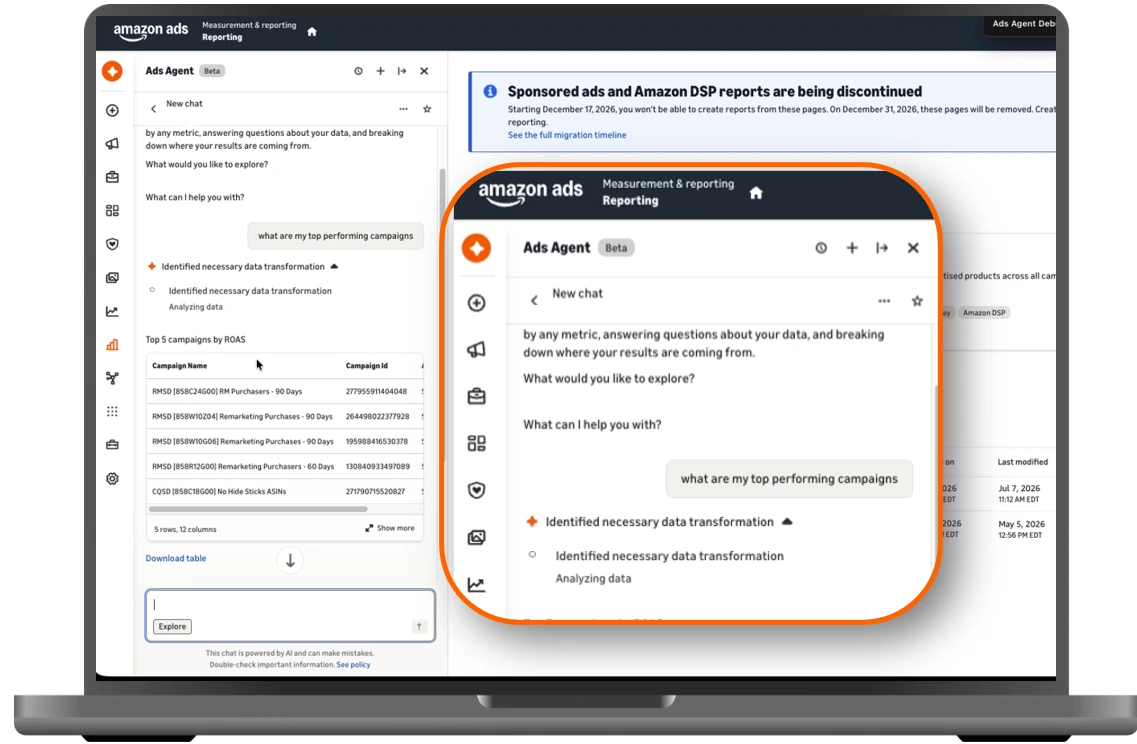
Unified reporting keeps up to 15 months of daily or weekly data and up to 6 years of monthly, yearly, or summary data. It also standardizes attribution “from conversion to traffic based attribution,” so some figures may differ from your old reports.
- List every scheduled report and who receives it, including agency and client exports.
- Recreate them in unified reporting before December 17, 2026. Amazon says an automated subscription migration tool “will be available soon,” without a date.
- Run old and new versions side by side for a few campaigns before you switch a dashboard over, so attribution differences don’t look like a performance drop.
- Check the banner in your own account. Amazon can move these dates, and the banner is the version that applies to you.
What are the three ways to run campaigns in Amazon Ads Agent?
Amazon offers two ways in: describe your goal in a conversation, or build a campaign yourself. Either way, you land on one of three campaign paths.
| Path | What you set | Status as of November 16, 2026 |
|---|---|---|
| Sponsored ads | Your existing Sponsored Products, Sponsored Brands, and other sponsored campaigns, priced per click | Carried over from the ads console |
| Display, Video, and Audio (DVA+) | Objective, products or brand URL, AI-generated creatives you review, budget; advanced settings for DSP-style control | “Extended closed beta in the United States”; general availability in 35 markets targeted for Q1 2027 |
| Full-Funnel Campaigns | Products, budget, and an optional ROAS threshold; Amazon’s AI picks formats and splits the budget | Open beta for “any US advertiser who sells on Amazon” |
On DVA+, Amazon’s September 29, 2026 DVA+ announcement expected open beta to start in late October 2026 and “international expansion planned through Q4 2026,” with payment invoice-only during closed beta. New and sponsored ads advertisers get the simple version; advanced settings are requested through an Amazon Ads account manager.
Full-Funnel Campaigns run alongside your current campaigns and add a Long-Term Sales metric covering new-to-brand customer value over 12 months. For what each sponsored format does, see our guide to Amazon ad types.
Who can use Amazon Ads Agent, and what does it cost?
Per Amazon’s FAQ, sellers enrolled in Brand Registry, book vendors, vendors, and agencies with clients get the full range of campaign types. Advertisers who don’t sell on Amazon can run Display, Video, and Audio campaigns.
The FAQ prices the ads, not the platform. Sponsored ads use cost-per-click pricing “with no minimum spend.” Display, Video, and Audio campaigns run self-service with budgets you set, or through managed service, which “typically requires a minimum spend that varies by country.”
Campaign Manager added multi-account management in November 2025, and agencies with existing entity access get both DVA+ experiences. If you run several client accounts, our roundup of Amazon agency software covers the tools around it.
What can the Amazon Ads Agent assistant do?
Amazon’s conversational experience page lists five jobs for enrolled beta advertisers:
- Plan: audience sizing, reach forecasts, and budget recommendations.
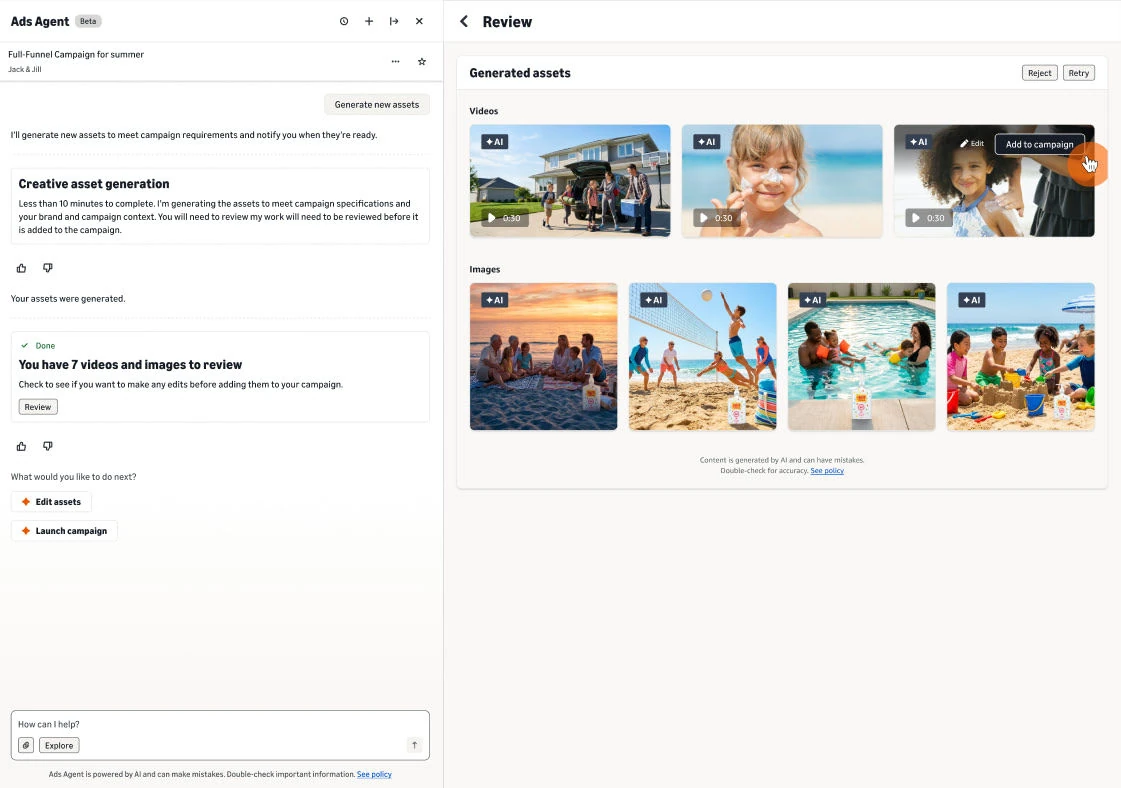
- Create: turn a media plan into Display, Video, and Audio campaigns, or get audience and keyword recommendations in DVA+ advanced settings.
- Manage and optimize: for sponsored ads, apply keyword, bid, and budget recommendations with one click, “then review and approve changes.”
- Measure: performance analysis, trends, and benchmarks, plus Amazon Marketing Cloud SQL written from a plain-language request.
- Get help: billing questions and ad policy issues.
Amazon says advertisers “review a summary of proposed changes and approve them before they’re applied.” Its welcome screen opens with suggested prompts for common advertising tasks.
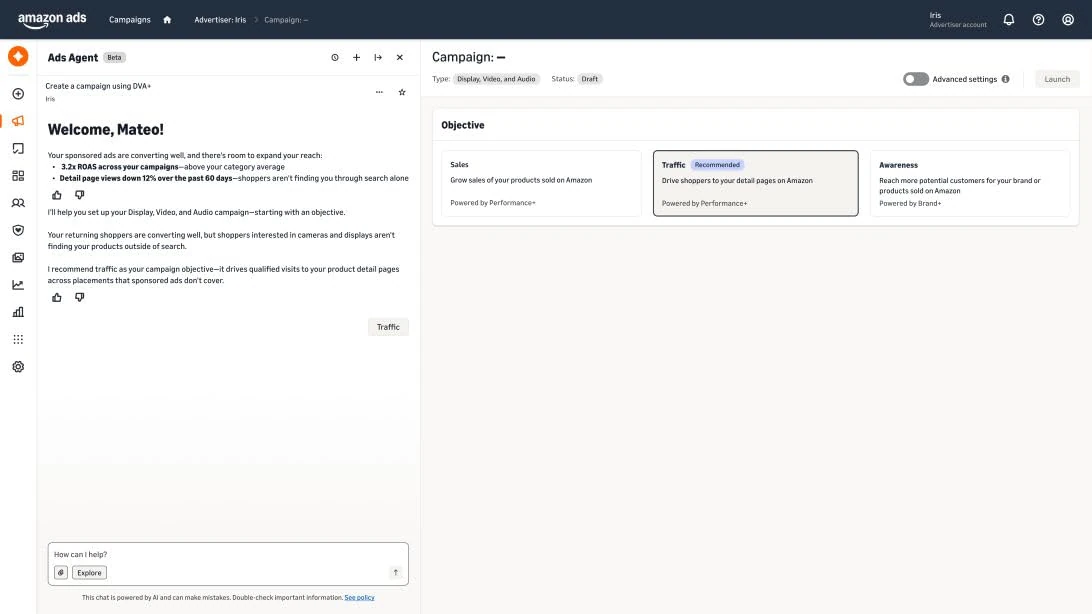
Access is limited. Amazon’s September 29, 2026 launch note calls it a closed beta for eligible self-service and managed-service advertisers in 25 countries: the US, Canada, Mexico, Brazil, Colombia, Chile, Belgium, Germany, Spain, France, Italy, the Netherlands, Poland, Sweden, Turkey, the UK, Egypt, Saudi Arabia, the UAE, Australia, India, Japan, Singapore, Nigeria, and South Africa. In Amazon’s words, interested advertisers “can express interest through their Amazon Ads account team.”
How much should you trust Amazon’s performance figures?
Amazon publishes four headline numbers. All come from its own data, and the footnotes are the only method it gives.
- “Up to 68% improvement in cost per acquisition” for DVA+ campaigns using Brand+ and Performance+. Footnote: Amazon Internal Data, U.S., 2025.
- “67% higher Long-Term ROAS” and new-to-brand customers “at 29% lower cost per purchase” for Full-Funnel Campaigns. Footnote: early beta advertisers, June to August 2026, against “the blended average of other campaign performance.”
- 26% less bid optimization workflow time with smart search in Campaign Manager, in early testing. Footnote: an internal report from June/August 2025, before versus after adoption.
None of them comes with sample sizes or a control group. The Full-Funnel page also describes the comparison two ways: “the same formats configured independently” in the text, a blended average of other campaigns in the footnote. Treat these as reasons to run a test, not forecasts for your account.
What should you check before letting AI change bids and budgets?
Amazon’s approval step is a safeguard, but only if someone reads what they approve. Amazon’s own chat panel carries the line “This chat is powered by AI and can make mistakes. Double-check important information.”
- Record a baseline first. Note ROAS or ACOS, spend, and new-to-brand sales for the campaigns you’ll hand over.
- Start small. Give the AI one portfolio or a few campaigns, and keep a similar set unchanged to compare against.
- Read every change summary. Check which campaigns, how big the bid or budget moves are, and whether a “bulk” change caught campaigns you meant to leave alone.
- Check the listing before the bid. Amazon’s Sponsored Products page says products must be “eligible for the Featured Offer” to advertise, and ads “only appear when your advertised items are in stock.” A higher bid won’t fix either.
- Use the limits Amazon gives you. Full-Funnel takes an optional ROAS threshold; DVA+ advanced settings add budget and frequency caps.
- Log what changed and when, so you can tie later results to a specific change.
💡 Expert Tip: Ask the assistant to list every change it proposes as a table, with the old value, the new value, and the reason, before you approve anything. A long list is your cue to approve part of it and check the rest a week later.
Can you connect your own AI tools to Amazon Ads Agent?
Yes, through the Amazon Ads MCP Server. Amazon opened it in open beta on February 2, 2026 “to Amazon Ads partners with active API credentials,” so AI tools such as Claude, ChatGPT, or Gemini can create, update, or delete campaigns, run reports, and read billing data.
At unBoxed 2026, Amazon added an MCP Server (Lite) “starting with just three core tools.” Our Amazon Ads MCP guide covers setup, access, and what the server can’t see.
Where does ChatGPT fit in?
On September 10, 2026, Amazon Ads announced a partnership with OpenAI to support advertising in ChatGPT, letting advertisers extend Amazon Ads campaigns into conversational ads there. Select US advertisers were testing ChatGPT Ads in a pilot as of that date, and Amazon hasn’t published how other advertisers can join.
What doesn’t Amazon Ads Agent see, and how do you watch it?
Amazon Ads Agent works from your ad data and Amazon’s shopping signals. None of the Amazon Ads Agent pages we read describe tracking these:
- Your organic rank on the keywords you pay for, next to your sponsored rank
- Your brand’s Share of Voice against competitors on a search page
- Who holds the Featured Offer (the Buy Box) on your listing, and at what price
- Edits to your title, bullets, or images by anyone else
One keyword, two very different ranks
Here is what SellerSonar recorded for a US listing we track: DURACELL Coppertop AA Batteries, 28 Count (B0B1DF9NVJ), on the keyword “aa batteries,” October 19 to November 16, 2026. Checks ran about twice a day; times are UTC.
| Period | Organic position | Sponsored position |
|---|---|---|
| October 19 to November 10 (morning) | 5 to 14 | #2 on October 29 and November 2; not recorded on other checks |
| November 10 (evening) to November 13 (morning) | 66 to 91, on page 2 | Not recorded |
| November 13 (evening) | 15 | #2, in a sponsored slot on page 3 |
| November 14 to 16 | 12, then 6 to 7 | #1 or #2 on four of five checks |
The brand view moved too. Share of Voice for DURACELL on “aa batteries,” organic and sponsored together across all its listings in the results, was 28.4% on November 9, 21.2% on November 11, and 28.7% on November 14.
We can’t see Duracell’s campaigns, spend, or tools, so this says nothing about why. It shows what an ad-only view leaves out: for three days the listing sat on page 2 organically, and on November 16 it ranked #1 sponsored and #6 organic.
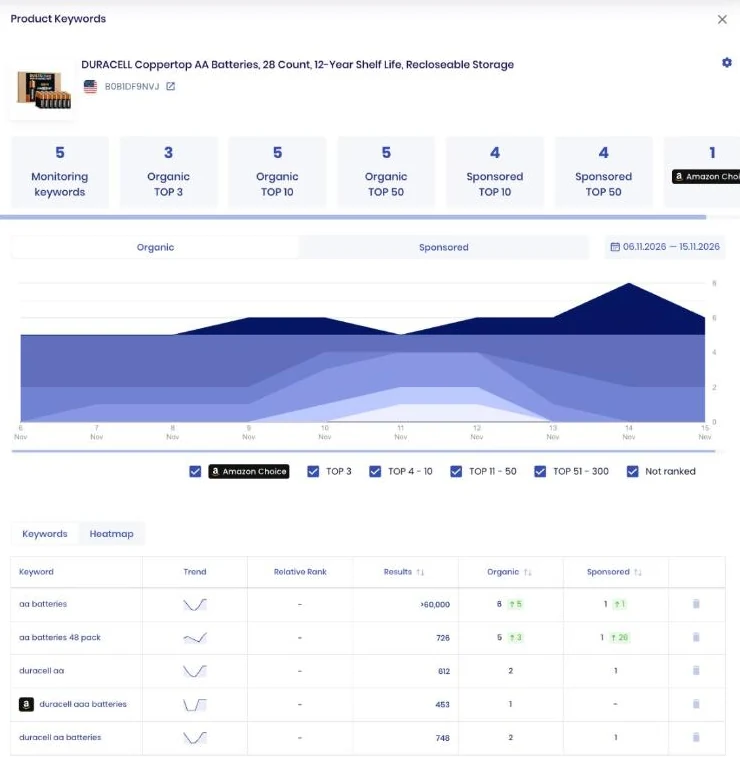
📌 From Our Experience: Organic and sponsored rank on the same keyword can move in opposite directions within a day. Before you judge an AI’s bid changes, look at both: a sponsored #1 tells you nothing about where you’d sit without the ad.
How SellerSonar fits in
SellerSonar watches the public side of Amazon. It doesn’t manage ads, read your ad spend, or connect to Amazon Ads, and it needs no Seller Central access.
- Keyword rank: keyword monitoring tracks organic and sponsored positions daily for every ASIN, with alerts on any change inside the top 10, 10 or more positions inside the top 50, and 25 or more inside the top 100.
- Competitor keywords: Keyword Outrank shows the keywords a competitor’s ASIN ranks for, and where competitors reach the top 3 but your listing never has. Use it as a second opinion on the assistant’s keyword recommendations.
- Share of Voice and Shelf Intelligence on the Business plan show how visible your brand is against competitors across tracked keywords. Our guide to Amazon Share of Voice explains the metric.
- Buy Box alerts (Buy Box Won and Lost on Premium and up) show who took it and at what price. They’re off by default, so switch them on in Alerts, then Delivery Settings.
- Content change alerts cover title, bullet points, description, images, and brand, with before and after text.
Checks run every 4 hours on Pro, every 2 hours on Premium, and every hour on Business and Enterprise.
Bringing it together
Amazon Ads Agent is a new name and a new layout more than a new set of rules for the campaigns you already run.
- What carried over: sponsored ads campaigns, reporting, and settings.
- What’s still in beta: DVA+, Full-Funnel Campaigns, and the conversational assistant, each with its own country list.
- What has a deadline: the old Sponsored Ads and Amazon DSP report pages, removed December 31, 2026, with report creation ending December 17.
- What it can’t see: organic rank, competitors’ share of the page, the Buy Box, and listing edits.
Final Expert Recommendations:
Move your scheduled reports first, because that date won’t wait. Then test the AI on a small set of campaigns with a baseline, read every change before you approve it, and check organic rank and the Buy Box before you blame or credit a bid.
Want organic and sponsored rank side by side for your own keywords? Start a free 14-day SellerSonar trial (5 ASINs and 10 keywords, no credit card).
Sources: Amazon Ads pages on Amazon Ads Agent, DVA+, Full-Funnel Campaigns, unified reporting, the MCP Server, ChatGPT Ads, Sponsored Products, and unBoxed 2025 and 2026 (November 10, 2025 to November 5, 2026), read November 16, 2026; SellerSonar keyword and Share of Voice records, October 19 to November 16, 2026.
