





Quick Answer
Amazon’s 2027 FBA fee changes start on January 15, 2027, when US fulfillment fees rise by $0.19 per unit on average, about 0.8% of the average selling price. On February 1, 2027, one age-based monthly storage fee replaces the storage utilization and aged inventory surcharges, and the low-inventory-level fee changes. The announcement covers the US store only.
Amazon announced its 2027 US fees on November 5, 2026, in the middle of the holiday peak. The headline number is small: $0.19 more per unit sold, on average. The spread behind that average is not.
This guide walks through every change on Amazon’s fee pages, with the rate cards, the dates, and worked examples you can redo for your own products. It ends with a dated plan for the weeks before January 15 and February 1, 2027.
About the Author: Diana Walsh writes about Amazon fees and Seller Central for our editorial team. She checked every rate and date in this guide against Amazon’s Seller Central help pages, and every SellerSonar figure against our own fee-change records, as of November 16, 2026.
What are the Amazon FBA fee changes for 2027?
Most fulfillment changes start on January 15, 2027, and most storage and inventory changes on February 1, 2027.
Not everything goes up. Amazon’s 2027 US Referral and Fulfillment by Amazon fees page says some fees will increase and others decrease, “so that each fee more closely matches our cost of fulfilling that product.”
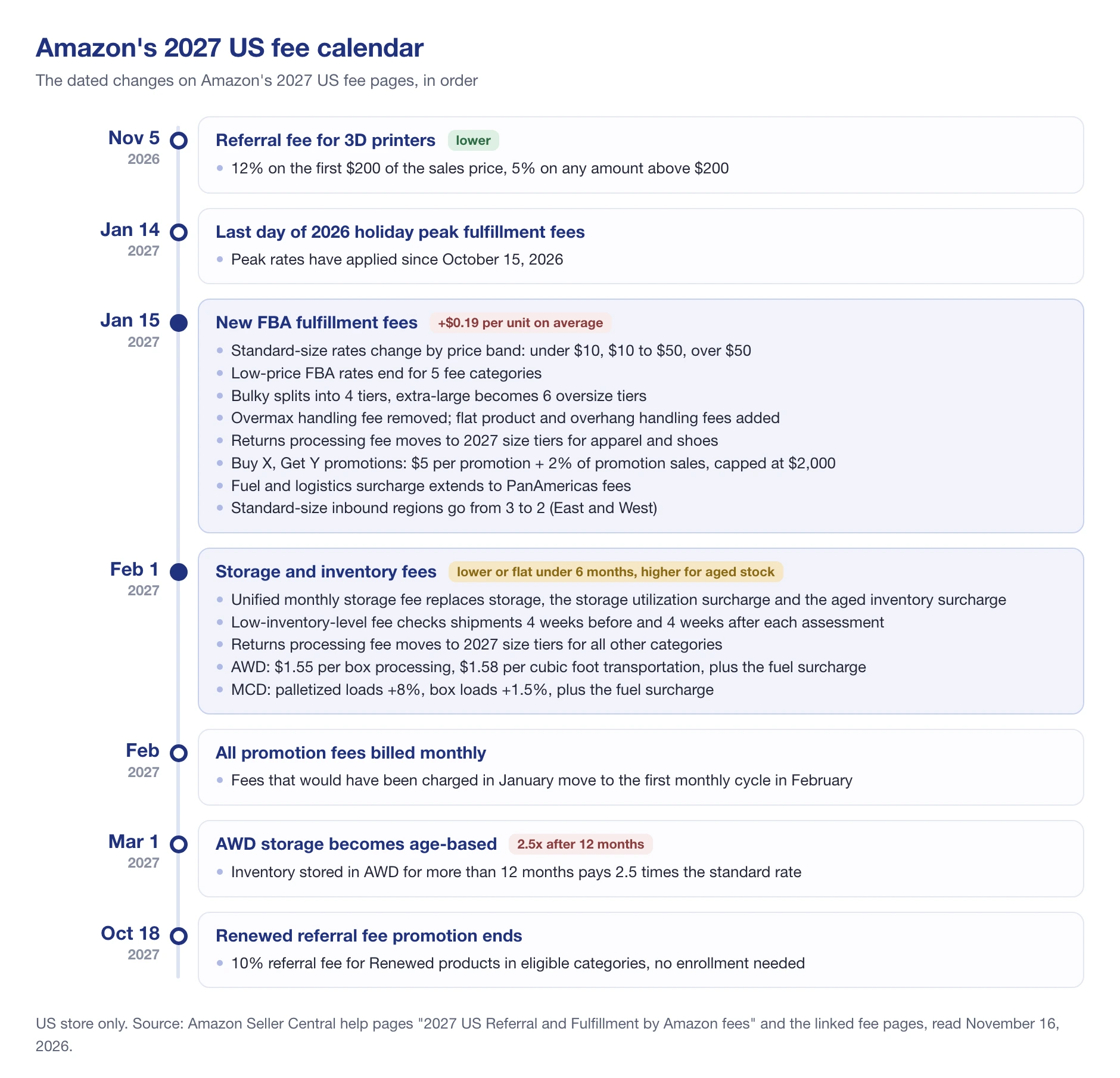
Who feels each change:
| Date | What changes | Who feels it |
|---|---|---|
| Nov 5, 2026 | Lower referral fee for 3D printers | 3D printer sellers |
| Jan 15, 2027 | Fulfillment rates, low-price FBA, bulky and oversize tiers, handling fees, Buy X Get Y fee | Almost every FBA seller |
| Feb 1, 2027 | Unified storage fee, low-inventory-level fee, AWD and MCD rates | Sellers with aged or very lean stock |
| Feb 2027 | All promotion fees billed monthly | Sellers running deals, coupons, and discounts |
| Mar 1, 2027 | AWD storage priced by age | AWD users with stock over 12 months old |
| Oct 18, 2027 | 10% Renewed referral promotion ends | Renewed sellers |
Until January 14, 2027, the holiday peak fees that started on October 15, 2026 still apply (our Black Friday strategies guide covers the peak).
Since April 17, 2026, Amazon has added a 3.5% fuel and logistics-related surcharge to US FBA fulfillment fees. The 2027 rate cards are printed without it, and Amazon says it will “keep reviewing the surcharge as conditions change.”
How much are FBA fulfillment fees going up in 2027?
The $0.19 is an average across all products. Amazon’s breakdown by size and price shows where the increase lands:
| Price | Small standard-size | Large standard-size |
|---|---|---|
| Under $10 | +$0.20 per unit | Unchanged (apparel +$0.08) |
| $10 to $50 | +$0.40 per unit | +$0.12 per unit |
| Over $50 | +$0.70 per unit | +$0.47 per unit |
Small standard items carry most of the increase. An item priced at exactly $10 or $50 gets the $10 to $50 rate.
A few rows from Amazon’s 2027 US FBA fulfillment fee changes rate card (non-apparel, surcharge not included):
| Size tier and shipping weight | $10 to $50: 2026 → 2027 | Over $50: 2026 → 2027 |
|---|---|---|
| Small standard, 2 oz or less | $3.32 → $3.75 | $3.58 → $4.31 |
| Small standard, 6+ to 8 oz | $3.54 → $3.97 | $3.80 → $4.53 |
| Small standard, 14+ to 16 oz | $3.96 → $4.32 | $4.22 → $4.88 |
| Large standard, 12+ to 16 oz | $4.60 → $4.67 | $4.86 → $5.23 |
In every small standard row priced $10 and up, the 2027 non-peak rate is higher than the 2026 peak rate, so those listings get no post-peak drop on January 15.
💡 Expert Tip: Check your prices against the $10 and $50 lines. A 6+ to 8 oz small standard item in a category that keeps low-price rates pays $2.83 in 2027 at $9.99 and $3.97 at $10.00, a $1.14 gap. At $50.00 it pays $3.97, and at $50.01 it pays $4.53.
Worked example: one $39.95 phone case we track
SellerSonar has logged every FBA fee change on a Casely iPhone 16 case (B0D7FWR719) since October 2025. Its fees match Amazon’s small standard 2+ to 4 oz rate at $10 to $50, plus 3.5%.
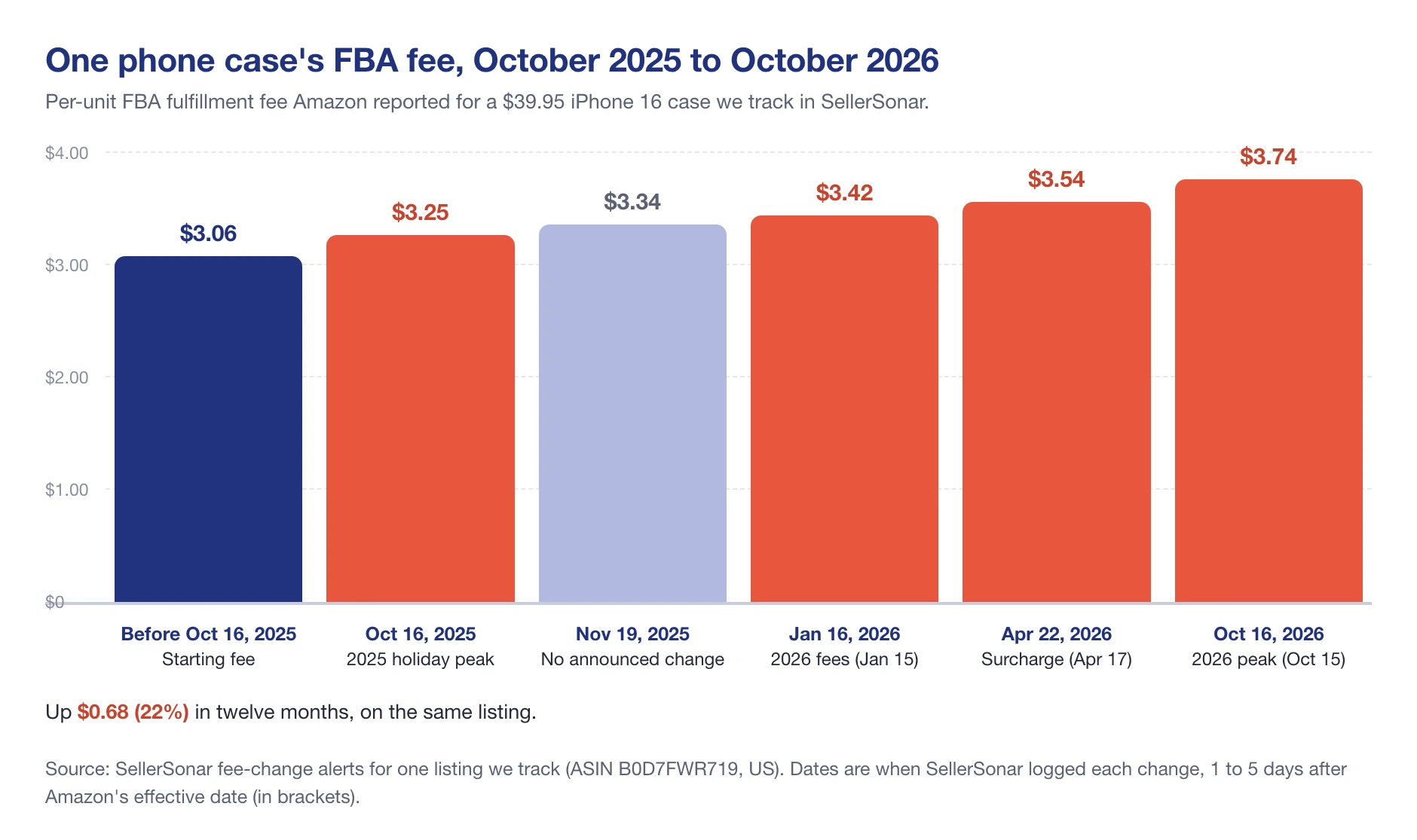
The arithmetic from Amazon’s rate card:
- 2026 non-peak: $3.42 × 1.035 = $3.54, the fee we logged from April 22, 2026.
- 2026 peak: $3.61 × 1.035 = $3.74, the fee we logged on October 16, 2026.
- 2027 non-peak: $3.78 × 1.035 = $3.91, if the surcharge is still 3.5% on January 15, 2027.
That’s $0.37 more than the 2026 non-peak fee and $0.17 more than the peak fee. At $39.95, the fee goes from 8.9% to 9.8% of the price, which is $370 more per 1,000 units sold.
Which products lose low-price FBA rates in 2027?
Through January 14, 2027, every product priced under $10 gets low-price FBA rates. From January 15, 2027, five fee categories lose them and pay the $10 to $50 rates instead:
- Automotive and Powersports
- Compact Appliances
- Computers
- Musical Instruments and AV Production
- Media: Books, DVD, Music, Software, Video
Amazon’s own example shows the cost. On its 2027 US Low Price FBA fulfillment fee page, a 3.35 lb iron in Compact Appliances priced under $10 paid $6.31 at the 2026 non-peak rate. From January 15, 2027, it pays $7.32, which is $1.01 more per unit, or 16%.
In other categories, heavier small standard items under $10 barely move: 14+ to 16 oz goes from $2.95 to $2.99.
What changes for bulky and oversize products?
From January 15, 2027, Amazon splits small bulky into small and medium bulky, and large bulky into large and extra-large bulky. The extra-large tiers become six oversize tiers: small, medium, large, long, special oversize light, and special oversize heavy.
Fees move both ways in Amazon’s own examples (non-peak, no surcharge):
| Amazon’s example (2027 tier) | 2026 | 2027 |
|---|---|---|
| Baby cot, 7.9 lb (small bulky) | $10.21 | $10.24 |
| Monitor, 54 x 34 x 3.5 in (small oversize) | $43.81 | $27.10 |
| TV, 65 x 20 x 7 in (medium oversize) | $48.57 | $36.55 |
| Wall panel, 60 x 30 x 3 in (small oversize + flat product fee) | $40.77 | $33.26 |
| Tabletop panel, 70 x 44 x 3 in (long oversize + flat product and overhang fees) | $70.32 | $97.48 |
The overmax handling fee ends on January 15, 2027. Two new fees replace it, and Amazon’s Oversize handling fees page lists both:
- Flat product handling fee: shortest side under 4 inches and median side 25 inches or more. $8.40 (small oversize) to $29.53 (special oversize heavy).
- Overhang handling fee: median side over 43 inches. $3.45 (long oversize) to $10.45 (special oversize heavy).
A product can pay both. The new tier limits are on Amazon’s Product size tiers page.
How does the unified monthly storage fee work?
From February 1, 2027, Amazon charges one storage rate per cubic foot that rises with inventory age. The storage utilization surcharge and the aged inventory surcharge both go away.
For standard-size inventory from January to September, the 2027 rates are $0.78 per cubic foot up to 180 days, $2.78 from 181 to 270 days, and $6.68 from 271 to 365 days. After a year it’s $7.68, and $8.68 after 455 days, or a per-unit charge if that’s higher.
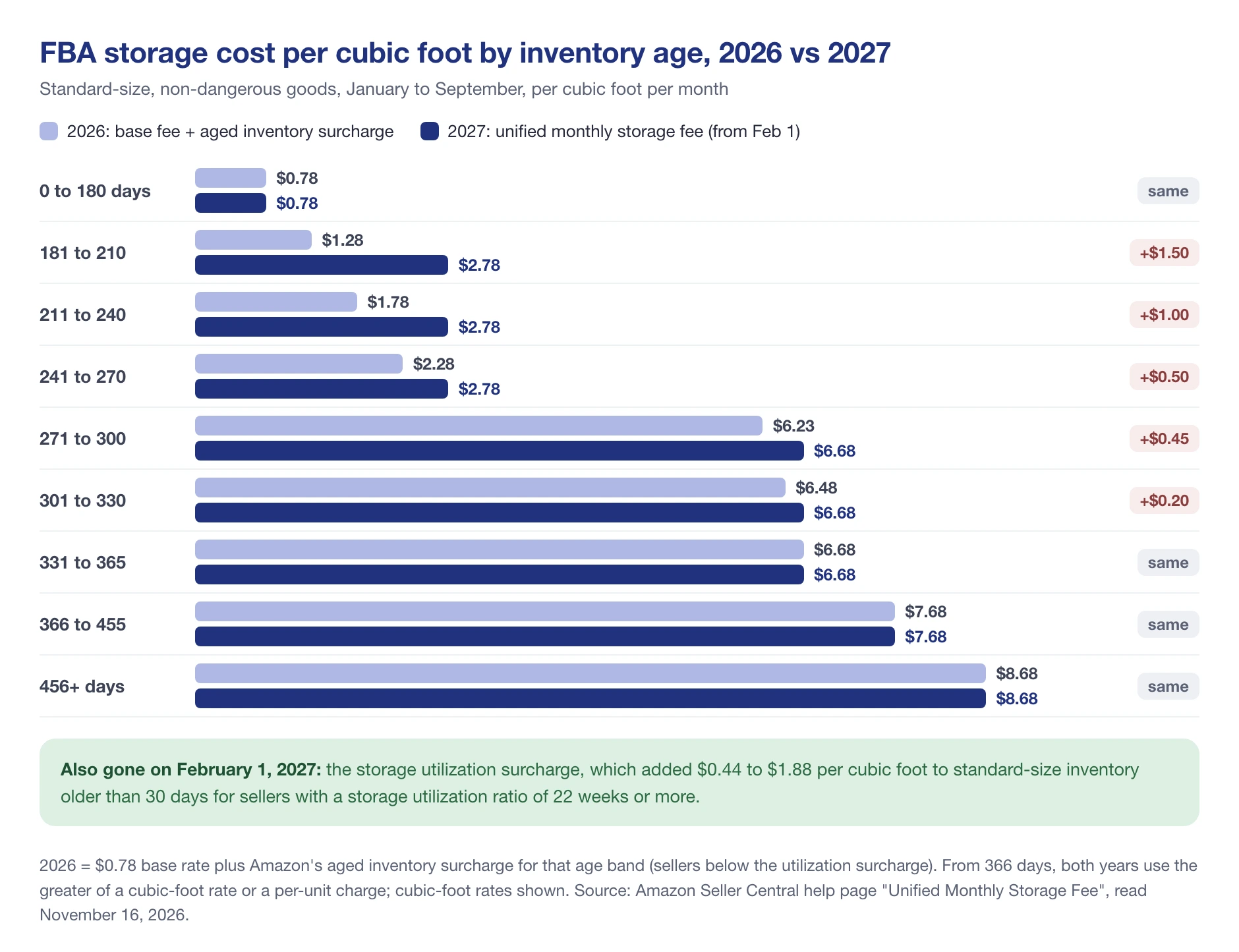
Compare totals, not base rates: a 200-day-old unit paid $0.78 plus a $0.50 aged surcharge in 2026, so $1.28 per cubic foot. In 2027 it pays $2.78.
Amazon’s Unified Monthly Storage Fee page confirms that inventory aged 181 to 330 days sees an increase. In our comparison, no age band gets cheaper unless you were paying the utilization surcharge.
Other storage rates and exemptions
- Peak (October to December): add $1.62 (standard-size) or $0.84 (bulky and oversize), the same totals as 2026 for stock under 181 days.
- Bulky and oversize: $0.56 up to 180 days, $2.56 for 181 to 270 days, and $6.46 for 271 to 365 days.
- Clothing, shoes, bags, jewelry, and watches: $1.78 for 181 to 270 days (standard-size). They were excluded from that aged surcharge band in 2026, so it now costs them $1.00 more.
- Dangerous goods: plus $0.21 (standard-size) or $0.22 (bulky and oversize) off-peak.
- Exemptions: FBA New Selection units get free storage for a limited time, and an FNSKU with 70% or more auto-replenished from AWD pays the 0 to 180 day rate at any age.
Worked example: 20 cubic feet at four ages
Take 400 standard-size units at 0.05 cubic feet each (Amazon’s example unit size), so 20 cubic feet, in one off-peak month:
| Inventory age and seller | 2026 | 2027 | Change |
|---|---|---|---|
| 0 to 180 days, no utilization surcharge | 20 × $0.78 = $15.60 | 20 × $0.78 = $15.60 | None |
| 31 to 180 days, utilization ratio of 28 to 36 weeks | 20 × $1.54 = $30.80 | 20 × $0.78 = $15.60 | $15.20 less |
| 181 to 210 days, no utilization surcharge | 20 × $1.28 = $25.60 | 20 × $2.78 = $55.60 | $30.00 more |
| 271 to 300 days, no utilization surcharge | 20 × $6.23 = $124.60 | 20 × $6.68 = $133.60 | $9.00 more |
The same 20 cubic feet can cost half, the same, or more than double. The table keeps all units in one age band; Amazon averages daily volume and assesses each FNSKU at month-end.
🎯 Pro Insight: January is the cheapest month to clear aged stock. A unit at 181 to 210 days costs $1.28 per cubic foot in January 2027 and $2.78 in February. If you planned a removal, liquidation, or clearance price for slow-moving inventory, finish it before February 1.
What changes in the low-inventory-level fee?
Until February 1, 2027, Amazon assesses the fee using trailing 30- and 90-day sales. From February 1, 2027, it compares your inventory with actual shipments in the 4 weeks before and the 4 weeks after each weekly check. The fee applies only if days of supply are under 28 in both periods.
Amazon’s Low-inventory-level fee 2027 page gives the math. With 360 units, 20 shipped per day before the check (18 days of supply) and 15 per day after (24 days), the higher figure is 24. That’s under 28, so a large standard 4+ to 8 oz item pays $0.36 per unit.
If sales drop after the check, no fee: in another Amazon example, 420 units cover 12 days before the check and 35 days after.
The fee also gets its own line on the Payment view report, arrives four weeks after each check, and now covers every oversize tier.
Exempt: new Professional sellers for 365 days, enrolled New Selection products for 120 days, SKUs 70% auto-replenished through AWD, products that shipped under 20 units in seven days, and grocery.
What changes for promotions, returns, and referral fees?
Promotions
From January 15, 2027, each Buy X, Get Y promotion costs $5 upfront plus 2% of promotion sales, with the variable part capped at $2,000. In Amazon’s example on its Buy X, Get Y fees page, $4,200 in promotion sales costs $5 + $84 = $89.
From February 2027, all promotions are billed monthly. Fees that would have been charged in January move to the first February cycle, and a deal that runs from September 23 to October 7 is charged after November 10.
Returns processing
The returns processing fee moves to the 2027 size tiers for apparel and shoes shipped from January 15, 2027, and for other high-return categories from February 1. The per-unit rates don’t change. A small bulky baby cot pays $8.98 in both, according to Amazon’s 2027 returns processing fee changes page.
Referral fees
Since November 5, 2026, 3D printers pay 12% on the first $200 of the sales price and 5% above $200. Renewed products in eligible categories pay a 10% referral fee through October 18, 2027, with no enrollment.
What changes for AWD, MCF, MCD, and cross-border fulfillment?
- AWD (February 1, 2027): processing $1.40 to $1.55 per box, transportation $1.40 to $1.58 per cubic foot plus the fuel surcharge. From March 1, stock over 12 months pays 2.5 times the storage rate (AWD fees).
- MCF (January 15, 2027): standard-speed and Buy with Prime fees rise 3.5% on average, while expedited fees stay the same on average (MCF pricing).
- MCD (February 1, 2027): palletized loads up 8%, box loads up 1.5%, plus the fuel surcharge.
- Cross-border: Remote Fulfillment rises $0.58 per unit into Canada and $0.16 into Mexico and Brazil, on average.
- Inbound placement: same rate card, but two inbound regions instead of three.
Who wins and who loses from the 2027 fee changes?
Likely to pay less or the same:
- Fast sellers, and anyone who paid the storage utilization surcharge
- Lean-stock sellers hit by sudden demand spikes or end-of-season drops
- Many small and medium oversize items, like Amazon’s monitor and TV examples
- 3D printer and Renewed sellers
Likely to pay more:
- Small standard items priced $10 and up
- Products under $10 in the five categories that lose low-price rates
- Slow movers aged 181 to 330 days, and apparel aged 181 to 270 days
- Flat or long oversize products that trigger the new handling fees
- AWD stock older than 12 months
For the full picture of what Amazon takes per sale, including referral fees, see our Amazon seller fees guide.
What should you do before January 15 and February 1, 2027?
Before January 15, 2027
- Open the Fee Change Comparison dashboard in Profit Analytics and sort your ASINs by the size of the change.
- Find prices just above $10 or $50.
- List SKUs under $10 in the five categories that lose low-price rates.
- Measure oversize items against the 4, 25, and 43-inch triggers; if Amazon measured one wrong, use the FBA Re-measurement and Reimbursement tool.
- Budget Buy X, Get Y promotions with the new $5 + 2% fee.
Before February 1, 2027
- Find units that will be 181 days or older on February 1, and sell them through or remove them in January.
- If you paid the utilization surcharge, plan your spring restock around the lower rate for young stock.
- Check SKUs near 28 days of supply, and plan replenishment around the four weeks after each weekly check, not only the four weeks before.
- If you use AWD, check which FNSKUs clear the 70% auto-replenishment line.
In February 2027
- Expect January’s promotion fees in the first February billing cycle.
- Read your first unified storage charge, which lands between the 7th and 15th of the following month, in the Unified Monthly Storage Fees report.
- Look for low-inventory-level fees as a separate line in the Payment view report.
How can you check the 2027 fee change on your own ASINs?
Start with Amazon’s Fee Change Comparison dashboard in Profit Analytics, which shows the 2027 change by account and product, and model scenarios in the Revenue Calculator. For a quick margin check, use our free FBA calculator.
Amazon’s dashboard covers your own catalog only, and fees also move outside the annual announcement.
SellerSonar’s “FBA fee increased” and “FBA fee decreased” alerts, part of our Retail Issues alerts, read the fee from the Seller Central revenue calculator for every ASIN you track, competitors included. The alert arrives after the next scheduled check: every 4 hours on Pro, 2 hours on Premium, and 1 hour on Business.
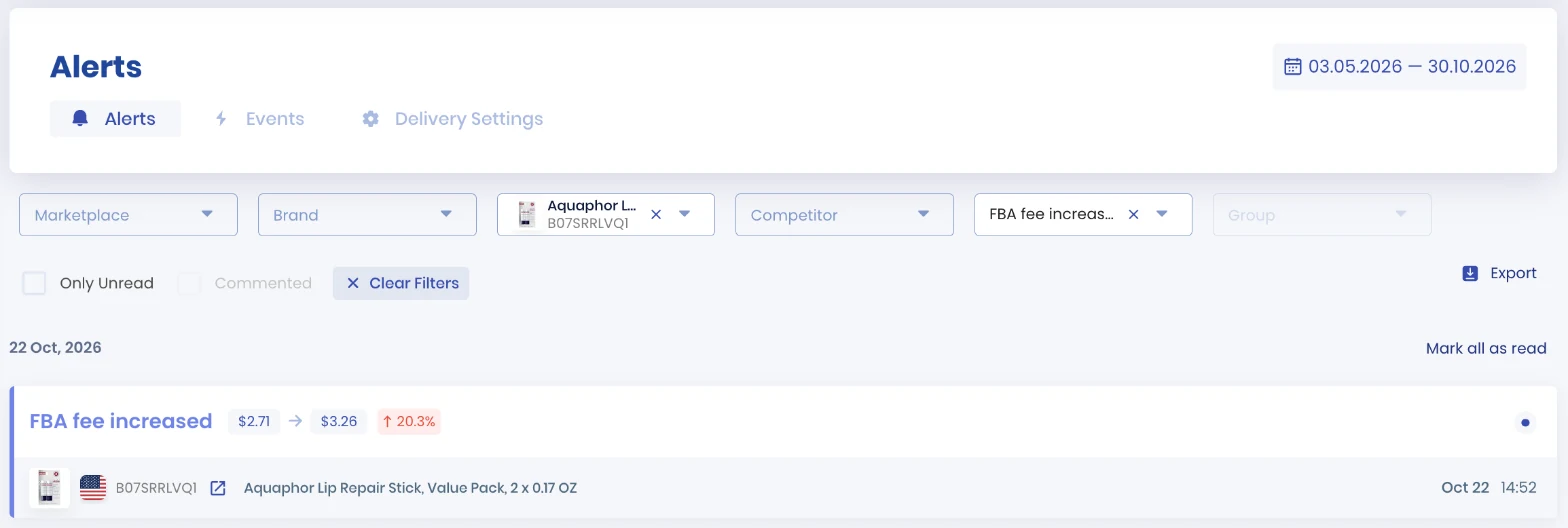
In October 2026, the US ASINs we track logged 32 FBA fee increases and 16 decreases. Thirty-one of the 32 increases came on or after October 15, the start of the holiday peak, and 17 landed on October 16 alone.
The alert above is one of the exceptions. Aquaphor’s lip repair 2-pack (B07SRRLVQ1) went from $2.71 to $3.26 on October 22, a week after the peak switch, while its price stayed at $6.19 on every day we recorded from October 19 to November 16.
Both numbers match Amazon’s peak rates under $10 plus 3.5%: $2.71 for small standard up to 2 oz, $3.26 for large standard up to 4 oz. On November 7, the fee went back to $2.71. By our reading of the rate card, that was a size-tier change, not a new rate.
📌 From Our Experience: When a fee moves on a date that matches no announcement, compare the new number with the next size tier on the rate card. If it matches, check the product’s dimensions in Seller Central before the extra cost runs for weeks.
The alert shows the old fee, the new fee, and the percentage change. It doesn’t say which fee component changed; that part you work out with the rate cards and Seller Central reports.
Bringing it together
The 2027 changes reward fast-moving, well-measured inventory and charge more for small items above $10, aged stock, and awkward shapes.
- January 15, 2027: new fulfillment rates, narrower low-price FBA, new bulky and oversize tiers.
- February 1, 2027: one age-based storage fee and a narrower low-inventory-level test.
- The average hides the spread: $0.19 overall, $0.70 on small standard items over $50.
Final Expert Recommendations:
Pull the Fee Change Comparison dashboard before January 15, 2027, mark every ASIN whose fee rises by more than your margin can absorb, and give each one a decision. Then set a reminder for February 1 to clear anything heading past 180 days.
Want to see the next FBA fee change on your products and your competitors’ without opening the revenue calculator? Start a free 14-day SellerSonar trial (5 ASINs and 10 keywords, no credit card).
Sources: Amazon Seller Central help pages on 2027 US fees, rate cards, size tiers, storage, low-inventory-level, promotion, returns, and AWD fees (read November 16, 2026); SellerSonar fee and price data for products we track, October and November 2026.
