





Black Friday 2026 falls on November 27, with Cyber Monday on November 30. Amazon will almost certainly run a Black Friday Week event starting the week before, as it did in both 2024 and 2025. And here’s the short version of the Amazon Black Friday strategy that follows: the decisions that determine how that week goes for you are the ones you make in September and October, not the ones you make in November.
That’s the whole argument of this piece, so I won’t bury it.
Most Black Friday advice for sellers is a list of 25 tips that could’ve been written in any year, about any event. This one is built on the 2025 results data, because 2025 said some genuinely surprising things about where the money went and when. A few of them contradict what sellers assume.
About the Author: Gloria Anderson writes for the SellerSonar editorial team on Amazon operations, pricing, and seasonal selling. She has spent the last several Q4s watching what happens to seller accounts when traffic triples in nine days, which is how she developed strong opinions about October.
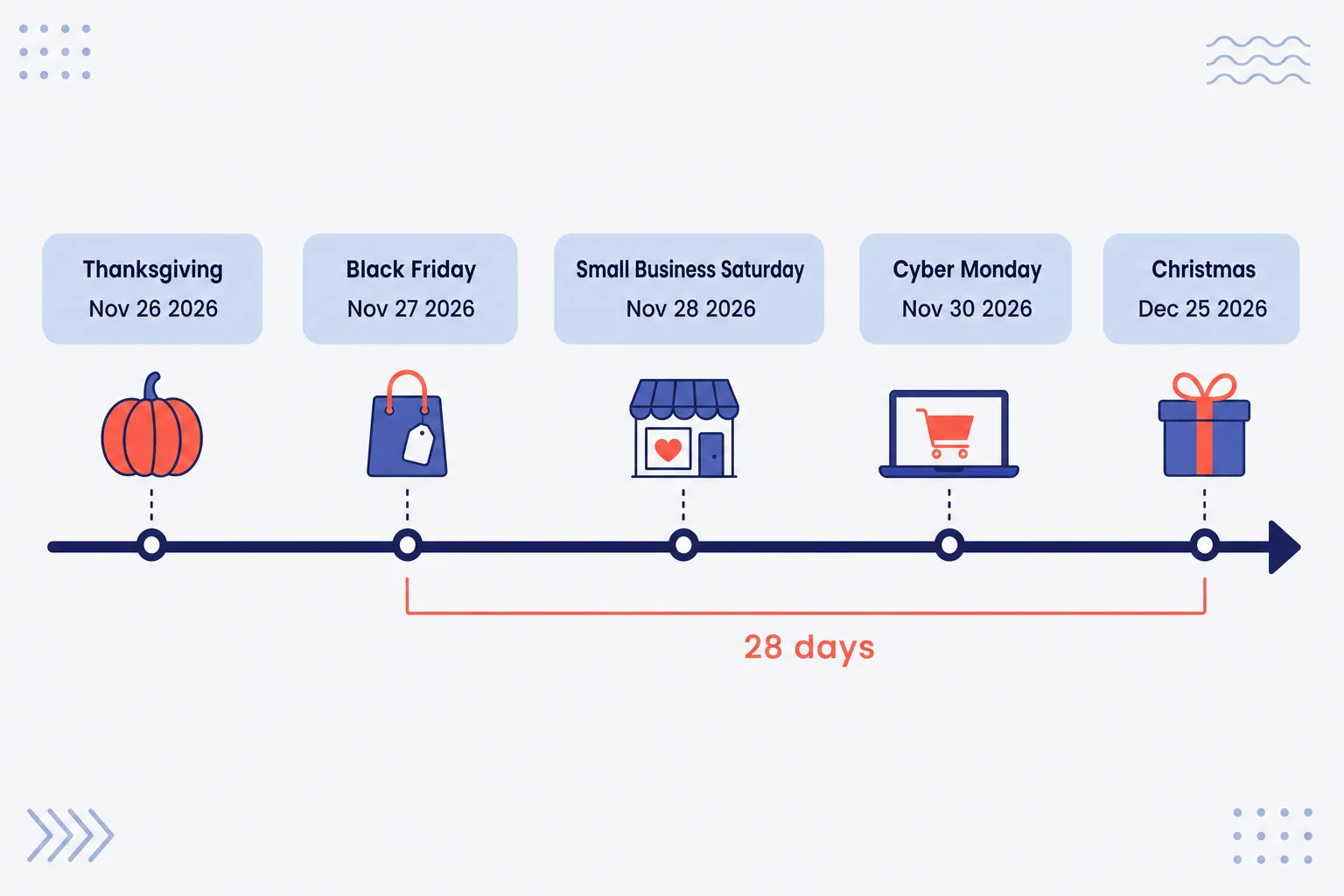
The 2026 Black Friday calendar for sellers
Here’s the skeleton to plan against.
| Date | Event |
|---|---|
| Thursday, November 26, 2026 | Thanksgiving |
| Friday, November 27, 2026 | Black Friday |
| Saturday, November 28, 2026 | Small Business Saturday |
| Monday, November 30, 2026 | Cyber Monday |
| Friday, December 25, 2026 | Christmas |
One detail worth noticing: there are 28 days between Black Friday and Christmas in 2026. In 2025 there were 27, and in 2024 there were 26. Thanksgiving drifts across a week-long window depending on the year, and 2026 sits at the early end of it.
That extra runway sounds like good news, and mostly it is. But it also means the pressure to buy right now on November 27 is slightly lower, because shoppers can see Christmas is comfortably far away. Longer seasons spread demand rather than concentrate it. So plan for a flatter curve, not a taller spike. Flatter, but longer.
Amazon typically announces its own Black Friday Week dates in late October or early November. In 2025 the event ran November 20 through December 1. I’d pencil in a similar shape for 2026, then confirm it the moment Amazon publishes.
What the 2025 numbers actually say
Two sources matter here, and they disagree in an interesting way.
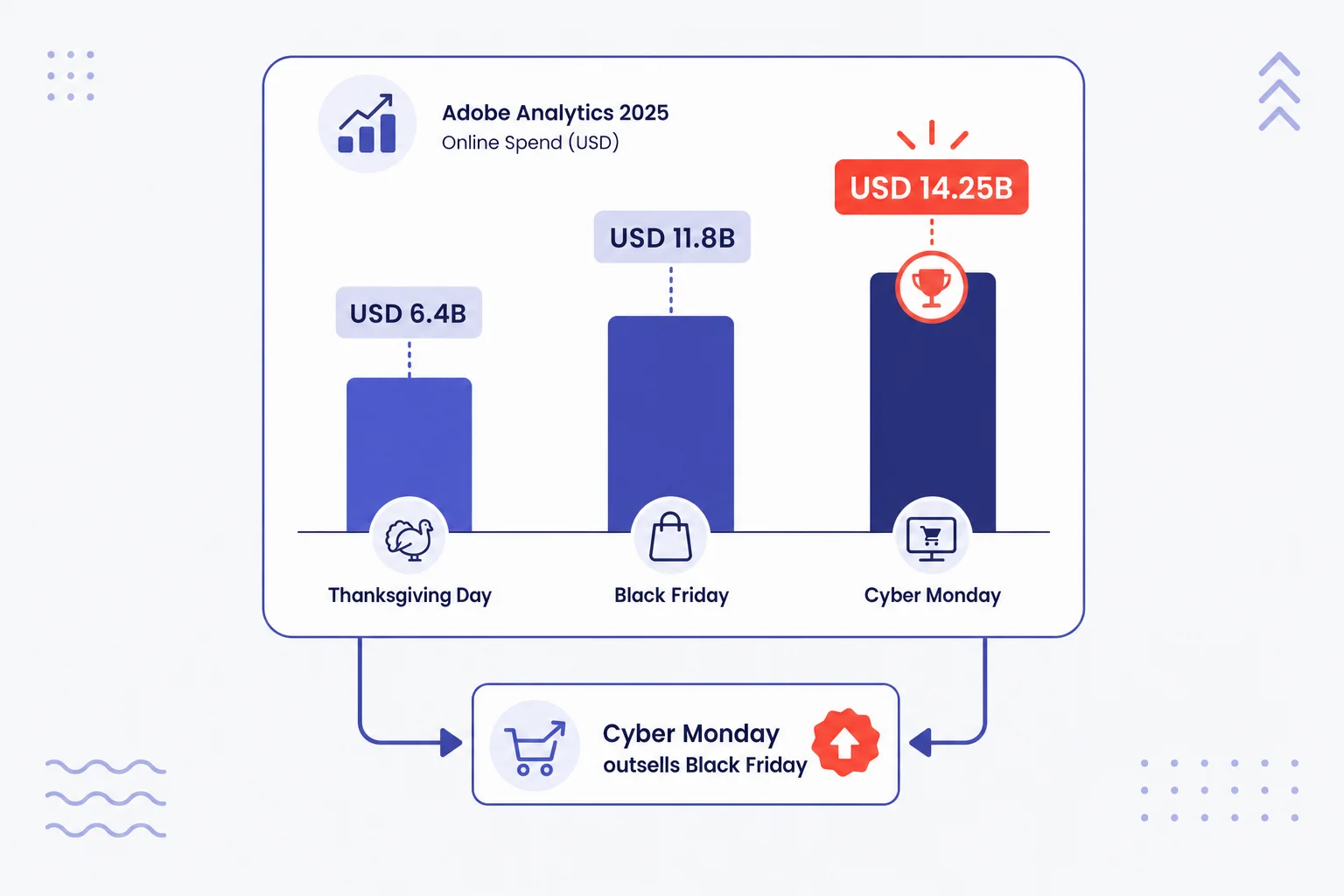
Per Adobe Analytics’ 2025 holiday season report, US shoppers spent $257.8 billion online between November 1 and December 31, up 6.8% year over year. Cyber Week alone took $44.2 billion, up 7.7%. Black Friday itself hit $11.8 billion, up 9.1%. Cyber Monday hit $14.25 billion, up 7.1%.
Read those last two again.
Cyber Monday out-earned Black Friday online by about $2.4 billion. Adobe’s data shows it has done so every single year they’ve tracked it. Yet most sellers still treat Black Friday as the main event and Cyber Monday as the afterthought. That’s backwards if your sales are entirely online. Which, on Amazon, they are.
Now the second source, and this is the part I find genuinely useful. The National Retail Federation’s Thanksgiving weekend survey found a record 202.9 million people shopped over the five-day weekend, up from 197 million. Online shoppers grew 9% to 134.9 million.
But Black Friday specifically? Per that same NRF survey it drew 85.7 million online shoppers, down from 87.3 million the year before. In-store fell too, from 81.7 million to 80.3 million.
So: more people shopped over the weekend than ever, and fewer of them shopped on Friday. The weekend is growing by spreading out, not by concentrating.
The same NRF survey puts average spend per person across the five days at $337.86, with about 67% ($225.74) of that going to gifts.
💡 Expert Tip: If your entire Black Friday strategy is one big price drop on Friday morning, you’re optimizing for the one day in the window that is losing share. Spread your promotional budget across the full Thanksgiving-to-Cyber-Monday run, and weight Cyber Monday at least as heavily as Friday.
A caveat on that NRF figure, because it deserves one. The survey covered 3,099 adults, ran November 26 to 30, and carries a margin of error of plus or minus 1.8 points. A 1.6-million-shopper decline sits close enough to that band that I’d call it a flattening, not a collapse. The direction is the story here, not the decimal.
Where independent sellers actually stand
Amazon’s own results page for its Black Friday Week and Cyber Monday event states that more than 60% of sales in its store came from independent sellers, most of them small and medium businesses, and that the event was the largest ever for that group.
Take that as encouragement, with an asterisk. Amazon’s report doesn’t break out how that 60% splits between a seller doing $400 million a year and one doing $40,000. So the headline tells you where the volume sits: in the third-party marketplace. It doesn’t tell you the competition is soft. It isn’t.
What Amazon’s number does justify is the effort. You’re not fighting for scraps in a first-party-dominated store. Most of that store is people like you.
Your Black Friday strategy starts in August
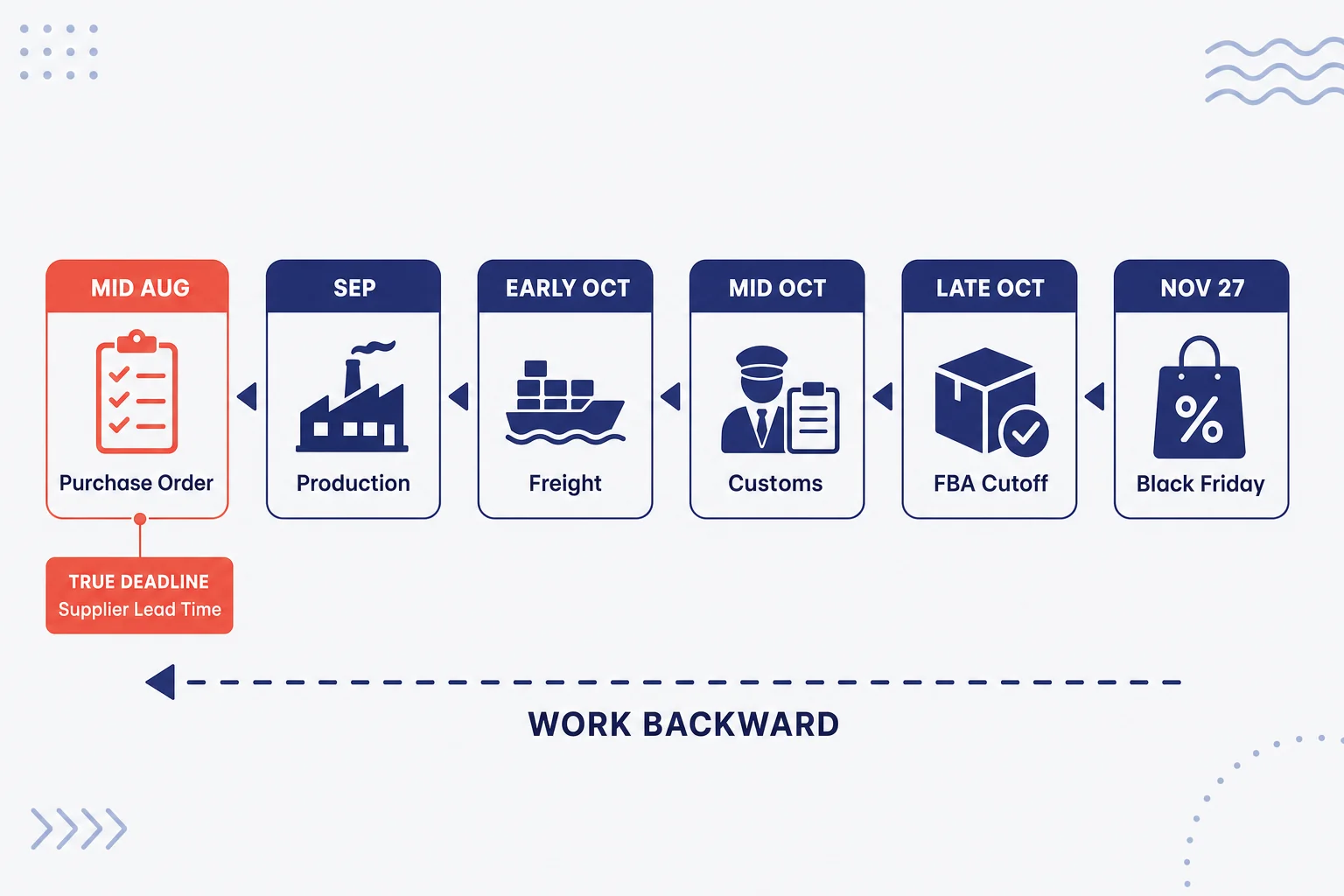
Work backward, not forward. It’s the only planning direction that survives contact with a freight schedule.
Amazon publishes an FBA inventory cutoff for the holiday period each year in Seller Central. Stock that arrives after it isn’t guaranteed to be received and Prime-eligible in time for the event. In recent years that date has landed in the second half of October, but check the notice for your year rather than trusting any blog, including this one. Amazon moves it.
Then work back from that date, and be honest about each leg:
- Amazon receiving time. Your shipment arriving at the warehouse isn’t the same thing as being available to sell. Build in a buffer.
- Freight and customs. Ocean freight from Asia is the leg that eats plans. Air freight is the expensive fix, and by November everyone else wants it too.
- Supplier lead time. This is the real deadline. If your manufacturer needs 30 days and your freight needs 35, your purchase order date is roughly mid-August, not October.
The FBA cutoff is the date everyone circles. Your supplier’s lead time is the date that actually binds you. Sellers who miss Black Friday almost never miss it because of Amazon; they miss it because a PO went out three weeks late in the summer.
One more thing that gets skipped: decide what you’ll do if you sell out on November 28. Going out of stock during peak week doesn’t just cost you those sales. It costs you sales rank, which you then spend all of December climbing back. Expensive twice.
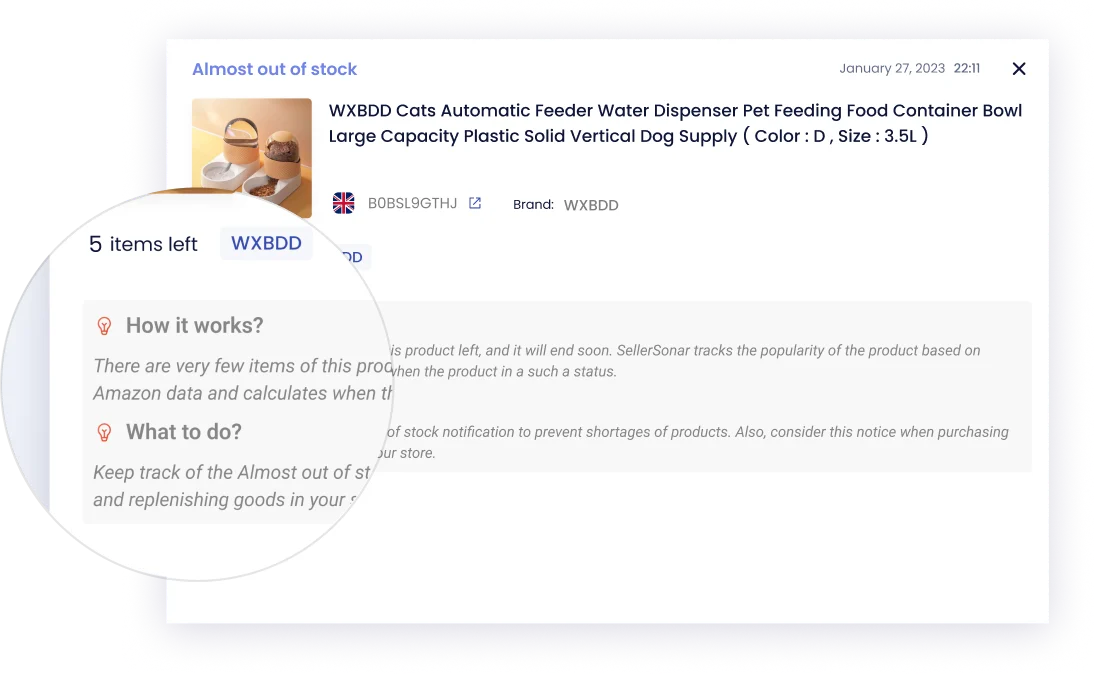
🎯 Pro Insight: Pick a floor quantity per ASIN and treat it as untouchable. When inventory hits it, pull back the discount or raise the price rather than letting the listing go dark. A less aggressive deal that stays live beats a great deal that runs out on day two, because rank recovery in December is slow and expensive.
Amazon Black Friday pricing strategy without wrecking your margin
Pricing is where the most money gets left behind, in both directions.
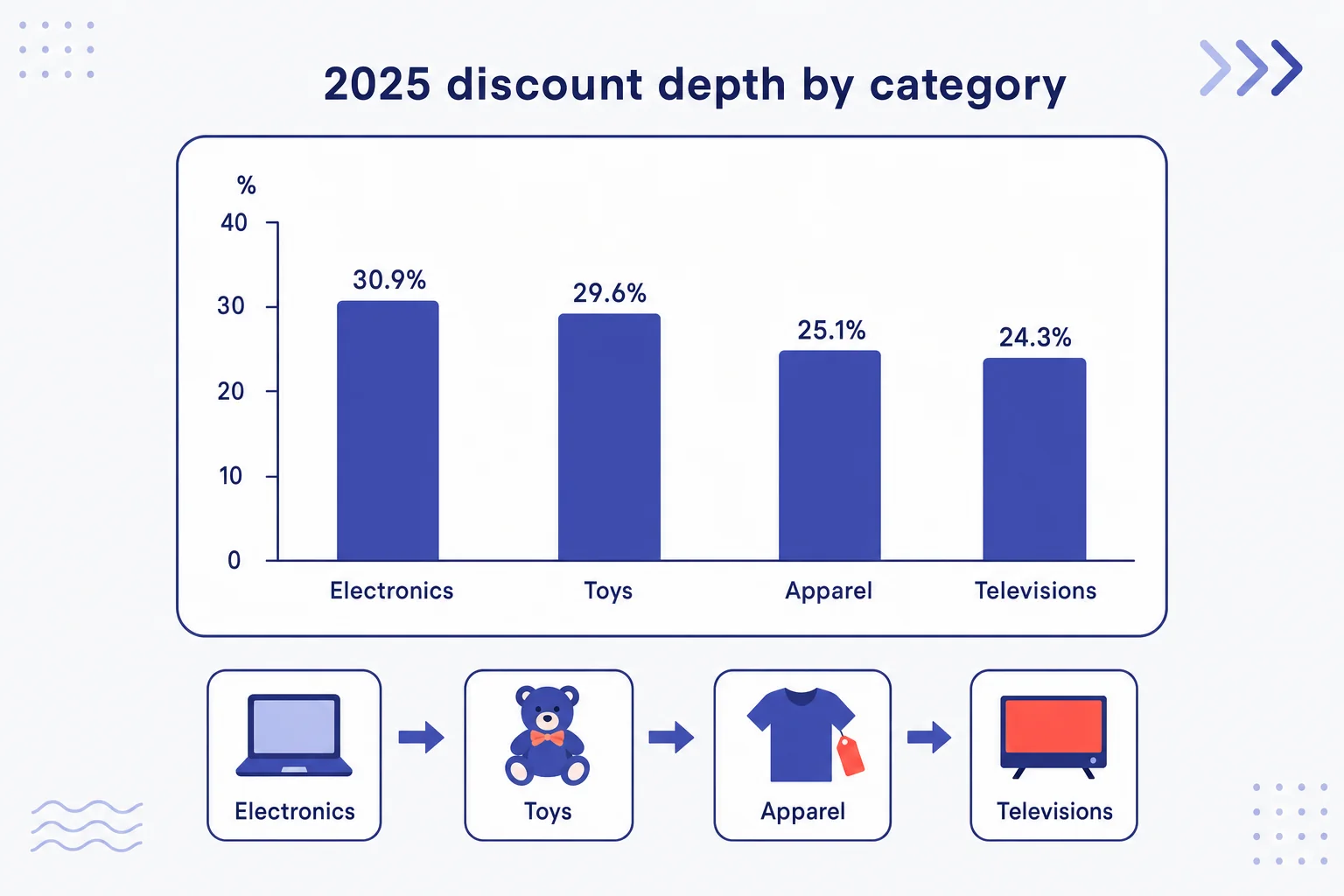
Adobe’s category data shows what shoppers actually saw in 2025: electronics discounted at 30.9% off list, toys at 29.6%, apparel at 25.1%, and televisions at 24.3%. Those are peak-week averages across the whole market, not targets. But if you sell toys and you’re planning 10% off, you now know roughly where you’ll sit against the field.
A few things I’d hold to.
Set your floor before you set your discount. Calculate your break-even including the referral fee, FBA fees, storage at Q4 rates (which are higher), and expected returns. Then decide how far above that you’ll stop. Doing this in October is analysis. Doing it at 11pm on November 26 is panic.
Watch the reference price. Deep discounts are only persuasive against a price Amazon considers legitimate. Slashing prices in October and then discounting from the reduced number in November gives you a smaller apparent saving and a worse deal badge.
Expect to lose the Buy Box. Q4 is when repricing gets aggressive, and when sellers you’ve never seen attach to your ASIN. Losing the Buy Box for six hours on Cyber Monday is a bad afternoon. Losing it for two days because nobody noticed is the difference between a good Q4 and a mediocre one. Automated Buy Box and pricing alerts exist for precisely this window, and honestly, this is the week they earn their keep.
Don’t promise what fulfillment can’t deliver. A lightning deal that outruns your stock creates cancellations, and cancellations in peak week are a customer metrics problem you carry into January.
Before any of that, run your top ASINs through a listing quality check in October. Fixing a thin bullet set in October is housekeeping. Doing it on November 26 is triage.
What breaks during Black Friday week
This is the least cheerful section, and the one I’d read twice.
Traffic surges attract attention you didn’t ask for. From what we see across seller accounts every Q4, the same handful of things go wrong, and they go wrong at the worst possible moment:
- Hijackers attaching to ranking ASINs. A listing climbing the charts during peak week is an advertisement. Unauthorized sellers show up for the traffic, undercut you, take the Buy Box, and are gone by mid-December with your reviews. Our guide to dealing with Amazon listing hijackers covers the removal process, but detection speed is what decides the cost.
- Listing suppressions at the worst time. A missing attribute or an image that fails a check will suppress a listing, and Amazon doesn’t call you about it. A suppressed listing on November 27 is a zero-revenue day for that ASIN.
- Content changes you didn’t make. Titles, bullets, and images get altered by Amazon, by other contributors, or by a catalog glitch. Usually harmless. Occasionally it removes the keyword your ranking depends on.
- Rank movement you notice too late. Your keyword position on November 20 and your position on November 27 can be very different, and by the time sales tell you, the week is half over.
The common thread is detection lag. None of these problems are hard to fix. All of them are expensive to find late. Checking manually works fine at 20 ASINs. It falls apart at 200, especially over a holiday weekend when you’d rather be eating.
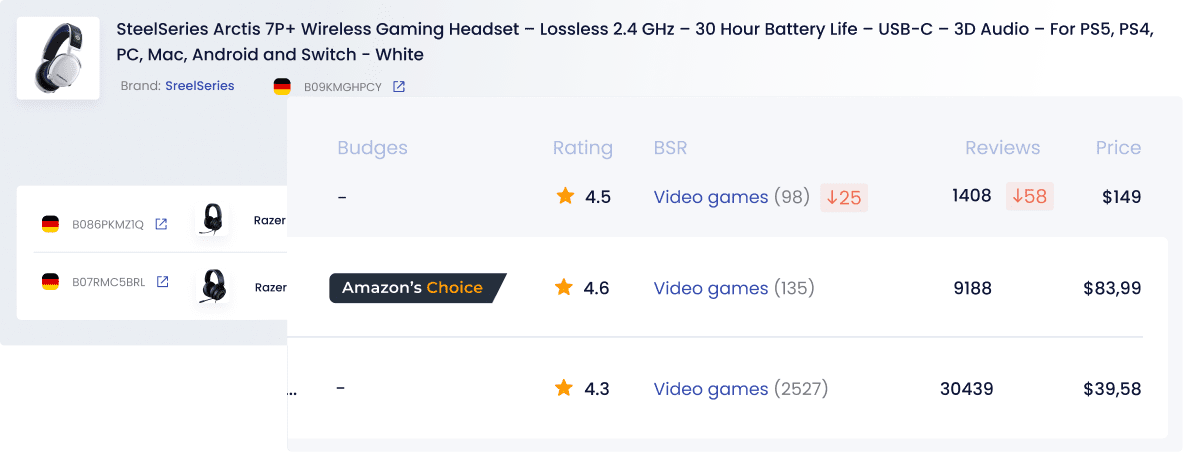
Badge, rating, BSR, review count, and price for every competing ASIN in one view. That is the difference between catching a change on the day it happens and finding it in the January reconciliation, when there is nothing left to do about it.
📌 From Our Experience: The sellers who come through peak week cleanest are not the ones with the best deals. They are the ones who set up monitoring in October, went quiet in November, and got a notification instead of a surprise. Set your alerts before the traffic arrives, not in response to it.
The window after Cyber Monday that most sellers waste
Black Friday week ends and attention drifts. That’s a mistake, because three things happen next.
Returns arrive. Peak-week volume produces peak-week returns, mostly in late December and January. They hit your margin after you’ve already counted the revenue. Forecast them into your Q4 numbers. Don’t just discover them in February.
Gift card redemption lands. The days right after Christmas are a real second wave, and a lot of sellers have already stopped watching. Inventory that survives to December 26 can still sell well.
Competitors go quiet. Advertising costs typically ease once the rush passes. If you have stock left, this is often cheaper traffic than anything you bought in November.
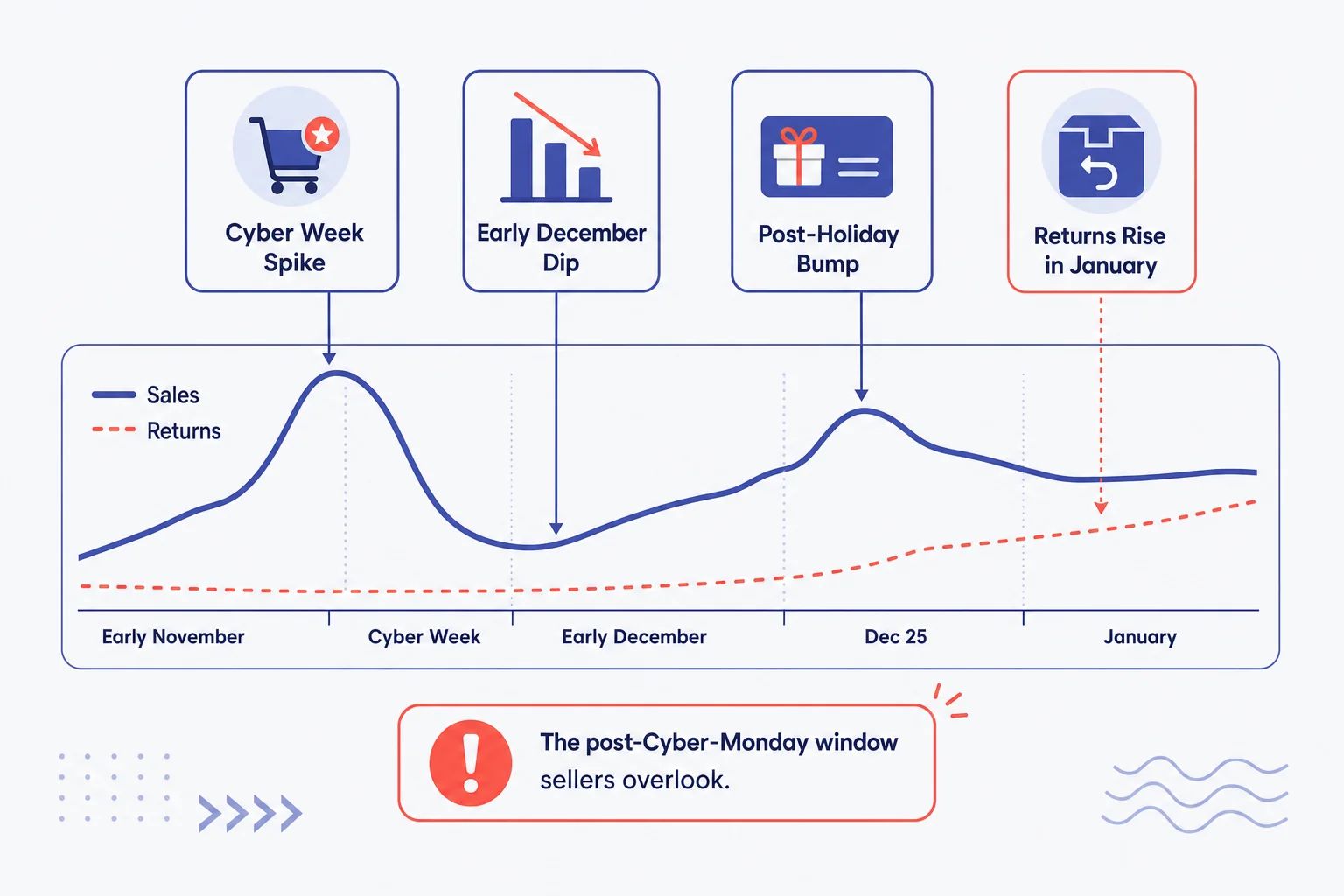
Look at the shape rather than the numbers. The early-December dip is real, the bump after the 25th is real, and the returns line does not start climbing until the revenue has already been counted. Most sellers stop paying attention somewhere around the dip.
And the rank you built in November is an asset. Track it into January instead of letting it decay unwatched; keyword rank tracking through the post-holiday period tells you whether the gains held or quietly slid back.
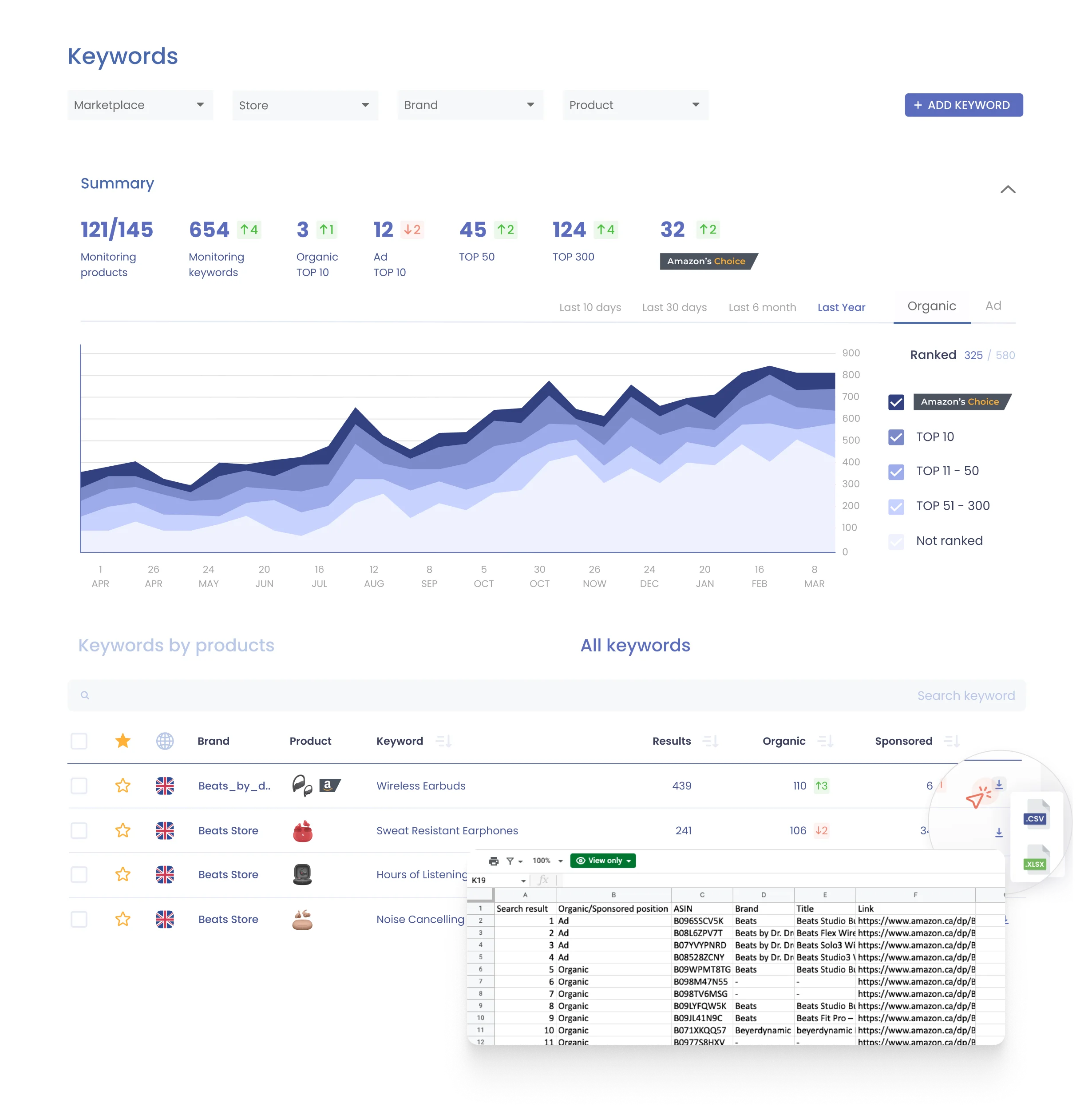
A full year of ranking spread in one view. In January that is the chart that tells you whether November was a real gain or a seasonal blip you are about to give back.
Bringing it together
A workable Amazon Black Friday strategy for 2026 comes down to five things, and none of them are exciting:
- Know the calendar. Black Friday is November 27, Cyber Monday is November 30, and you have 28 days from one to Christmas.
- Weight Cyber Monday properly. It out-earns Black Friday online, consistently, and Friday’s share is flattening.
- Place your purchase orders in August. The FBA cutoff is not your binding deadline; your supplier’s lead time is.
- Set your price floor in October. Benchmark the discount against your category, then refuse to go below the floor when the week gets loud.
- Turn on monitoring before the traffic arrives. Hijackers, suppressions, and Buy Box losses are cheap to fix and expensive to find late.
Final Expert Recommendations:
Based on what we see across seller accounts each Q4, the single biggest predictor of a good Black Friday isn’t deal depth. It’s whether the seller finished preparing before November started. Sellers still editing listings and negotiating freight in mid-November spend peak week reacting; the ones who locked everything down in October spend it watching and adjusting. If you’re getting started now, do the inventory math first, because it’s the only decision here with a hard deadline attached. Everything else can be fixed in a week. A late purchase order can’t.
Want to know the moment a hijacker attaches, your Buy Box flips, or a listing gets suppressed during peak week? Start a free 14-day SellerSonar trial and have your alerts running before Black Friday traffic shows up.
Sources: Adobe Analytics 2025 holiday season report (Nov 1 to Dec 31, 2025); National Retail Federation and Prosper Insights & Analytics Thanksgiving weekend survey, 3,099 adult consumers, fielded November 26 to 30, 2025, margin of error plus or minus 1.8 percentage points; Amazon Black Friday Week and Cyber Monday results.

