






Quick Answer
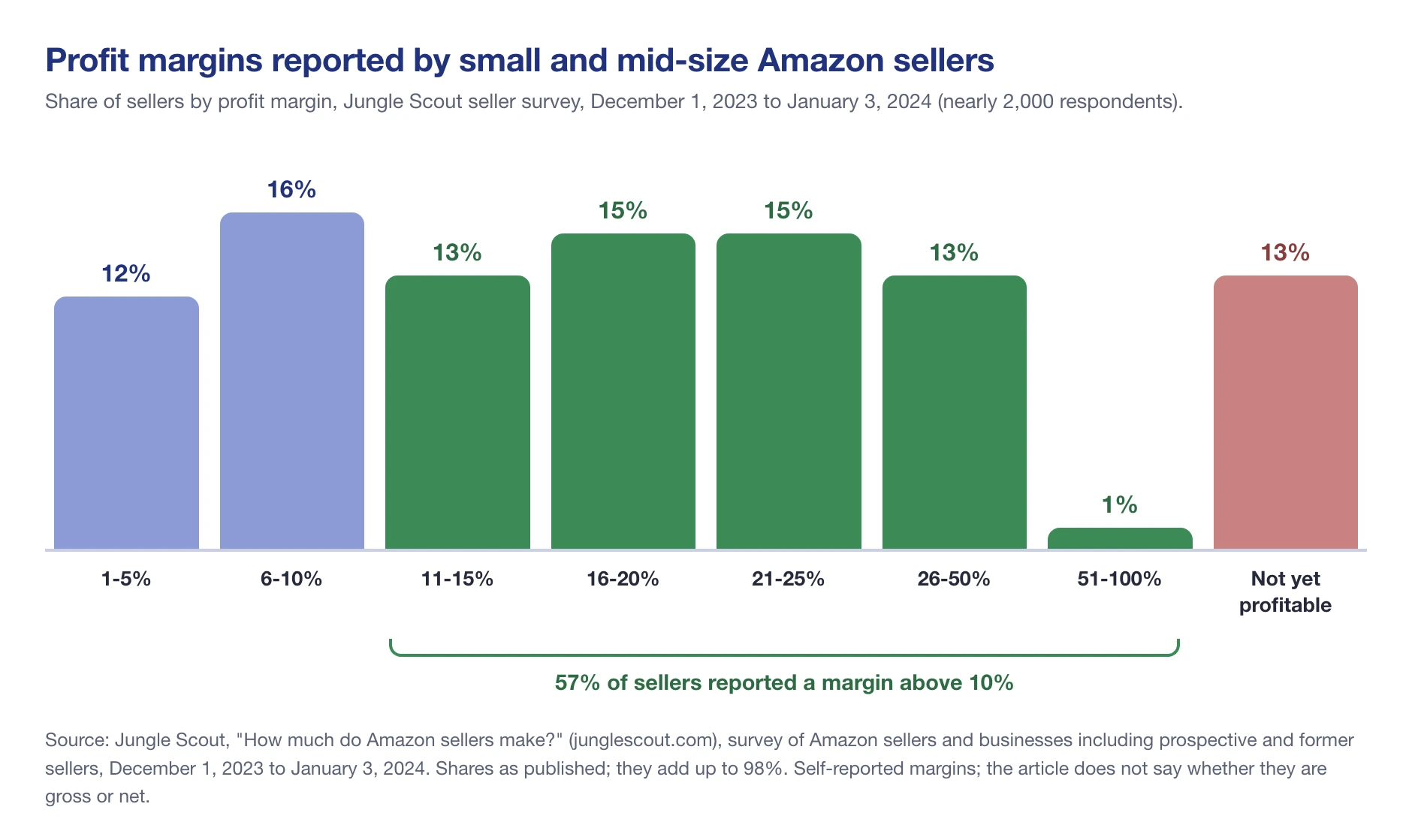
Your Amazon profit margin is the share of each sale you keep after every cost: product, Amazon’s referral and FBA fees, storage, ads and returns. Amazon’s own guide says many ecommerce businesses aim for a 10% to 20% net margin. In a Jungle Scout survey run from December 2023 to January 2024, 57% of sellers reported margins above 10%, and 13% weren’t profitable yet. On a $25 FBA product in 2026, Amazon’s fees alone take about 30% of the price.
Revenue is the number every Amazon seller can see. Profit is the one that decides whether the business is worth running, and it’s easy to overestimate when fees, ads and returns arrive at different times.
This guide explains what a good Amazon profit margin looks like, how to calculate yours with Amazon’s 2026 fees, and what Amazon sellers actually report earning. You’ll also see a worked example you can copy for your own product.
About the Author: Gloria Anderson writes for the SellerSonar editorial team about Amazon fees, pricing and selling on Amazon. She checks every fee in her articles against Amazon’s own rate cards in Seller Central help, and the examples against live Amazon listings we track in SellerSonar.
What Is a Good Profit Margin on Amazon?
There’s no single number, but there is a useful range. Amazon’s guide on how to calculate profit margins (July 27, 2026) puts it plainly: “Many ecommerce businesses aim for a net profit margin in the range of 10%–20%, though results vary widely.”
That’s net margin, after everything. Gross margin is a different, much bigger number, so always check which one someone is quoting.
What sellers report lines up with that range. Jungle Scout surveyed nearly 2,000 Amazon sellers and businesses between December 1, 2023 and January 3, 2024. In its write-up, How much do Amazon sellers make?, 57% of small and mid-size sellers reported margins above 10%. Another 28% sat between 1% and 10%, and 13% said they weren’t profitable yet.
So a practical way to read your own number:
- Below 10% net: thin. One fee change, a price war or a bad return month can wipe it out.
- 10% to 20% net: where Amazon says many ecommerce businesses aim, and where most surveyed sellers landed.
- Above 20% net: strong. Usually a product with pricing power, low fulfillment costs or little ad dependence.
Is a 37% gross margin good? It depends on what you subtracted. If 37% is left after product cost only, Amazon’s fees and ads still have to come out of it, and the net result may be close to zero. If 37% is left after product cost and Amazon’s fees, you have room for advertising and still a healthy profit.
How to Calculate Amazon Profit Margin
The formula is the same one any business uses. Amazon’s guide writes it as:
Profit margin = (revenue − costs) ÷ revenue × 100
The hard part is the word “costs”. On Amazon, these are the ones that belong in it, per unit sold:
- Product cost (COGS): what you pay the supplier, plus packaging, inbound freight, duties and prep. Our guide to cost of goods sold covers what to include.
- Referral fee: Amazon’s commission, 15% in most categories, with a $0.30 minimum per item, according to Amazon’s referral fee table.
- FBA fulfillment fee: set by size tier, weight and price band, plus a 3.5% fuel and logistics surcharge since April 17, 2026.
- Storage and inventory fees: monthly storage, aged inventory and low-inventory fees.
- Advertising: your Sponsored Products and other ad spend, spread over all units sold.
- Returns: refunds you can’t resell, plus Amazon’s refund administration fee.
- Your plan and tools: the $39.99 Professional plan, software, photos and samples.
We don’t repeat every fee rate here. Our guide to Amazon seller fees in 2026 lists them all, with the dates they changed.
Gross, operating and net margin
Amazon’s guide separates three margins. Each one subtracts more:
- Gross margin subtracts only COGS. A $25 product that costs you $6 has a 76% gross margin. That sounds great and says little about Amazon.
- Operating margin also subtracts running costs: marketing, shipping, warehousing, software and wages. On Amazon, that’s where the referral fee, FBA fee and ads land.
- Net margin subtracts everything, taxes and interest included. It’s what you actually keep.
When sellers on forums say “my margin is 30%”, ask which one. Most per-unit calculators show the margin after product cost and Amazon’s fees, before ads, overhead and tax.
Margin vs ROI (and the “3x rule”)
Margin divides profit by the selling price. ROI (return on investment) divides profit by what you paid for the unit. A $7 profit on a $25 sale is a 28% margin. If the unit cost you $6, it’s a 117% ROI.
Many sellers screen products with the “3x rule”: sell for at least three times your landed cost. It’s a quick filter, not a calculation. On a cheap product, Amazon’s fees can take more than a third of the price on their own, as the next sections show.
💡 Expert Tip: Track margin and ROI side by side. Margin tells you how much room you have for ads and price cuts. ROI tells you how hard your cash is working, which matters more when you’re paying for inventory months before it sells.
Amazon FBA Profit Margin: A Worked 2026 Example
Here’s the full calculation for one product with Amazon’s real 2026 US fees. The product is a $25.00 Home and Kitchen item in small standard size, weighing 6 to 8 ounces, packed in a 10 x 6 x 0.75 inch box (0.026 cubic feet). The product cost, ad spend and returns are example figures; swap in your own.
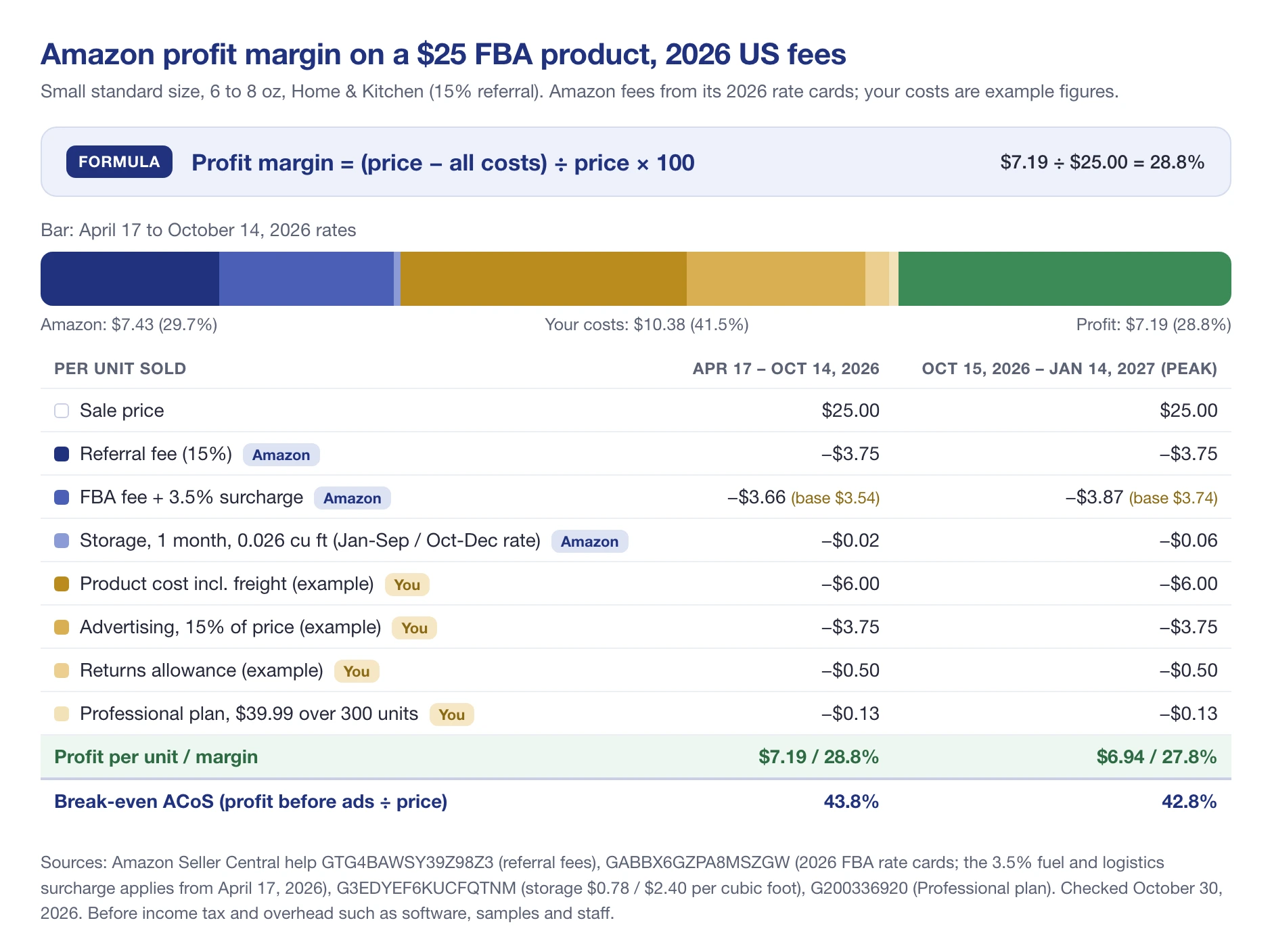
Step by step, at the rates that applied from April 17 to October 14, 2026:
- Referral fee: 15% of $25.00 = $3.75.
- FBA fulfillment fee: $3.54 on Amazon’s 2026 FBA rate card for this tier and price band, plus the 3.5% surcharge = $3.66.
- Storage: 0.026 cubic feet at $0.78 per cubic foot (January to September) = $0.02 for a month.
- Amazon’s total: $7.43, or 29.7% of the price.
- Your costs: $6.00 product cost with freight, $3.75 in ads (15% of the price), $0.50 for returns, and $0.13 for the Professional plan if you sell 300 units a month. Total: $10.38.
- Profit: $25.00 − $7.43 − $10.38 = $7.19.
- Margin: $7.19 ÷ $25.00 × 100 = 28.8%.
During the holiday peak (October 15, 2026 to January 14, 2027), the FBA fee for the same item is $3.74, or $3.87 with the surcharge. Storage rises to $2.40 per cubic foot from October to December, so $0.06 here. Profit drops to $6.94, a 27.8% margin.
That 28.8% is before income tax and overhead like software, samples and your own time. Take those out and the net margin lands lower, which is why the 10% to 20% range is a realistic target and not a pessimistic one.
Break-even ACoS: your ad ceiling
The same numbers tell you how much you can spend on ads before a sale loses money. Take profit before ads ($7.19 + $3.75 = $10.94) and divide by the price: 43.8%.
That’s your break-even ACoS. If an ad campaign’s cost of sales goes above 43.8% on this product, every ad-driven sale loses money. Below it, ads still leave profit, just less of it.
🎯 Pro Insight: Work out break-even ACoS for every product before you launch ads, not after. It turns “is this campaign good?” into a yes or no question, and it changes with the peak rate card, so recheck it in mid-October.
Why Low-Priced Products Have Thinner Margins
The referral fee scales with the price. The FBA fee doesn’t: it’s set by size, weight and price band. So the cheaper the product, the bigger the share Amazon’s fees take.
We saw this on a listing we track in SellerSonar. An OTOFLY iPhone 16 Pro Max case (ASIN B0F1BKF8QK) sold for $12.99 every day from October 1 to October 30, 2026. Its FBA fee went from $3.54 to $3.74 on October 16, 2026, the exact peak step on Amazon’s rate card for a 6 to 8 ounce small standard item. The price didn’t move; the fee did.
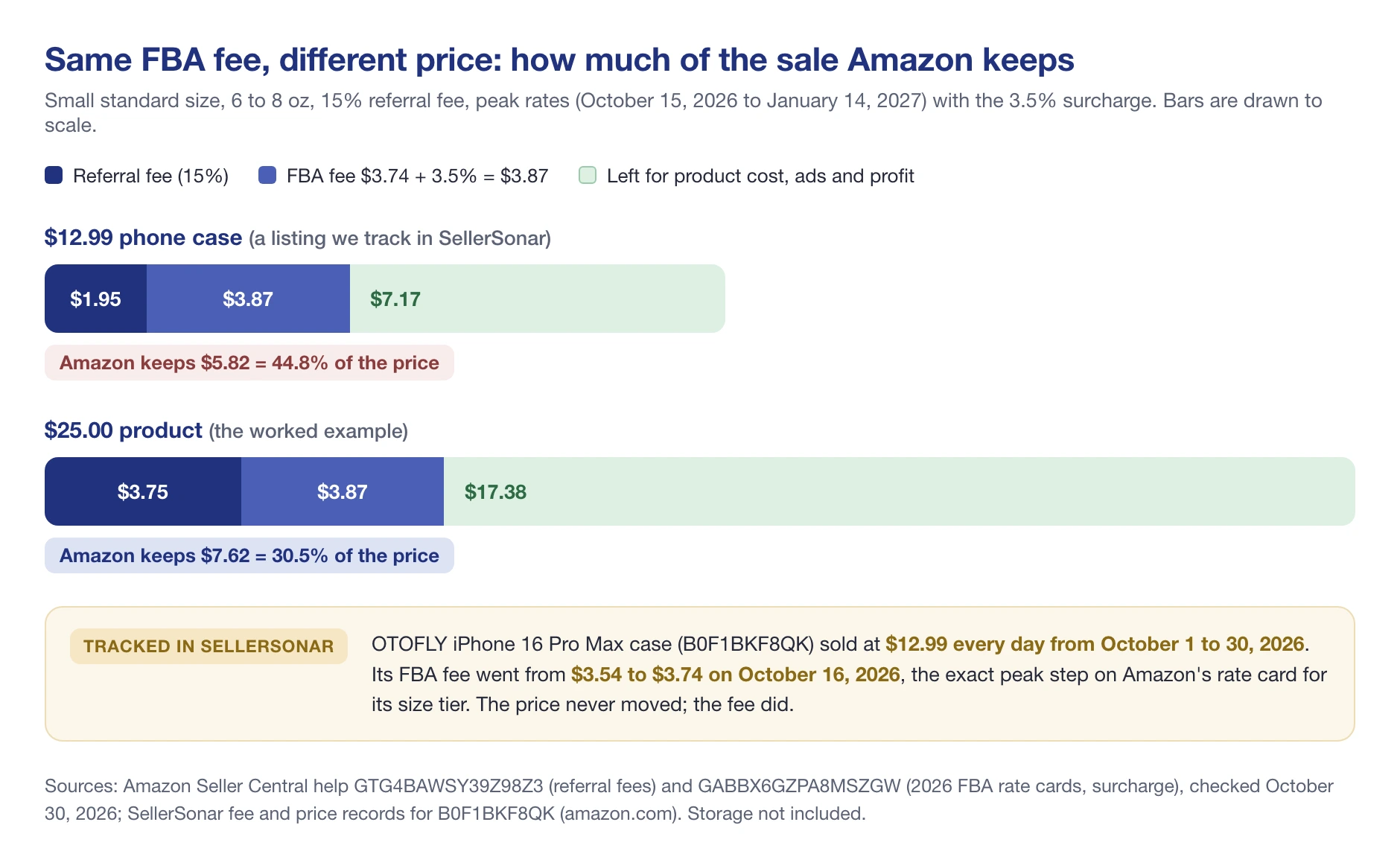
At a 15% referral fee, that case pays $1.95 in referral fees and $3.87 in FBA fees with the surcharge. That’s $5.82, or 44.8% of the price, before the seller pays for the case itself or a single click of advertising. The $25 product in the same tier gives up 30.5%.
If your product sells for under about $15, run the numbers twice. A small price increase often helps the margin more than any cost cut, because the fulfillment fee stays the same while the price goes up.
Amazon Seller Income: How Much Do Amazon Sellers Make?
Most published “seller income” numbers are sales, not take-home pay. Keep that in mind with every figure below.
- Amazon’s own number: “Independent sellers in the U.S. averaged more than $375,000 in annual sales in Amazon’s store” in 2025, nearly 30% more than in 2024, according to Amazon’s 2025 Small Business Empowerment Report (published April 30, 2026). The same report says more than 75,000 independent sellers passed $1 million in sales.
- Jungle Scout’s survey: small and mid-size sellers averaged $11,671 in sales a month (Jungle Scout’s weighted estimate from the survey ranges). Using their average 21% margin, Jungle Scout estimates about $2,451 a month in profit, or $29,412 a year.
- The spread is wide. In the same survey, 31% of sellers made under $500 a month in sales when starting out, while 19% passed $10,000 a month.
An average is pulled up by the biggest sellers, so the typical seller earns less than $375,000 in sales. And sales minus every cost in the worked example above is what becomes income.
Can you make $10,000 a month? In sales, about one in five surveyed sellers did. In profit, at a 20% net margin you’d need around $50,000 a month in sales. That’s a very different business.
Is Selling on Amazon Profitable in 2026?
For most sellers who price with real numbers, yes. In Jungle Scout’s survey, 58% of sellers said they became profitable within their first year, and 13% weren’t profitable yet.
2026 made the math tighter, though. Amazon added the 3.5% fuel and logistics surcharge on FBA fees from April 17, 2026. Peak fulfillment fees run from October 15, 2026 to January 14, 2027, and Q4 storage costs about three times the January to September rate. None of that kills a healthy product, but it does punish products priced on 2025 numbers.
The sellers who struggle usually share one of three problems: a product too cheap for its size tier, ad spend above break-even ACoS, or stock that sits long enough to pay aged inventory fees.
📌 From Our Experience: When we compare fee records on the listings we track, the surprises rarely come from Amazon’s announced fee dates. They come from single listings whose fee changes on a day nobody planned for, while the price stays put.
How to Improve Your Amazon Profit Margin
Start with the costs you control, then the fees you can influence:
- Price with the fee bands in mind. FBA fees are set in price bands (under $10, $10 to $50, over $50) and some referral fees change at price thresholds. Check what a small price change does to both.
- Shrink the package. Dropping a size tier or a weight step lowers the FBA fee on every unit. Small standard size stops at 0.75 inch thick and 16 ounces.
- Cap ad spend at break-even ACoS. Know the number per product and cut campaigns that run above it.
- Renegotiate product cost. As volume grows, ask for volume pricing or better payment terms. It’s the biggest cost in most examples.
- Keep inventory moving. Order enough to avoid low-inventory fees, but not so much that units age past 181 days and start paying the aged inventory surcharge.
- Recheck in October. Peak fulfillment fees and Q4 storage change the margin on every FBA product for three months.
Before you list a new product, run it through our free FBA calculator: paste an ASIN and you get the referral fee, the FBA fee and a margin estimate, no account needed. Our walkthrough on how to use an Amazon FBA calculator includes a spreadsheet version you can keep per SKU.
Protect Your Margin: Watch Fee and Price Changes
A margin calculation is a snapshot. Amazon recalculates fees, competitors change prices, and the number you worked out at launch drifts.
Here’s how it looked on listings we track in SellerSonar in October 2026. An Aquaphor Lip Repair 2-pack (ASIN B07SRRLVQ1) stayed at $6.19, yet its FBA fee went from $2.71 to $3.26 on October 22, a week after peak rates began. In total, SellerSonar logged 17 FBA fee changes on the US listings we track between October 1 and October 30, 2026, some of them decreases.
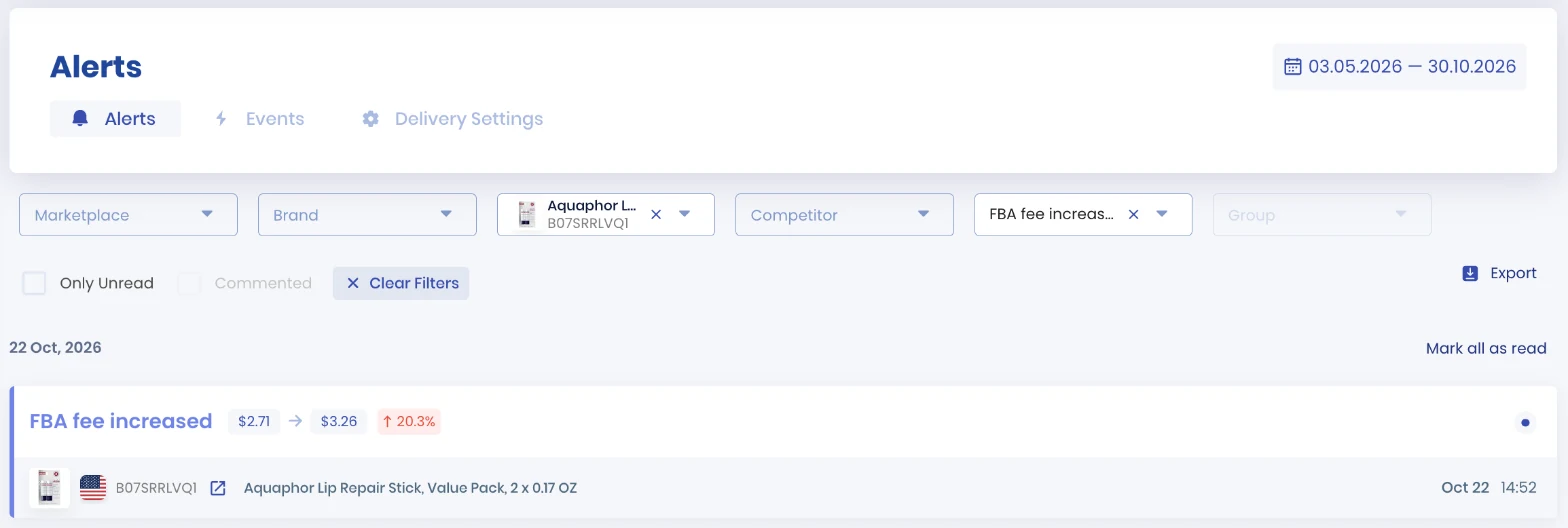
SellerSonar’s FBA fee increased and FBA fee decreased alerts flag these changes for your products and competitors. Each alert shows the total change and the percentage, not which fee component moved. Alongside them, the Seller’s price changed alert tells you when a seller on your listing reprices. The Buy Box and pricing alerts are off by default, so switch them on in Alerts, then Delivery Settings. Checks run every 4 hours on Pro, every 2 hours on Premium and every hour on Business and Enterprise.
To try it on your own listings, SellerSonar has a free 14-day trial with 5 ASINs and 10 keywords, no card required. Compare the plans on our plans page.
Final Thoughts on Amazon Profit Margins
A good Amazon profit margin is usually 10% to 20% net, after product cost, Amazon’s fees, ads, returns and overhead. Gross margins look much bigger, so always compare like with like.
Work your margin out per product with 2026 fees, including the 3.5% surcharge and the peak rate card. Then set your break-even ACoS, and recheck both whenever Amazon’s fees or your price change.

