





Quick Answer
Amazon inventory management software is a tool that tracks your stock on Amazon (and often on your other sales channels), forecasts demand, and tells you what to reorder and when, so you avoid both stockouts and aged-inventory fees. Start with the free tools in Seller Central: the FBA Inventory page, Replenishment Alerts and Minimum Inventory Level. Pay for software when you need forecasting and purchase orders across many SKUs (SoStocked, RestockPro, InventoryLab), stock sync with Shopify, eBay or Walmart (Veeqo, Zoho Inventory, Linnworks), or a full ERP (Cin7 Core, Sellercloud, Brightpearl). Every price below was checked on the vendor’s own site on November 13, 2026.
Run out of stock on Amazon and you lose sales. Send in too much and you pay to store it, month after month. Inventory software is there to keep you between those two mistakes.
This guide starts with what Amazon already gives you for free, explains the US storage fee changes that take effect on February 1, 2027, and then compares 15 tools by the job they actually do, with each price taken from the vendor’s own pricing page.
About the Author: Gloria Anderson writes about Amazon operations, fees and inventory for our editorial team. She checked every Amazon rule in this guide against Seller Central help pages, and every price against the vendor’s own pricing page, on November 13, 2026.
What Amazon inventory management software does
Amazon’s own guide to inventory management puts it plainly: an inventory system “can be a manual count and ledger, a spreadsheet, or an automated software solution.” Software earns its cost once a spreadsheet stops keeping up.
Most tools do some mix of five jobs:
- Track stock across FBA, your own warehouse and inbound shipments.
- Forecast demand from sales velocity, seasonality and lead time.
- Plan reorders with purchase orders and FBA shipment plans.
- Sync quantities across Amazon, Shopify, eBay, Walmart and other channels.
- Run the warehouse: picking, barcode scanning, bundles and kits.
No single tool is best at all five. That’s why the tools below are grouped by job instead of ranked in one list.
Free Amazon inventory management software: what Seller Central already does
Before you pay for anything, use what’s built into your account. Several of these tools cover most of what a small FBA catalog needs.
The FBA Inventory page
The FBA Inventory page pulls stock levels, excess and aged inventory into one view. It replaced the separate Restock Inventory and Inventory Age pages: restock recommendations and the inventory age column live there.
Amazon says its restock recommendations “are based on current inventory levels, forecasted demand, open shipments, and your lead time.” For some SKUs that are still healthy, it also shows “a proactive early low stock alert based on our forward 42-day projections.” Each SKU gets a status such as out of stock, low stock or excess.
Replenishment Alerts: Amazon’s own inventory tracker
If you want a simple Amazon inventory tracker, Replenishment Alerts are it. You set a threshold per product or product group, in units or in weeks of cover, and Amazon emails you when fulfillable quantity hits it.
Amazon’s own example: if it takes you two weeks to order and ship a product and you sell about 100 units a week, set the alert to at least 300 units. That rule of thumb works for any tool you use later.
Minimum Inventory Level and SKU settings
Minimum Inventory Level is a weekly-updated floor per product, designed to help you keep delivery speeds up and “reduce the risk of incurring a low-inventory-level fee.” Your stock counts as low stock once it falls below that level.
The restock math only works if Amazon knows your real lead time and order rhythm. That’s what Customize SKU settings is for.
💡 Expert Tip: Fix your SKU settings before you judge Amazon’s restock numbers, or any paid tool’s. Amazon’s own example: if the default replenishment frequency is four weeks but you actually reorder every week, “the recommendations will be four times too high.”
IPI and FBA capacity limits
The Inventory Performance dashboard scores you with the Inventory Performance Index (IPI). Amazon’s guideline is to “maintain enough inventory to cover 30 to 60 days of your expected sales.” IPI is available only on the Professional selling plan.
Ignore any article that gives you a fixed IPI cutoff. Per Amazon’s IPI FAQ, it tells you the threshold “four to eight weeks before the new period limit goes into effect.” The same FAQ counts an item as excess when it has over 90 days of supply, and new ASINs don’t affect your score in their first 90 days.
IPI feeds your FBA capacity limits, together with sales history, forecasts, scheduled deals and fulfillment center capacity:
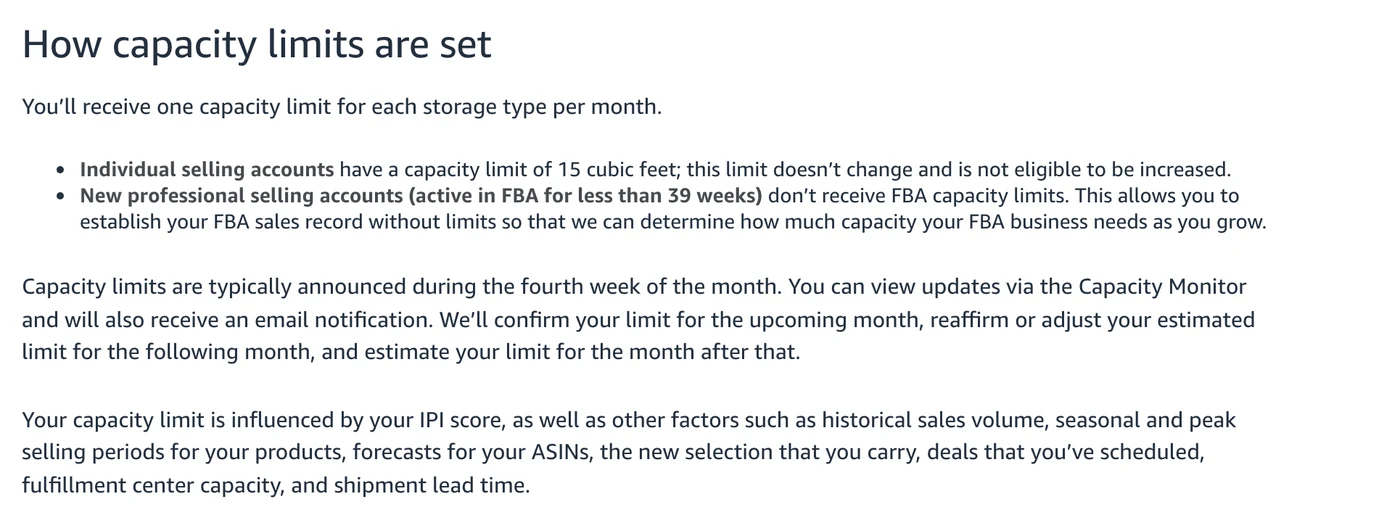
Limits are usually announced in the fourth week of the month. If your on-hand stock plus inbound shipments go over the limit, Amazon blocks new shipments.
Need more room? Capacity Manager lets you request extra capacity at a reservation fee you set, and pays a $0.15 performance credit for every dollar of sales you make with it.
AWD: Amazon’s built-in replenishment
Amazon Warehousing and Distribution (AWD) stores your stock and refills FBA from it. For FBA sellers, enrolling is free, and the base storage rate is $0.48 per cubic foot per month (East and South) or $0.57 (West Coast).
Per Amazon’s help page on replenishment from AWD to FBA, enrolled stock is auto-replenished by default (you can opt out per SKU), and auto-replenished inventory is exempt from FBA capacity limits. From February 1, 2027, AWD transportation fees in the US get a fuel and logistics surcharge, announced at 3.5%.
Where the free tools stop
Amazon’s tools only see Amazon. They won’t sync stock with your Shopify store or eBay listings, and Replenishment Alerts cover only inventory in Amazon’s fulfillment centers. Once you sell on several channels, run your own warehouse, or manage hundreds of SKUs with suppliers and purchase orders, paid software starts to make sense.
The fees that make inventory planning pay
Inventory software sells itself on fees. Here is what Amazon charges in the US until January 31, 2027, and what changes on February 1, 2027 (Amazon’s summary of the 2027 US fee changes).
Too little stock: the low-inventory-level fee
Until January 31, 2027, the low-inventory-level fee applies only when both your 90-day and 30-day historical days of supply are below 28 days. For a small standard-size item up to 16 oz, it’s $0.89, $0.63 or $0.32 per unit, depending on whether you’re under 14, 14 to 21, or 21 to 28 days of supply.
From February 1, 2027, Amazon will judge the 28 days on actual shipments in the four weeks before and after the assessment date. According to Amazon, exemptions include new Professional sellers in their first 365 days, products that sold fewer than 20 units in the past 7 days, and SKUs with 70% or more of inventory auto-replenished through AWD.
Too much stock: storage and aged inventory
Until January 31, 2027, standard-size monthly storage fees are $0.78 per cubic foot from January to September and $2.40 from October to December. On top of that come a storage utilization surcharge ($0.44 to $1.88 per cubic foot for standard-size items at a utilization ratio of 22 weeks and up) and the aged inventory surcharge from 181 days, starting at $0.50 per cubic foot.
On February 1, 2027, both surcharges go away. Amazon folds them into one age-based unified monthly storage fee:
| Inventory age | Standard-size, off-peak (January to September), per cubic foot per month |
|---|---|
| 0 to 180 days | $0.78 |
| 181 to 270 days | $2.78 |
| 271 to 365 days | $6.68 |
| 366 to 455 days | $7.68, or $0.78 plus $0.30 per unit, whichever is greater |
| 456 days and over | $8.68, or $0.78 plus $0.35 per unit, whichever is greater |
From October to December, according to Amazon’s 2027 table, add $1.62 per cubic foot for standard-size items and $0.84 for bulky and oversize. For stock under 181 days, that works out to $2.40, the same as the October to December 2026 rate.
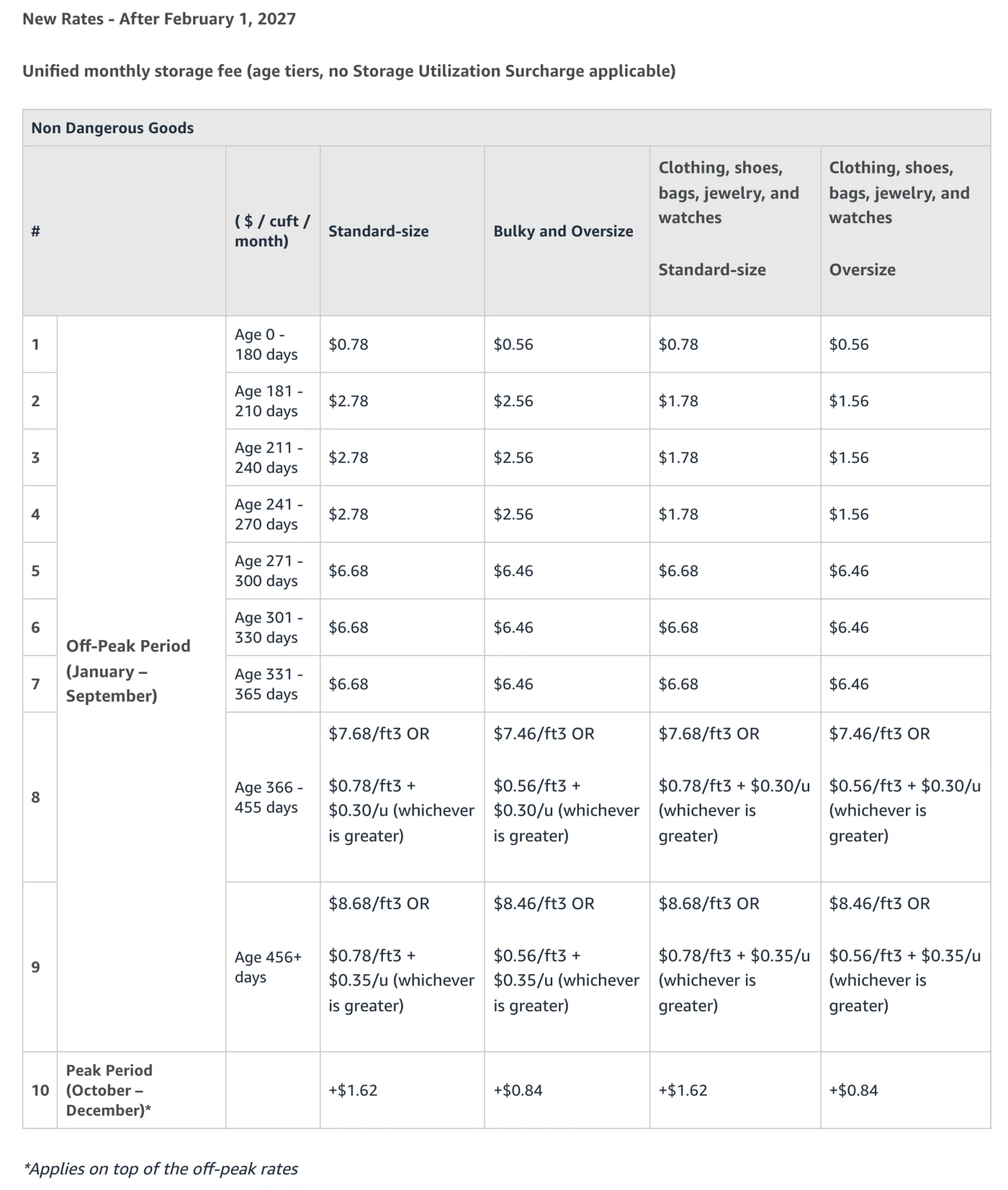
The takeaway: from February 2027, a unit that sits past 180 days costs more than three times as much to store, and the price keeps climbing with age. That makes forecasting accuracy, and a plan for slow-moving inventory, worth more than before.
🎯 Pro Insight: AWD gets a quiet advantage in 2027. According to Amazon’s fee pages, when you auto-replenish 70% or more of an FNSKU from AWD to FBA, Amazon charges the 0 to 180 day storage rate for that FNSKU regardless of its age, and the same 70% rule exempts it from the low-inventory-level fee.
Amazon inventory management software compared (prices as of November 13, 2026)
Every price is copied from the vendor’s own pricing page on November 13, 2026. “Quote only” means the vendor publishes no number.
| Tool | Main job | Price as published | Free trial or plan | Channels |
|---|---|---|---|---|
| Seller Central tools | FBA restock, alerts, IPI | Included with your selling plan | Free | Amazon only |
| SoStocked | FBA forecasting, POs | Starting at $175/month | Free trial | All Amazon marketplaces |
| RestockPro | FBA forecasting, POs | Starting at $49/month (1,000 FBA orders) | Free trial | 10 Amazon marketplaces |
| InventoryLab | Listing, FBA shipments, P&L | $69/month, or $58/month billed annually | 30 days | Amazon (FBA and FBM) |
| Helium 10 | Restock inside a research suite | Platinum $129/month (40 SKUs); Diamond $359/month (500 SKUs) | Limited free plan | Amazon, Walmart, TikTok |
| Jungle Scout | Restock inside a research suite | Growth Accelerator $79/month and up | No trial; 7-day money-back | Amazon |
| Sellerboard | Profit plus restock planning | Standard $19/month ($15 billed annually) | 1 month | Amazon |
| Veeqo | Multichannel stock and shipping | Inventory plan from $19/month | Shipping plan free | Amazon, Shopify, eBay, Walmart, WooCommerce |
| Zoho Inventory | Multichannel stock, orders | Free (50 orders); Standard $29/month billed annually | Free plan, 14 days | Integrates with Amazon |
| Linnworks | Multichannel sync, WMS | Tiered by monthly orders, no public price | Demo | 100+ channels |
| Sellbrite | Multichannel listing and sync | Plan prices not published here | Free to start, 14 days | Amazon (incl. FBA) and others |
| Inventory Planner | Multichannel forecasting | Quote only | Demo | Amazon and others |
| Cin7 Core | Inventory ERP | Standard $349/month | Demo | Multichannel |
| Sellercloud | Marketplace ERP | Essentials from $1,349/month | Demo | Multichannel, FBA and FBM |
| Descartes Finale | Inventory and warehouse | Essentials from $499/month | Demo | Multichannel |
| Brightpearl | Retail ERP | Quote only | Demo | Multichannel |
Amazon FBA inventory management software (forecasting and replenishment)
These tools are built around Amazon and FBA. They answer one question well: how much should I send in, and when?
SoStocked
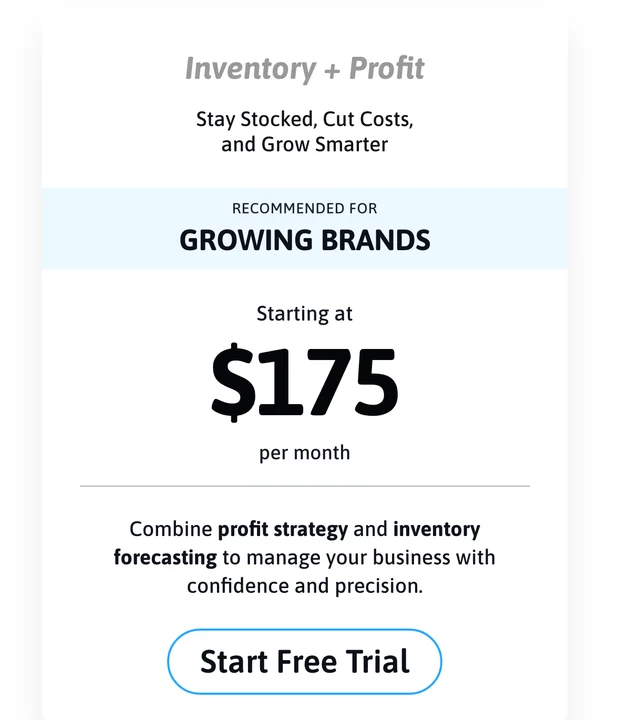
SoStocked, part of Carbon6, focuses on customizable FBA forecasting and purchase orders. Pricing is “Starting at $175 per month” for its Inventory plus Profit plan, with a free trial (length not stated). It says it supports all Amazon marketplaces.
Best for Amazon brands that want to tune their own forecast rules.
RestockPro
RestockPro now lives at eComEngine. It covers forecasting, purchase orders, kitting and labels for FBA, starting at $49 a month for 1,000 FBA orders, with a free trial.
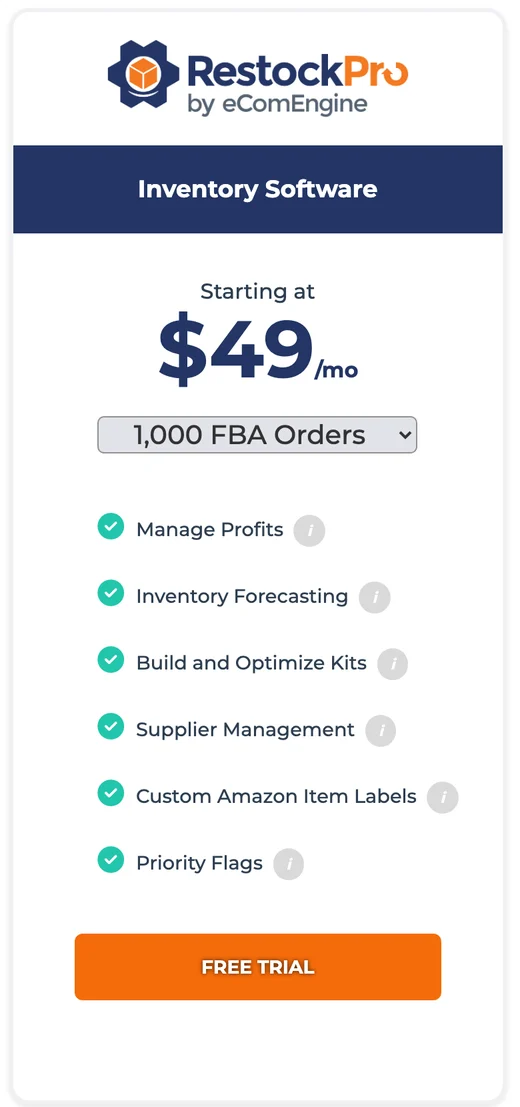
It works in 10 Amazon marketplaces: Australia, Canada, France, Germany, Italy, Mexico, the Netherlands, Spain, the UK and the US. A good fit for private label and wholesale sellers on a budget.
InventoryLab
InventoryLab, now part of Threecolts, is built for resellers and arbitrage sellers. It creates FBA or FBM listings, manages FBA shipments and tracks local stock, with profit and loss reporting.
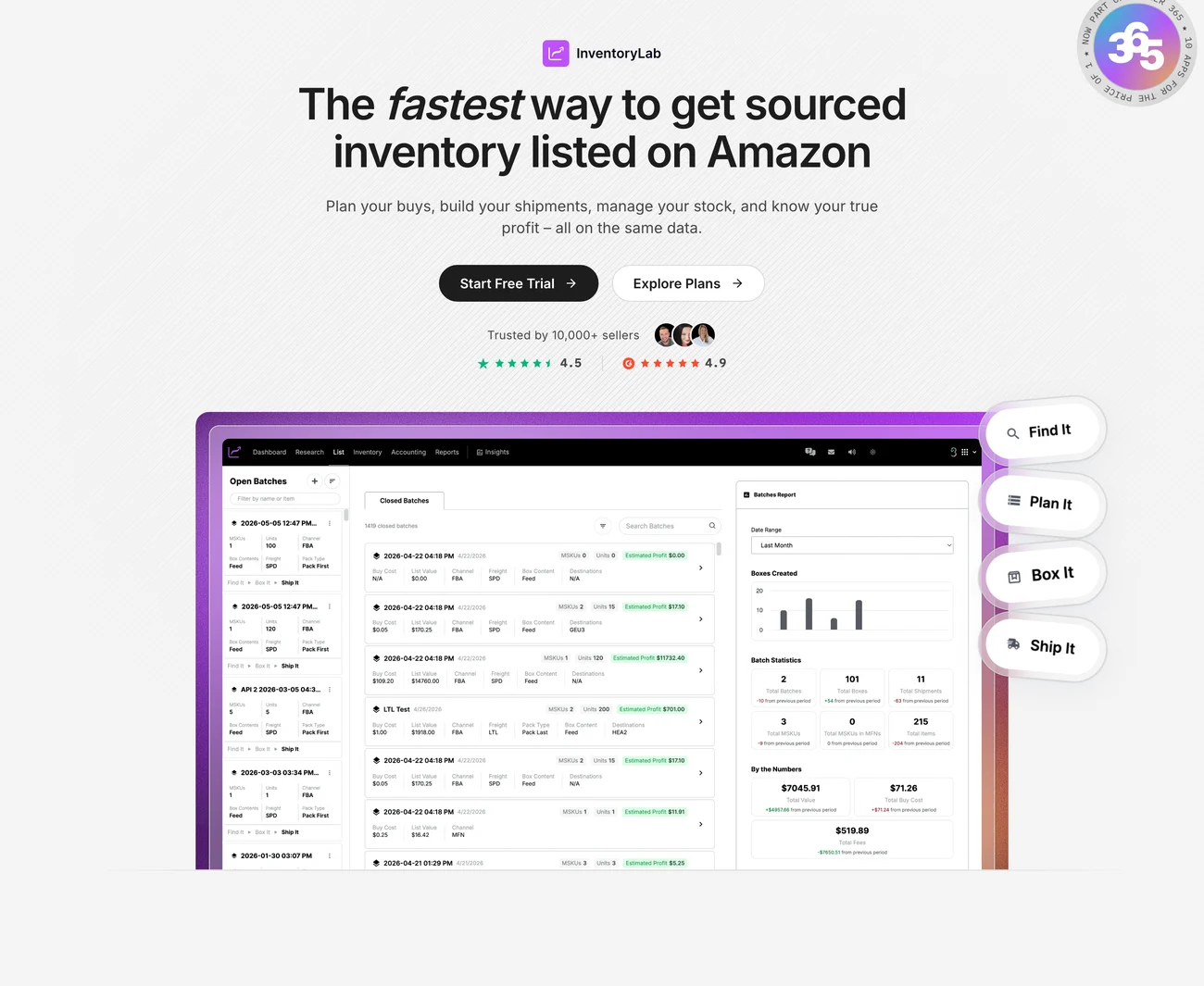
It costs $69 a month, or $58 billed annually, with a 30-day free trial. Forecasting is lighter than in SoStocked or RestockPro. Details in our InventoryLab pricing breakdown.
Helium 10 Inventory Management
Helium 10 includes purchase orders, inbound shipments and restock suggestions “whether you ship to Amazon or your own warehouse.” The catch is the SKU cap: inventory management covers 40 SKUs on Platinum ($129 a month, or $99 billed yearly) and 500 SKUs on Diamond ($359, or $279 billed yearly).
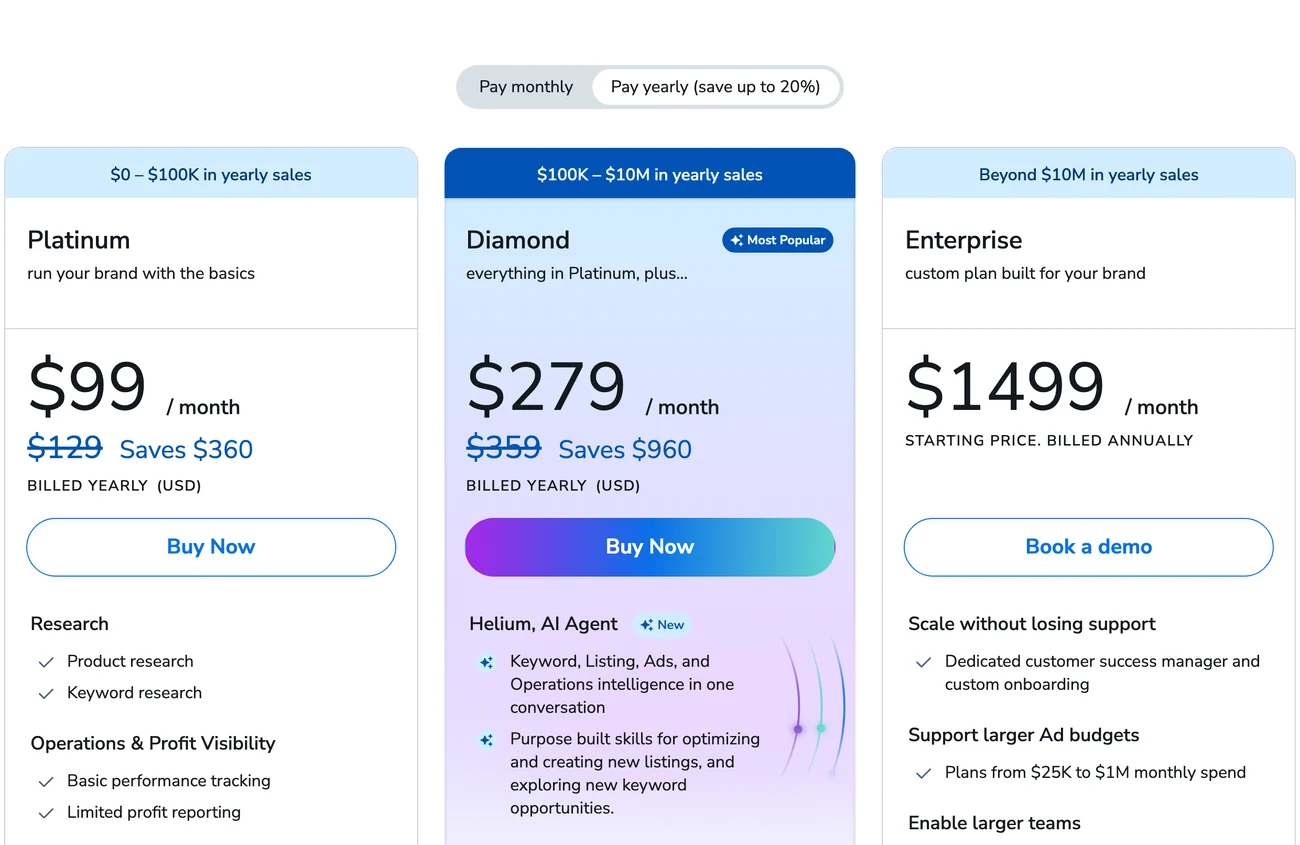
It makes sense if you already pay for Helium 10.
Jungle Scout Inventory Manager
Jungle Scout moved Inventory Manager into its Catalyst plans. It’s included on Growth Accelerator ($79 a month, or $49 billed annually) and Brand Owner ($149, or $129 billed annually), not on Starter.
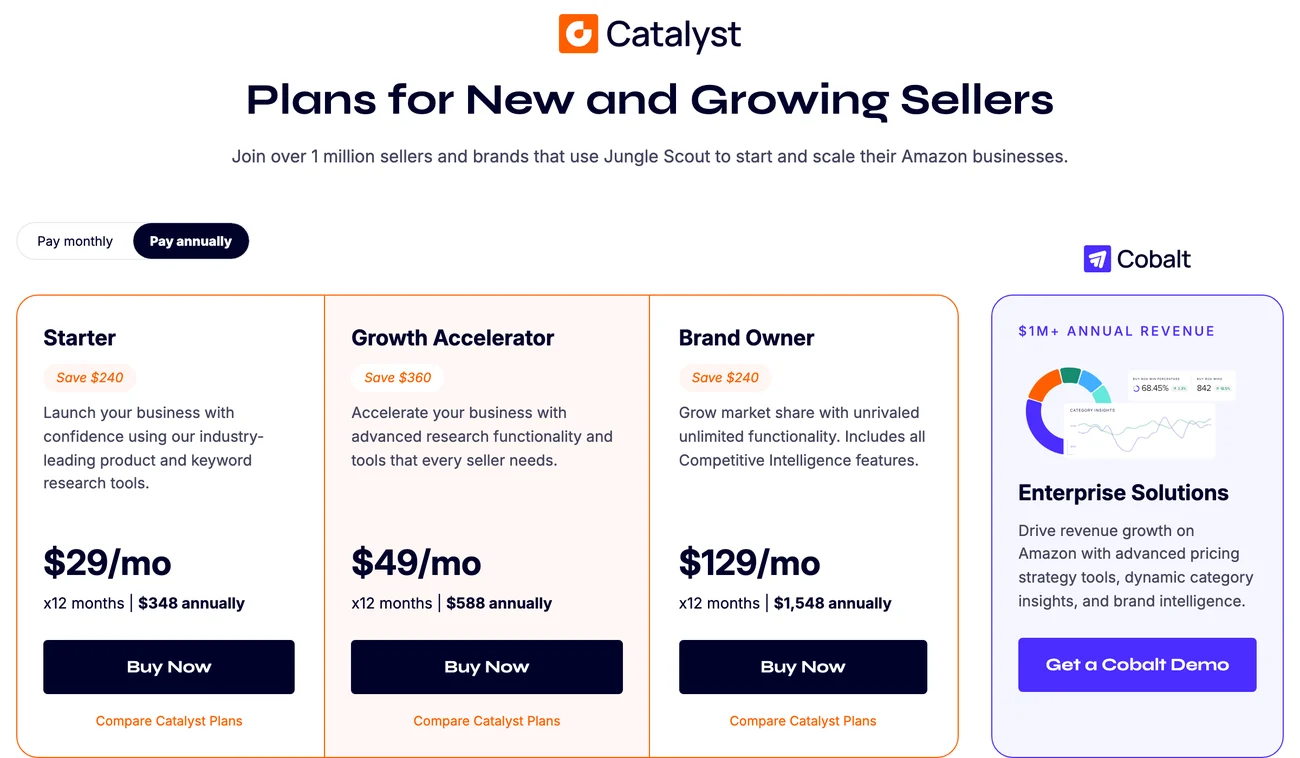
Jungle Scout offers no free trial, only a 7-day money-back guarantee. Best for research-first sellers who want restock planning in the same tool.
Sellerboard
Sellerboard is a profit dashboard first, with inventory management in its feature list. Standard costs $19 a month, or $15 a month billed annually, with a one-month free trial and no credit card.
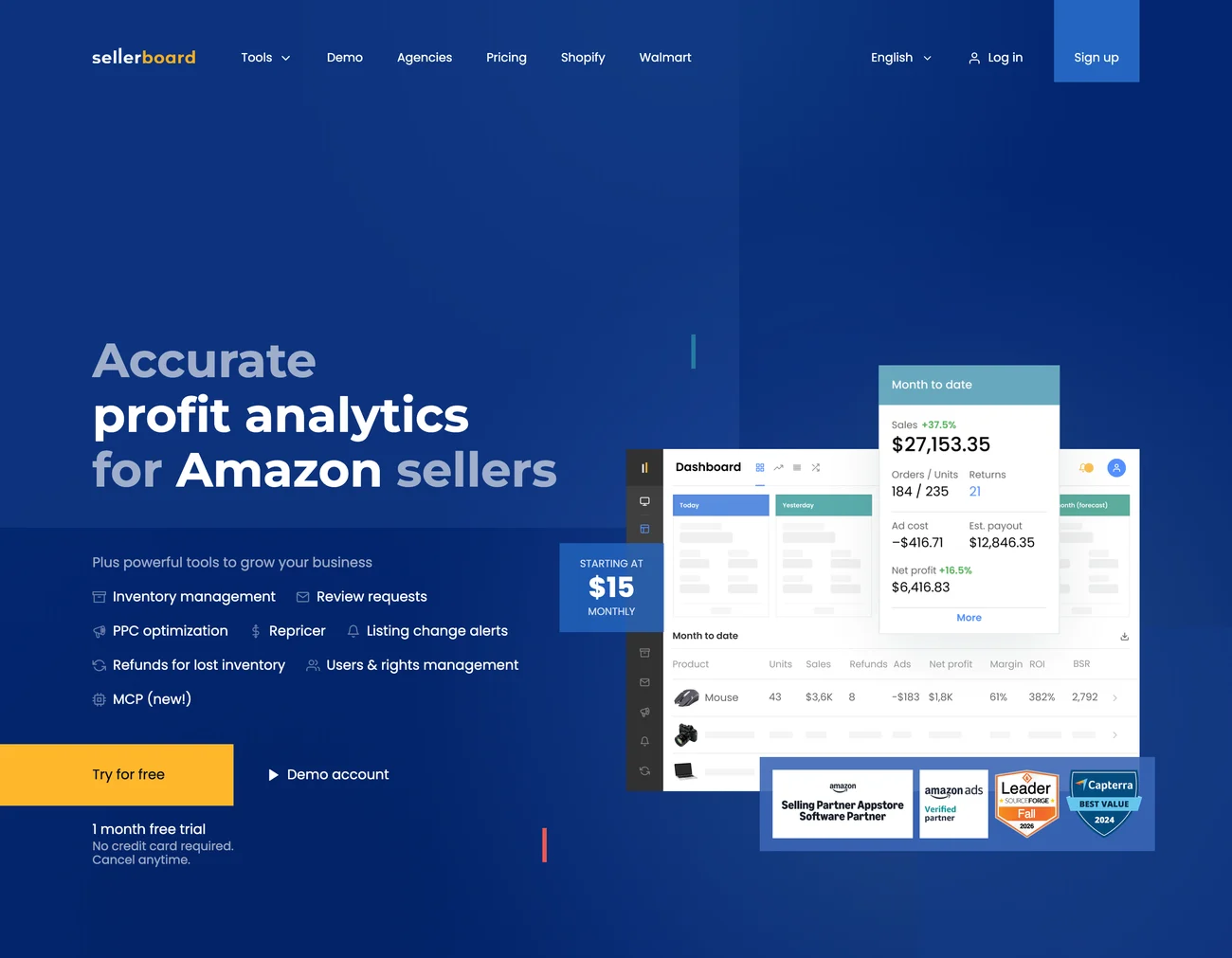
If profit tracking is your main need and restock planning a bonus, read our Sellerboard review.
Multichannel inventory management software for Amazon sellers
If you also sell on Shopify, eBay, Walmart or your own site, the main risk shifts from stockouts to overselling: the same unit sold twice on two channels. These tools keep one stock count across channels.
Veeqo
Veeqo was acquired by Amazon in 2021, and Amazon’s own guide calls it “free Amazon inventory management software.” That’s only half true.
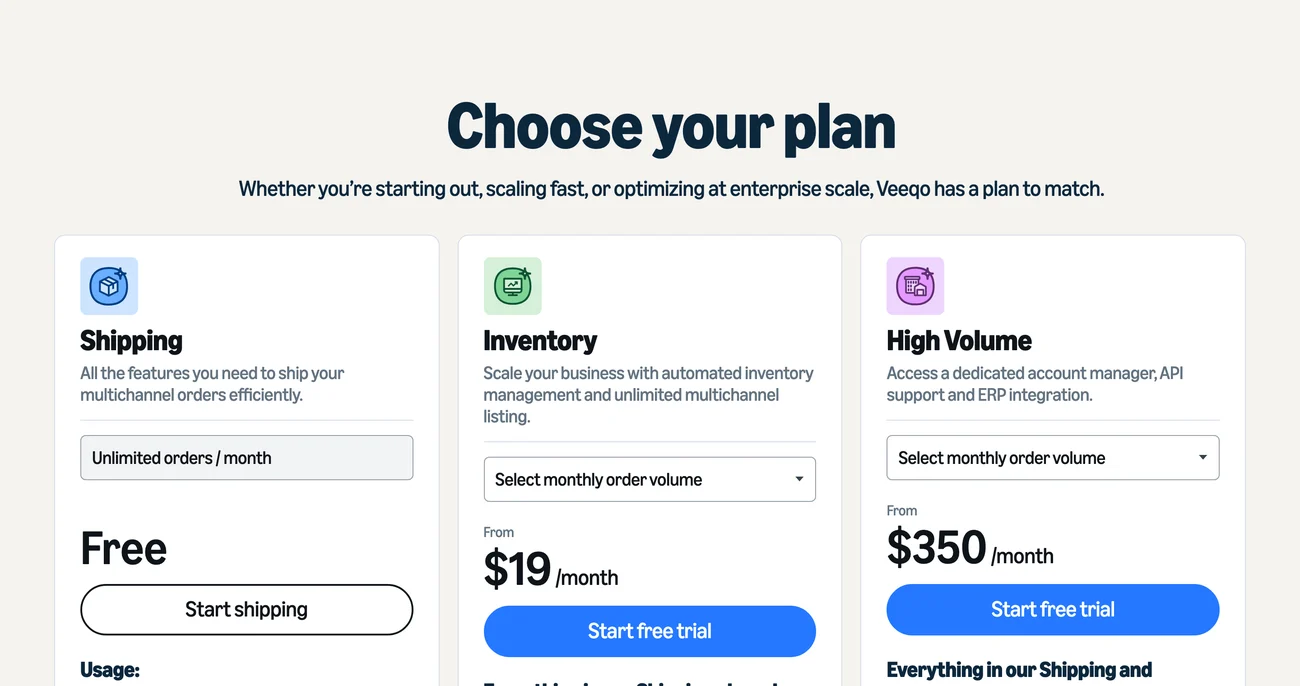
The Shipping plan is free, but inventory sync, demand forecasting and digital picking sit in the Inventory plan, from $19 a month (High Volume starts at $350). It ships orders from Amazon, Shopify, eBay, Walmart and WooCommerce, so it suits sellers who fulfill orders themselves.
Zoho Inventory
Zoho Inventory integrates with Amazon and has a forever-free plan for 50 orders and one user.
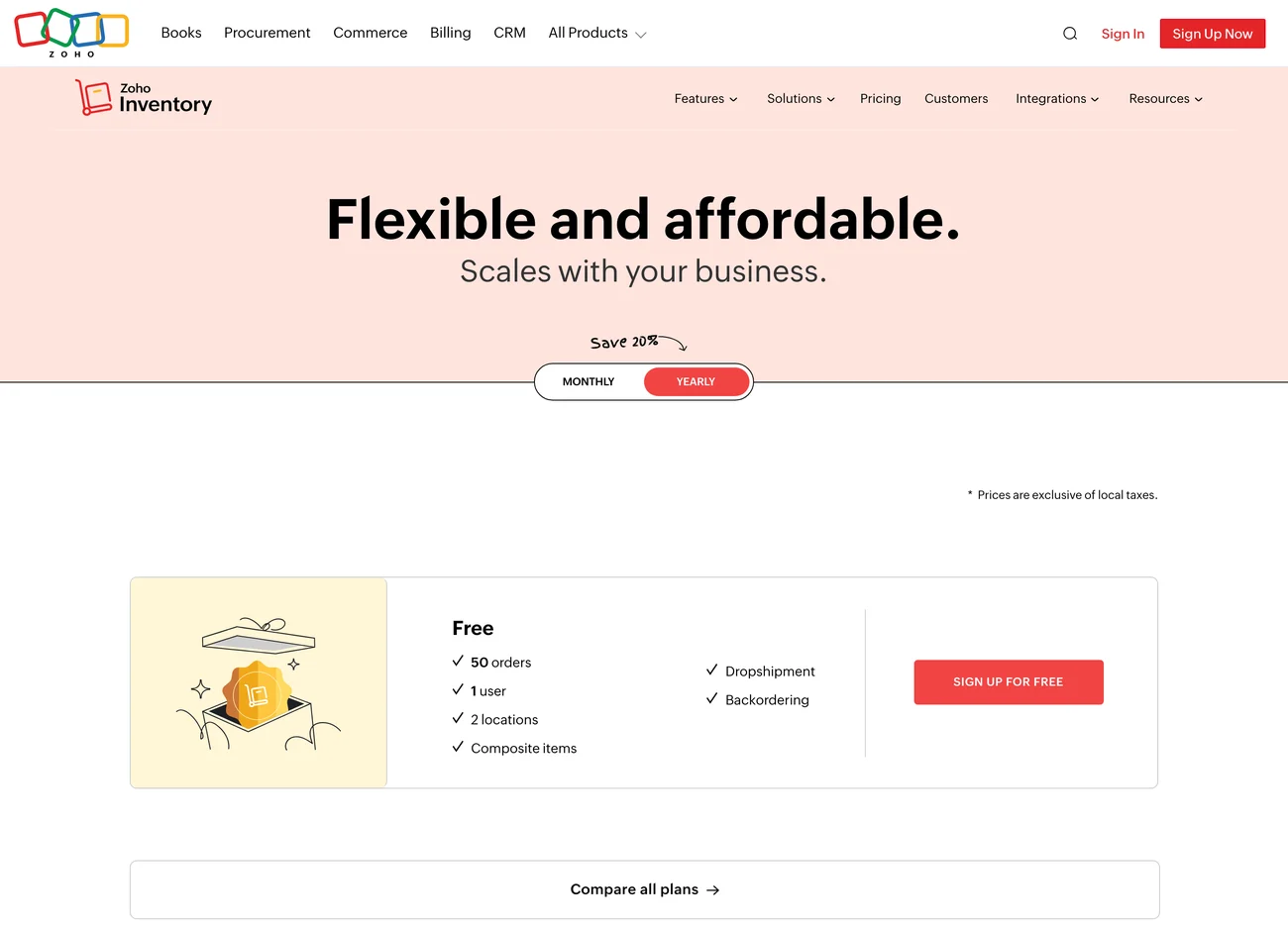
Paid plans billed annually run from Standard at $29 per organization a month (500 orders) to Professional at $79, Premium at $129 and Enterprise at $249, with a 14-day free trial. A sensible start for small multichannel retailers.
Linnworks (with SkuVault)
Linnworks connects to more than 100 channels and now runs SkuVault as its warehouse management product.
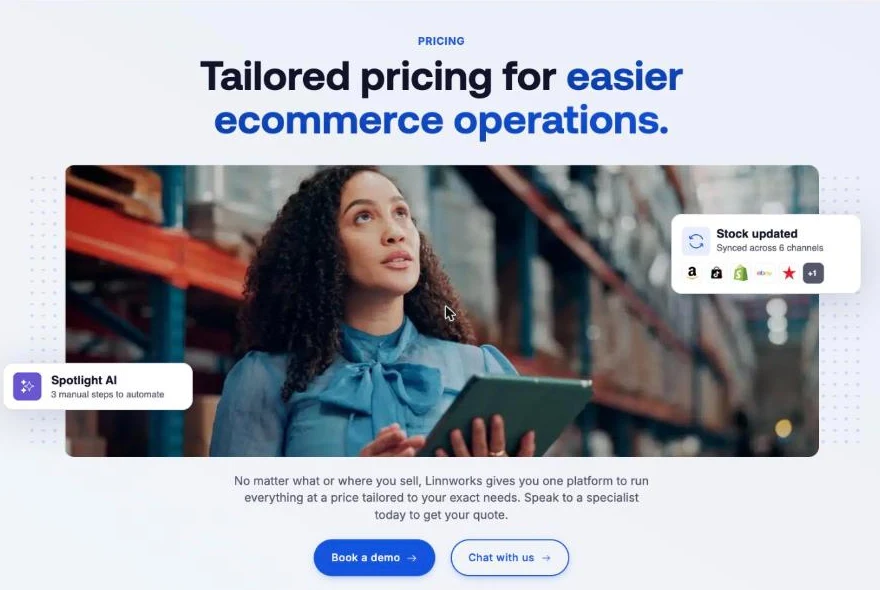
It publishes no price: plans are tiered by monthly orders, with overages, and Linnworks Forecasting is a flat fee. Expect a demo before a quote. Best for multichannel brands with their own warehouse.
Sellbrite
Sellbrite, owned by GoDaddy, lists FBA inventory integration and multichannel FBA integration among its features.
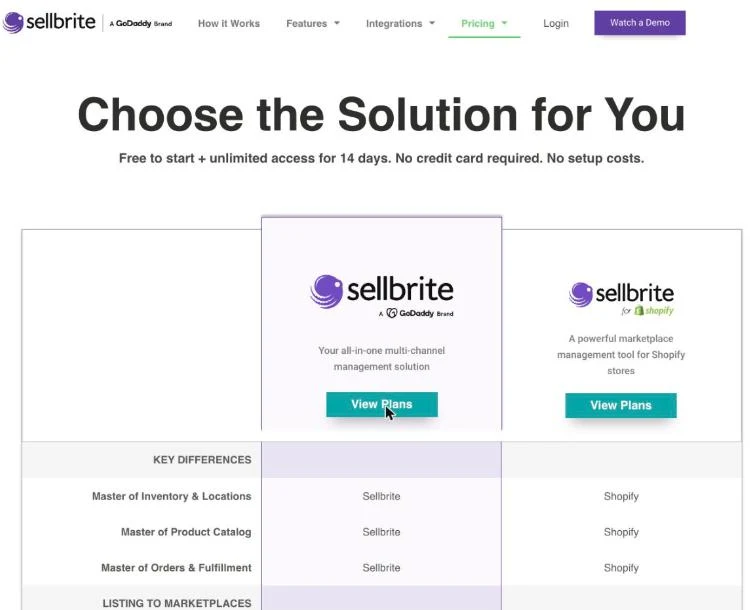
It’s “Free to start + unlimited access for 14 days,” with no credit card. Its plan prices sit behind a “View Plans” button, so we haven’t quoted one.
Inventory Planner
Inventory Planner, now part of Sage, is a multichannel forecasting tool with an Amazon integration.
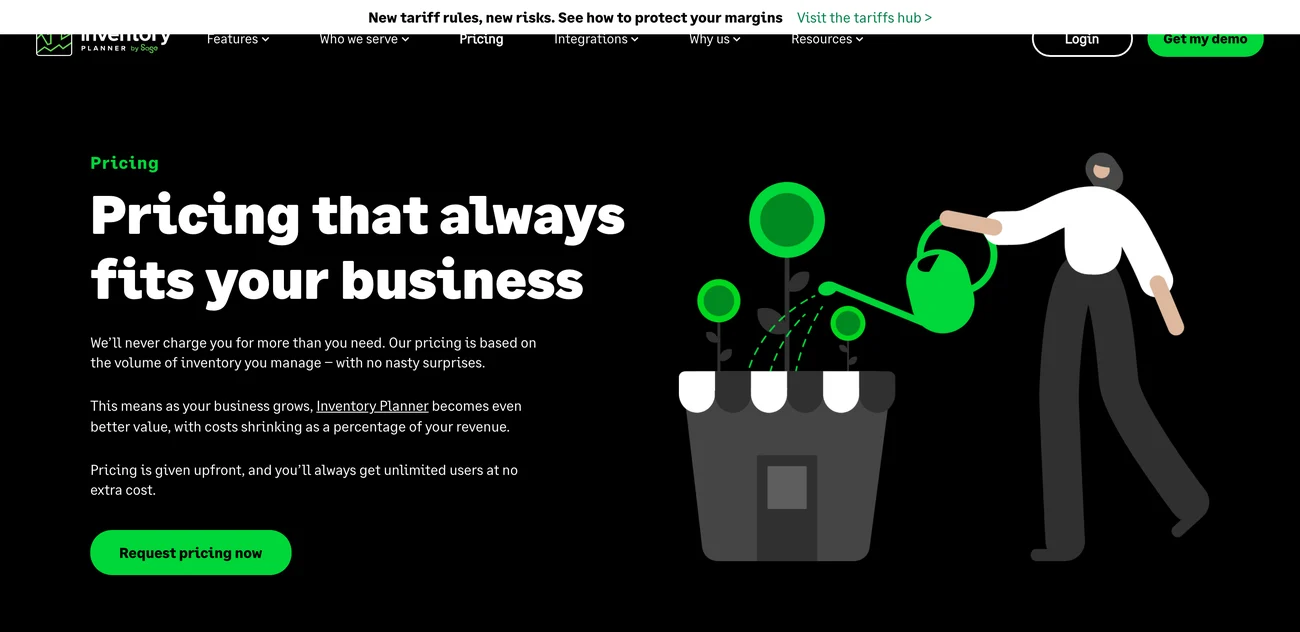
Pricing is quote only and “based on the volume of inventory you manage,” with unlimited users at no extra cost. Its pricing page says customers go live in four weeks on average.
ERP and warehouse systems for high-volume sellers
These are full operating systems for stock, orders and warehouses. They cost more and take longer to set up, and only pay off at volume.
Cin7 Core
Cin7 Core costs $349 a month on Standard, $599 on Pro and $1,199 on Advanced; Cin7 Omni is custom priced.
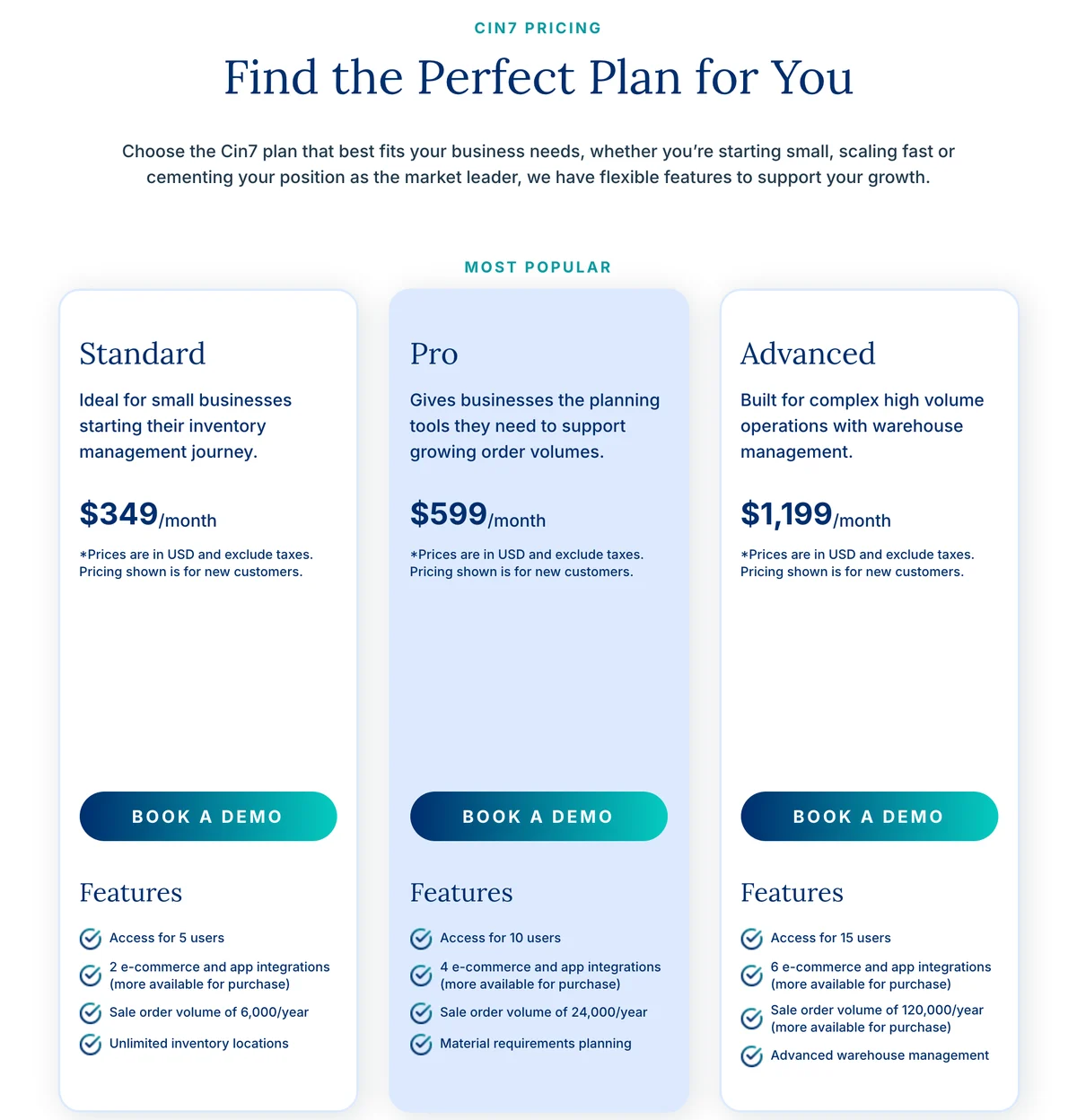
It suits growing product brands, including manufacturers.
Descartes Sellercloud
On Descartes Sellercloud, Essentials starts at $1,349 a month and Growth at $1,998.
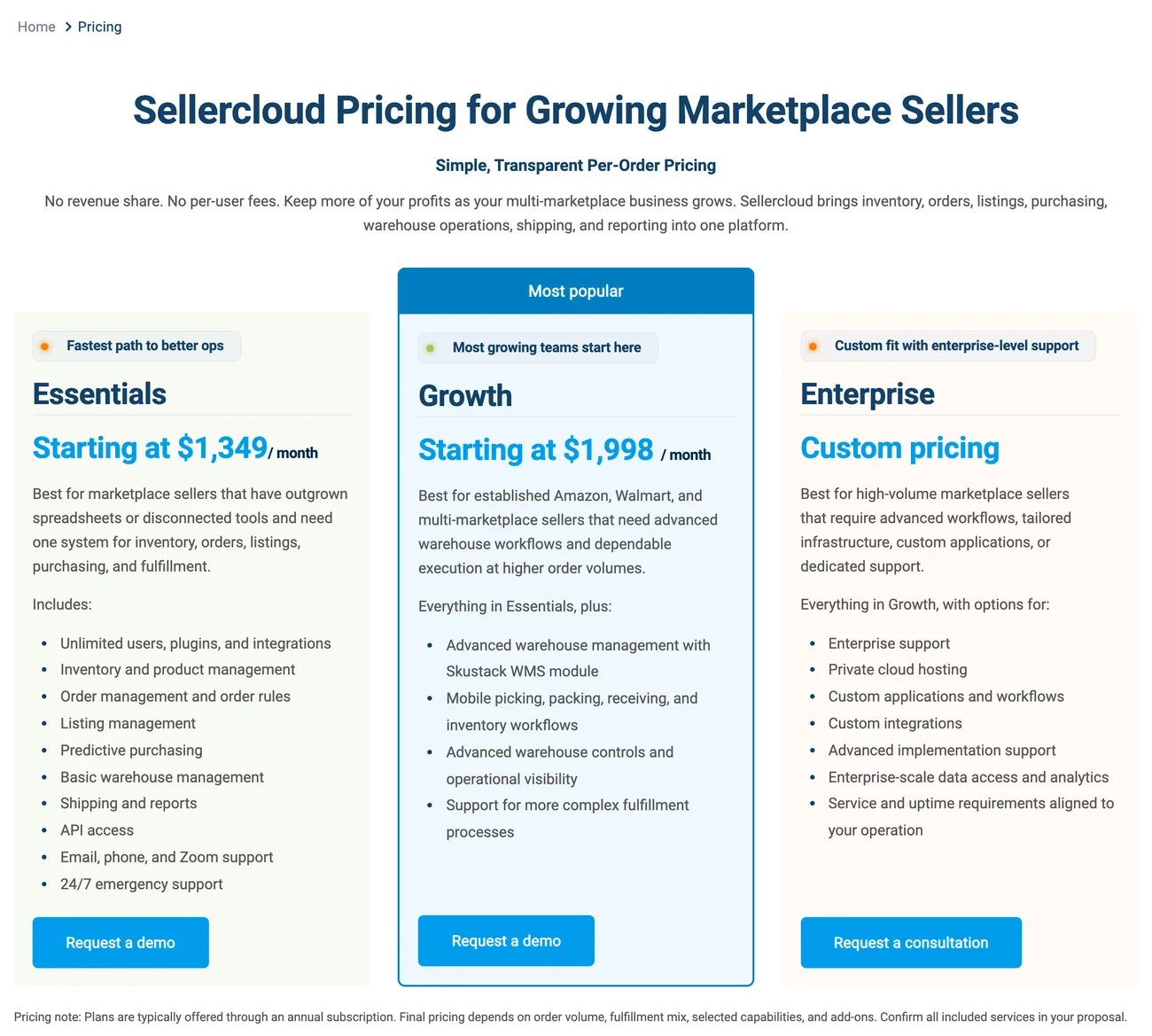
It handles merchant-fulfilled and FBA orders for high-volume marketplace sellers. See our Sellercloud review.
Descartes Finale
Descartes Finale, formerly Finale Inventory, starts at $499 a month on its Essentials plan.
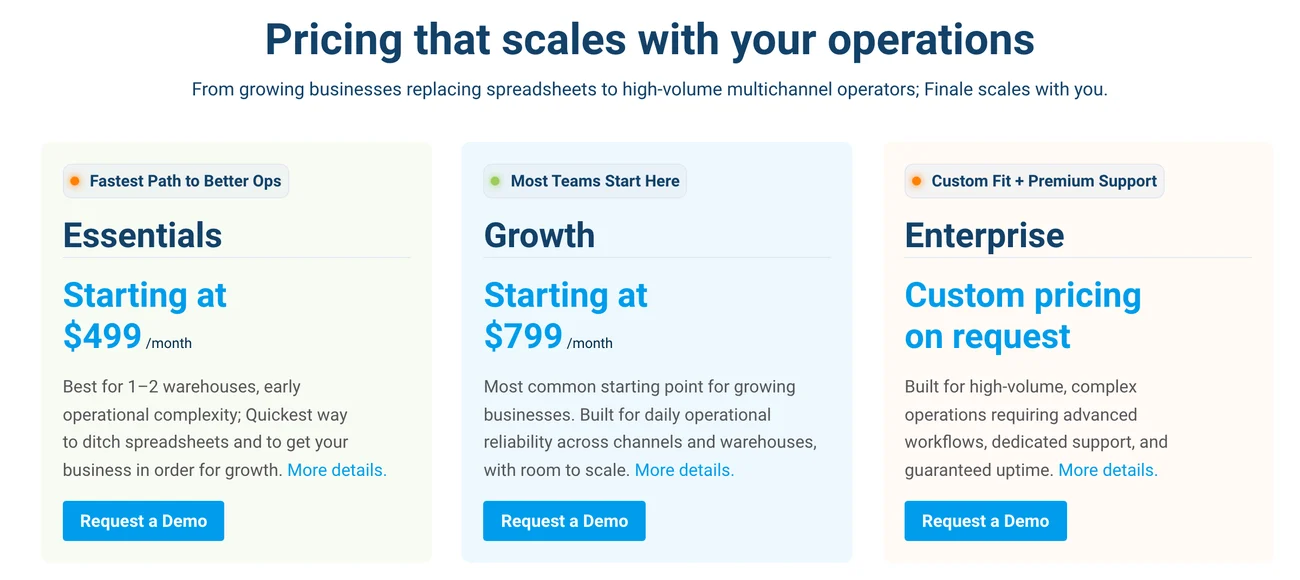
It fits brands running one or two warehouses.
Brightpearl
Brightpearl, now sold as “Brightpearl by Sage”, is a retail ERP with quote-only pricing.
Brightpearl says customers go live in 90 to 120 days on average, so it’s not a quick fix.
Tools you’ll still see on older lists
Many inventory software roundups haven’t been updated. As of November 13, 2026:
- Forecastly is gone. Its domain now redirects to a general finance blog with no Amazon product. Lists that still quote a monthly price for it are out of date.
- SkuVault is now part of Linnworks. The old skuvault.com site redirects to Linnworks, where it runs as Linnworks’ warehouse management product.
- RepricerExpress is a repricer, not inventory software. Its sign-ups go to Repricer.com.
- SellerApp and Seller Labs are an advertising suite and a profit analytics suite. SellerApp’s inventory forecasting is tied to pausing ads, and Seller Labs’ Profit Genius reports on inventory without planning reorders.
- Renamed or rehomed: RestockPro (now under eComEngine), InventoryLab (Threecolts), Sellercloud and Finale (Descartes), Brightpearl and Inventory Planner (Sage), SoStocked (Carbon6).
FBA vs FBM: which kind of software you need
How you fulfill decides which tool category fits. Our FBA vs FBM comparison covers the wider tradeoffs.
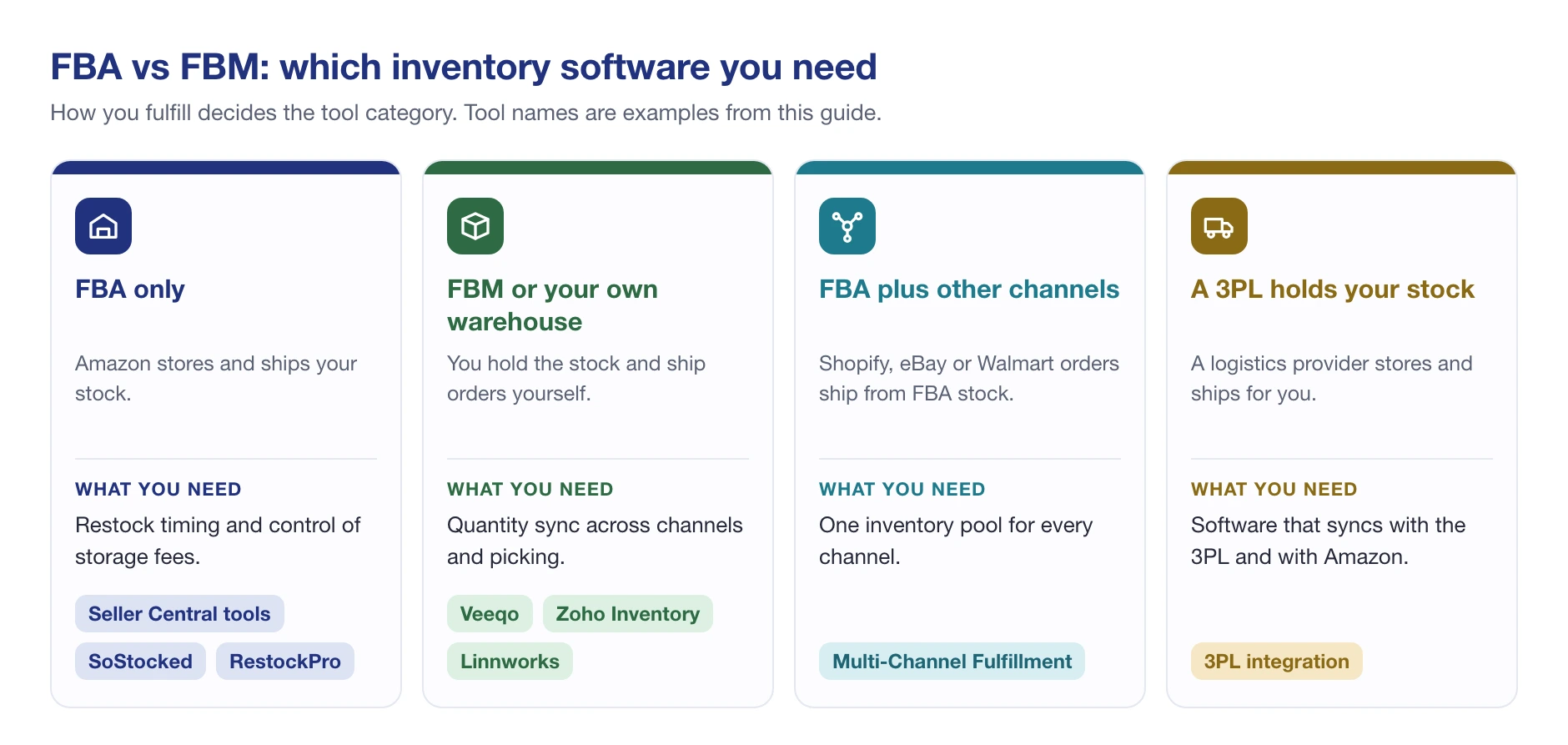
- FBA only: Amazon holds the stock, so your problem is timing and fees. Start with the Seller Central tools, then add an FBA forecasting tool (SoStocked, RestockPro) when purchase orders and supplier lead times get complicated.
- FBM or your own warehouse: you hold the stock and ship it, so you need quantity sync and picking. Veeqo, Zoho Inventory and Linnworks fit here.
- FBA plus other channels: Amazon’s Multi-Channel Fulfillment lets you create orders for connected channels such as Shopify, eBay or Walmart from FBA stock, so you work from a single pool of inventory. Amazon recommends keeping at least 8 weeks of cover and 100 units in a fulfillment center for MCF.
- A third-party logistics provider: a 3PL such as ShipBob (quote-based pricing) holds the stock for you. Your software then needs to sync with the 3PL as well as with Amazon.
Most third-party tools connect to your account through the Selling Partner Appstore, where Amazon says it vets the apps listed and monitors their data-privacy compliance.
How to choose Amazon inventory management software
Amazon’s own inventory guide lists what to look for in a system:
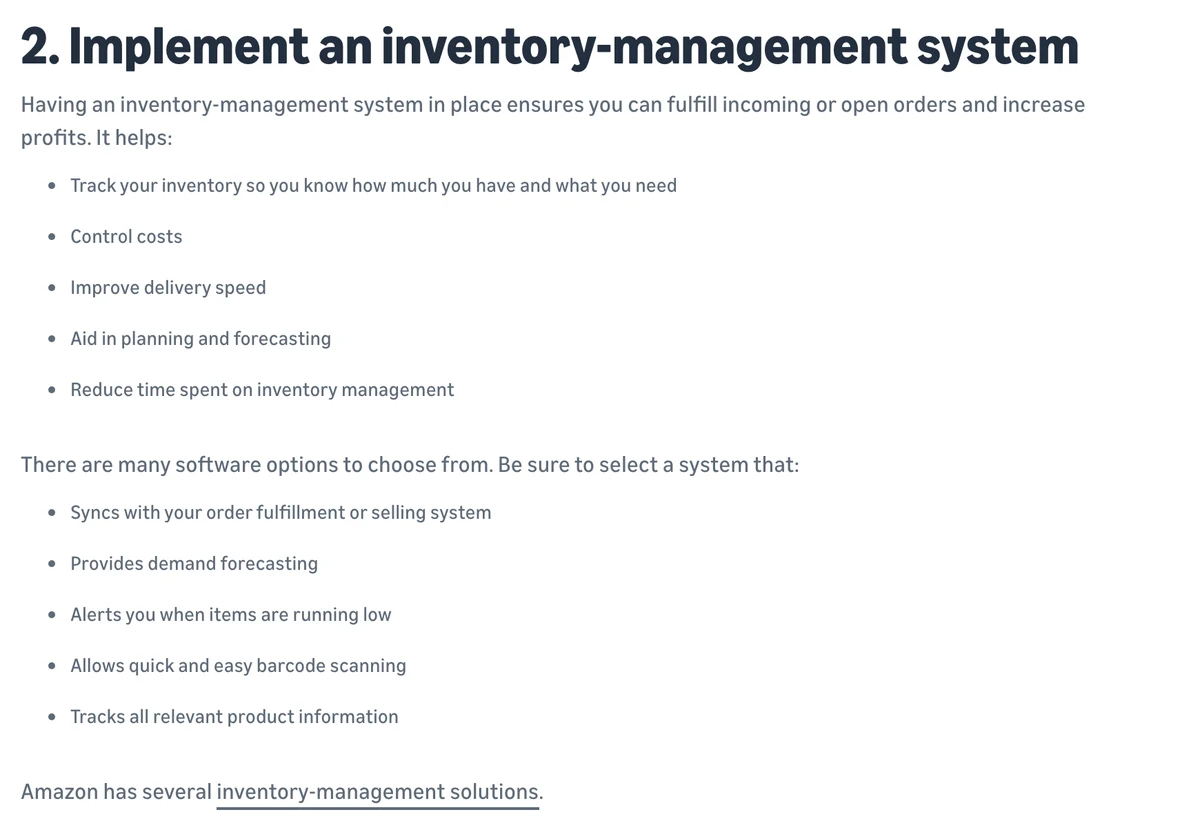
Turn that checklist into four questions:
- Where does your stock sit? FBA only, your own shelves, a 3PL, or a mix. That picks the category.
- How many SKUs will you plan? Check caps before you buy: Helium 10 covers 40 SKUs on Platinum and 500 on Diamond.
- What does it cost at your volume? Several tools price by orders (RestockPro, Zoho, Linnworks), so price your next 12 months, not today.
- Does the forecast beat Amazon’s? Run a free trial against the FBA Inventory page’s restock recommendations on the same SKUs. If the paid tool doesn’t change your decisions, keep your money.
📌 From Our Experience: Sellers tend to buy inventory software to fix a forecasting problem that’s really a data problem: wrong lead times, a missing supplier delay, a bundle counted as two products. Clean that up in Seller Central first. Whatever tool you choose afterwards will give you better numbers.
Inventory software plans your stock. A listing monitor shows what shoppers see
Every tool above works from your own data: units on hand, inbound shipments, sales velocity. That’s a different question from what a shopper sees on the product page. Your listing can show as unavailable, a competitor can sell out, or another seller can take the Buy Box, and your inventory count won’t tell you.
A listing monitor such as SellerSonar covers that side. It reports stock and availability as the marketplace shows it (Out of stock, In stock, Unavailable to buy, and Almost out of stock when Amazon itself displays a limited quantity), tied to the Seller IDs you choose, for your own ASINs and competitors’. Checks run as often as every hour on Business and Enterprise plans and every 4 hours on Pro.
It is not inventory software: it doesn’t see your warehouse counts or let you set unit thresholds, so use it next to an inventory tool, not instead of one.

The two work best together: your inventory tool plans the next shipment, and the monitor tells you if the listing goes unavailable or a competitor runs out of stock before it arrives.
Bringing it together
- Start free. The FBA Inventory page, Replenishment Alerts and Minimum Inventory Level cover a small FBA catalog.
- Plan for February 1, 2027. The unified monthly storage fee makes stock older than 180 days much more expensive, and the low-inventory-level fee moves to actual shipments.
- Buy by job. FBA forecasting (SoStocked, RestockPro, InventoryLab), multichannel sync (Veeqo, Zoho Inventory, Linnworks), or ERP (Cin7 Core, Sellercloud, Brightpearl).
- Check prices and caps yourself. Veeqo’s inventory features aren’t free, Helium 10 caps SKUs, and Jungle Scout leaves inventory off its Starter plan.
Final Expert Recommendations:
If you sell only on Amazon with a few dozen SKUs, set up Replenishment Alerts and correct your SKU settings this week, and hold off on paid software. When purchase orders and supplier lead times start eating your time, trial RestockPro or SoStocked against Amazon’s own restock numbers. Once a second sales channel or your own warehouse enters the picture, move to a multichannel tool before overselling forces the decision for you.
Want to know when your listing, or a competitor’s, shows out of stock or unavailable on Amazon? Start a free 14-day trial (5 ASINs and 10 keywords, no credit card) and see availability the way shoppers do.

