





Verdict: Sellercloud is a legitimate, full-scale inventory and order management platform for sellers who run Amazon, Walmart, eBay and their own store from one catalog and one or more warehouses. It is priced for operations teams, not side businesses: a 12-month license, a monthly minimum in the four figures and a six to eight week setup.
Best for: multichannel brands, wholesalers and 3PLs shipping thousands of orders a month who keep overselling or running stock in spreadsheets. Look elsewhere if: you sell mainly on Amazon through FBA, ship a few hundred orders a month, or want a month-to-month plan.
How much does Sellercloud cost? As of November 12, 2026, the Sellercloud pricing page lists Essentials starting at $1,349 a month, Growth starting at $1,998 a month and Enterprise at custom pricing, typically on an annual subscription, with the final price set by your order volume.
This Sellercloud review covers what the platform does, all three plans and what each includes, how per-order pricing works, the contract and refund terms, what changed in 2026, what Sellercloud reviews say, and the best Sellercloud alternatives and competitors.
Disclosure: SellerSonar publishes this review and sells Amazon listing monitoring, not inventory or order management, so we don’t compete with Sellercloud. This is desk research: we didn’t request a demo or a quote. Every Sellercloud fact comes from sellercloud.com, its FAQ and terms, and archived copies of its pricing page, read on November 12, 2026.
What is Sellercloud?
Sellercloud is an inventory management system (IMS) and order management system (OMS) for marketplace sellers. Its homepage calls it an inventory and order management platform “for Amazon, Walmart, and multichannel ecommerce sellers”, covering the catalog, listings, orders, purchasing, warehouse, shipping, reporting and returns in one system.
In practice, it is the system that holds the master stock count. When a unit sells on Walmart, Sellercloud lowers the quantity on Amazon, eBay and Shopify so you don’t sell the same unit twice, then routes the order to the right warehouse, FBA or a 3PL.
Who is Sellercloud? It is a US company headquartered in New Jersey, and since October 14, 2024 it has belonged to Descartes Systems Group, according to the Descartes acquisition press release. That is why the site now says “Descartes Sellercloud”.
Sellercloud at a glance
From Sellercloud’s own pages, as of November 12, 2026.
| Question | Sellercloud |
|---|---|
| Main job | Multichannel inventory, order and warehouse management |
| Owner | Descartes Systems Group, since October 14, 2024 |
| Plans | Essentials, Growth, Enterprise |
| Starting price | $1,349 a month (Essentials) |
| Pricing model | Per order, with a monthly minimum |
| Contract | Typically a 12-month license |
| Free trial | None listed; demo only |
| Users and integrations | Unlimited on every plan |
| Setup time | About six to eight weeks |
| Amazon | FBA, FBM, MCF, AWD, multiple seller accounts |
Sellercloud pricing in 2026
Sellercloud publishes three plans. Here are the plan cards on its pricing page.
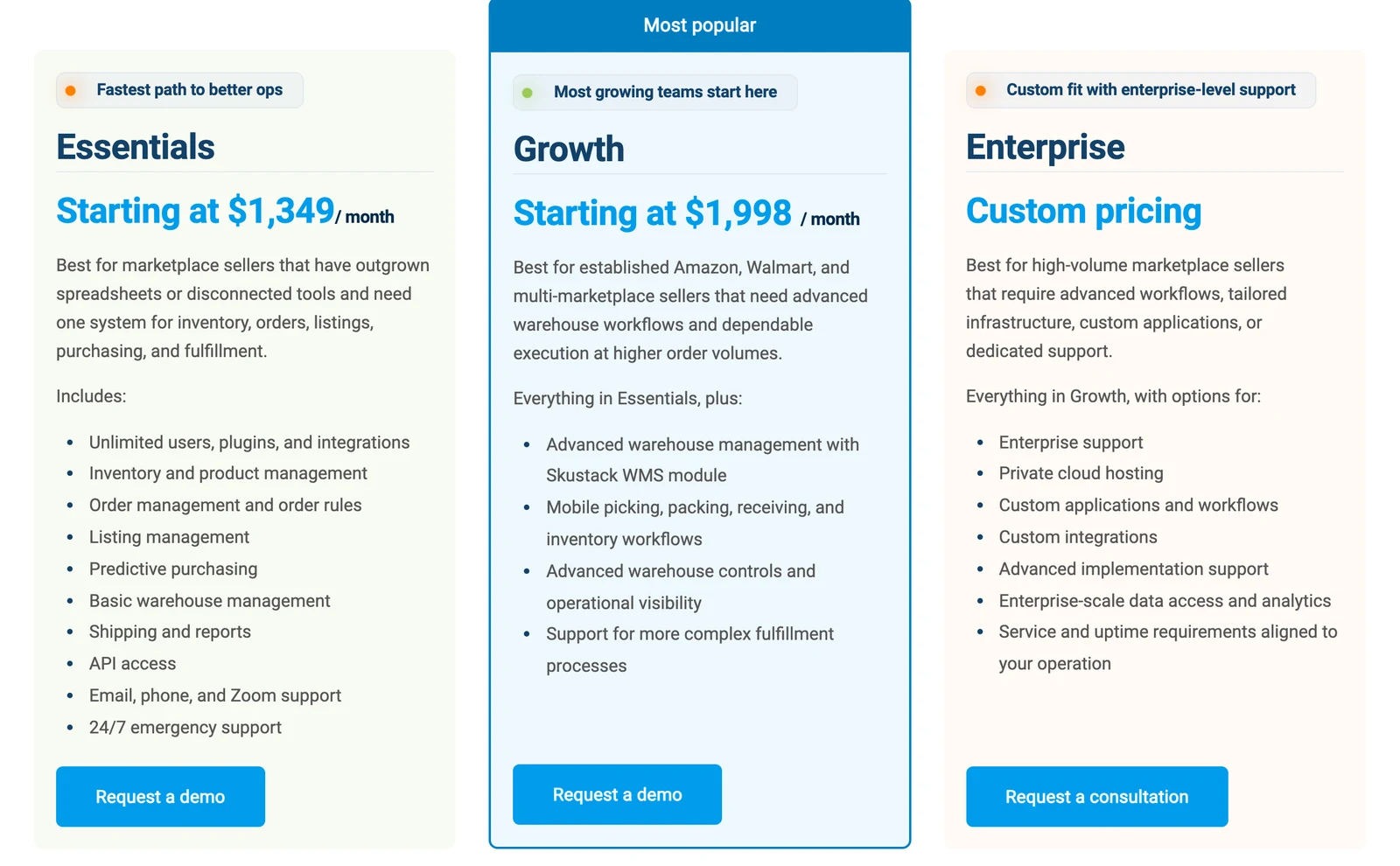
The prices are floors, not quotes. According to the note under the cards, “Final pricing depends on order volume, fulfillment mix, selected capabilities, and add-ons”, and plans “are typically offered through an annual subscription”.
| Plan | Starting price | Adds | Best for, per Sellercloud |
|---|---|---|---|
| Essentials | $1,349 a month | Inventory, orders, listings, purchasing, basic warehouse, shipping, reports, API | Sellers who outgrew spreadsheets |
| Growth | $1,998 a month | Skustack WMS: mobile picking, packing, receiving | Established Amazon and Walmart sellers |
| Enterprise | Custom | Private cloud, custom apps and integrations, enterprise support | High-volume sellers |
How Sellercloud per-order pricing works
The monthly minimum buys a set number of orders. The pricing FAQ gives the numbers.
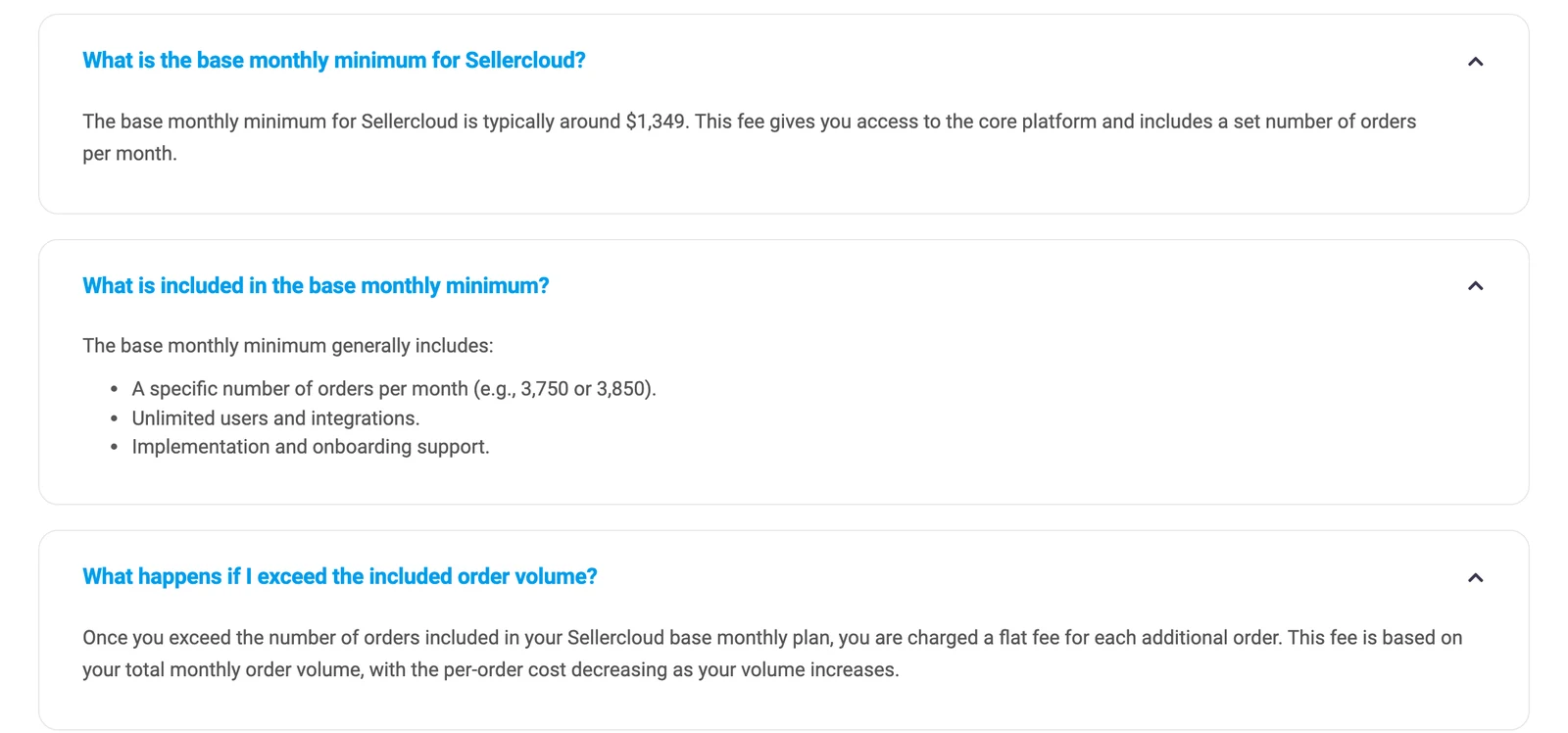
According to the FAQ, the base minimum includes “a specific number of orders per month (e.g., 3,750 or 3,850)”, unlimited users and integrations, and onboarding. Above that you pay a flat fee per extra order, which falls as volume rises, and the fee differs for merchant-fulfilled and FBA orders.
According to our math on the pricing FAQ’s figures, $1,349 for 3,750 orders works out to about 36 cents an order at the minimum. A seller with 500 orders a month pays the same $1,349, or about $2.70 an order. Seasonal sellers can ask for a fixed rate based on annual average volume, the FAQ says.
Contract, setup fees and refunds
Sellercloud’s general FAQ is direct about the term.
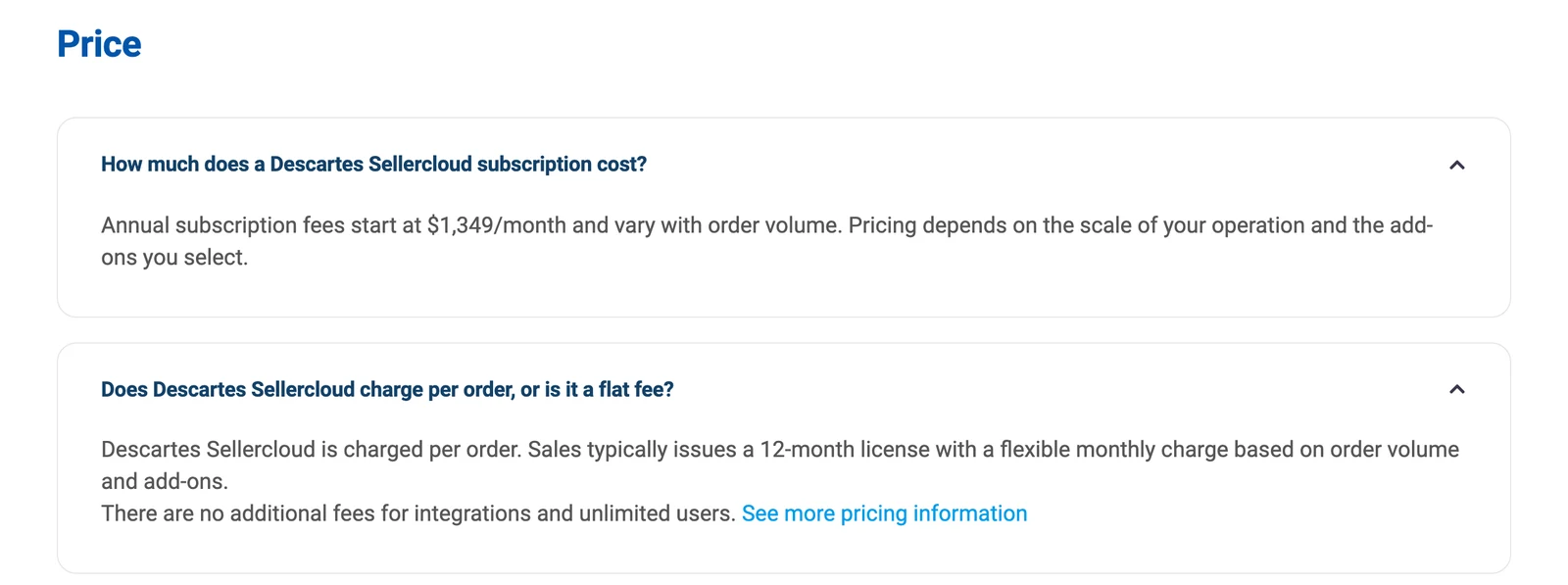
According to the Sellercloud FAQ, “Sales typically issues a 12-month license with a flexible monthly charge based on order volume and add-ons.” Budget for a year, not a month.
The Sellercloud terms of use add three points worth reading before you sign. Unused subscription fees are non-refundable, Sellercloud “may also charge you a non-refundable setup fee”, and when the agreement ends, moving your data off its servers is “your sole responsibility”.
The pricing FAQ says implementation is generally built into the monthly fee, while custom integration work costs extra. Ask for both points in writing in your proposal.
Is there a Sellercloud free trial?
We found no free trial on Sellercloud’s pricing, FAQ or demo pages. The route in is a personalized demo, followed by a proposal. There are no Sellercloud promo codes or coupons on its site, and we don’t list affiliate codes.
💡 Expert Tip: Before the demo, pull 12 months of order counts by channel and by fulfillment method from your marketplaces. Sellercloud prices on order volume and the FBA versus merchant-fulfilled split, so those two numbers decide your quote more than your revenue does.
What changed in Sellercloud pricing in 2026
Archived copies of the pricing page show three steps. The November 9, 2025 copy shows one price, “Starting at $1199 /month”, with the line “Monthly subscription based on order volume and add-ons”.
By January 15, 2026, the archived pricing page shows $1,349 a month and the line changed to “Annual subscription based on order volume and add-ons”. The October 9, 2026 copy still shows that single $1,349 price.
The named Essentials, Growth and Enterprise plans, the $1,998 Growth price and the plan comparison table appear on the live page we read on November 12, 2026. So, according to the archived and live pricing pages, the entry price rose $150 since late 2025, and the advanced warehouse module now sits in a higher plan.
What each Sellercloud plan includes
The comparison table on the pricing page shows where the plans differ. Most rows are the same on all three.
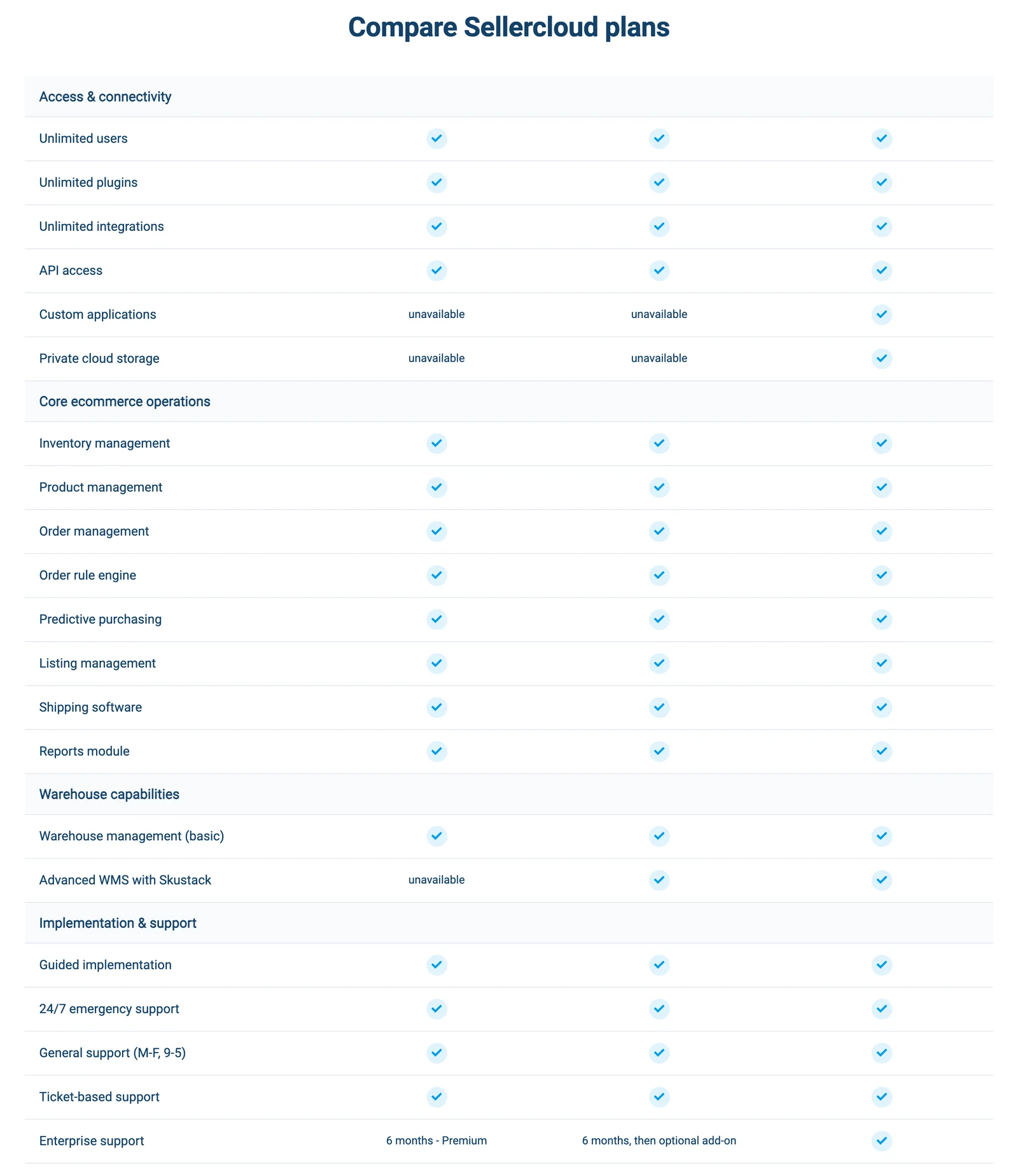
Every plan includes unlimited users, plugins and integrations, API access, inventory, product and order management, the order rule engine, predictive purchasing, listing management, shipping software, reports and basic warehouse management.
Growth adds advanced WMS with Skustack, the mobile app for picking, packing, receiving and inventory workflows. Enterprise adds custom applications and private cloud storage. Premium support is included for six months on Essentials and Growth, then becomes an optional add-on, according to the table.
Standard support is free on every plan, according to the FAQ: phone, email and the support portal from 9:00 a.m. to 5:00 p.m. EST on weekdays, plus an emergency phone line around the clock.
Sellercloud for Amazon sellers
Amazon is a native integration included in the subscription, according to the Sellercloud Amazon integration page. Here is its feature list.
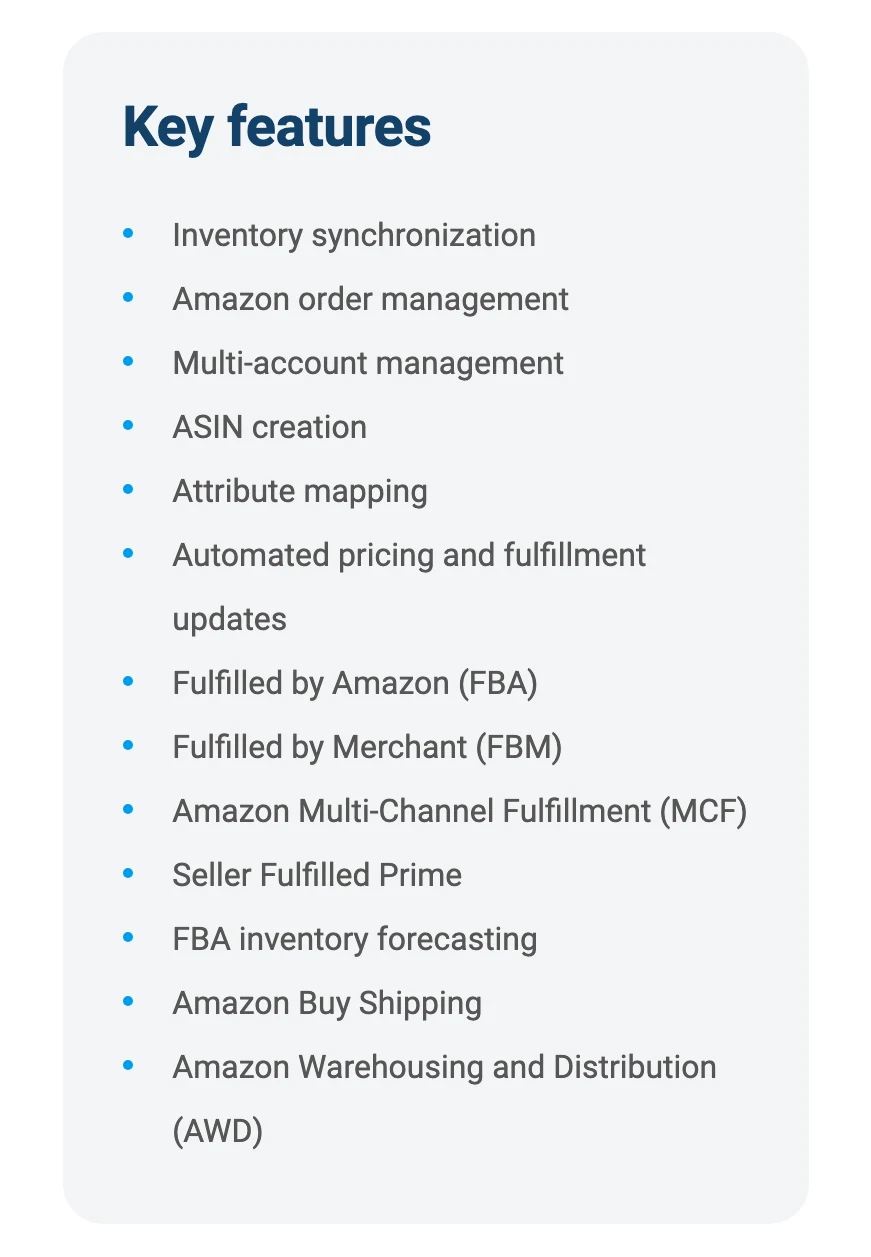
The useful parts for Amazon sellers are FBA inbound shipments and replenishment planning, Multi-Channel Fulfillment (MCF) to ship Walmart or Shopify orders from FBA stock, kits and multipacks tied to child SKUs, and several domestic and international Amazon seller accounts in one place.
Sellercloud also connects to repricers such as Feedvisor, Informed.co and Seller Snap, according to its integrations page. It doesn’t reprice by itself; our guide to the best Amazon repricers compares those tools.
🎯 Pro Insight: If nearly all your orders are FBA on one Amazon marketplace, Amazon already holds your stock count. An IMS earns its fee when you also ship merchant-fulfilled orders, sell on Walmart or eBay from the same units, or run your own warehouse.
Sellercloud reviews: what users say
In our Google check for “sellercloud review” on November 12, 2026, page one held an AI Overview, FeaturedCustomers, Capterra, Web Retailer, a LinkedIn post by Sellercloud and four Sellercloud pages, including its own “Top 5 Alternatives to Sellercloud” post from October 2024. We don’t quote third-party star ratings.
The recurring themes in those snippets: Sellercloud fits teams that treat it as an operations system with strict catalog rules, and the complaints are about cost, a long setup and a learning curve. That matches what Sellercloud publishes itself: a monthly minimum and six to eight weeks to go live.
Sellercloud on Reddit and the Amazon forums
Google shows two r/ecommerce threads, “Have you tried Sellercloud?” and “Inventory Management Systems – SellerCloud Vs ChannelAdvisor Vs others”, and an Amazon Seller Forums thread titled “Sellercloud Reviews?”. The Reddit threads are several years old, and Reddit blocks automated reading, so we summarize titles only.
Is Sellercloud legit, and is Sellercloud down?
Yes, Sellercloud is legit. It is a working platform owned by a listed logistics software company, with published prices, terms and a help center. According to its homepage, it has 1,000+ sellers.
If you think Sellercloud is down, check the public Sellercloud system status page first. The terms set a service level credit of 5% of the net service fees for each full hour of service level failure, which you have to report to claim.
What Sellercloud does well
- One stock count across channels. Inventory, orders and listings for Amazon, Walmart, eBay, Shopify and many retail channels in one catalog.
- Deep Amazon fulfillment. FBA inbound shipments, MCF, Seller Fulfilled Prime, AWD and Amazon Buy Shipping labels.
- No seat or connection fees. Unlimited users and integrations on every plan, according to the pricing page.
- Warehouse depth. Bins, lots, serial numbers, expiry dates, kits and, on Growth, mobile picking with Skustack.
- Published prices. Rare in this category: Linnworks and Rithum show no prices at all.
Where Sellercloud falls short
- High floor. According to the pricing FAQ, the $1,349 minimum applies whether you ship 500 or 3,750 orders a month.
- Annual commitment. A 12-month license and non-refundable fees, per the FAQ and terms.
- Slow start. About six to eight weeks to implement, according to the FAQ.
- Inconsistent channel counts. Its own pages say 45+, 50+, 150+ and “over 250” channel integrations, so ask for your exact channels.
- No listing monitoring. It pushes your data to Amazon but lists no alerts for hijackers, Buy Box loss or edits other sellers make.
Sellercloud alternatives and competitors
Pick a Sellercloud alternative by order volume and contract tolerance. Prices below come from each vendor’s own pricing page on November 12, 2026.
| Tool | Best for | Entry price, monthly | Trial | Contract |
|---|---|---|---|---|
| Sellercloud | Multichannel ops with a warehouse | $1,349 | Demo only | 12-month license |
| Linnworks | Multichannel ops, US, UK and Australia | Quote | Demo | – |
| Zentail | Amazon sellers adding Walmart | $300 plus usage | First month fee waived | Annual, or monthly on Walmart start |
| Cin7 Core | Inventory with accounting | $349 | Free trial | – |
| Finale Inventory | Inventory-first, 1 to 2 warehouses | $499 | Demo | 12, 24 or 36 months |
| Sellbrite | Small sellers, listings and stock sync | Free to $179 | 14 days | Monthly or annual |
| SellerChamp | Listing and sync, no lock-in | Quote | Demo | Month to month |
Linnworks
The Linnworks pricing page shows no prices: “Plans are priced on order volume, not revenue”, with add-on modules and a quote after a demo. It lists 100+ channel integrations. Linnworks is the closest like-for-like Sellercloud competitor, and its site has US, UK, Canadian and Australian versions.
Zentail
According to the Zentail pricing page, Base starts at $300 a month plus $0.10 per active listing and $0.50 per order, and Pro starts at $2,000 a month on an annual contract. The Walmart self-serve start runs month to month with the first month’s platform fee waived.
For an Amazon seller whose next step is Walmart, Zentail costs far less to try than Sellercloud.
Cin7 Core
Per the Cin7 pricing page, Cin7 Core Standard costs $349 a month for 5 users, 2 integrations and 6,000 sale orders a year, Pro $599 and Advanced $1,199 with warehouse management. It links to Xero and QuickBooks Online and offers a free trial. Watch the integration caps if you sell on many channels.
Finale Inventory
The Finale pricing page lists Essentials from $499 a month, Growth from $799 with a mobile barcode WMS, and Enterprise on request, with 40+ sales channel integrations. Finale is another Descartes product, so it is the inventory-first sibling for sellers who don’t need Sellercloud’s order routing.
Sellbrite
According to the Sellbrite pricing page, a free plan covers 30 orders a month, and Pro plans cost $29, $79 and $179 a month billed annually for 100, 500 and 2,000 orders. FBA orders don’t count toward the limit; the FBA integration costs $19 a month.
For a small Amazon FBA seller adding eBay or Etsy, Sellbrite does the listing and stock sync for a fraction of Sellercloud’s price.
SellerChamp
The SellerChamp pricing page quotes by SKU count, order volume, channels and features, with month-to-month plans and 20% off for annual billing. It says most sellers go live in 2 to 5 business days, a much shorter start than Sellercloud’s.
Rithum (ChannelAdvisor)
The Rithum site carries the ChannelAdvisor login and offers a demo, not a pricing page. It is an enterprise option for large brands that also want retail media and dropship programs.
For Amazon-first sellers who mostly need stock and profit numbers, see our best Amazon inventory management tools and our Sellerboard review.
Is Sellercloud worth it?
| Seller type | Worth it? | Why |
|---|---|---|
| Multichannel brand, own warehouse, 4,000+ orders a month | Yes | Stock sync, order routing and WMS in one system |
| 3PL serving marketplace sellers | Yes | Client inventory, FBA and WFS workflows, unlimited users |
| Amazon and Walmart seller, 1,000 to 3,000 orders | Maybe | You pay the full minimum; compare Zentail and Linnworks quotes |
| FBA-only seller on one marketplace | No | Amazon already tracks your stock |
| Under 500 orders a month | No | Sellbrite or Cin7 Core cost a fraction |
Pros & cons
| Pros | Cons |
|---|---|
| Inventory, orders, listings and WMS in one platform | From $1,349 a month, with a 12-month license |
| Unlimited users and integrations | Six to eight weeks to implement |
| FBA, MCF, AWD and multi-account Amazon support | No free trial; non-refundable fees |
| Per-order pricing with no revenue share | Premium support only for the first six months |
| Published prices and a public status page | Channel counts differ across its own pages |
When a monitoring tool makes more sense
Sellercloud controls what you send to Amazon: stock, prices and listing data. It doesn’t tell you what changes on the listing after that, such as another seller editing your title, Amazon suppressing the Buy Box or a fee going up.
SellerSonar does that part. It watches Amazon product pages and alerts you to changes, and it does no inventory sync, order routing, repricing or accounting, so it runs next to an IMS, not instead of one.
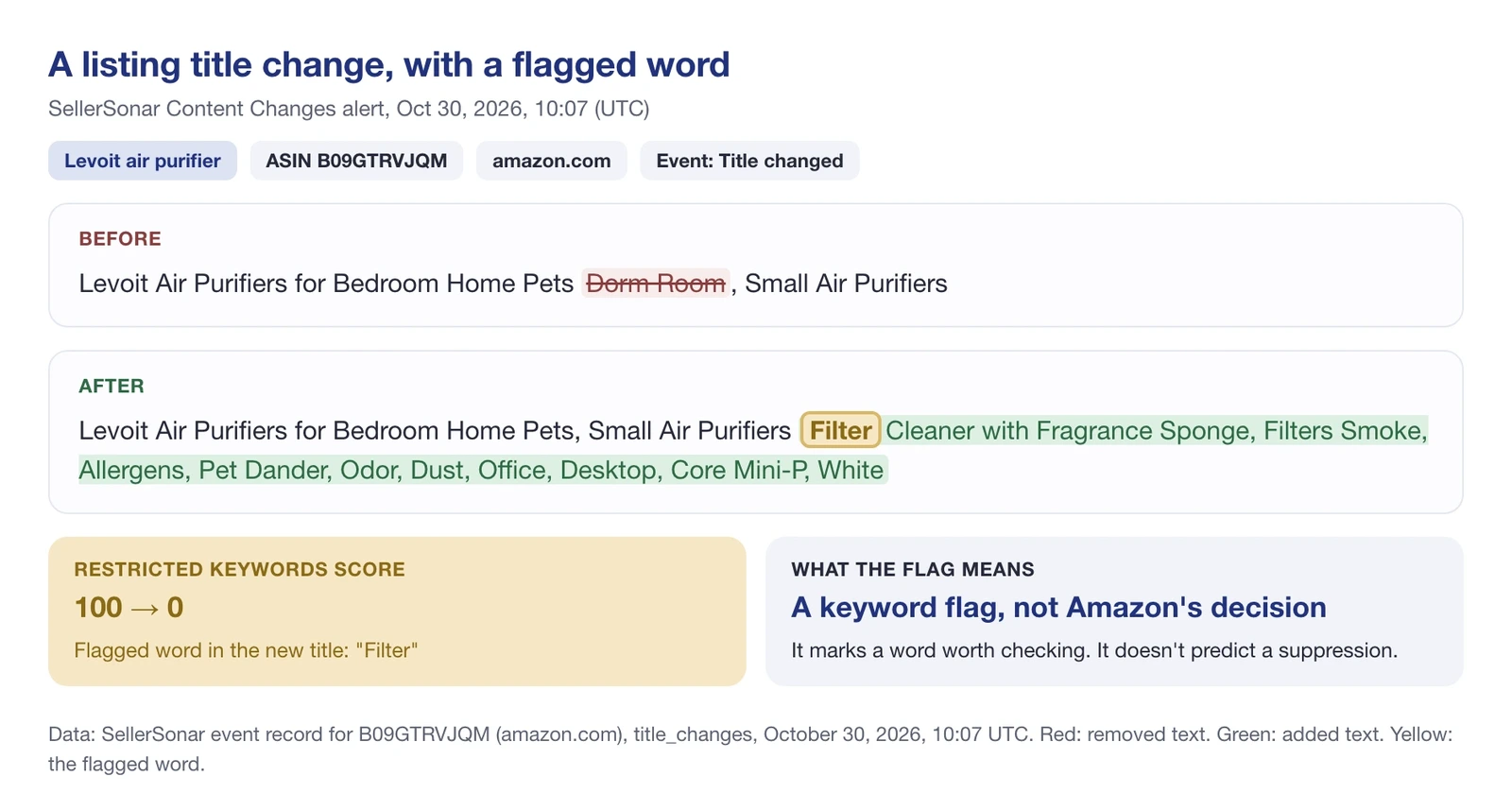
Its content change alerts cover the title, bullet points, description, images and brand, with the text before and after. That shows whether the title Amazon displays is still the one your catalog pushed.
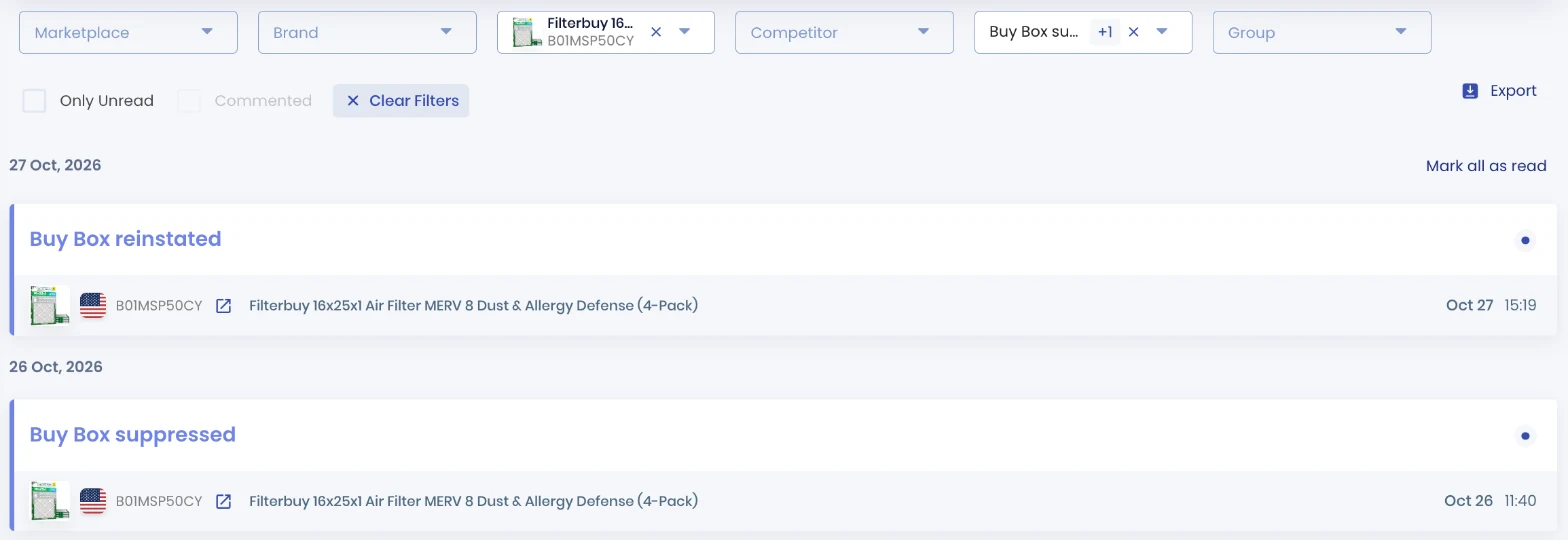
The retail issue alerts include Buy Box suppressed and reinstated, listing and search suppression, and FBA fee increased or decreased. Seller appeared alerts flag a possible hijacker; all Buy Box and pricing alerts are off by default, so switch them on in Delivery Settings.
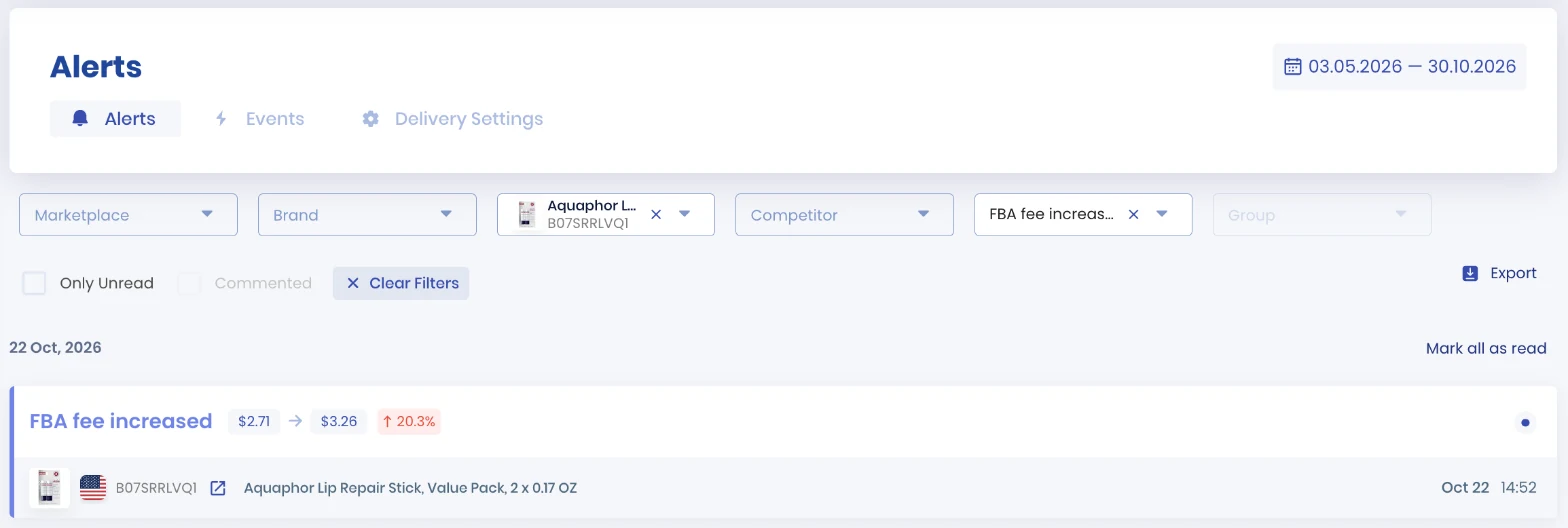
Here the FBA fee on a lip balm 2-pack rose from $2.71 to $3.26, up 20.3%, per SellerSonar data. The alert shows the total change, not which fee component moved.
According to SellerSonar’s plans, Pro costs $19.98 a month billed yearly for 150 ASINs checked every 4 hours, and Premium at $39.98 checks every 2 hours and adds the Buy Box tracker. It covers 23 Amazon marketplaces without a Seller Central connection.
📌 From Our Experience: Sellers who move to an IMS often assume the catalog now controls the listing. On shared ASINs it doesn’t: another seller’s contribution or an Amazon catalog update can change the title or images. Watch your top 20 ASINs during the migration weeks, when nobody is sure which system is the source of truth.
If a new seller does appear on your listing, our guide on how to remove an Amazon hijacker covers the next steps.
Final Expert Recommendations:
Choose Sellercloud if you ship thousands of orders a month across Amazon, Walmart and other channels from your own warehouse or a 3PL, and you can commit to a year and a six to eight week setup. Get Linnworks and Zentail quotes alongside it. If you sell mostly through FBA or ship under a thousand orders a month, start with Sellbrite or Cin7 Core, and add listing monitoring for the ASINs that matter most.
Start your free 14-day SellerSonar trial and see what’s happening on your listings today.
Related: Sellerboard pricing · InventoryLab pricing · Teikametrics review · Amazon FBA vs FBM

