





Verdict: Sellozo is Amazon PPC software with a flat fee: $250 a month for one marketplace plus $50 for each extra marketplace, with no percentage of ad spend, according to Sellozo’s pricing page. The fee is a bargain at high ad spend and expensive at low spend, and Sellozo itself says sellers spending under $2,000 a month on ads are a poor fit.
Best for: brands spending roughly $10,000 or more a month on Amazon ads that want keyword harvesting and bid automation without a spend fee. Look elsewhere if: your ad budget is small, you want a refund-friendly contract, or you need alerts about sellers and the Buy Box on your listings.
This Sellozo review covers pricing, the trial and cancellation terms, how the automation works and where it falls short. Every Sellozo fact comes from sellozo.com, its user guide, its terms or Wayback Machine copies of its pricing page, read on November 12, 2026.
Disclosure: SellerSonar publishes this review. SellerSonar monitors Amazon listings and doesn’t manage ads, so it competes with Sellozo only on tracking; we say where Sellozo is the better choice and link every fact to Sellozo’s own pages.
What is Sellozo?
Sellozo is an Amazon advertising platform. Its user guide calls it “an analytics and growth suite” whose “custom-built PPC automation and optimization platform lets Amazon sellers drive more sales, increase profitability, and lower their ACoS.”
The app has five main parts:
- PPC Manager and the optimizer: bids, negatives and new keywords for Sponsored Products, Sponsored Brands, Sponsored Display and RAS campaigns.
- AutoPilot: launches and runs whole campaign sets from a budget and a target ACoS.
- Campaign Studio: drag-and-drop keyword harvesting between auto, broad, phrase and exact campaigns.
- AI Dayparting and budget rules: hour-by-hour ad scheduling.
- ProductVu and Financial Reports: profit per SKU after fees, COGS and ad spend, plus a rule-based repricer.
Is Sellozo legit?
Yes, it’s an established company. Sellozo’s About page says it was “Founded in 2017”, and its May 2022 release notes announce “Sellozo is now an Amazon Advanced Partner!”
Its terms are governed by Delaware law. The newest entry on its release notes page is dated July 2025, so ask what has shipped since.
Sellozo pricing at a glance
Sellozo prices by marketplace, not by ad spend or SKU count. Here is what the Sellozo pricing page and its agency pricing page show on November 12, 2026:
| Plan | Price | What changes the bill | Trial |
|---|---|---|---|
| Sellozo Platform | $250/mo for 1 marketplace | +$50 per extra marketplace, up to 20 | 30 days |
| Agency Plan | $250/mo per seller account | +$50 per extra marketplace per account | 30 days |
| Strategic Management | Set by the partner agency | Free matching with a Sellozo agency | – |
So how much does Sellozo cost? One marketplace is $3,000 a year, and a seller on the US, Canada and Mexico pays $350 a month, per Sellozo’s own calculator. All 20 marketplaces come to $1,200 a month.
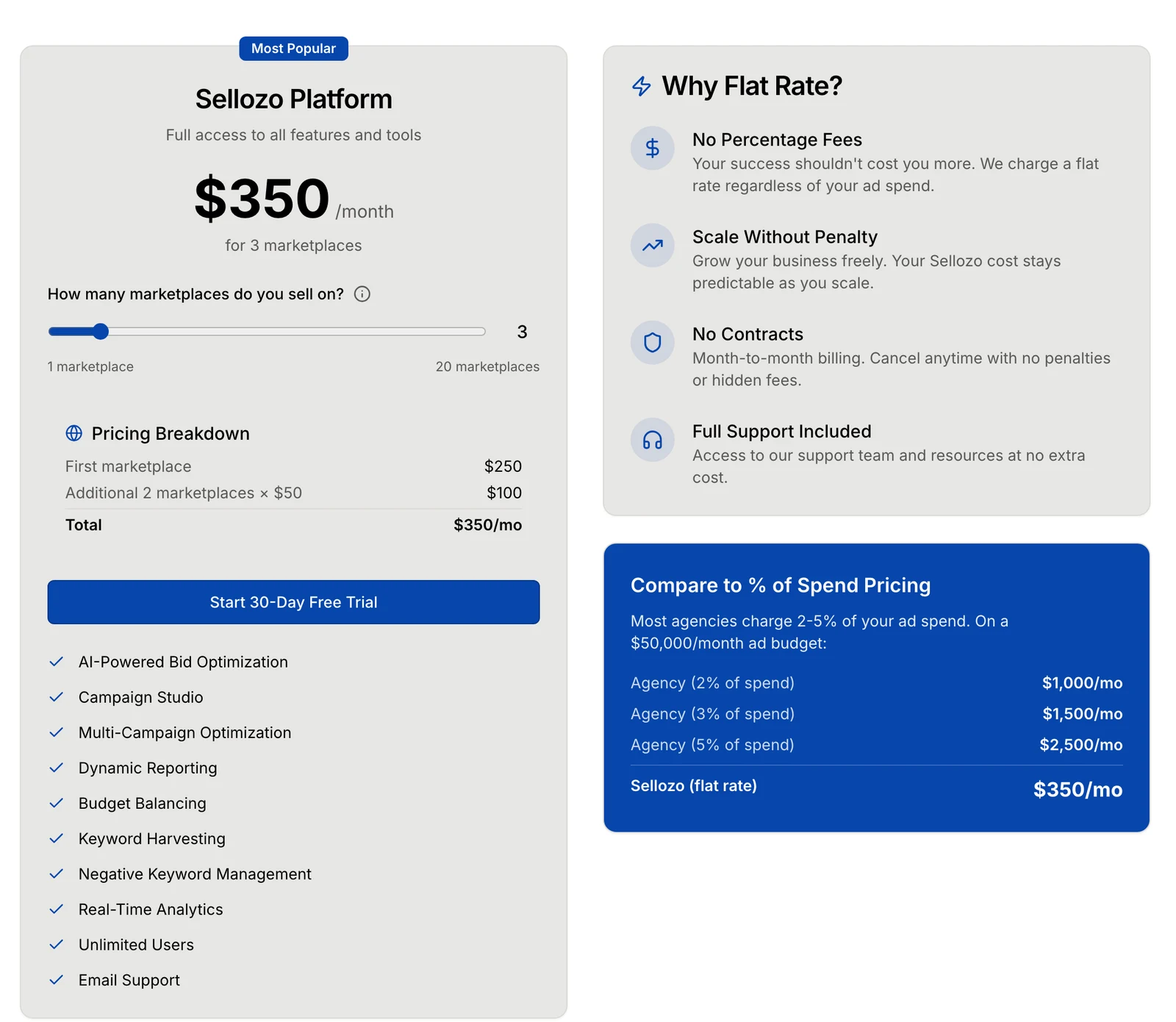
Sellozo publishes no annual price, and the card says “Full access to all features and tools”. Its checklist names bid optimization, Campaign Studio, budget balancing, keyword harvesting, unlimited users and email support, but not the repricer or dayparting, so confirm both are in your plan before you start.
Where the flat fee beats a percentage
Many PPC tools charge a share of ad spend. At 3%, the fee reaches Sellozo’s $250 at about $8,300 a month in ad spend; with three marketplaces at $350, the break-even moves to about $11,700, per Sellozo’s listed prices and our math.
According to Sellozo’s pricing page, at $50,000 a month in spend an agency charging 3% costs “$1,500/mo” against Sellozo’s flat rate. Below the break-even, a flat fee costs you more than a percentage would.
Sellozo promo codes, coupons and discounts
Sellozo’s site shows no coupon or promo code, and the pricing page has no discount field. The only discount it mentions is “Volume discounts available for large agencies”, on the agency services page.
Many Sellozo “deals” online are referral links. Sellozo’s referral program pays partners a “10% Lifetime Commission” on “every payment your referrals make”, so a review with a signup link may earn from your subscription.
What changed in Sellozo pricing, 2023 to 2026
Sellozo has changed its pricing model three times since 2023, per Wayback Machine copies of its pricing page:
- March 2023: the Platform plan cost $149, $299 or $399 a month by SKU count (0-10, 11-1,000, 1,001+), with a 14-day trial, per the March 26, 2023 copy. Managed Ads started at $1,750 a month.
- October 2024: the October 2024 release notes announce “the return of our self-serve plan” in three SKU tiers.
- July 2025 to January 2026: no public price. The January 23, 2026 copy says “Reach out to us for a personalized quote” and offers Self-Serve “TRY FREE FOR 14 DAYS”.
- April 2026: $250 a month for the first marketplace and a 30-day trial, per the April 18, 2026 copy.
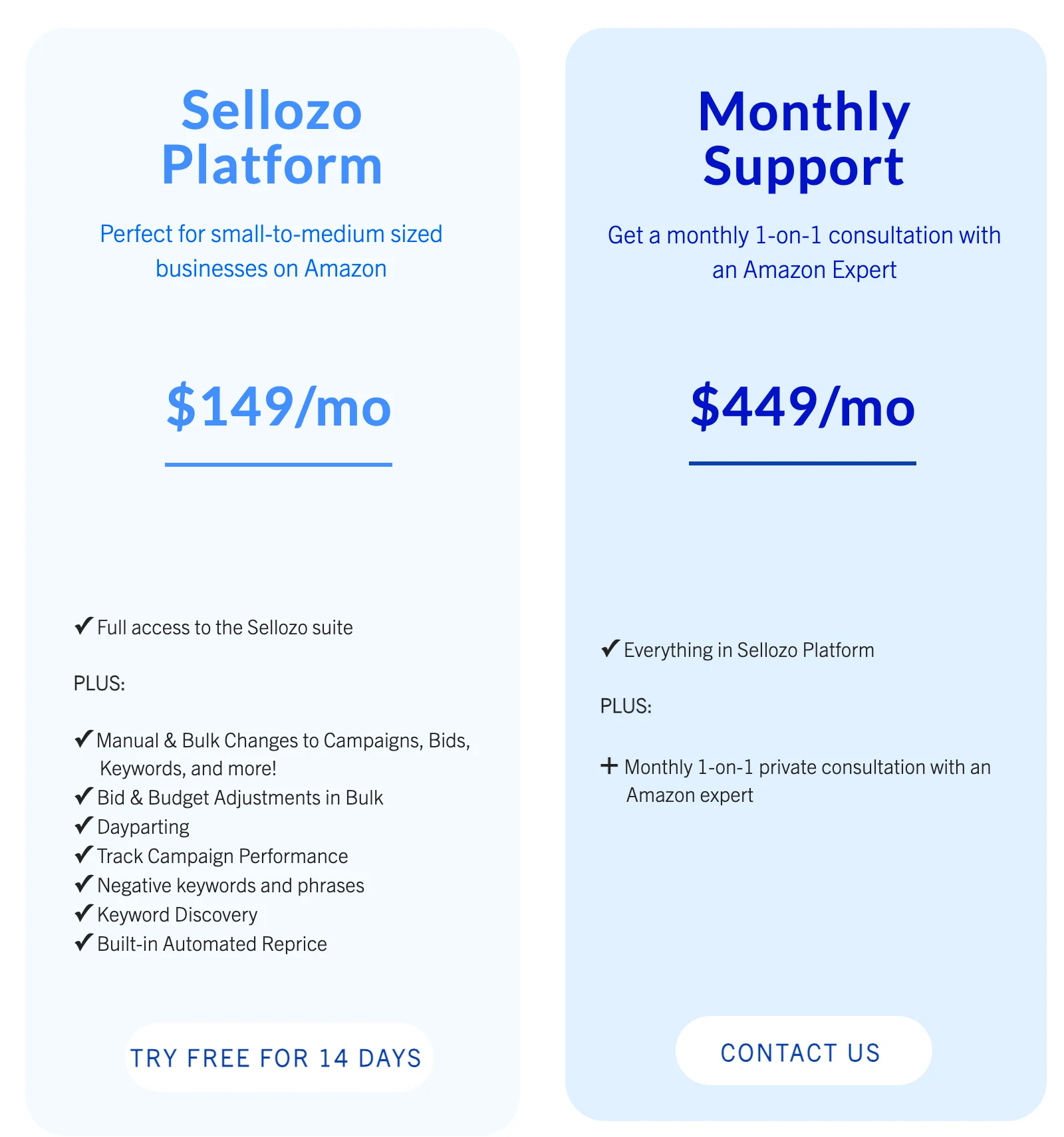
A review quoting $149 a month describes the 2023 plan, per Sellozo’s archived pricing page, and that plan is gone.

The managed tiers left the pricing page in 2026. Done-for-you management now runs through partner agencies.
Sellozo free trial, contract and cancellation
Every pricing card offers a “Start 30-Day Free Trial” button, and the pricing page promises “Month-to-month billing. Cancel anytime with no penalties or hidden fees.”
Plan on giving a card. Sellozo’s terms of use (last updated January 1, 2026) say “to use our Services, you must provide a valid credit card”, and you sign in to your Amazon seller account so Sellozo can “view and make changes to your marketing strategy and spend”.
Can you cancel Sellozo anytime?
Yes, but by email and on time. The terms say you “must cancel your subscription at least 24 hours prior to the start of the new term” by writing to support, “or you may be charged for the next term”.
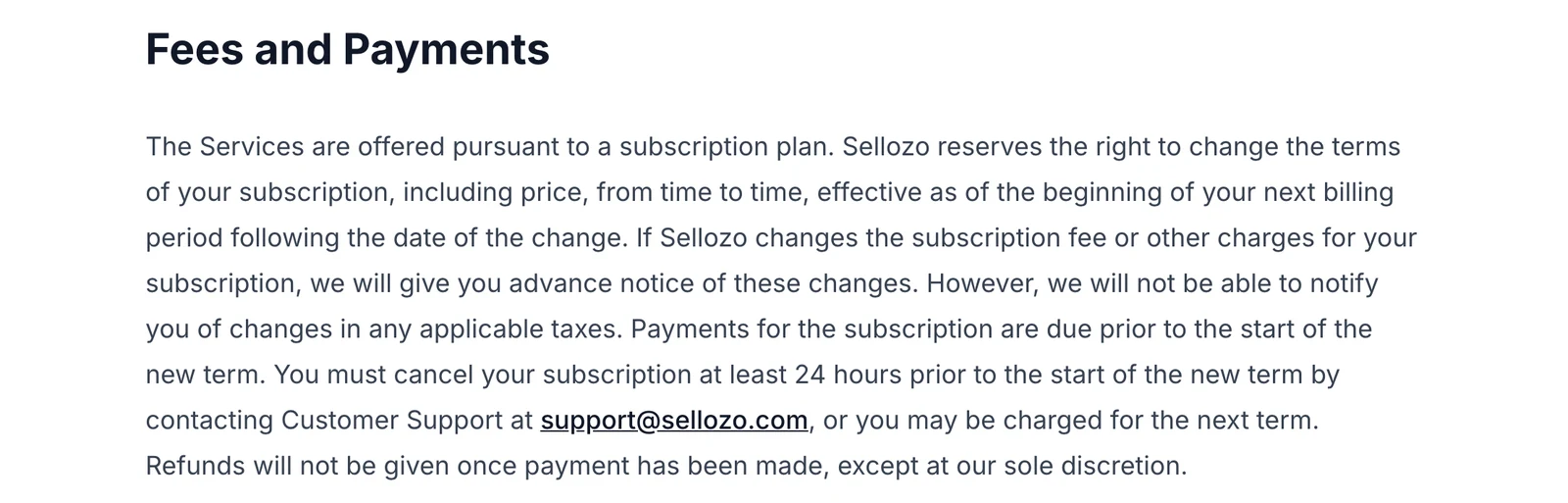
Refunds are rare: “Refunds will not be given once payment has been made, except at our sole discretion.”
💡 Expert Tip: On the day you start the Sellozo trial, put a reminder two days before it ends. If you’re not staying, email support then and keep the reply, because the terms put the deadline at 24 hours before the next term.
How Sellozo automates your ads
You set a target ACoS per campaign and switch the optimizer on. Per the user guide, “The optimizer runs once per day, adjusting bids, setting negative keywords, and adding new converting keywords.”
AutoPilot goes further, per Sellozo’s user guide: you pick products, a total daily budget and an ACoS target, and it builds the campaigns. “25%” of the group budget “goes to the Auto campaign” and “75%” is split among the manual campaigns, and AutoPilot sets top-of-search and product page multipliers “to 5% as a best practice”.
Dayparting cuts hours, not bids. According to the user guide, when spend reaches 90% of budget, “The system pauses the campaign during the hour with the highest ACoS”, one hour per day, and reactivates hours once spend drops below 90%.
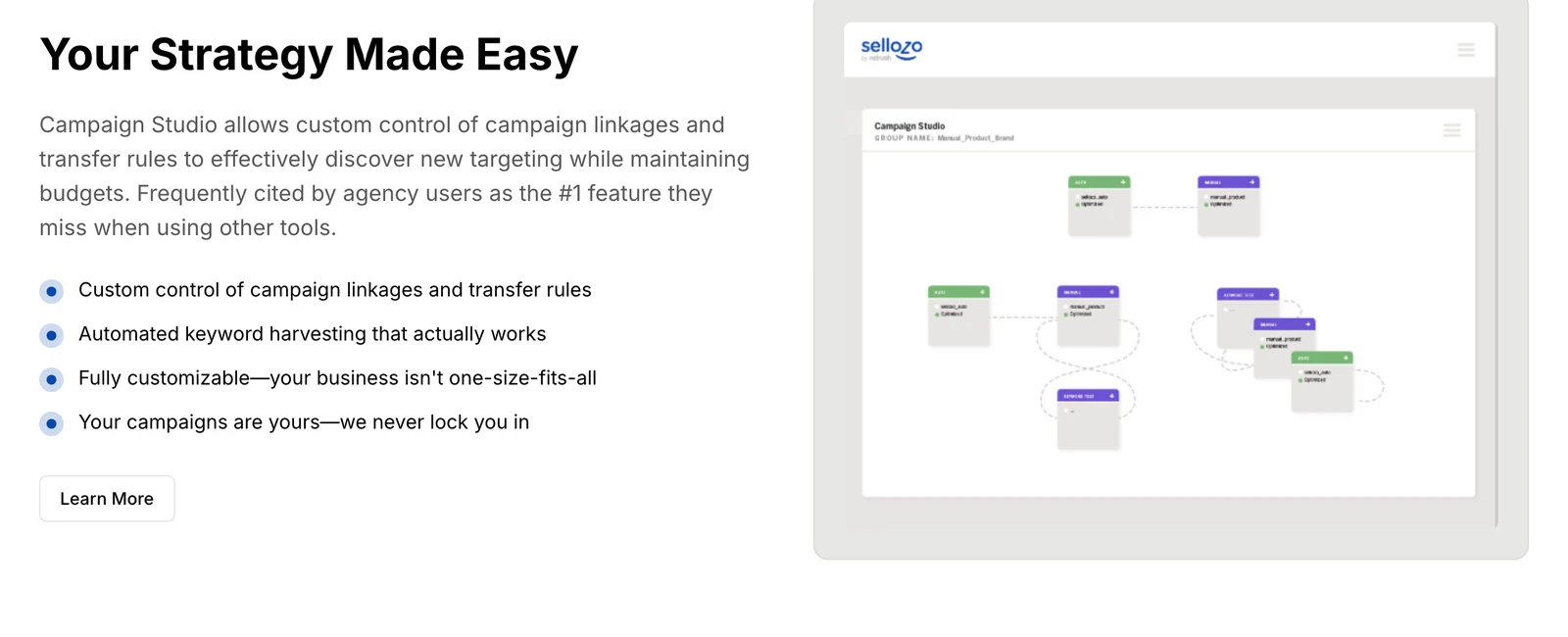
Campaign Studio is the part agencies cite. You link campaigns and set transfer rules; the Campaign Studio page says it will “Automatically harvest new targets daily from your auto, broad, phrase, and category campaigns.” The user guide lists ready-made patterns such as Auto-Broad-Phrase-Exact, and AutoPilot moves an ASIN target after 1 or 2 conversions, depending on the discovery level.
Who Sellozo is for, in its own words
Sellozo’s Why Sellozo page is unusually frank. Its best-fit customers “have $1M to $25M in annual Amazon revenue, spend between $10K and $150K per month on advertising” and “manage 10 to 250 ASINs”.
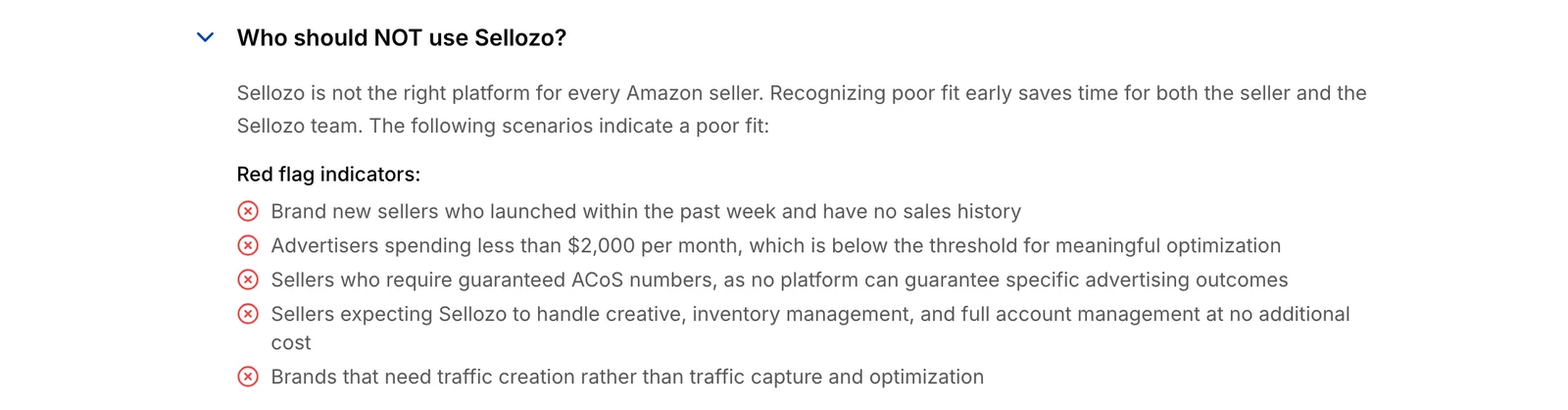
According to the same page, red flags include “Advertisers spending less than $2,000 per month”, brand-new sellers with no sales history, and anyone expecting “creative, inventory management, and full account management at no additional cost”. It names supplements, CPG, beauty, pet products and consumables as the best categories.
What Sellozo does well
A fee that doesn’t grow with spend
A brand going from $20,000 to $80,000 a month in ad spend pays the same $250 on one marketplace, per Sellozo’s pricing page, while a 3% tool’s fee would rise from $600 to $2,400.
Keyword harvesting you can see
Campaign Studio shows each campaign as a node and each transfer rule as a link, so you can read why a keyword moved. Patterns are editable, and the guide says SB-to-SB transfers default to 5 conversions “because SB campaigns are more expensive”.
Profit next to ad data
The dashboard combines ad spend with FBA fees, commission, COGS and shipping into a True Profit figure.
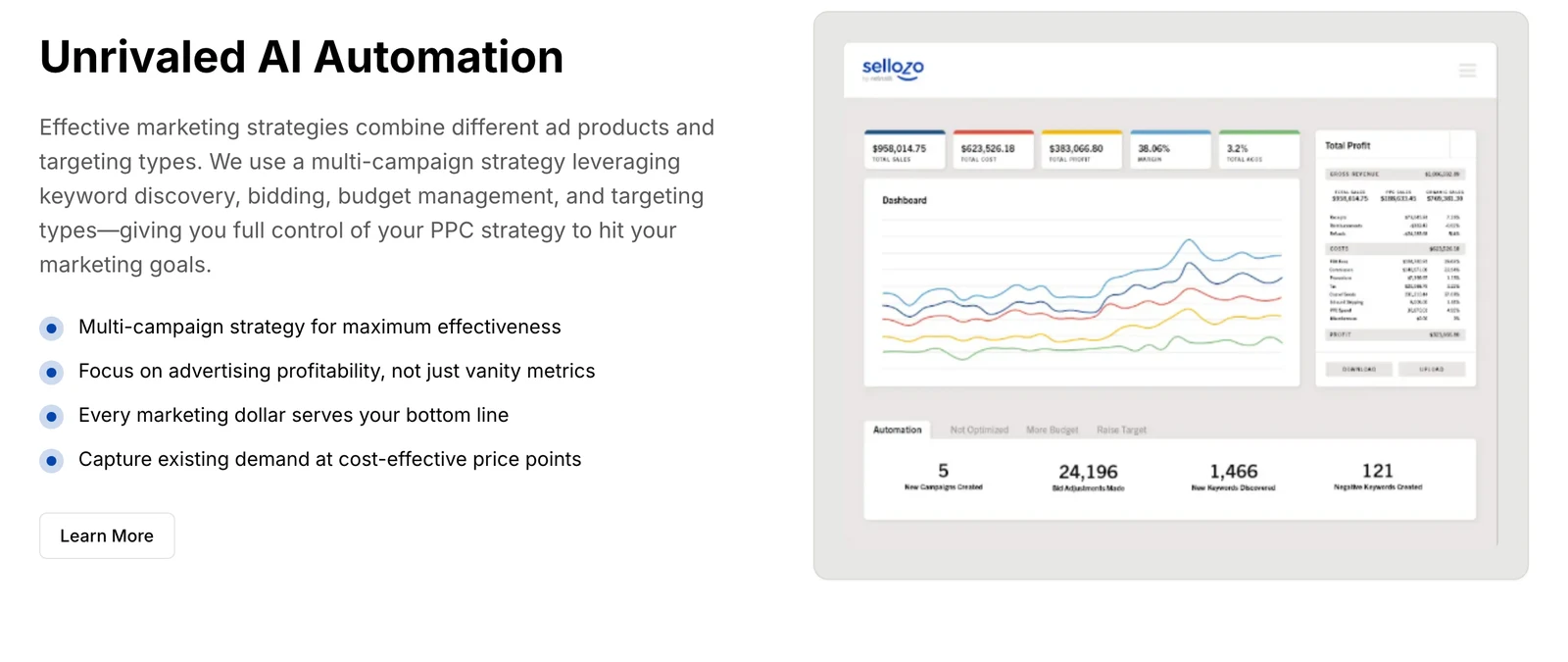
Per the user guide, Total ACoS is “PPC Spend / Total Sales x 100”, which is TACoS by another name.
Rules for sellers who like control
Client Scripts let you write bid and negative rules, test them with a dry run and schedule them, per the user guide.
Where Sellozo falls short
- Expensive at low spend. At $1,000 a month in ads, the $250 fee is a quarter of your ad budget, per Sellozo’s pricing page, and Sellozo itself flags spend under $2,000.
- Daily, not hourly, bidding. The optimizer runs “once per day”, per the user guide.
- Amazon only, 20 marketplaces. The pricing page lists 20; Belgium, Ireland and Egypt aren’t among them, and the Walmart tool from the 2023 release notes isn’t on the site.
- Cancellation by email, no refunds. Per the terms quoted above.
- Few public updates. No release notes after July 2025.
- No listing alerts. ProductVu shows “Buy Box winning status and history” for your SKUs, per the guide, but nothing we read describes alerts for a new seller on your listing, a title change or a suppressed Buy Box.
Sellozo alternatives and how they compare
Most Sellozo competitors charge a percentage of ad spend. Prices on November 12, 2026, from each vendor’s pricing page:
| Tool | Entry price | Pricing model | Free trial |
|---|---|---|---|
| Sellozo | $250/mo, 1 marketplace | Flat, +$50 per marketplace | 30 days |
| Teikametrics | $149/mo yearly, up to $10K spend | Custom + 3% over $10K | 30 days |
| Perpetua (ex-Sellics) | $695/mo, up to $10K spend | $695 + % of spend over $10K | – |
| Ad Badger | $660/mo flat at $75K spend | Flat monthly fee | 30 days |
Teikametrics Essentials costs “$149 / month” on annual billing for up to $10,000 in ad spend, per the Teikametrics pricing page, and our review found it changes Amazon bids hourly. Under $10,000 it’s cheaper than Sellozo; above it, the 3% fee makes Sellozo cheaper. Our Teikametrics review covers its contract terms.
Perpetua, which absorbed Sellics, charges “$695 /mth” up to $10,000 in spend, per Perpetua’s pricing page; see our Sellics alternatives guide. Ad Badger is the other flat-fee option: its pricing calculator shows “$660 /mo, flat” at $75,000 in spend.
All-in-one suites bundle PPC with research tools. “Sellozo vs Helium 10” means Sellozo against Adtomic, covered in our Helium 10 review, and SellerApp’s ad automation is in our SellerApp review.
Is Sellozo worth it?
It depends on your monthly ad spend and how many marketplaces you run:
| Seller type | Verdict | Why |
|---|---|---|
| Under $2K/mo ad spend | Not worth it | Sellozo calls this a poor fit; the fee eats the budget |
| $2K to $8K/mo, one marketplace | Compare first | A 3% tool or Teikametrics Essentials costs less |
| $10K to $150K/mo, Amazon only | Strong fit | Flat $250 against a fee that grows with spend |
| Agency with 5 to 50 accounts | Worth a trial | $250 per account, white-label reports, volume discounts |
| Brand also on Walmart or TikTok Shop | Look elsewhere | Sellozo’s site covers Amazon only |
🎯 Pro Insight: Before the trial ends, divide $250, plus $50 per extra marketplace per Sellozo’s pricing page, by your monthly ad spend. If that’s above 3%, a percentage tool is cheaper; if it’s below, Sellozo wins on fee alone, and the trial only has to prove the bidding.
Sellozo pros and cons
| Pros | Cons |
|---|---|
| Flat $250 a month, no percentage of spend | Costly for sellers under $2K/mo in ads |
| Visual keyword harvesting in Campaign Studio | Optimizer adjusts bids once a day |
| Profit and TACoS next to ad data | Cancel by email 24 hours ahead, no refunds |
| Unlimited users, 30-day trial | Amazon only, 20 marketplaces |
| Dayparting, budget rules and scripts | No alerts for new sellers or listing changes |
When a monitoring tool makes more sense
An ad tool assumes your listing can sell. The Amazon Ads FAQ says: “If your product isn’t the Featured Offer or is out of stock, your ad will not display.” If a hijacker takes the Buy Box, your Sponsored Products ads on that ASIN stop, and Sellozo’s daily optimizer only sees fewer clicks.
SellerSonar watches that side: the Buy Box, sellers, prices and listing content on any ASIN, with no Seller Central connection.
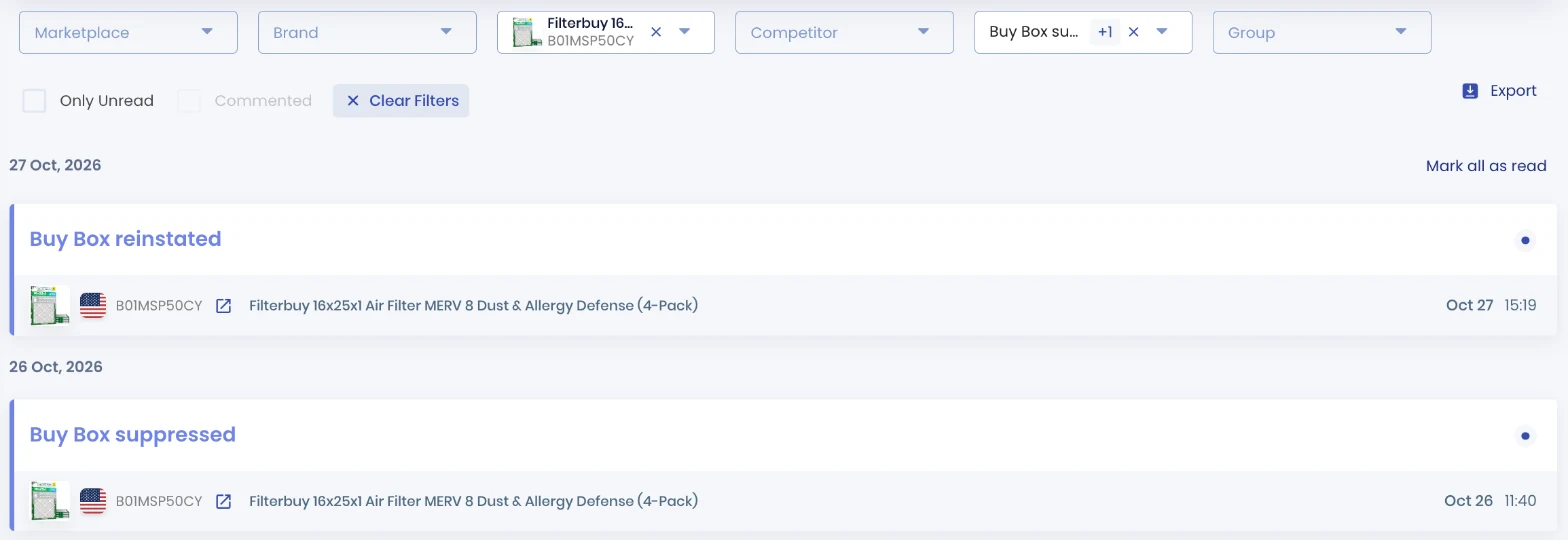
Buy Box suppressed is one of SellerSonar’s retail issues alerts, on every plan. For about a day, ads on that ASIN had no Featured Offer to point to.
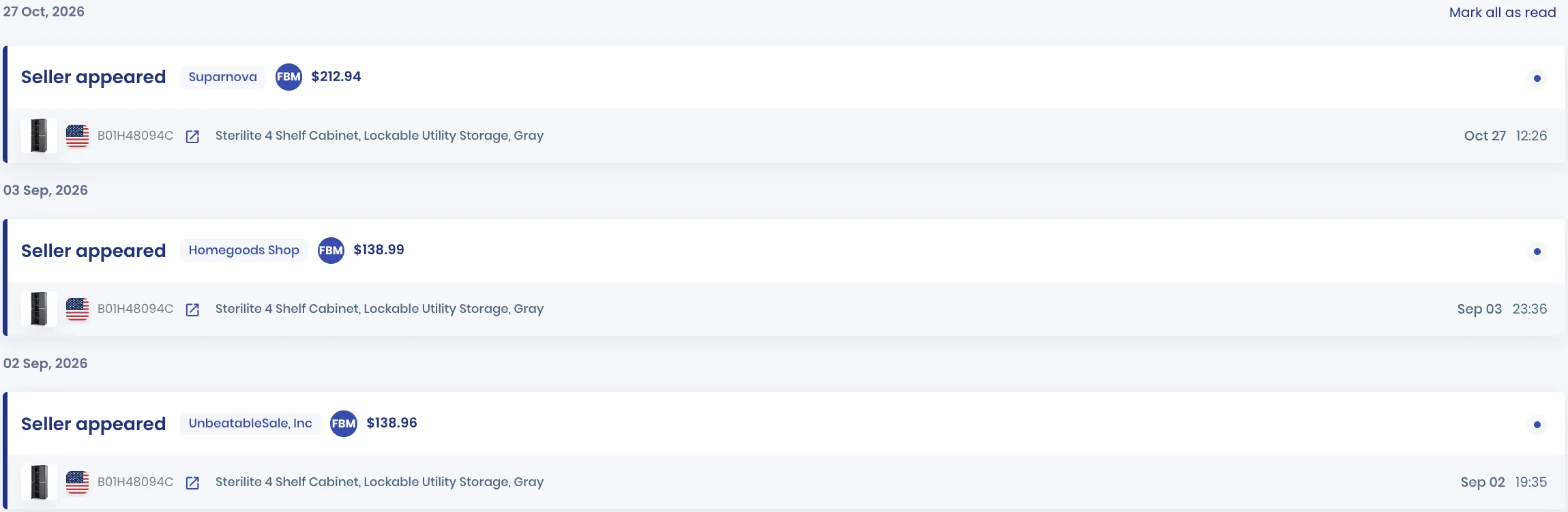
Seller appeared and seller price alerts come with every plan, per SellerSonar’s plans page, while Buy Box Won and Lost alerts start on Premium. Pro costs $19.98 a month billed yearly for 150 ASINs checked every 4 hours; Premium costs $39.98 for 300 ASINs every 2 hours.
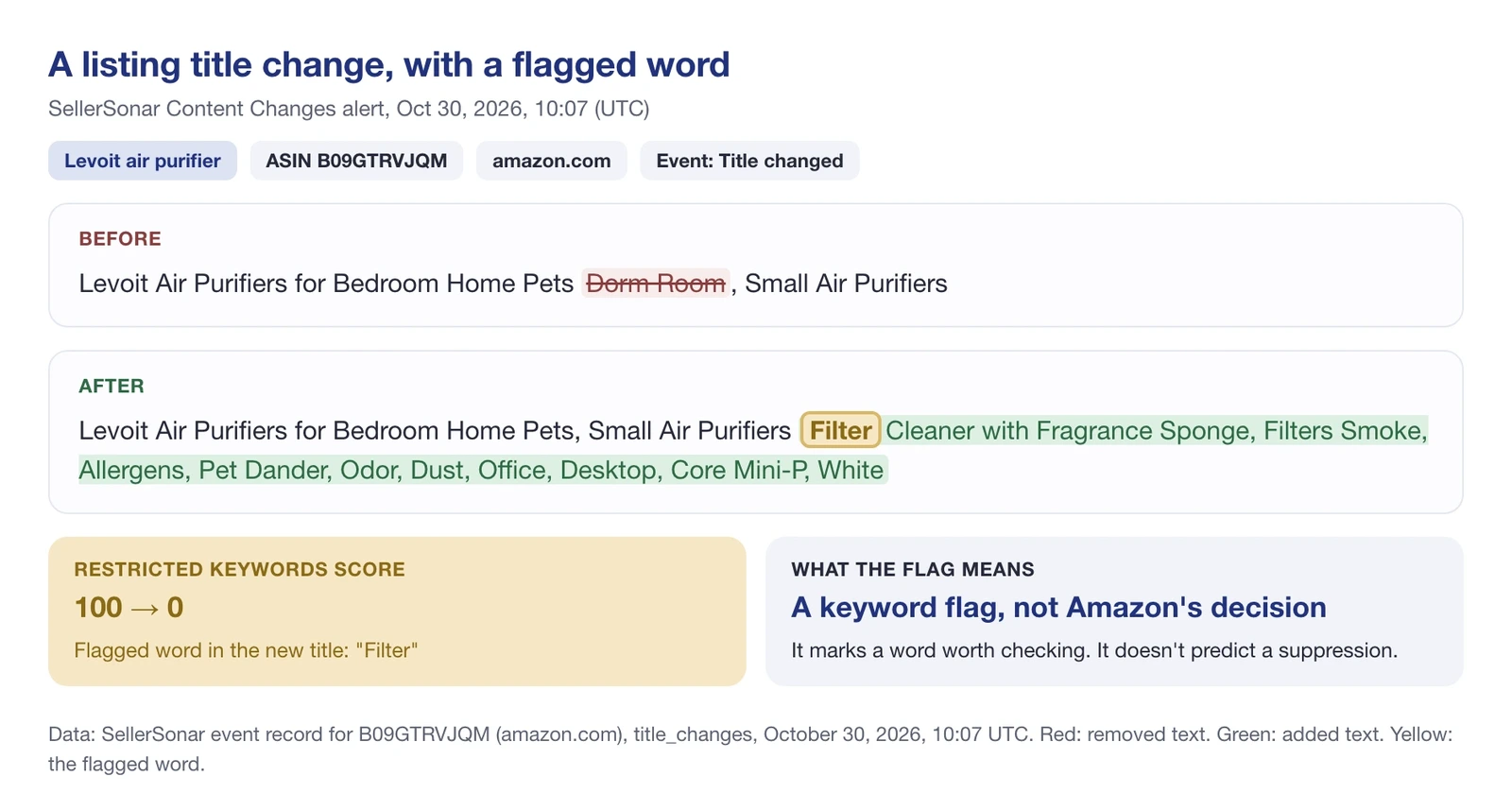
A changed title can cut conversion while the bidder keeps paying for clicks. SellerSonar’s content change alerts show the old and new text, and the Buy Box Tracker shows each seller’s daily Buy Box share from Premium up, on 23 Amazon marketplaces.
SellerSonar doesn’t set bids, harvest keywords or reprice. It works next to Sellozo: Buy Box and pricing alerts explain the drops an ad tool can’t. For bid tactics, see our Amazon PPC strategies guide, and for repricing tools, our best Amazon repricers comparison.
📌 From Our Experience: When you add your ASINs to SellerSonar, also add the competitor ASINs you target with product ads. A price cut or a new seller on their listing explains a sudden change in your ACoS better than any bid report.
Final Expert Recommendations:
Start the Sellozo trial if you spend $10,000 or more a month on Amazon ads and want flat-fee automation, at $250 a month for one marketplace per Sellozo’s pricing page. Below about $8,000 in spend, price Teikametrics Essentials or a percentage tool first. Either way, note the 24-hour cancellation rule on day one, and add Buy Box and seller alerts, because no bidder can tell you why your ads stopped showing.
Start your free 14-day SellerSonar trial and see what’s happening on your listings today.
Related: Amazon ad types · What is the Amazon Buy Box? · Amazon listing hijacking · Seller Labs review

