





Verdict: DataHawk is an Amazon and Walmart analytics platform that pulls your Seller Central, Vendor Central and Ads data into dashboards and a hosted Snowflake or BigQuery database, and its documentation lists Standard at $299 a month, Growth at $599 and custom Enterprise pricing. SellerSonar is a monitoring tool from $19.98 a month billed yearly that checks any ASIN as often as every hour and alerts by email or Slack, with no Seller Central connection.
Best for: brands and agencies that need profit, advertising and multi-channel reporting in their own BI tools. Look elsewhere if: you need alerts more than once a day, or a tool that costs less than $100 a month.
DataHawk and SellerSonar both watch Buy Box owners, prices and listing content, but they do different jobs. DataHawk is a reporting layer for your own accounts, with daily data and a daily alert email. SellerSonar checks public product pages through the day and tells you what changed.
Disclosure: SellerSonar publishes this comparison and competes with DataHawk in Buy Box, content and keyword monitoring, so we say where DataHawk is the better choice. Every DataHawk price, limit and quote below was read on datahawk.co, its documentation, pricing calculator, changelog and incident log on November 4, 2026. We did not sign up for a DataHawk account.
DataHawk vs SellerSonar at a glance
Per each vendor’s documentation and plans pages, as of November 4, 2026.
| Feature | DataHawk | SellerSonar |
|---|---|---|
| Main job | Analytics and BI: sales, profit, ads, inventory, market share | Listing, Buy Box, competitor and keyword monitoring with alerts |
| Data source | Your connected Amazon and Walmart accounts, plus public product data | Amazon’s public pages, no account connection |
| Marketplaces | 17 Amazon marketplaces plus Walmart | 23 Amazon marketplaces |
| Alert checks | Once a day | Every 4 hours (Pro), 2 hours (Premium), 1 hour (Business) |
| Alert delivery | One daily email per recipient group at 12pm CET | Email or Slack, as found or as a daily or weekly report; webhooks on Business |
| Tracked products | 50 (Standard), 200 (Growth) | 150 (Pro), 300 (Premium), 500 (Business) |
| Tracked keywords | 50 organic (Standard), 200 (Growth) | 500, 2,000 and 3,000, organic and sponsored |
| Profit, ads and inventory analytics | Yes | No |
| Data warehouse and BI | Snowflake, BigQuery, Power BI, Looker Studio, Sheets, Excel | Data export; API on Enterprise |
| MCP | Every package, read-only, in beta | Business and Enterprise, read and write |
| Free trial | 14 days, no card, 50 products and 50 keywords | 14 days, 5 ASINs and 10 keywords |
| Entry price | $299/mo (Standard) | $19.98/mo billed yearly, $23.98 monthly |
What is DataHawk?
DataHawk describes itself as “an end-to-end eCommerce analytics platform that automatically gathers every datapoint from Amazon and Walmart” on its FAQ page. It is sold to brands, agencies and high-volume sellers, not to new sellers.
Ownership changed in 2025. DataHawk’s changelog records that Worldeye Technologies acquired DataHawk on April 15, 2025, and DataHawk now sits in the Seller Suite network with BidX (ad automation), Intellifox and Spotlight. Each Seller Suite app keeps its own account, per that site’s FAQ.
Most of the product is reporting: a managed Snowflake or BigQuery database per customer, plus Power BI and Looker Studio templates for seller, vendor, advertising and market views. On top sit Alerts, an AI Copywriter, an AI agent called Sherlock and an MCP server.
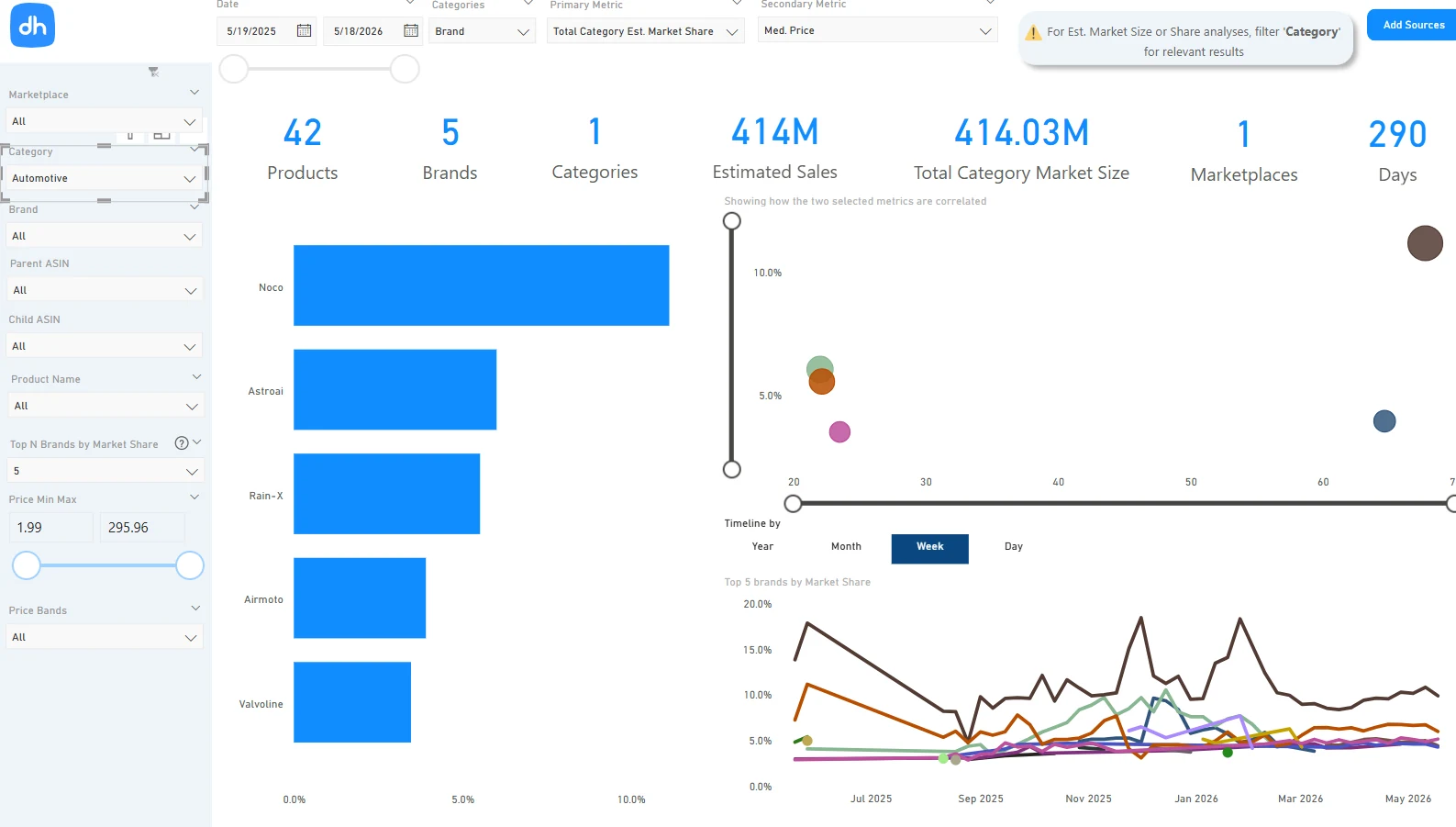
That is the screen DataHawk is built around: category share, estimated sales and brand trends, refreshed daily.
DataHawk pricing in 2026
DataHawk’s website and its documentation tell two stories. The DataHawk pricing page says “Custom pricing available with annual plans tailored to your business” and sends every button to a demo form.
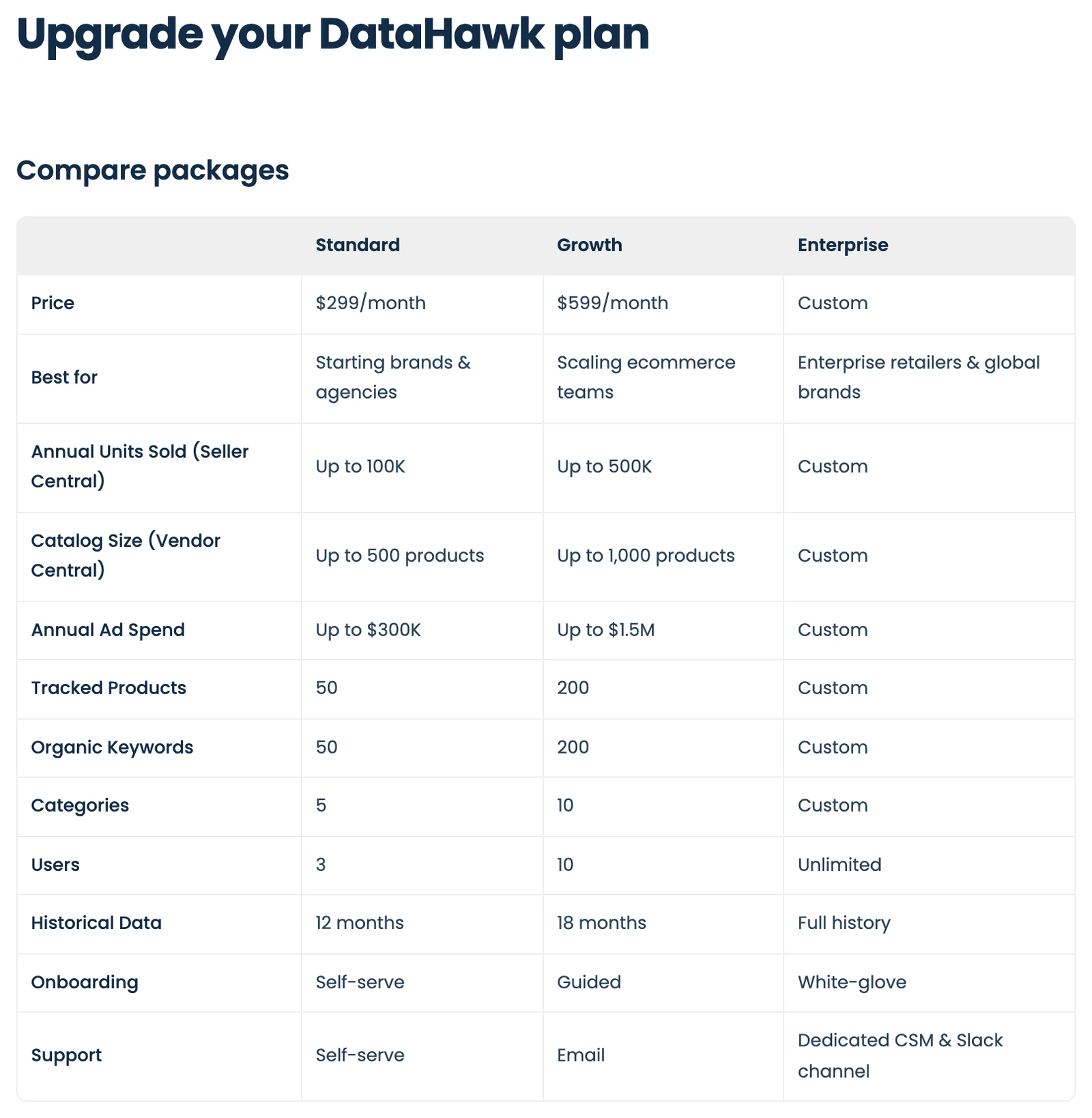
The documentation is specific. Its Upgrade your DataHawk plan page says “Standard costs $299/month, Growth $599/month, and Enterprise has custom pricing.” You upgrade by emailing sales for a Stripe payment link.
| Package | Price | Tracked products | Organic keywords | Categories | Users | History | Seller Central units a year | Ad spend a year |
|---|---|---|---|---|---|---|---|---|
| Standard | $299/mo | 50 | 50 | 5 | 3 | 12 months | Up to 100K | Up to $300K |
| Growth | $599/mo | 200 | 200 | 10 | 10 | 18 months | Up to 500K | Up to $1.5M |
| Enterprise | Custom | Custom | Custom | Custom | Unlimited | Full history | Custom | Custom |
Every package includes Alerts, AI Copywriter, Sherlock, DataHawk MCP, dashboard templates and direct database access, per the same page. Limits count per marketplace, so one product tracked on Amazon US and Amazon UK uses 2 of Standard’s 50 slots.
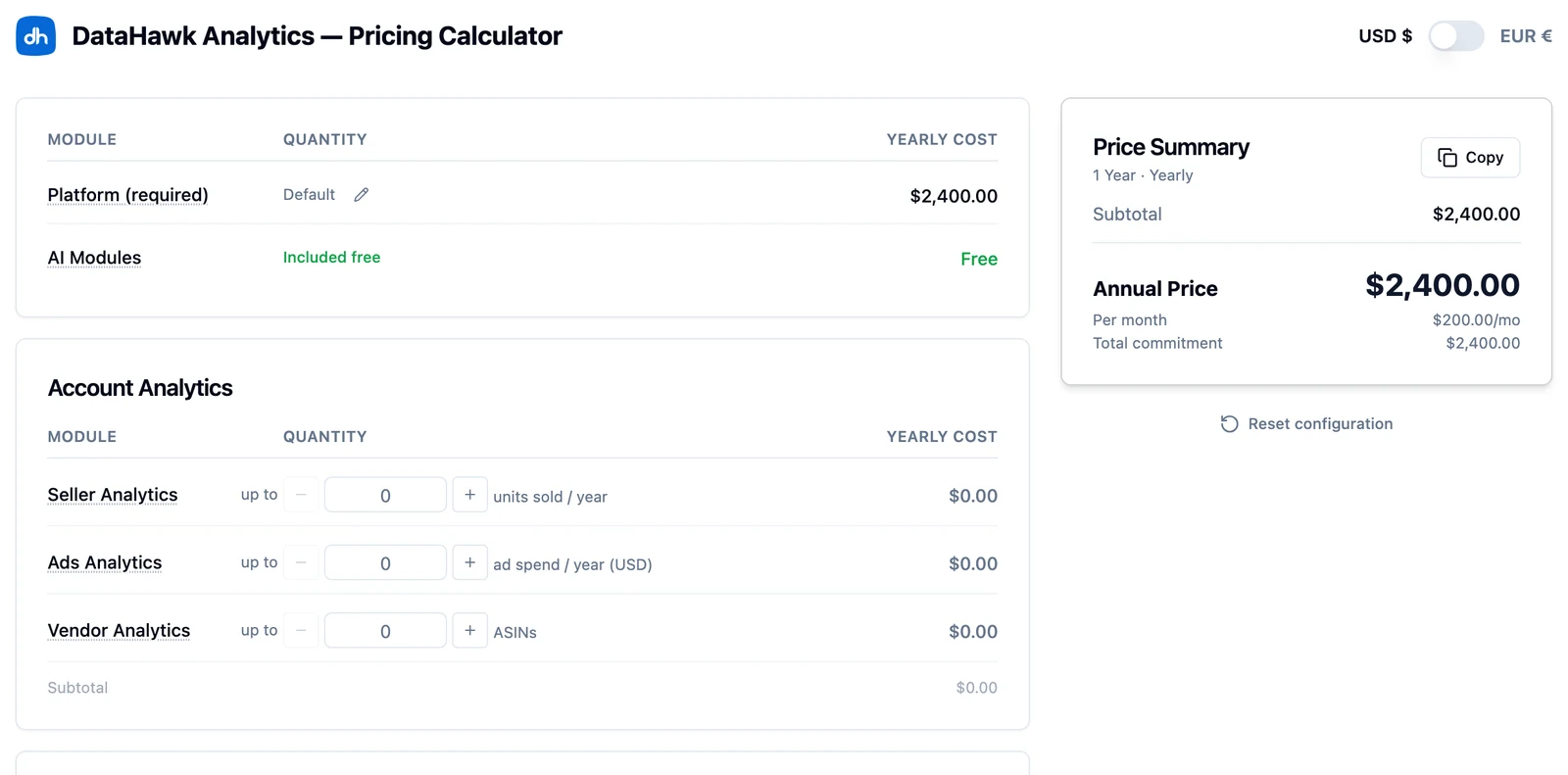
Enterprise is priced from parts. The Enterprise pricing guide describes a platform fee plus usage-based Account Analytics (units sold, catalog size, ad spend) and Digital Shelf Analytics (products, keywords, categories). DataHawk’s public pricing calculator starts the platform fee at $2,400 a year, or $200 a month, before any data module is added.
Sponsored keyword ranks cost extra: standard sponsored ranks were retired on July 8, 2025, and they now need the paid Premium Keywords add-on, per a changelog entry.
DataHawk free trial and free plan
DataHawk has no free plan. Its free trial page offers 14 days with no credit card, one account of each type (Seller Central, Vendor Central, Advertising, Walmart Marketplace and Walmart Connect), 50 tracked products, 50 organic keywords and 5 categories. When the trial ends, access is reduced but the workspace and data are kept.
A May 2022 capture of the pricing page shows plans “Starting $199/mo” and a trial that switched to a “lifetime free plan”.
What changed at DataHawk in 2025 and 2026
- October 2025: an October 9, 2025 capture of the pricing page reads “Custom pricing starts at $549/month with an annual commitment”; by November 12, 2025 the figure was gone, per the Wayback Machine.
- November 27, 2025: alerts moved to Amazon catalog and featured-offer data, and DataHawk now has “New” Buy Box data only, “no longer ‘Used’ buybox”, per its changelog.
- June 30, 2026: the Insights module was retired, with a replacement promised.
- August 30 to 31, 2026: a collection outage left a permanent gap in FBA inventory snapshots, per DataHawk’s own incident log.
Who each tool is for
DataHawk fits a brand, vendor or agency with an analyst who wants every Amazon and Walmart number in one database: sales, SKU profit, advertising, inventory and market share. Its question is “how is the business performing, and why?”
SellerSonar fits a seller, brand or agency asking “what changed on these listings today?”, whoever owns them. It does not do product research, listing creation, PPC management, profit tracking or repricing.
Your accounts vs Amazon’s public pages
Both tools read public product pages, but only DataHawk reads your accounts. Its data sourcing guide splits public data (titles, prices, Buy Box price, BSR, sales estimates, search ranks), which works for “your competitors’ products” too, from private data (orders, inventory, ad spend, fees, COGS) that needs your Seller Central, Vendor Central or Advertising account authorized through Amazon’s API.
Without a connection, the same guide says, profit, inventory alerts and ad performance stay empty, which is most of what the subscription pays for.
Coverage differs too. DataHawk’s product tracking guide lists 17 Amazon marketplaces, from the US and Brazil to India, Japan and Australia, plus Walmart. SellerSonar covers 23 Amazon marketplaces, adding Turkey, Belgium, Ireland, Saudi Arabia, Egypt and South Africa, but no Walmart.
DataHawk alerts vs SellerSonar alerts
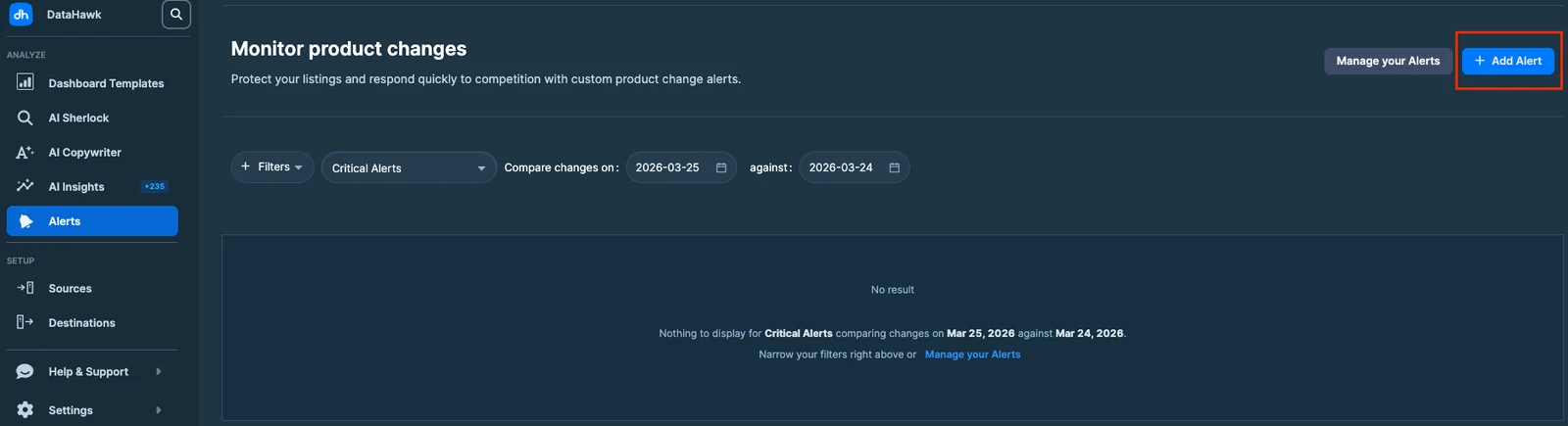
DataHawk Alerts watch three areas, per its Alerts introduction: listing details (title, bullets, A+ content, images, videos), reviews and ratings, and Buy Box and pricing (Buy Box price and owner, number of sellers, BSR, availability). Competitor products work once tracked.
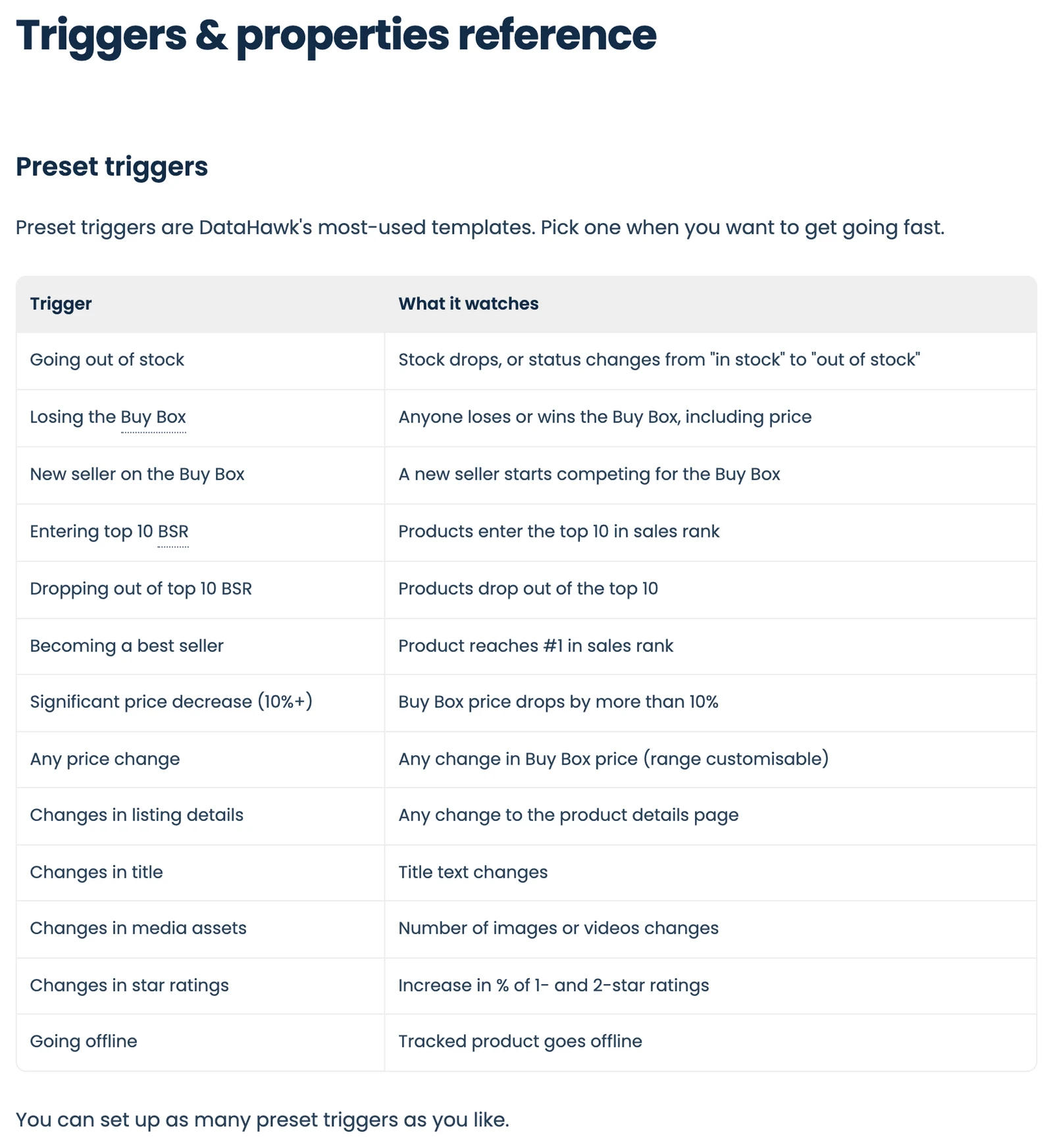
Preset triggers cover the common cases, including “Losing the Buy Box”, “New seller on the Buy Box”, “Significant price decrease (10%+)” and title changes, according to the triggers reference.
Timing is the trade-off. DataHawk “checks your conditions once a day and sends a single daily email per recipient group”, sent “everyday at 12pm CET”, per the Alerts introduction. Its FAQ page adds that product data is checked once a day, “usually between 12AM-6AM UTC”.
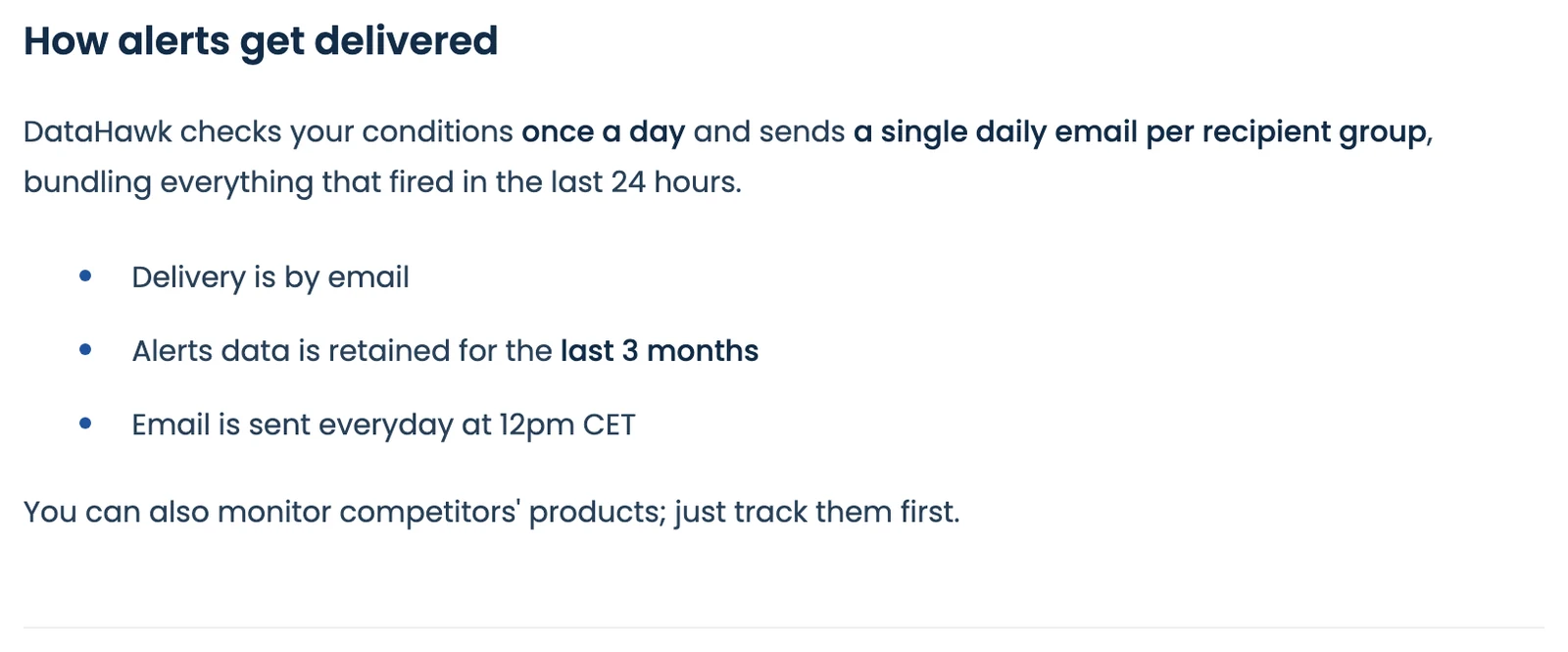
So a change made after the morning check reaches you in the next day’s email. The Alerts FAQ also says Slack, Teams and webhooks are not offered natively, alerts are not in the API or the data share, and alert history is kept for 3 months.
SellerSonar checks public product pages every 4 hours on Pro, every 2 hours on Premium and every hour on Business, per its plans page, with alerts by email or Slack as found or in a daily or weekly report. Its documentation lists 76 alert types in 7 categories, including Seller appeared, Buy Box Won and Lost, suppression, badges and FBA fee changes.
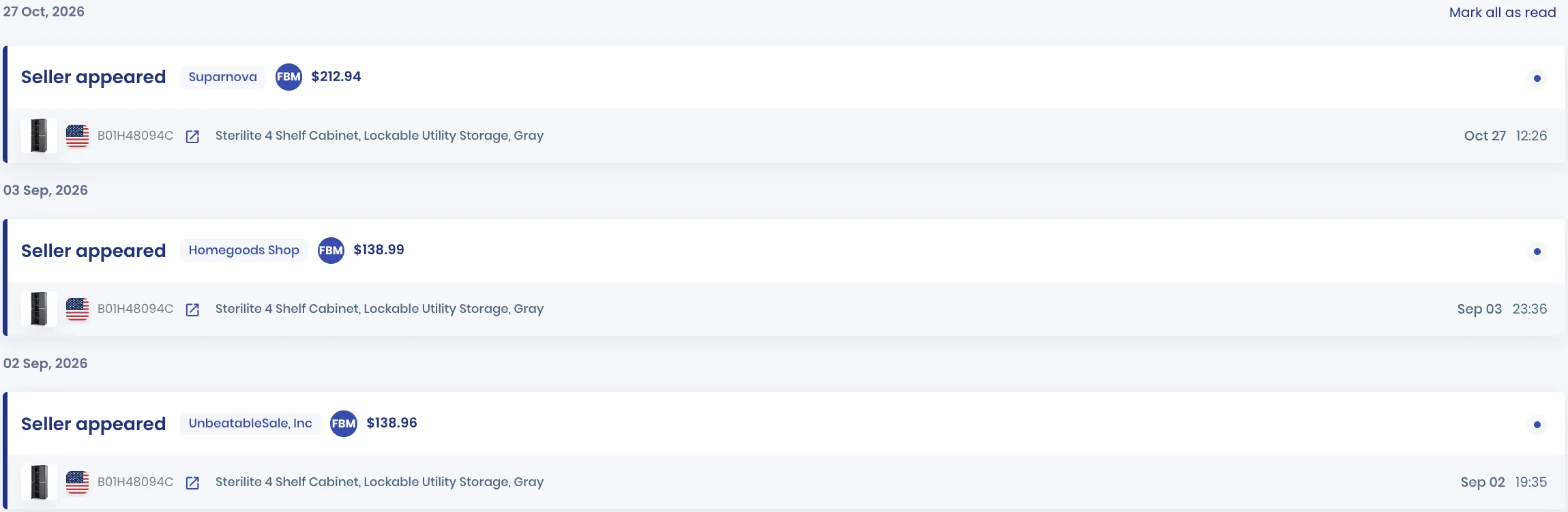
Buy Box Won and Lost alerts start on Premium, and all five Buy Box and pricing alerts are off by default, so switch them on in Delivery Settings. Webhooks for Zapier, Make or n8n come with Business, per SellerSonar’s documentation.
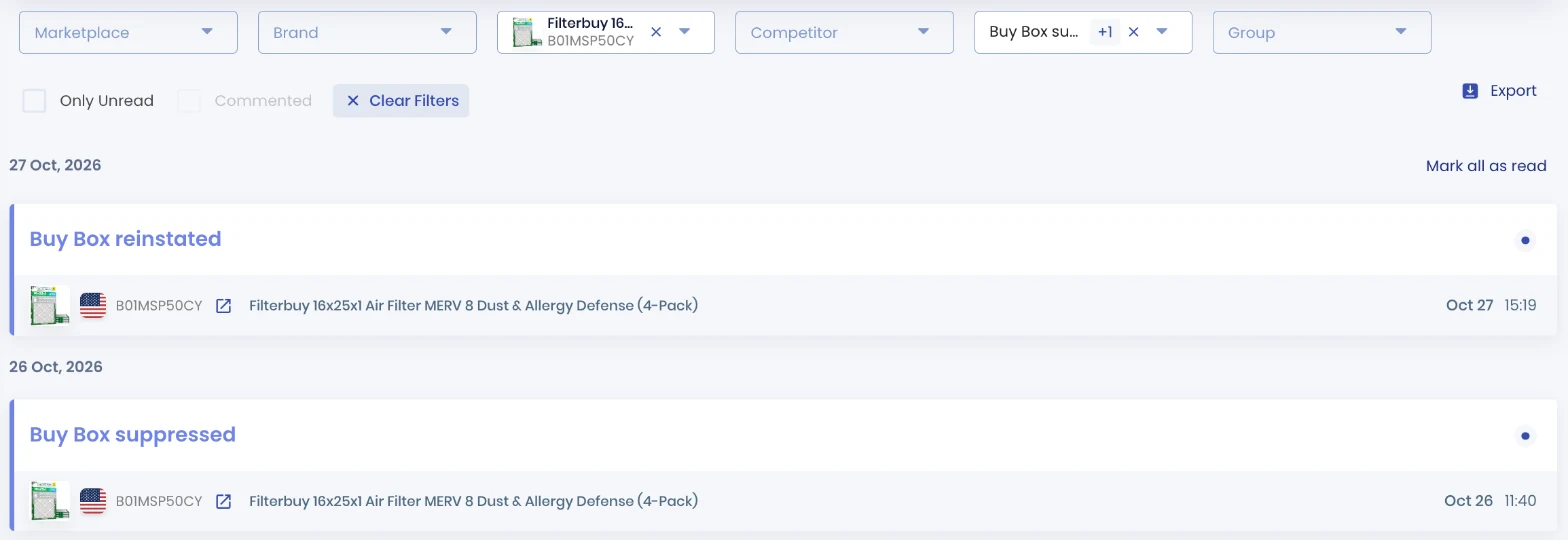
The gap is hours, not features: DataHawk reports a lost Buy Box the next day, while SellerSonar’s next check on Business is never more than an hour away.
💡 Expert Tip: If you already pay for DataHawk, keep its daily email for trends and put a monitor on the handful of hero ASINs where a hijacker or a lost Buy Box costs money every hour it goes unnoticed.
Keyword tracking and share of voice
DataHawk collects the first 5 pages of Amazon results, “roughly 200 products”, for every tracked keyword each day, per its keyword tracking guide. That gives organic share of voice for you and every competitor on the page; sponsored ranks need Premium Keywords.
The entry limits are tight: 50 organic keywords on Standard and 200 on Growth, per DataHawk’s package table. SellerSonar’s keyword tracker follows 500 keywords on Pro, 2,000 on Premium and 3,000 on Business, per its plans page, with organic and sponsored positions refreshed about every 6 to 10 hours and alerts when a rank moves inside the top 100.
DataHawk adds keyword research with search volumes, Brand Analytics Search Query Performance reports and category market share, which SellerSonar does not have.
DataHawk MCP vs SellerSonar MCP
Both connect to Claude and ChatGPT through the Model Context Protocol. The DataHawk MCP guide says it is “currently in beta” and read-only (“it can’t update listings, change ad budgets, or take any action”), covering about 14 months of sales, ads, inventory, finance and keyword data. The package table lists it on every plan.
SellerSonar MCP comes with Business and Enterprise and can read and write: an assistant can ask what changed overnight and also add a product or keyword to monitoring. It cannot answer profit or ad spend questions.
🎯 Pro Insight: Ask which question costs you more when it goes unanswered. “Why did profit fall last month?” is DataHawk’s question. “Who took my Buy Box this morning?” is a monitoring question.
Where DataHawk wins
- Profitability: SKU-level P&L with fees, reimbursements and COGS uploads, plus up to 2 years of backfilled data from Seller Central, per its seller account guide. SellerSonar has no profit tools.
- Advertising: Sponsored Products, Brands, Display and DSP data at campaign and keyword level, with TACoS views. SellerSonar does not report on or manage PPC.
- Multi-channel BI: Seller, Vendor and Walmart data in one hosted Snowflake or BigQuery database, with Power BI, Looker Studio, Sheets and Excel connectors.
- Vendor Central: sell-through, fill rate and demand forecasts for 1P brands.
- Market intelligence: the top 100 products in each tracked category, with sales estimates.
- Transparency: a public changelog and incident log.
It does not automate anything, though. DataHawk “is strictly an analytics platform and does not push changes to Amazon”, per its Amazon Analytics page, which points buyers to sister company BidX for bidding.
Where SellerSonar wins
- Price: 150 ASINs and 500 keywords on Pro at $19.98 a month billed yearly, against $299 a month for 50 products and 50 keywords on DataHawk Standard, per each vendor’s pricing pages.
- Check frequency: hourly on Business, every 2 hours on Premium, against once a day.
- Delivery: email and Slack, plus webhooks on Business, against one daily email.
- No account connection: an agency can watch a client’s or a reseller’s listing with only the ASIN, through competitor tracking on any marketplace.
- More marketplaces: 23 against 17, including Turkey and Saudi Arabia.
- Alert depth: 76 types, including suppression, badges, coupons, variations and FBA fees, plus SharkGuard for your ASINs appearing on new marketplaces.
DataHawk vs Helium 10
Helium 10 is a research and selling suite (product and keyword research, listings, PPC, profits, alerts), with Platinum at $99 a month billed yearly or $129 monthly and Diamond at $279 billed yearly, per Helium 10’s pricing page. DataHawk does no product research; it reports on accounts you already run.
Pick Helium 10 to find and launch products, and DataHawk to report on a large catalog inside BI tools. Our Helium 10 review and SellerSonar vs Helium 10 cover Helium 10 in full.
DataHawk alternatives
- SellerSonar for Buy Box, seller and listing alerts on any ASIN, checked up to hourly, from $19.98 a month billed yearly.
- sellerboard for profit analytics at a seller’s price, from $19 a month on sellerboard’s pricing page; see SellerSonar vs sellerboard.
- Sellerise for profit, PPC and alerts in one subscription, from $19.99 a month per the Sellerise pricing page.
- Helium 10 for research-heavy work; our Helium 10 alternatives list its rivals.
Is DataHawk worth it? Verdict by seller type
| Seller type | Better pick | Why |
|---|---|---|
| Brand or agency with an analyst and a BI tool | DataHawk Growth or Enterprise | Hosted warehouse, Power BI and Looker Studio templates |
| Vendor Central brand | DataHawk | Sell-through, forecasts and 1P ad data |
| Seller on Amazon and Walmart | DataHawk | One database for both channels |
| Private label seller under 100K units a year | SellerSonar plus a profit tool | DataHawk Standard buys 50 tracked products |
| Brand worried about hijackers and Buy Box losses | SellerSonar | Checks up to hourly, alerts by email or Slack |
| Agency watching client or competitor listings | SellerSonar | No account access needed per client |
| Seller on Amazon Turkey, Belgium or Saudi Arabia | SellerSonar | DataHawk does not list these marketplaces |
📌 From Our Experience: Daily data is the right cadence for a P&L review and the wrong one for a hijacker. If you run DataHawk, keep it for reporting and put your top ASINs under an hourly monitor. If alerts are all you need, DataHawk’s entry price buys a lot of reporting you will not open.
Final Expert Recommendations:
Choose DataHawk when your team needs profit, advertising, vendor and Walmart data in one warehouse and reads it in Power BI or Looker Studio. Choose SellerSonar to know within hours when a seller joins your listing, the Buy Box moves or content changes, on any ASIN and without connecting Seller Central. Compare the plans on SellerSonar’s plans page or start with Buy Box monitoring.
Start your free 14-day SellerSonar trial and see what’s happening on your listings today.
Related: Helium 10 pricing and review · SellerSonar vs Helium 10 · SellerSonar vs sellerboard · Helium 10 alternatives

