




Quick Answer
You can sell digital products on Amazon only through Amazon’s own creator programs, not through a regular Seller Central account. Seller Central policy bans third-party listings for digital downloads and access codes. The open routes are Kindle Direct Publishing for eBooks and print-on-demand books (70% or 35% eBook royalties), ACX for audiobooks, Merch on Demand for designs, the Amazon Appstore for Fire TV and Fire tablet apps, Prime Video Direct for films, and Amazon Music through a distributor.
Plenty of guides say you can list an eBook, a course or a printable on Amazon the way you list a phone case. You can’t. Amazon keeps digital sales inside separate programs, each with its own account, rules and payout.
This guide maps every Amazon channel that takes digital work in 2026, what each one pays, which programs have closed, and where files Amazon won’t accept, such as courses and printables, can go instead.
About the Author: Gloria Anderson writes for the SellerSonar editorial team about Amazon selling programs, fees and marketplaces. She checks every Amazon rule in her articles against Amazon’s own help pages, and every royalty example against the platforms’ published rates.
Can You Sell Digital Products on Amazon?
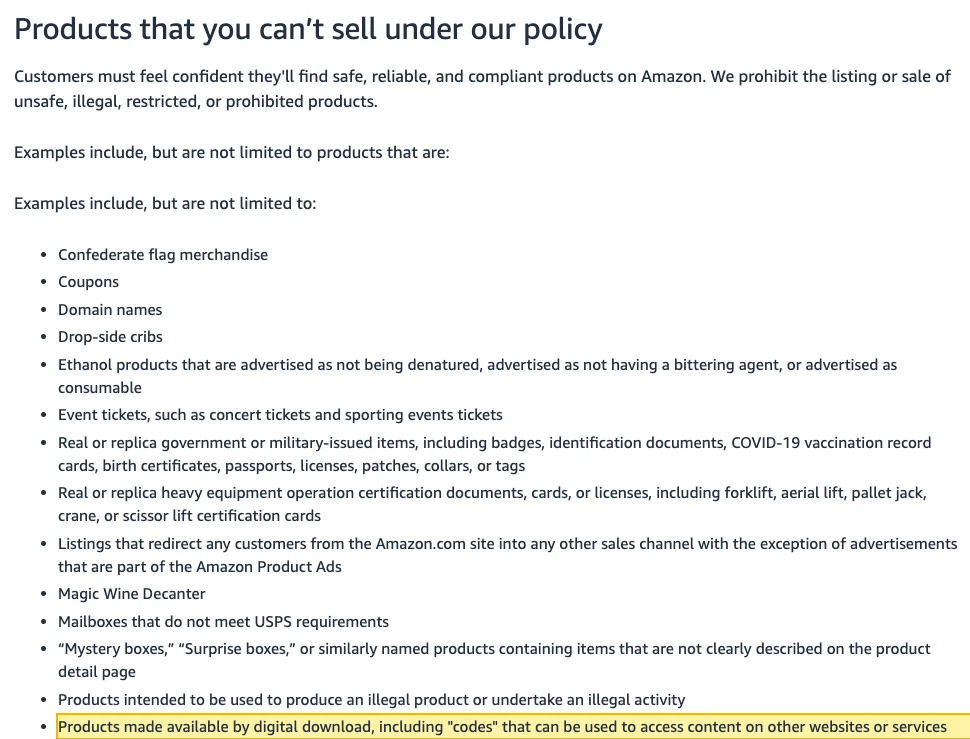
Yes, but not as a normal seller. Amazon’s Other restricted products policy lists “Products made available by digital download, including “codes” that can be used to access content on other websites or services” among the products you can’t sell. That covers PDFs, templates, download links, course access, game keys and gift codes.
Software follows the same rule. Amazon’s Sell software policy says “Only full retail versions of physical software may be sold on Amazon.” Sellers can’t sell downloadable software “by any means whatsoever”, including activation codes, license keys or serial numbers sent by email or printed on a card.
So when people sell digital products on Amazon, Amazon is the store and the publisher: you upload the work to a creator program, Amazon sells and delivers it, and you get a royalty. You don’t set up an offer, ship anything or handle the customer.
Every Amazon Channel for Digital Products in 2026
Here is the full map for the US store. Each row is a separate sign-up, and none of them is a Seller Central account.
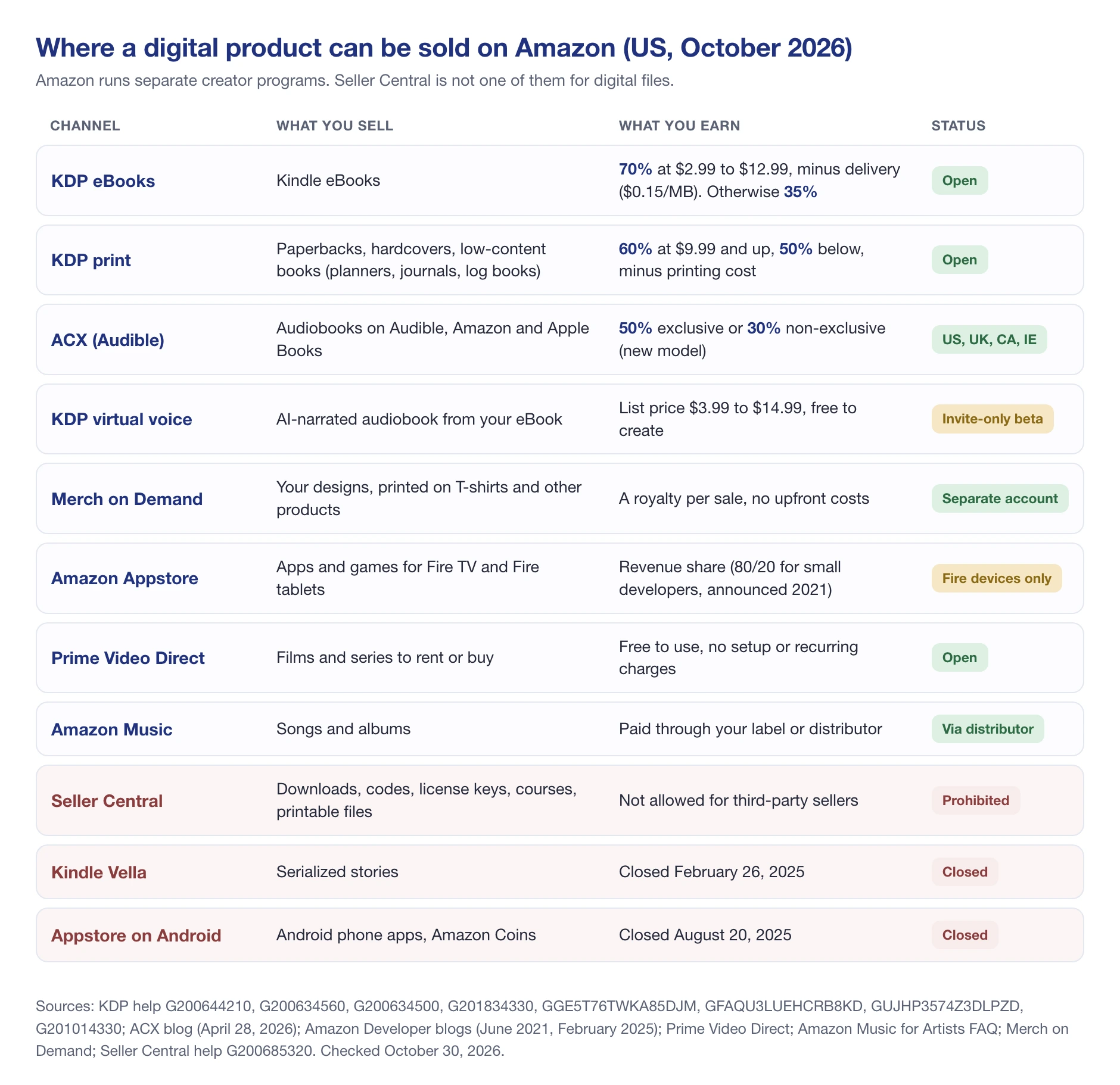
The sections below cover each channel in the order most creators meet them.
eBooks: Kindle Direct Publishing
Kindle Direct Publishing (KDP) is the biggest digital channel on Amazon and free to use. You upload a manuscript and a cover, set a list price, and Amazon sells the Kindle edition worldwide. Our guide to how Amazon KDP works covers the account setup step by step.
You pick one of two royalty options per book, per KDP’s eBook royalties page:
- 70% option: 70% of the list price without VAT, minus a delivery cost, for buyers in Amazon’s 70% territories. Buyers elsewhere still pay you 35%.
- 35% option: 35% of the list price, no delivery cost.
The 70% option has a price band. Since July 7, 2026, it covers list prices from $2.99 to $12.99 on Amazon.com, up from the old $9.99 cap, according to KDP’s list price requirements.
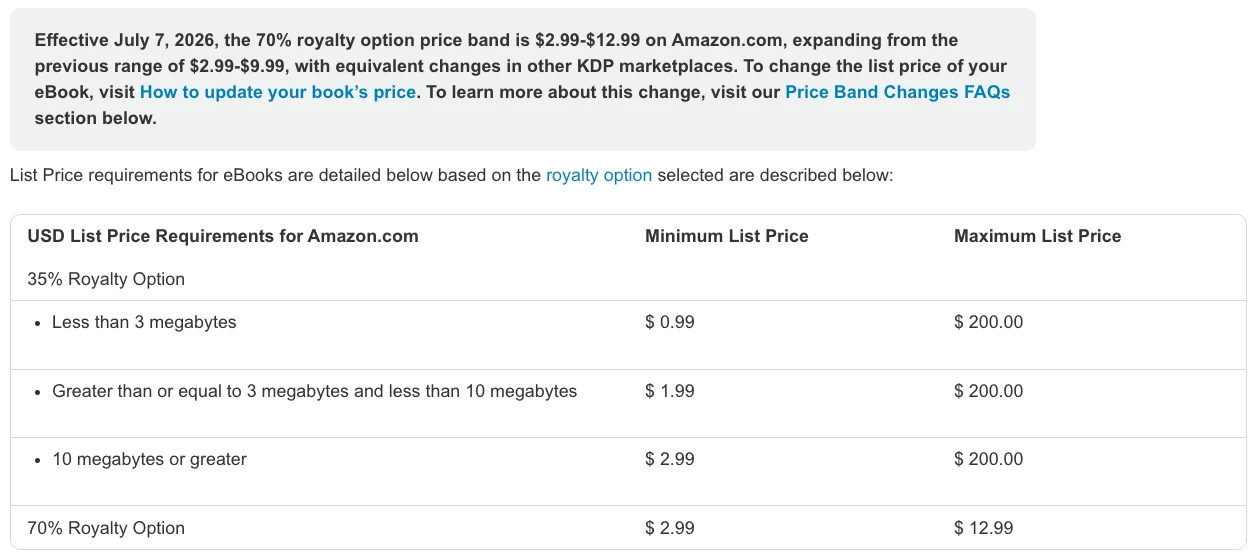
The delivery cost on Amazon.com is $0.15 per MB of file size, so image-heavy books earn less per sale. Public domain works only qualify for 35%. Price a book outside the band and every sale drops to 35%.
Printables, planners and journals: KDP low-content books
Amazon won’t sell a printable PDF, but it will print one for you. KDP’s low-content books are paperbacks or hardcovers whose pages are “designed to be filled in by the user”: notebooks, planners, diaries, prompt journals, log books, crafting templates and blank sheet music.
A few rules differ from normal books. Low-content books get no free KDP ISBN, and you must tick the Low-content box during setup, or Amazon says “your book will be rejected.” Puzzle books and coloring books usually don’t count as low-content, so they normally go through as regular print books.
Print royalties work differently from eBooks. KDP pays 60% on paperbacks listed at $9.99 or more on Amazon.com and 50% at $9.98 or less, then subtracts the printing cost. A thick planner priced at $7.99 can leave you very little, so check the printing cost before you pick a price.
Audiobooks: ACX and KDP virtual voice
Audiobooks reach Audible and Amazon through ACX, the Audiobook Creation Exchange. KDP’s ACX help page says ACX is open to residents of the United States, the United Kingdom, Canada and Ireland with a local tax ID and bank account. ACX is also a marketplace where narrators and studios audition for audiobook projects.
ACX royalties changed in 2026. Under Audible’s new royalty model, open to all ACX creators from May 26, 2026, you earn 50% for exclusive distribution to Audible, Amazon and Apple Books, or 30% non-exclusive. The legacy rates were 40% and 25%, and ACX says the legacy model ends by the end of the year.
KDP also runs audiobooks with virtual voice, which turns an eligible eBook into an AI-narrated audiobook for free. It is an invite-only beta, and list prices run from $3.99 to $14.99.
Designs and art: Merch on Demand
If you design graphics, Merch on Demand prints your artwork on T-shirts and other products when a customer orders. Amazon handles “production, shipping, and customer service” with no upfront costs, and you earn a royalty per sale. You sell a physical product, but the only thing you make is the digital design.
Merch has its own account, separate from Seller Central. Our guide to Merch by Amazon walks through the design specs and the upload steps.
Apps and games: Amazon Appstore
The Amazon Appstore still sells apps and games, but only for Fire TV, Fire tablets and Fire TV built-in devices. Amazon ended the Appstore on Android devices on August 20, 2025, stopped new Android app submissions on February 20, 2025, and closed Amazon Coins on the same August date.
For small developers, Amazon announced the Small Business Accelerator Program in 2021: an 80/20 revenue share for developers who earned under $1 million the year before, plus AWS credits worth 10% of revenue. Check your developer console for the split that applies to you today.
Films and series: Prime Video Direct
Filmmakers and rights holders can offer titles to rent or buy on Prime Video through Prime Video Direct. Amazon says it “is free to use. There are no setup or recurring charges to submit content or manage your titles.” The support portal is now called Prime Video Slate.
Music: Amazon Music through a distributor
There is no direct upload for musicians. Songs reach Amazon Music through a label or a distributor such as CD Baby, DistroKid or TuneCore, and the Amazon Music for Artists FAQ tells artists to contact their label or distributor about royalties. TuneCore is one of those third-party distributors, not an Amazon service.
💡 Expert Tip: Treat each program as its own business account. KDP, ACX, Merch, the Appstore and Prime Video Direct each run their own tax interview, payout schedule and content rules. Set them up one at a time, starting with the one that matches what you already make.
What You Can’t Sell on Amazon as a Digital Product
Most “digital products” people want to sell fall outside every channel above. Here is where they stand in October 2026:
| Product | Can you sell it on Amazon? | What to do instead |
|---|---|---|
| Printable PDFs, planners, templates | Not as files | Publish a printed version as a KDP low-content book, or sell the file on Etsy or your own site |
| Online courses and video lessons | No | Turn the material into a book or workbook on KDP; host the course elsewhere |
| Software downloads, license keys | No (only full retail physical software) | Sell through your own site or an app store; Fire TV and Fire tablet apps go to the Appstore |
| Game codes, gift codes, access codes | No | Not allowed for third-party sellers |
| Digital art files, stock photos, fonts | Not as files | Print the art through Merch on Demand |
| Digital items on Amazon Handmade | No | Handmade bans “Digital or downloadable products”; see our Amazon Handmade guide |
| Serialized stories (Kindle Vella) | Closed | Publish the story as a Kindle eBook |
Kindle Vella, Amazon’s serialized story platform, shut down on February 26, 2025, per KDP’s Kindle Vella FAQ. KDP says it strongly encourages authors to republish those stories as eBooks.
For printables and digital art files, Etsy is the usual alternative. Its seller rules allow “your original design as a digital download”, as long as you made or designed it. Our comparison of Amazon Handmade and Etsy covers how the two marketplaces differ for makers.
How Much You Keep From One Digital Sale
Royalty percentages are hard to compare until you run one sale through them. Here is a $9.99 sale in the US, as a Kindle eBook and as the same file on Etsy:
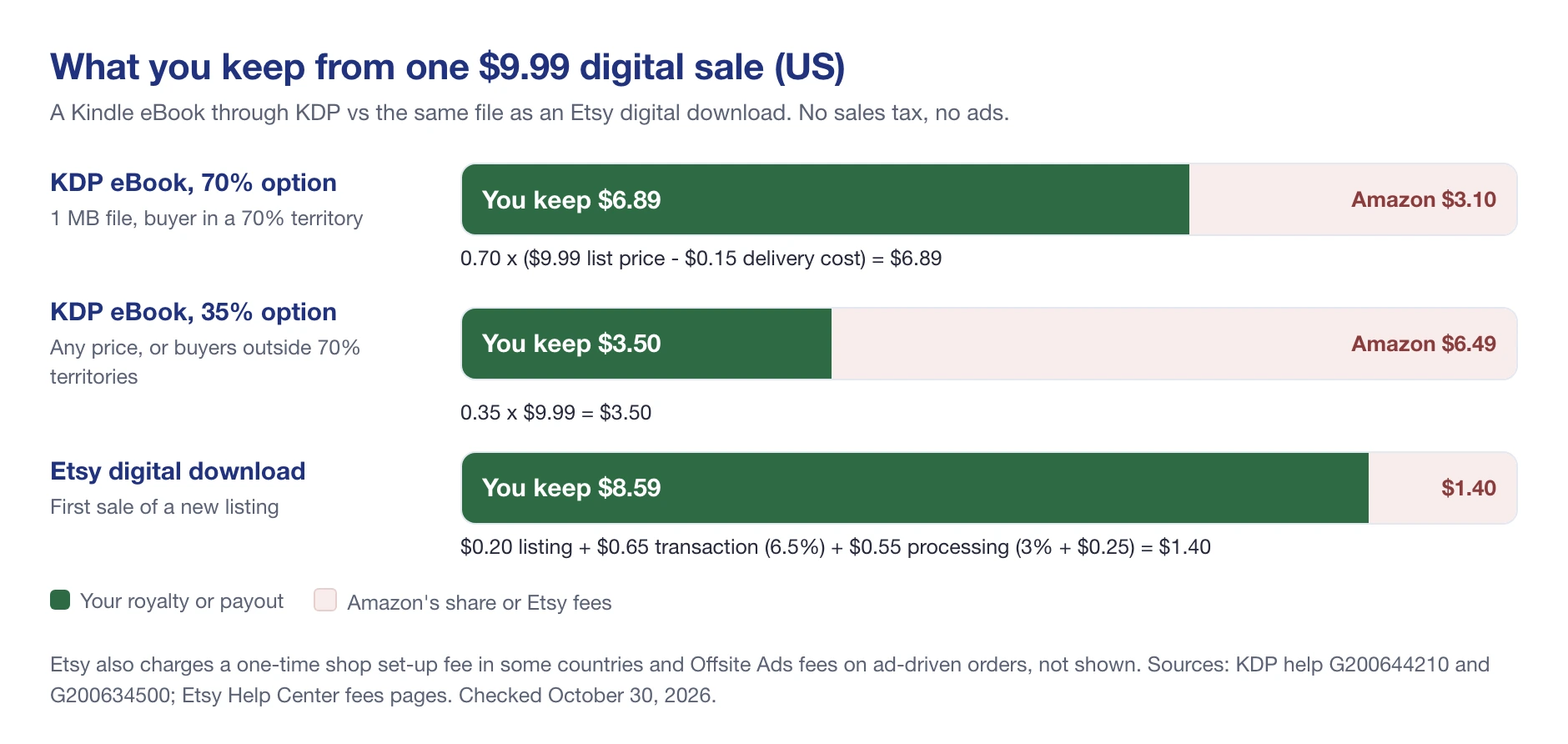
The math behind it:
- KDP, 70% option: 0.70 x ($9.99 – $0.15 delivery cost for a 1 MB file) = $6.89.
- KDP, 35% option: 0.35 x $9.99 = $3.50.
- Etsy: $0.20 listing fee, a 6.5% transaction fee ($0.65) and payment processing of 3% plus $0.25 ($0.55), from Etsy’s fees and taxes page. That leaves $8.59.
Etsy keeps less per sale, but you bring most of the buyers yourself. On Kindle, the store’s readers find your book through Amazon search, and Kindle+ (formerly Kindle Unlimited) pays KDP Select authors for pages read. Amazon reports $69.3 million in KDP Select author earnings for September 2026 alone.
🎯 Pro Insight: Run the numbers on your real format before you choose a channel. A short, image-light eBook at $4.99 earns about $3.39 at 70%. A 300-page planner as a paperback earns its royalty minus a printing cost that grows with the page count, so it often needs a higher price to be worth it.
How to Sell Digital Products on Amazon, Step by Step
The steps are similar across programs. This is the order that wastes the least time:
- Match your product to a channel. Written work goes to KDP, audio to ACX, designs to Merch, apps to the Appstore, films to Prime Video Direct, music to a distributor. If nothing fits, the product can’t be sold on Amazon as a file.
- Check the format rules first. KDP has separate requirements for eBooks, paperbacks and low-content books. Merch and ACX publish their own file specs.
- Open the program account. Each one asks for your tax details and bank information. Non-US creators should finish the tax interview to avoid extra US withholding.
- Prepare the files and the listing copy. Title, description, keywords and categories decide whether shoppers find you, the same way a listing does in Seller Central.
- Set a price inside the royalty band. For a Kindle eBook, that means $2.99 to $12.99 if you want 70% on Amazon.com.
- Publish and wait for review. KDP reviews each title before it goes live. Amazon can reject files that break its content rules.
- Promote outside Amazon too. A mailing list, social posts or a website give a new title its first sales and reviews.
Rules That Get Creators Blocked
Each program enforces its own rules, and KDP’s are the strictest. Its content guidelines are where most rejected titles go wrong:
- Disclose AI-generated content. KDP requires you to tell it when text, images or translations were created by an AI tool, “even if you applied substantial edits afterwards.” AI-assisted editing and brainstorming don’t need a disclosure.
- Don’t republish free web content. KDP won’t accept copyrighted content “that is freely available on the web unless it’s provided by the owner of the copyright.”
- Don’t flood the store. KDP’s title creation limit allows “up to 2 new titles per book format each week.”
- Describe the book honestly. KDP removes content “meant to mislead customers” and books that are “typically disappointing to customers.”
- Never buy reviews. Free review copies are fine only if you don’t require a review in return.
📌 From Our Experience: Low-content creators often publish dozens of near-identical journals with a new cover each. That pattern runs straight into the weekly title limit and the “disappointing content” rule. Fewer titles with a real use case, such as a specific log book for a hobby, tend to last longer on the store.
Tracking a Print Book or Merch Product After Launch
Paperbacks, hardcovers and Merch products get regular Amazon product pages with an ASIN and a Best Sellers Rank. That means you can watch them like any other product. Amazon’s sales rank is relative to other titles, so the trend over days tells you more than a single number.
Here is a real example from SellerSonar. We track The Psychology of Money paperback (ASIN 0857197681) on amazon.com, a traditionally published book that shows the pattern well. Between October 19 and 30, 2026, its rank in Books moved from #69 to a best of #51 on October 25 and back to #72 on October 30. On every one of those days it was still #1 in Macroeconomics, Wealth Management and Occupational and Organizational Popular Psychology.
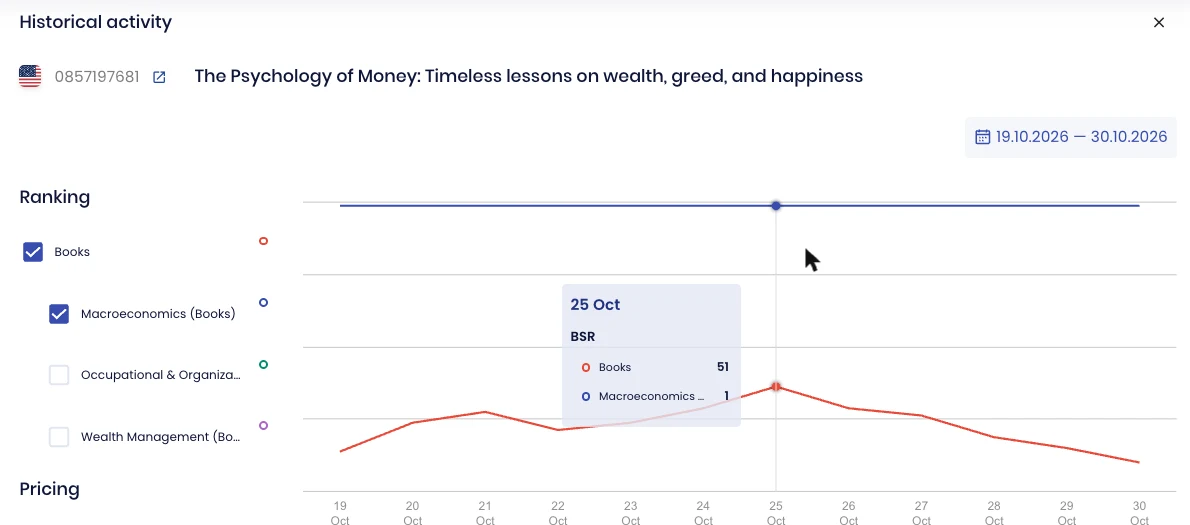
So a “#1 Best Seller” badge in a subcategory and the overall rank can tell very different stories. On the same chart, The Atomic Habits Workbook jumped from #41 to #5 in Personal Transformation Self-Help between October 24 and 26, then slid back to #34 by October 29. Spikes like that are easy to miss without daily data. Our guide to Amazon Best Sellers Rank explains how the rank is calculated.
SellerSonar’s ranking tracker records BSR and subcategory rank for your titles and the competing books you choose, and it can alert you to rank changes on its next check. It also tracks where a book ranks for its keywords in Amazon search. It doesn’t track KDP royalties or Kindle page reads, which stay in your KDP reports.
Is Selling Digital Products on Amazon Worth It?
It is if your product fits one of Amazon’s channels. Books, audiobooks, designs, Fire TV apps and films can reach Amazon’s shoppers with no inventory and no Seller Central account. The trade-off is control: Amazon sets the royalty rules, owns the customer and can change a program, as Kindle Vella and the Android Appstore showed.
If your product is a course, a template pack or a printable file, Amazon isn’t the place to sell the file itself. Sell it on Etsy or your own site, and use KDP for a printed or book version that can be found in Amazon search.
Once a print book or Merch design is live, SellerSonar can keep an eye on its rank and your competitors. You can try it free for 14 days, with 5 ASINs and 10 keywords and no credit card.

