




Quick Answer
The Amazon Influencer Program is Amazon’s invitation-based extension of the Associates affiliate program, designed for social media creators who can drive traffic to Amazon products. Approved influencers get a dedicated storefront URL, can curate product collections by category, earn commissions on qualifying sales, and access Amazon Live for video-based promotion. Acceptance is selective: Amazon evaluates follower count, engagement quality, and content fit before approval.
Key facts:
- Application reviewed in 1-5 business days; approval rates vary by platform
- Qualifying platforms: YouTube, Instagram, TikTok, Facebook
- Commission rates range roughly 1-10% depending on product category
- Influencers get a unique storefront URL, such as
amazon.com/shop/yourname - The Influencer Program differs from Amazon Associates in scope, perks, and audience expectations
In early 2026, a friend with 12,000 TikTok followers on a niche cooking account applied to the Amazon Influencer Program on a Tuesday afternoon. By Thursday morning she had her storefront URL. By the weekend she had curated 40 kitchen products into themed collections and her first sale rolled in by Monday. Total time invested: under five hours across the week. She didn’t expect to make a career out of it. But the income started arriving without her changing anything about how she posted.
That gap, between “I have an audience” and “I get paid for product recommendations my audience was already trusting,” is what the Amazon Influencer Program closes. In this guide we’ll cover what the program actually is, who qualifies in 2026, how the application works, realistic earnings expectations, the storefront setup, and the most common mistakes new influencers make in their first month.
About the Author: The SellerSonar editorial team writes about Amazon for sellers, brands, and creators participating in Amazon’s affiliate and influencer programs. SellerSonar tracks Amazon listings and brand health for thousands of seller accounts. From the creator side, we work with influencers who promote SellerSonar-monitored brands and understand how the influencer ecosystem actually pays out.
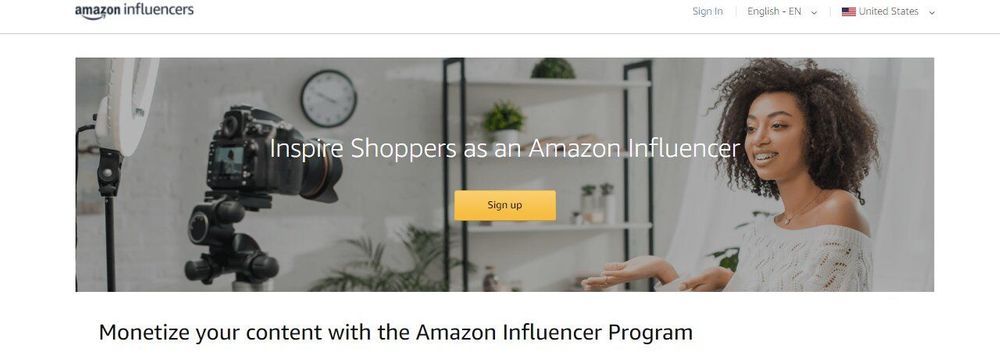
Amazon Influencer Program signup page
What is the Amazon Influencer Program?
The Amazon Influencer Program is a curated extension of Amazon Associates, the original affiliate program that anyone can join. Where Associates is open-enrollment, the Influencer Program is invitation-based and selective. Amazon evaluates each applicant’s social presence, audience engagement, and content quality before granting access.
Approved influencers receive:
- A dedicated storefront URL, such as
amazon.com/shop/yourname, that hosts their curated product picks - Idea Lists for themed product collections, such as gift guides, room setups, and gear recommendations
- Amazon Live access for live-streamed product recommendations and shopping events
- Commission earnings on qualifying purchases driven by the storefront and individual product links
- Performance dashboards tracking clicks, conversion rates, and earnings per product
The program targets creators who can drive traffic and conversions, not just any account with a follower count. Quality of engagement matters more than raw follower size. A 5,000-follower account with active comments and video views often gets approved when a 50,000-follower account with bot-driven metrics does not.
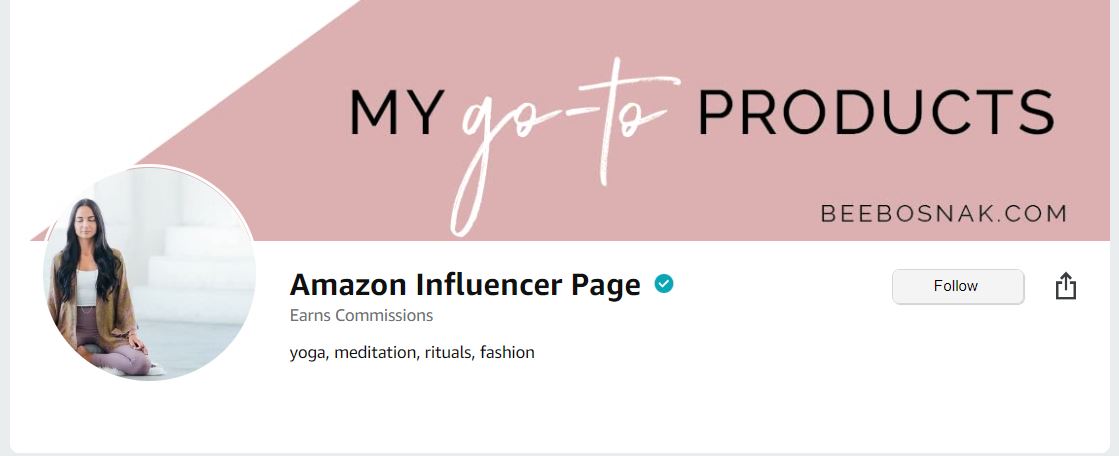
Example of an Amazon influencer storefront
Amazon Influencer Program vs Amazon Associates
Sellers and creators frequently confuse these. They’re related, but the differences matter.
| Feature | Amazon Associates | Amazon Influencer Program |
|---|---|---|
| Approval | Open enrollment | Invitation-based, selective |
| Format | Affiliate links, banners | Personal storefront + affiliate links |
| Storefront URL | None | amazon.com/shop/yourname |
| Amazon Live access | No | Yes |
| Audience type | Any website owner | Social media creators specifically |
| Commission structure | Same percentage tiers | Same percentage tiers |
| Approval review time | 24 hours, typically | 1-5 business days |
The simplest framing: Associates is for affiliate links on a blog or website; the Influencer Program is for creators with active social audiences who want a branded shopping destination.
Expert Tip: You can be in both programs simultaneously. Many creators sign up for Associates first for immediate approval, build their content using affiliate links, then apply for the Influencer Program once they have a stronger social presence. The application looks at your actual audience, so building reach first improves approval odds.
Amazon Influencer Program requirements in 2026
Amazon doesn’t publish exact follower thresholds, which trips up most applicants. The actual evaluation looks at a combination of factors.
Qualifying platforms as of 2026:
- YouTube
- TikTok
Twitter/X is no longer formally accepted as a primary platform; some applicants link Twitter as supporting evidence rather than the lead platform.
What Amazon actually checks:
- Follower count, which varies by platform; Instagram and TikTok tend to require fewer followers than Facebook
- Engagement rate, including likes, comments, and shares relative to follower count
- Content frequency, meaning active recent posting, not a dormant account
- Content fit, meaning whether your content lifestyle or category overlaps with Amazon product categories
- Audience authenticity, because suspected bot followers are a fast rejection
What the community consistently reports works:
- 10,000+ followers on at least one qualifying platform: strong signal
- 5,000-10,000 followers with high engagement: often works
- Under 5,000 followers: possible but harder; engagement and niche fit carry more weight
Niche matters too. Beauty, home/decor, kitchen, parenting, fitness, tech, and books are the strongest-converting categories. Niches outside Amazon’s catalog reach, such as B2B services, real estate, or financial advice, struggle to convert and sometimes don’t get approved despite strong follower counts.
How to apply to the Amazon Influencer Program
The application is straightforward but has a few non-obvious steps.
Step 1. Visit the Amazon Influencer Program signup page. Sign in with your Amazon shopping account or create one if needed.
Step 2. Connect your social media account. Pick the platform with your strongest engagement. This is the one Amazon evaluates. Amazon pulls your profile data through the platform’s API; make sure your account is public during application review.
Step 3. Provide tax and payment information. Amazon requires a W-9 for US creators or W-8BEN for non-US creators, plus a bank account or check delivery address for commission payouts. Set this up correctly the first time; it is tedious to fix later.
Step 4. Wait for the decision. Amazon reviews applications within 1-5 business days. You’ll get an email approval or rejection. Rejections include a reason; you can reapply after 60 days with stronger metrics.
Step 5. Set up your storefront. Once approved, claim your storefront URL, such as amazon.com/shop/yourname, upload a header image and bio, and start adding products to collections.
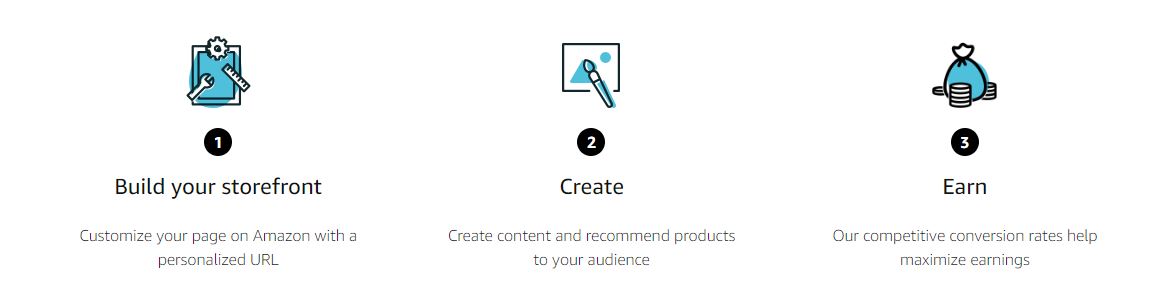
Steps to apply for the Amazon Influencer Program
Pro Insight: If you’re rejected the first time, the most common fix is engagement rate, not follower count. Posting consistently for 60 days with strong audience interaction, including comments, replies, and shares, often turns a no into a yes. Don’t buy followers; Amazon’s bot detection is aggressive and will permanently deny accounts flagged for inauthentic growth.
How much do Amazon influencers actually earn?
This is the question that drives most applications. The honest answer: it varies enormously, and the public stories are skewed toward the high earners.
Commission rates by category, based on the Amazon Associates rate card that applies to both programs:
| Category | Commission |
|---|---|
| Luxury Beauty, Amazon Coins | 10% |
| Digital Music, Physical Music, Handmade, Furniture | 5% |
| Outdoors, Tools | 3% |
| PC, PC Components, DVD & Blu-Ray | 2.5% |
| Toys, Furniture, Home, Pets | 3% |
| Grocery | 1% |
| Health & Personal Care, Beauty | 3% |
| Headphones, Wireless | 3% |
| Most other categories | 1-4% |
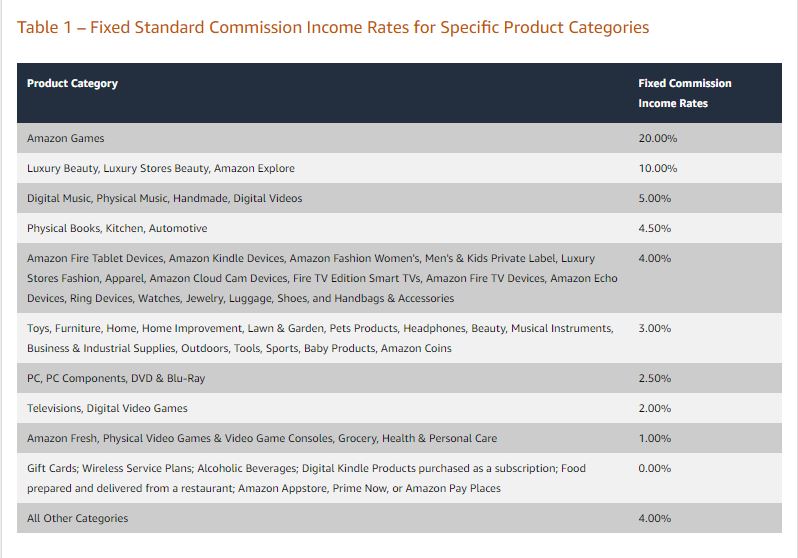
Amazon Influencer Program commission rates by category
What influencers actually earn, based on community-reported ranges:
- Brand-new influencers, 0-3 months in program: $50-$500/month
- Established mid-tier influencers, 50K-500K followers: $1,000-$10,000/month
- Top-tier influencers, 1M+ followers, multi-platform: $10,000+/month, sometimes substantially more
The variables that move earnings:
- Audience size and engagement: larger, more active audiences usually drive more sales
- Content frequency: more posts with affiliate links means more clicks and more chances to convert
- Category mix: high-commission categories such as Luxury Beauty at 10% outperform low-commission categories such as Grocery at 1%
- Conversion quality: recommendations that match audience trust convert better than generic product pushes
- Storefront curation effort: influencers who actively curate themed collections earn more than those who only post individual links
A realistic expectation: a niche creator with 20-50K engaged followers who posts product-related content 2-3 times a week typically earns $500-$2,000/month within 3-6 months of joining.
Setting up your Amazon influencer storefront
Once approved, the storefront is where most of your conversion happens. Treat it like a curated retail experience, not a dumping ground for affiliate links.
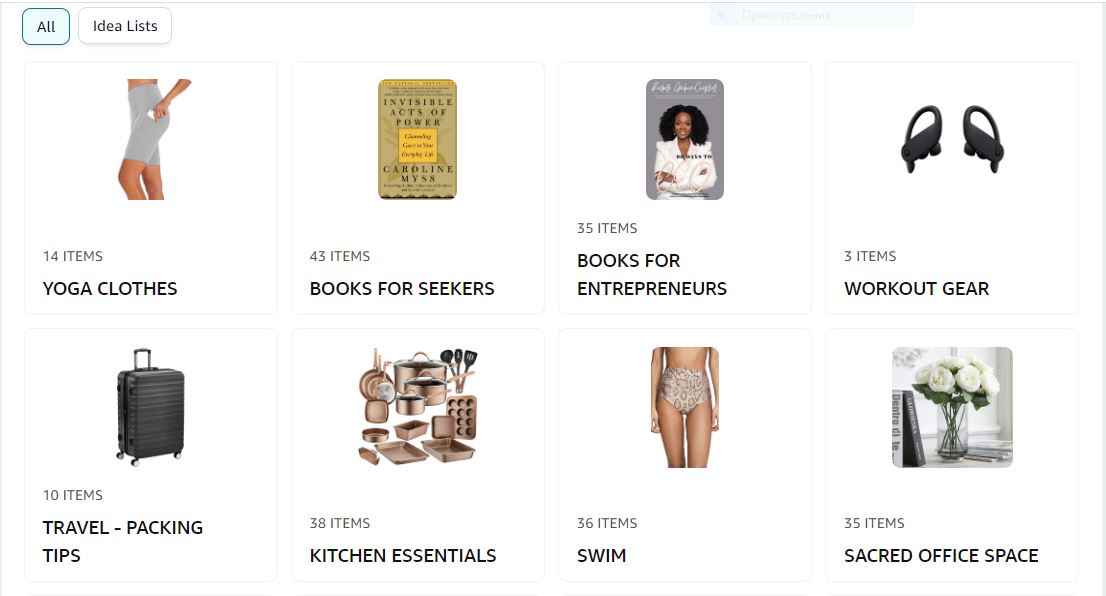
Amazon influencer storefront product selection
Storefront setup on mobile
- Open the Amazon Shopping app
- Tap your profile, then go to “Your Account” and “Your Influencer Hub”
- Add a profile photo and bio
- Create your first Idea List, meaning a themed collection
- Add products by searching ASINs or scanning items in the app
- Set the product order carefully, because your top-listed products get the most clicks
Storefront setup on desktop
- Go to
affiliate-program.amazon.com - Log into your influencer account
- Click “Storefront” and then “Settings”
- Upload a header image, with 3000×1000 pixels recommended
- Write a short bio with your audience hook in 1-2 sentences
- Create Idea Lists and populate them
- Set the order with your strongest categories first
A few storefront patterns that consistently outperform:
- Themed collections beat generic product dumps. “My Holiday Gift Picks for Cooks” converts better than “Kitchen Stuff I Like”.
- Photos in lists matter. Idea Lists with custom photos and personal captions convert higher than bare links.
- Seasonal updates help. Refresh your top collections at the start of each season.
- Cross-link with intent. Your social posts should point to specific Idea Lists, not just the storefront homepage.
From Our Experience: From what we see across the brands that work with influencers in SellerSonar’s monitored set, influencer-driven sales spike when the creator’s storefront sends visitors to specific themed collections rather than a generic homepage. A TikTok video about “minimalist apartment setups” that links to a specific apartment-starter-kit Idea List converts at 3-5x the rate of the same video linking to the influencer’s main storefront. Specificity wins.
Common mistakes new Amazon influencers make
A handful of patterns show up across new influencers who underperform their potential. None are complicated to fix; all are common.
Generic product picks. Listing the same trending products everyone else is listing dilutes your trust signal. Pick products that match your actual audience’s needs, even if they’re not the highest-volume sellers.
Static storefront. Setting up the storefront once and never updating it. Amazon’s algorithm rewards active accounts; stale storefronts lose visibility in Amazon’s own influencer discovery features.
No tracking. Not paying attention to which products convert and which don’t. Amazon’s dashboard shows clicks and conversions per product; ignoring this data means optimizing on intuition rather than results.
Over-monetization. Making every post about Amazon products. Audiences disengage from creators who only post affiliate content. The 80/20 rule applies: 80% value, 20% monetization.
Ignoring Amazon Live. Live-streamed product recommendations have some of the highest conversion rates in the program. Most influencers never use it because it requires more effort than posting an Idea List.
Failing the FTC disclosure rules. Affiliate relationships must be disclosed clearly. “#ad” or “#affiliate” in posts is required, not optional. Amazon can suspend accounts for repeated disclosure failures.
When the Amazon Influencer Program might not work for you
The program isn’t right for every creator. A few honest scenarios where it underperforms expectations:
- Your audience isn’t in shopping mode. B2B audiences, professional services audiences, or audiences focused on free content rarely convert at meaningful rates.
- Your follower count is inflated. Bought followers or engagement pods will get flagged either at application or after enrollment.
- You’re in a niche outside Amazon’s catalog. Amazon’s product range is wide but not infinite; some niches have weak inventory matches.
- You don’t want to disclose affiliate relationships. This isn’t optional; if disclosure feels off-brand for you, the program isn’t a fit.
- You can’t commit to consistency. Storefronts that get updated quarterly underperform storefronts that get updated weekly.
If any of these apply, Amazon Associates, with open enrollment and no storefront expectation, may be a better starting point.
Bottom line
The Amazon Influencer Program is one of the lower-friction monetization paths for social media creators with engaged niche audiences. It rewards consistency and curation more than raw follower count. Influencers who treat it as a real retail business, with active curation, specific themed collections, regular updates, and clear disclosure, outperform those who treat it as a passive add-on.
A few takeaways to hold onto:
- Engagement quality beats raw follower count. Amazon’s selection algorithm looks at how your audience interacts, not just how big it is.
- Niche fit matters. Categories aligned with Amazon’s strongest verticals, such as beauty, home, kitchen, parenting, and tech, convert better than off-platform niches.
- Storefront curation drives earnings. Themed Idea Lists with personal captions outperform generic product dumps by significant margins.
- Amazon Live is underused. Live-streamed recommendations convert at higher rates than static content; most influencers ignore this lever.
- Disclosure is non-negotiable. Repeated FTC compliance failures get accounts suspended; build the habit from day one.
Final Expert Recommendations: Based on what we see across the broader Amazon ecosystem, the influencers who turn the program into meaningful income share a few habits: weekly storefront updates, narrow niche focus, themed collection curation, and a content cadence that prioritizes audience value over monetization volume. Build the audience first, then monetize; that order works better than the reverse.
For Amazon sellers reading this because you’re considering working with influencers to promote your products, SellerSonar’s listing monitoring catches the listing changes, Buy Box shifts, and review patterns that influencer-driven sales spikes can sometimes trigger. The free 14-day trial covers 5 ASINs and 10 keywords with no credit card required.

