





Quick Answer
Amazon Marketing Services (AMS) was the name of Amazon’s self-service advertising program for sellers, vendors and authors. Amazon retired the name on September 5, 2018, when it became Amazon Advertising, today called Amazon Ads. The products AMS sold still exist under new names: Headline Search Ads became Sponsored Brands, Product Display Ads became Sponsored Display (now called display ads), and the old ad console is now Amazon Ads Agent.
- What you can run: three campaign types, Sponsored ads; Display, Video, and Audio; and Full-Funnel Campaigns.
- Who can use it: professional sellers, vendors, book vendors, KDP authors and agencies. Sponsored Brands needs Brand Registry if you are a seller.
- What it costs: sponsored ads are pay-per-click with no minimum spend and no monthly or upfront fees.
If you searched for Amazon Marketing Services, you are looking for something Amazon stopped calling by that name in 2018. The ads did not go away. They were renamed, reorganized and, in 2026, moved into one platform.
This guide maps every old AMS name to what it is called now, shows who can run which ads, explains what they cost in Amazon’s own words, and walks through how to start.
About the Author: Gloria Anderson writes for the SellerSonar editorial team on Amazon advertising, pricing and marketplace operations. She checks every name, date and rule in this article against Amazon Ads’ own pages and announcements.
What Is Amazon Marketing Services (AMS)?
Amazon Marketing Services was the brand Amazon used for its pay-per-click advertising. Through the AMS console, advertisers bought three kinds of ads: Sponsored Products, Headline Search Ads and Product Display Ads.
On September 5, 2018, Amazon announced that it was now simply Amazon Advertising and was retiring three names at once: Amazon Media Group (AMG), Amazon Marketing Services (AMS) and Amazon Advertising Platform (AAP). In the same post, Headline Search Ads became Sponsored Brands and AAP became the Amazon DSP.
So when someone says “AMS ads” today, they almost always mean Amazon sponsored ads, the pay-per-click ads that appear in Amazon search results and on product pages. The business behind them is Amazon Ads.
💡 Expert Tip: “AMS” also stands for unrelated things, such as AWS Managed Services, Amazon’s cloud operations service. If a search result talks about servers and cloud accounts, it is not about advertising.
What AMS Is Called Now: Old Names and Current Names
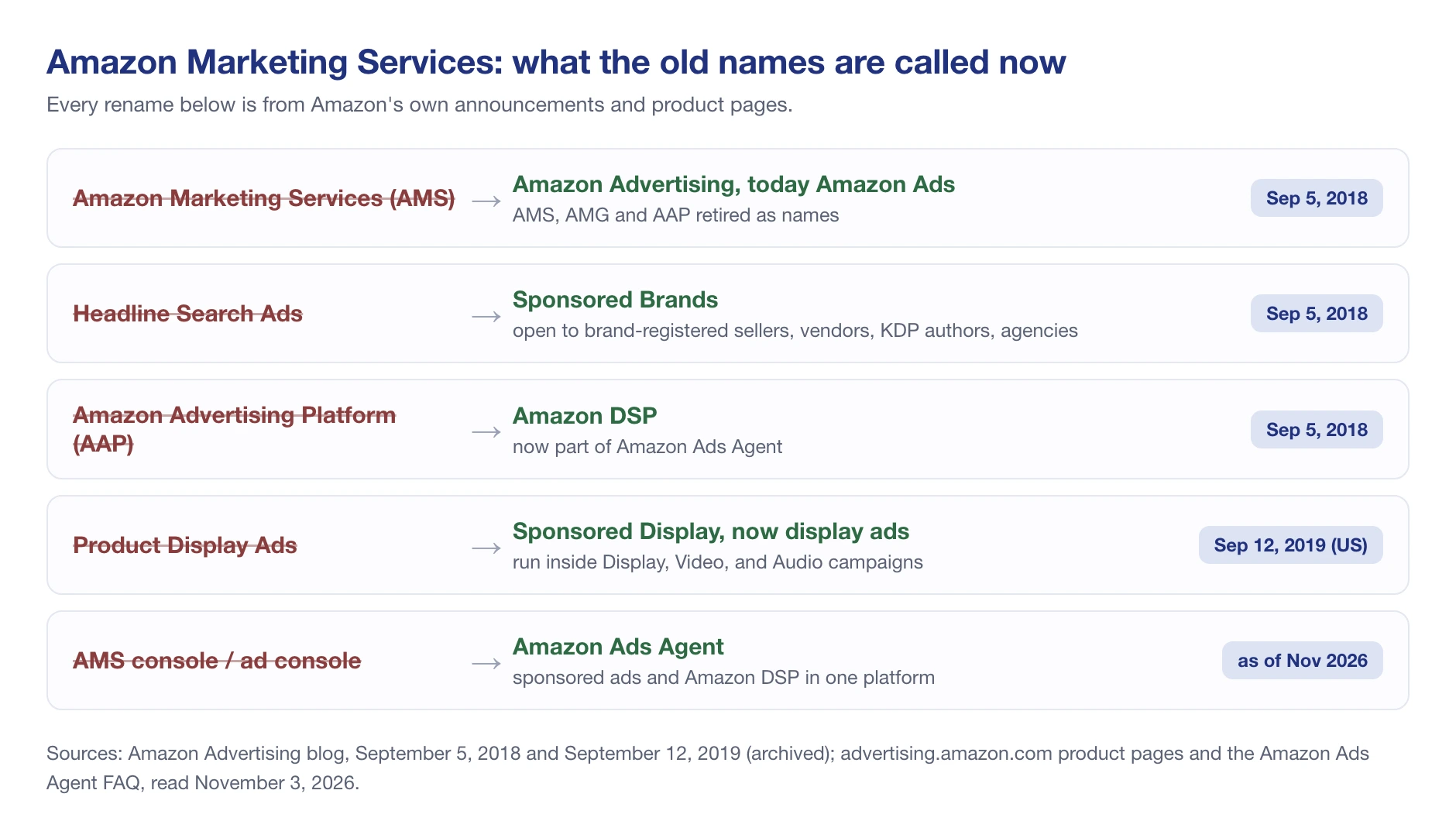
Most of the confusion around AMS comes from articles that still use the 2017 product names. Here is how each one maps to today.
| Old name | Current name | When it changed |
|---|---|---|
| Amazon Marketing Services (AMS) | Amazon Advertising, today Amazon Ads | September 5, 2018 |
| Headline Search Ads | Sponsored Brands | September 5, 2018 |
| Amazon Advertising Platform (AAP) | Amazon DSP, now part of Amazon Ads Agent | September 5, 2018 |
| Product Display Ads | Sponsored Display, now called display ads | September 12, 2019 (US) |
| AMS console, later the ad console | Amazon Ads Agent | As of November 2026 |
Product Display Ads were folded into Sponsored Display on September 12, 2019, when Amazon moved all US Product Display Ads campaigns into Sponsored Display with no action needed from advertisers. In 2026 the Sponsored Display page says it “is now known as display ads”, and existing Sponsored Display campaigns keep running inside Display, Video, and Audio campaigns.
The console changed too. Amazon’s Amazon Ads Agent page answers the question directly: it brought sponsored ads and Amazon DSP together into one ad platform, and existing campaigns, reporting and settings carried over.
What You Can Run With Amazon Ads in 2026
Amazon’s products page now groups its ads into three campaign types.
| Campaign type | What it includes | Best fit |
|---|---|---|
| Sponsored ads | Sponsored Products and Sponsored Brands, pay-per-click ads in Amazon search results and on product pages | Sellers, vendors and authors who want sales from Amazon shoppers |
| Display, Video, and Audio | Display ads (formerly Sponsored Display), online video, audio and streaming TV, on Amazon and on other sites and apps | Brands reaching audiences on and off Amazon |
| Full-Funnel Campaigns | Search, streaming, video and display in one AI-optimized campaign | US advertisers that sell on Amazon and run several formats together |
Two other pieces sit next to the ads. A Brand Store is free to create and maintain, and you do not need to advertise to have one. And for teams that want to work with campaign data in their own tools, there is the Amazon Ads MCP server.
Each format has its own placements, targeting and creative rules. We cover them one by one in our guide to Amazon ad types in 2026, so this article stays on the questions people still ask about AMS: who can use it, what it costs and how to start.
Who Can Use Amazon Ads (and How to Sign Up)
The old belief that AMS was “only for vendors” was never fully true, and it is wrong today. Amazon lists the eligible advertisers for each product on its own pages.
- Sponsored Products is available for professional sellers, vendors, book vendors, KDP authors and agencies. The products must be in eligible categories and able to win the Featured Offer.
- Sponsored Brands is available for vendors, book vendors, KDP authors, agencies and professional sellers enrolled in Amazon Brand Registry. For sellers, Brand Registry is a requirement, not a recommendation.
- Display, Video, and Audio campaigns are open to brands on Amazon and to businesses that don’t sell there; Amazon says no retail presence is required for advertisers who do not sell on Amazon.
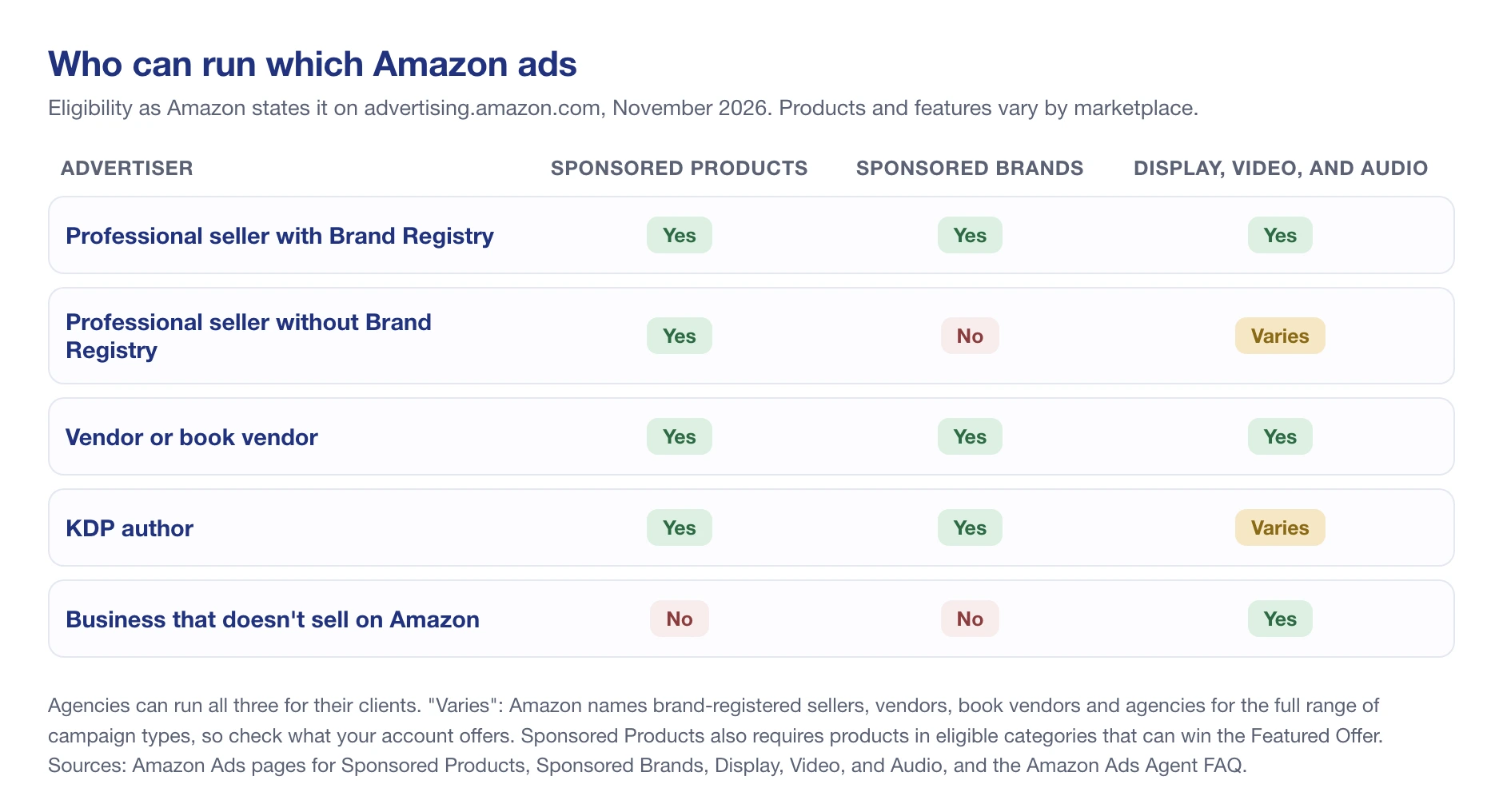
That covers third-party sellers, vendors who sell to Amazon through Vendor Central, and KDP authors promoting their books.
There is no separate “AMS account” to create anymore. On the Amazon Ads registration page you choose an advertiser account, for one business or brand, or a manager account, for several. Agencies that manage other advertisers register for the Partner Network instead.
How Much Amazon Ads Cost
The old AMS articles quoted average spend figures that nobody can trace to a source. Here is what Amazon itself says about pricing.
- Sponsored ads use cost-per-click (CPC) pricing with no minimum spend and budgets you control. Sponsored Products campaigns have no monthly or upfront fees.
- Sponsored Brands can be bought per click or per 1,000 viewable impressions (vCPM), with no minimum spend for either. Only reserved share of voice requires a minimum spend commitment.
- Display, Video, and Audio campaigns bill per 1,000 impressions (CPM) with no minimum spend.
- Managed service with an Amazon Ads account executive typically requires a minimum spend of $50,000, according to the Amazon Ads FAQ, and Amazon notes that the minimum varies by country.
The number that tells you whether sponsored ads pay off is ACoS, advertising cost of sale: ad spend divided by the sales those ads produced. If a product sells for $30 and leaves you $9 before advertising, that is a 30% margin, so your break-even ACoS is 30%. Above that, each ad-driven sale loses money.
🎯 Pro Insight: Compare ACoS with each product’s own margin, not with an account average. The same ACoS can be profitable on a high-margin product and lose money on a low-margin one, so a single target for the whole account hides both.
How to Start Advertising on Amazon (What Replaced the AMS Sign-Up)
Amazon’s own advice for new advertisers is to start with sponsored ads. Here is the short path.
- Register. Create an advertiser account for one business, or a manager account if you run ads for several brands.
- Pick products that can sell. Sponsored Products only serves offers that can win the Featured Offer, so check price, stock and the listing before spending.
- Start with one Sponsored Products campaign. Set a daily budget you are comfortable losing while you learn, and let it run long enough to collect search term data.
- Add Sponsored Brands once you have Brand Registry and more than one product to show.
- Review search terms every week. Move converting terms into their own keywords and add the irrelevant ones as negatives.
If you would rather hand campaigns to specialists, Amazon keeps a Partner Directory of vetted agencies. For bidding, budgets and keyword structure, see our Amazon PPC strategies.
📌 From Our Experience: Most wasted ad spend we see on new accounts comes from broad keywords with no negatives. A weekly search term review usually saves more money than any bid change.
Track Organic and Sponsored Rank Side by Side
Amazon’s console tells you what your ads cost and what they sold. It does not show how your product ranks organically for the same keyword, which is the other half of the story.
Here is a real example from products we track: Duracell Coppertop AA batteries on Amazon.com, for the keyword “aa batteries”. Between October 24 and November 3, 2026, its organic position moved between 8 and 11.
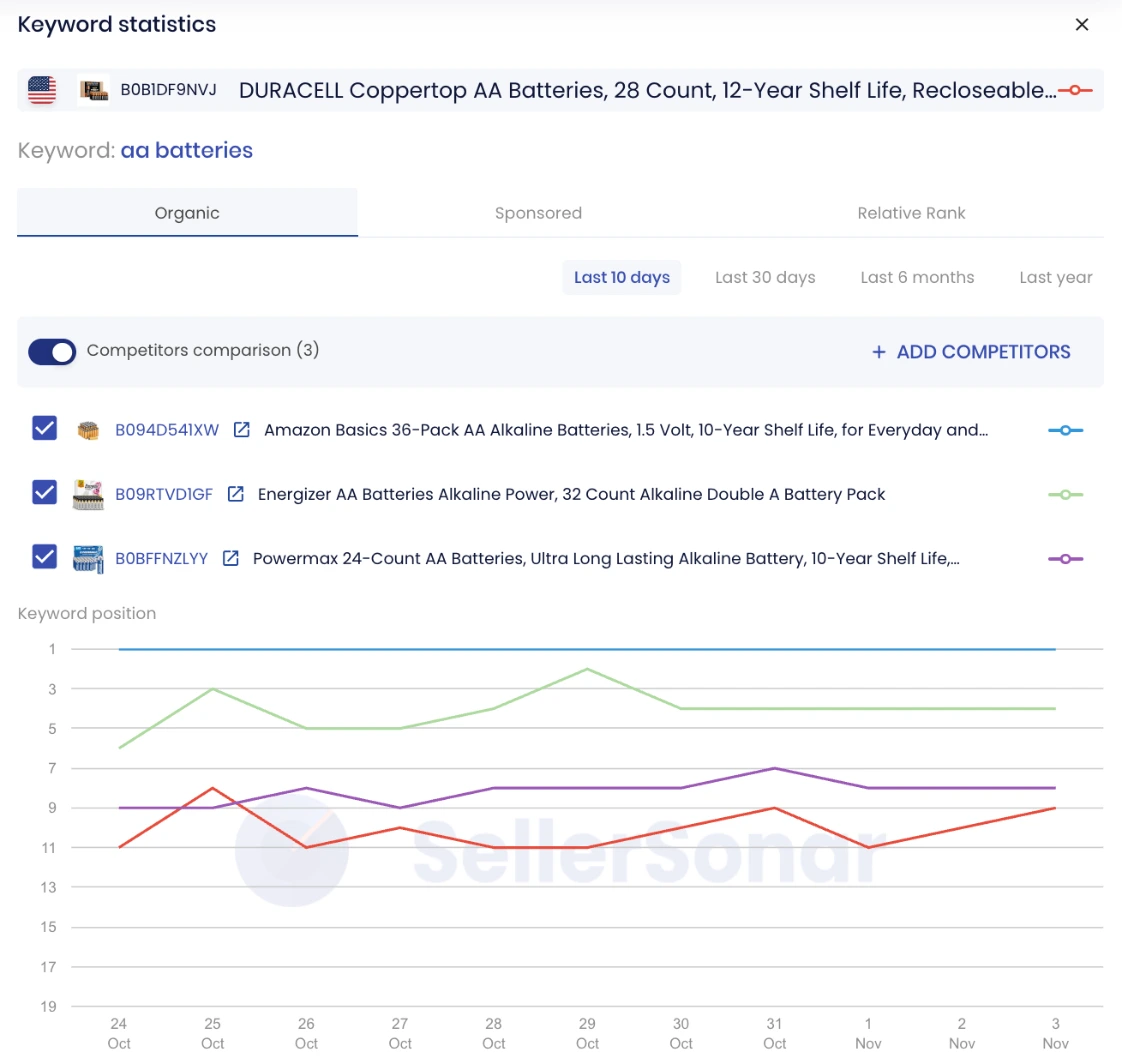
Over the same days, its sponsored listing showed up at position 2 each time we caught the ad, on October 29 and November 2. The ad bought a spot near the top of the page that organic search had not earned.
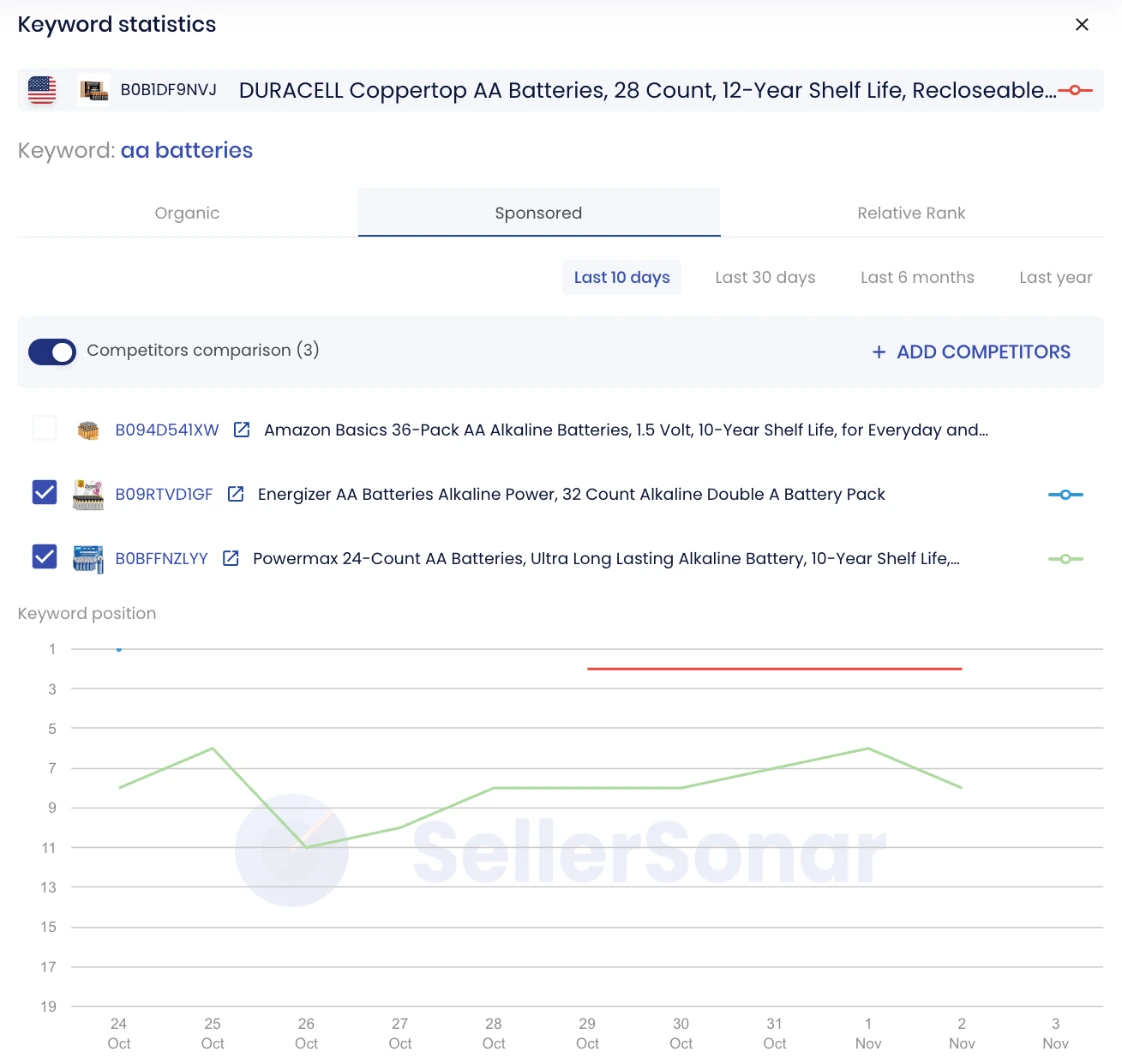
That gap is the decision. If organic rank climbs while you advertise, the ads are building something. If it stays flat, you are renting the position. SellerSonar’s keyword tracker records organic and sponsored rank daily for every ASIN you track, with history charts, so you can see both lines without exporting reports.
Bottom Line
Amazon Marketing Services is a 2018 name for what is now Amazon Ads. The ads you could buy through AMS still exist, under clearer names, in one platform called Amazon Ads Agent, and more of them are open to sellers than the old guides suggest.
Final Expert Recommendations:
Start with Sponsored Products on two or three products that already win the Featured Offer. Set your break-even ACoS per product before you set a bid. Add Sponsored Brands after Brand Registry, and judge every campaign on whether it lifts organic rank as well as sales.
If you want to watch organic and sponsored rank for your keywords in one place, you can try SellerSonar free for 14 days: 5 ASINs and 10 keywords, no credit card.

