





An Amazon FBA coach is someone you pay for one-to-one advice on running your seller account, usually by the call rather than by the month. According to one established agency’s published rate card, thirty minutes runs $150 to $400. You don’t need one to sell on Amazon.
What you need is a way to tell the useful ones from the rest, because this corner of the Amazon economy has a documented fraud record. According to the Federal Trade Commission, one operation it shut down in 2025 was charging a management fee of at least $45,000. It was the third Amazon coaching and “automation” business the agency had closed since 2024.
Prices quoted below are one agency’s published rates on the date given. They are an example of the market, not a survey of it.
What an FBA coach actually does
A coach sells judgment, not labor. They don’t run your account, which is what an agency does. You’re buying time with someone who has already made the decision you are facing and can tell you how it turned out.
The work lands in a few places:
- Account setup. The entity, the registration, the first listings, and the parts of Seller Central that are easy to get wrong once and slow to unwind.
- Advertising. Campaign structure and bidding, where new sellers most often spend steadily without a mechanism for stopping.
- Sourcing. Reading a supplier, checking a sample, and the questions that separate a factory from a trading company.
- Listing and ranking. Images, copy, A+ content and keywords, judged against what already ranks in your category.
- Diagnosis. One specific thing is wrong and you can’t see it.
That last one is the honest case for coaching. A general “teach me Amazon” session competes with free material that is already good. A specific stuck problem doesn’t.
Coach, consultant or agency
The three words get used interchangeably and they buy different things. The distinction matters mostly because it decides who is accountable when something goes wrong.
- Coach. Advice by the hour. You keep the work and the decisions. Cheapest, and useless if you won’t act on it.
- Consultant. Paid to look at your account and produce a diagnosis or a plan. Deeper than a call, still yours to implement.
- Agency. Paid monthly to do the work: ads, listings, cases. The most expensive, and the only one of the three that takes operational load off you.
Sellers often buy the first when they needed the third, then conclude that coaching doesn’t work. If the real constraint is that nobody has time to run the ads, an hour of advice about running ads doesn’t solve it.
What Amazon FBA coaching costs
At the established end, rates are published rather than negotiated. My Amazon Guy, an agency that ranks for these terms, lists six coaches at $150 to $400 for a thirty-minute call, plus $50 to put a question by email. Those were the rates on 30 September 2026.
Half an hour at $400 works out at $800 an hour, which is consulting pricing rather than teaching pricing.
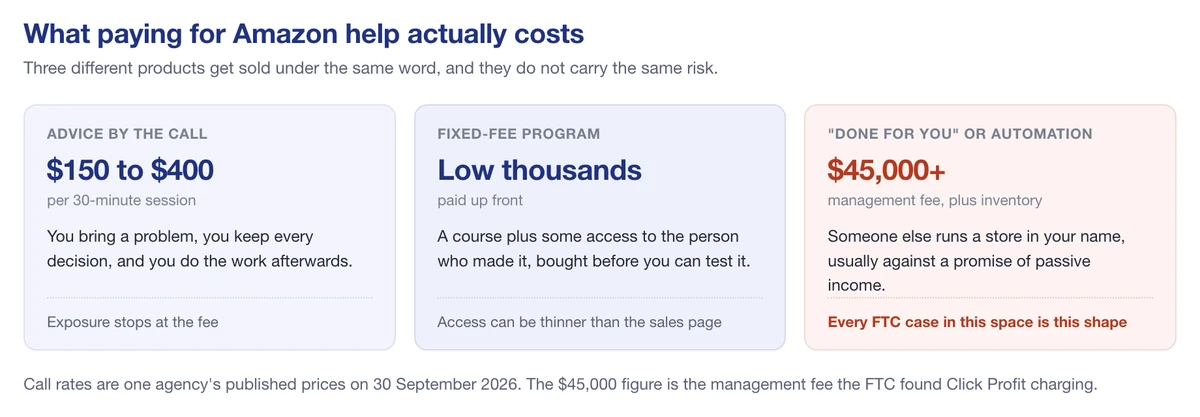
The three things sold under the word “coaching”, and what each one costs
Three shapes are common, and they don’t carry the same risk:
- Per call. You buy an hour and you keep every decision. Your exposure stops at the fee.
- Fixed-fee program. A course plus some access, paid up front. The risk is that the access turns out thinner than the sales page implied.
- “Done for you” or “automation”. You pay a large fee and someone else runs a store in your name, usually against a promise of passive income. Every enforcement action below is this third shape.
The FTC has closed three Amazon coaching operations since 2024
Most coaching guides leave this out, generally because the site publishing them sells something adjacent. These are federal actions with public case files.
| Operation | What it sold | What the FTC found |
|---|---|---|
| DK Automation March 2024 |
Amazon and Walmart “business packages” and coaching, sold as AMZDFY, Amazon Done For You and Amazon Done With You | Income promised “on autopilot”, supported by fake reviews touting profits. The FTC sent $2.8 million in refunds to 890 consumers. |
| Automators AI February 2024 |
AI-run Amazon and Walmart storefronts plus coaching, on “a proven system” | A judgment of $21,765,902.65, partly suspended, and a permanent ban on selling business opportunities or e-commerce coaching. |
| Click Profit complaint March 2025, banned August 2025 |
AI-powered storefronts on Amazon, Walmart and TikTok, with claimed ties to Nike and Disney | A management fee of at least $45,000 per customer and at least $14 million in consumer losses. |
Two details from the Click Profit complaint are worth carrying with you. Amazon had blocked, suspended or terminated about 95% of the company’s stores. And after Amazon’s fees, more than a fifth of those stores earned nothing at all, while another third earned under $2,500 in gross lifetime sales.
The Automators AI outcome is the one to note on the other side. That wasn’t a fine to be absorbed as a cost of doing business, and it’s the reason the case is worth ten minutes before you wire anyone a five-figure fee. It removed the operators from the industry.
How to tell a coach from a business opportunity
The difference isn’t polish. Scheme marketing is usually the more polished of the two. It’s what is being sold, and what is being promised.
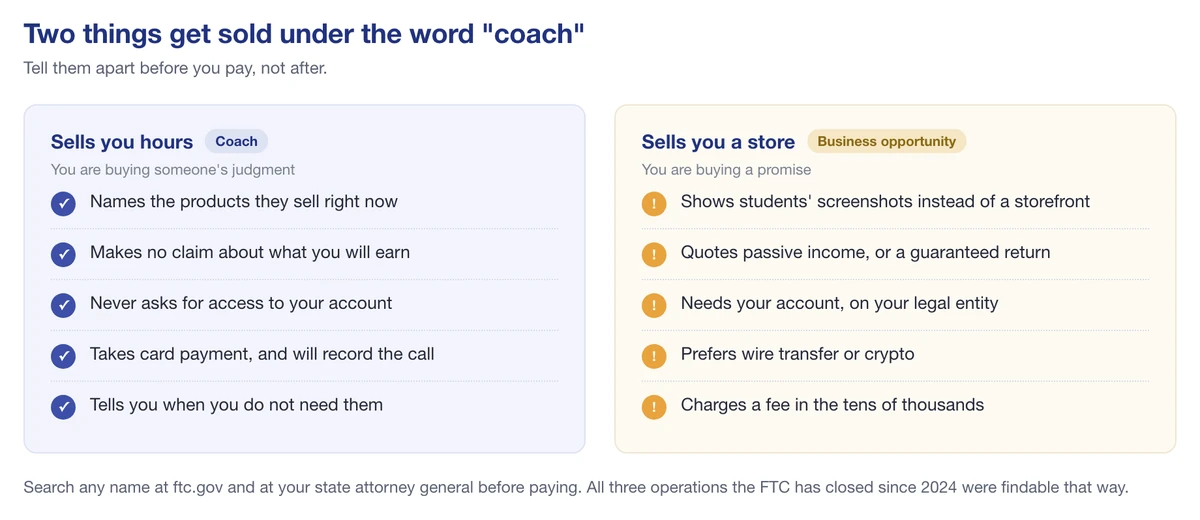
One sells you hours; the other sells you a store
Four tests, in the order they save you the most:
- Ask what they sell on Amazon now, and to see the storefront. An active seller answers in a sentence. Anyone who redirects to their students’ results is teaching a business they don’t run.
- Treat an earnings claim as the end of the conversation. Guaranteed returns, passive income, a multiple your store will later sell for. All three complaints above turn on claims of that kind.
- Do not hand over the account. “Done for you” means someone else making decisions on your legal entity. When it goes wrong, the suspension lands on your account, not theirs.
- Search the name at ftc.gov and at your state attorney general before you pay. It takes two minutes, and all three operations above were findable.
Two smaller ones: pay by card rather than bank transfer or crypto, and ask for the session to be recorded, so an expensive hour doesn’t survive only in your notes.
How to get value out of a paid hour
At $150 to $400 for thirty minutes, the difference between a useful call and a wasted one is mostly preparation.
Write the questions down before the call and put the hardest one first, because the session will overrun and the last question is the one that gets dropped. Give them access or screenshots in advance rather than spending the first ten minutes describing the problem. Bring numbers: units sold, ad spend, conversion rate, the dates things changed. Ask for the recording.
Then pick the areas where you’re genuinely weak rather than the ones you enjoy talking about. Sourcing, advertising and account health are the usual answers. Nobody needs paid help choosing a brand name.
“Performance coaching” in Seller Central is a different thing
If you searched for coaching and landed on Amazon’s own Performance coaching page, that is a name collision. It isn’t mentoring, and you can’t enrol in it.
It’s a defect ladder for FBA shipments. Amazon measures your shipment problem rate over 120 days for each problem group, such as missing barcodes or unplanned prep, then assigns a level: Standard, Elevated or Critical.
At Standard, Amazon may contact you with suggestions. At Critical, FBA can suspend your ability to choose who preps and labels your units, do the work itself and charge you a per-unit fee. Getting back to Standard takes 120 days below the acceptable rate, and only counts if you send inventory during them.
It’s a compliance escalation, not education. Worth knowing it exists. Not what you were looking for.
What you can get without paying anyone
Before you buy an hour, spend one. Seller University is Amazon’s own free training, now open without a selling account, covering more than 125 topics across listing, fulfillment, advertising and account health. It’s dry. It’s also accurate, which is the opposite trade to most paid material.
Our own explainers cover the same ground for free: how FBA works, what Amazon charges, and how to open an account.
When a coach is worth the money
Pay for one when the problem is specific and bounded, and staying stuck costs more than the fee. A suppressed listing, a rejected category application, an ad account spending without returning. An hour with someone who has seen it before is cheap against a month of guessing.
Do not pay for one to be taught Amazon in general, to be handed a product to sell, or to have the business run for you. The first is free elsewhere. The second and third are the shapes the FTC keeps having to close.
If you’re still choosing a model, FBA against FBM, private label and whether to form an LLC are decisions to settle before you pay anyone to advise you on them.
SellerSonar tracks the things a coach would otherwise have to find for you: listing changes, Buy Box hijackers, keyword rank movements and suppressions. Start your free 14-day trial.


Thanks a lot for sharing this amazing blog with us.