





Do I need an LLC to sell on Amazon? No. Amazon doesn’t require one, and you can open a seller account as an individual. Plenty of sellers never form anything.
The useful question is whether you should, and the answer turns on two things that have nothing to do with Amazon: how much risk your product carries, and how much you are making.
This is general information for sellers in the United States, not legal or tax advice. Entity choice depends on your state, your product and your circumstances. An hour with an accountant or attorney before you file is cheaper than unwinding it afterwards.
What an LLC actually does
Mainly one thing: it puts a legal boundary between the business and you. If the business is sued or owes money it cannot pay, the claim runs against the company rather than your house and your savings.
For an Amazon seller that matters most when the product can hurt somebody. Supplements, electronics with batteries, anything with a cord, a blade or a small part a child could swallow. If you import goods under your own brand, you carry the liability of the manufacturer rather than a shopkeeper, because there is no domestic maker for a claim to land on first.
The boundary isn’t automatic. It holds only while you treat the company as genuinely separate: its own bank account, its own records, no paying household bills out of business funds. Sellers who form an LLC and then run everything through a personal account have bought the fee without the protection.
What an LLC does not do
It doesn’t cut your tax bill, which is the claim you will meet most often.
The IRS treats a single-member LLC as a disregarded entity. In its own words, “for income tax purposes, an LLC with only one member is treated as an entity disregarded as separate from its owner.” You report the same profit on the same Schedule C and pay the same self-employment tax as a sole proprietor. By default, nothing about your tax changes.
There is an S corporation election that can change the self-employment arithmetic once profits are substantial, but that is a tax election you can make later. It isn’t a reason to form an LLC today, and it only starts to pay once you are earning enough to cover the payroll and filing it demands.
An LLC also doesn’t shield you from your own negligence, doesn’t change how Amazon treats your account, and doesn’t remove the need to be registered where you actually operate.
What it costs, including the part people miss
- A one-off filing fee to the state you form in. It varies by state and it is the smallest of the three.
- An annual fee or tax, every year, whether or not you’re trading. This is the one that surprises people.
- A registered agent, yearly, if you don’t want your home address on a public record.
California is the sharpest illustration. Per the state’s Franchise Tax Board, “every LLC that is doing business or organized in California must pay an annual tax of $800”, and “this yearly tax will be due, even if you are not conducting business, until you cancel your LLC.” A seller who forms one, sells nothing all year and forgets about it still owes that $800.
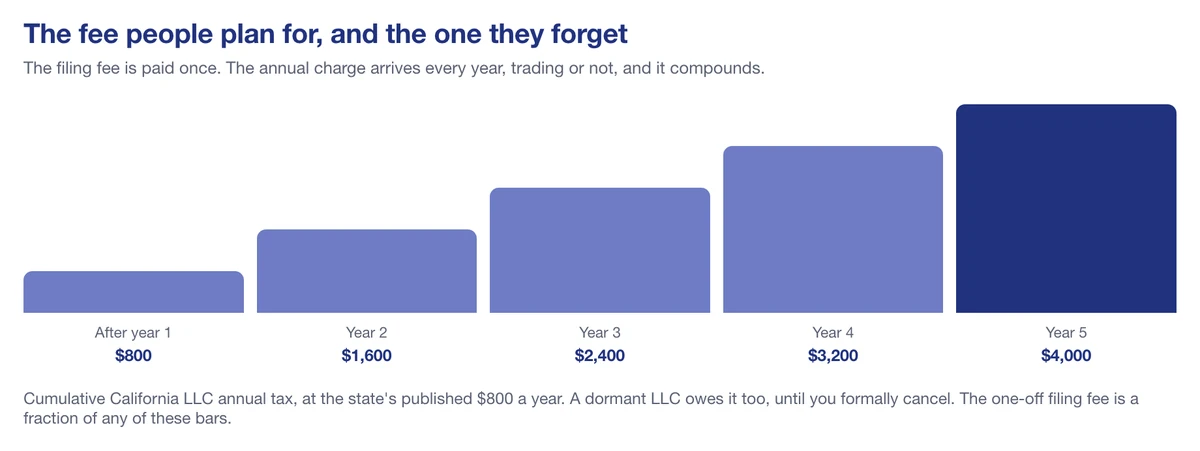
The annual charge is the one that adds up, and it is due even when dormant
Read that twice before you file.
LLC against sole proprietorship, side by side
A sole proprietorship is what you already are if you have sold anything and never filed. It isn’t a lesser choice, it’s the default one.
| Sole proprietorship | Single-member LLC | |
|---|---|---|
| To start it | Nothing. You already have one. | File with the state, pay the fee |
| Personal assets if sued | Exposed | Separated, while you keep it separate |
| Federal income tax | Schedule C | Schedule C, identically |
| Self-employment tax | Yes | Yes, unless you later elect S corp |
| Annual cost | None | State fee or tax, every year, trading or not |
| Tax ID | Your SSN, or a free EIN | A free EIN |
| Admin | None | Annual report, separate books, separate bank account |
The row that decides it is the second one. Every other line is either identical or a cost.
The expensive mistake: forming in the wrong state
Search this topic and most of the first page is companies that sell company formation, which is worth holding in mind while you read their advice about whether you need one. Many steer you to Wyoming, Delaware or Nevada on low fees and privacy. For a typical Amazon seller, that costs money.
States tax you on where you do business, not where you filed the paperwork. California’s wording is the giveaway: doing business or organized in the state. So an LLC filed in Wyoming but run from a kitchen table in San Diego owes Wyoming’s annual report, registers in California as a foreign LLC, and pays California’s $800 anyway. Two sets of fees and two filing calendars for one business.
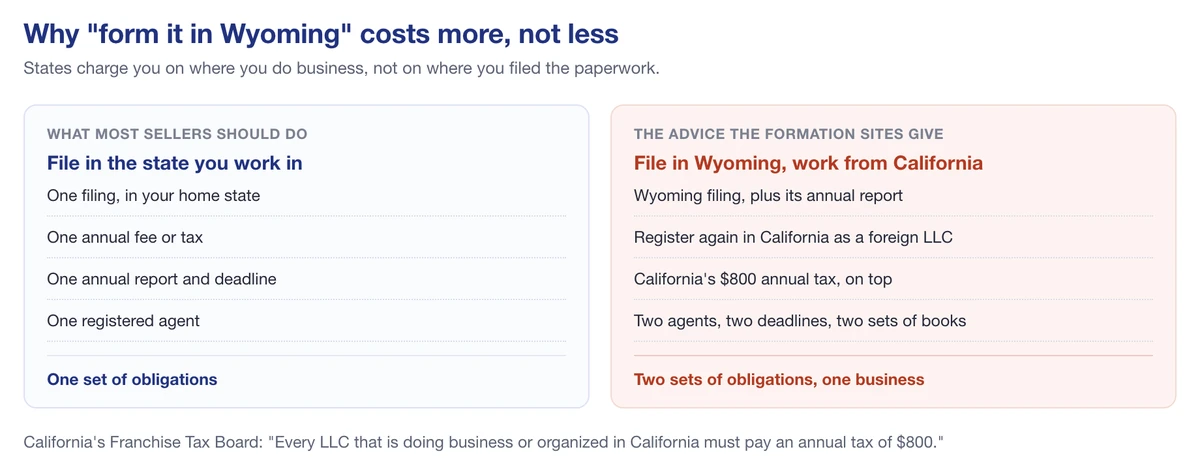
States charge on where you trade, not where you filed
For almost every Amazon seller, the right state is the one you live and work in.
The out-of-state choice genuinely suits a narrow group: non-residents with no US physical presence, businesses raising outside investment, and sellers with a specific reason their attorney can name. “I read it was better for taxes” is not one.
Your EIN is free
While you are here, don’t pay anyone for an EIN. The IRS is blunt about it: “Beware of websites that charge for an EIN. You never have to pay a fee for an EIN.”
You apply directly with the IRS, online, and you get the number in the same session. Formation services routinely bundle it in as a paid extra.
So when is it worth forming one
Form one when the downside of not having it is real:
- Your product could injure somebody. This is the strongest reason and it applies from your first unit, not at some revenue threshold.
- You are private labelling, so the brand on the box is yours and claims start with you.
- Profit is high enough that an S corporation election would save more than the entity costs to run.
- You have a partner, and you need the ownership split written down before it is tested.
- You are signing leases, credit lines or supplier contracts you would rather not sign personally.
Wait if you are testing whether the business works at all. Selling a handful of low-risk units while you learn is the case where a sole proprietorship is genuinely the reasonable answer, and you can form an LLC later without losing the account or the listings.
How to form one
- Pick your home state, unless a professional has given you a specific reason not to.
- Check the name is free on that state’s Secretary of State register, and check the matching domain and Amazon brand availability while you are there.
- File the articles of organization with the state, directly on its website. This is the step formation companies charge a markup to perform.
- Write an operating agreement, even as a single member. Some states require it, and it is what evidences the separation you are paying for.
- Get the EIN free from the IRS.
- Open a business bank account and move the Amazon disbursements to it. Skip this and the rest was decoration.
Then update the legal entity and tax details on your Seller Central account so the name Amazon pays matches the name on the bank account.
Changing the account over afterwards
You don’t need a new Seller Central account, and you shouldn’t open one. Opening a second account to “start fresh” as the LLC is the route to both being suspended.
Instead you update the legal entity on the existing account, in Account Info. Expect Amazon to re-verify you, because the name on the account, the name on the bank account and the name on your tax details all have to agree again. Have the formation document, the EIN letter and a bank account in the company name ready before you start, and don’t begin the change in the middle of your busiest week.
Your listings, reviews, feedback and ranking history stay where they are. Same account, different name.
Amazon.com Services LLC is not your LLC
One point of confusion sends people to pages like this one. Amazon.com Services LLC is Amazon’s own operating company, the entity named on your invoices and in its legal notices. It has nothing to do with whether you form a company. There’s nothing to join.
If that is what you came for: it’s the Amazon subsidiary that runs the store.
The short version
An LLC buys liability separation, and only if you run it properly. It doesn’t buy a tax cut. Form it in the state you actually work in, get the EIN yourself for nothing, and decide on risk rather than on a formation company’s landing page.
If you are still setting things up, our guides to opening a seller account, what Amazon charges and the tax you actually owe cover the ground around this decision.
Once the business is running, SellerSonar watches the part that needs daily attention: listing changes, Buy Box hijackers, keyword rankings and suppressions. Start your free 14-day trial.

