






Six months ago, almost no Amazon seller had heard of MCP. Today, six mainstream tools ship one, and every vendor’s pitch sounds the same: “Ask Claude or ChatGPT questions about your Amazon business.”
Problem is, they don’t answer the same questions.
Pick the wrong Amazon seller MCP and you either end up paying for a plan tier you don’t need (Helium 10 Diamond, Jungle Scout Cobalt), or you connect a shiny new AI copilot to a dataset that can’t see the one thing you actually care about (competitor ASINs, unshipped orders, hijackers, whatever it is for you).
Honestly, this is the kind of purchase where a comparison article should save you a week of trial-and-error. So that’s what this is. Six live Amazon seller MCPs, what each one exposes, who each one is genuinely built for, and the honest limitation each vendor keeps quiet about on their landing page.
About the Author: Gloria Anderson is an Amazon Brand Protection Specialist with 9 years of experience helping private label brands and distributors protect their pricing policies on Amazon. She has worked with brands managing 50 to 2,000+ resellers and has seen firsthand what happens when MAP enforcement is reactive instead of proactive.
Quick Answer
An Amazon seller MCP is a connector that lets Claude, ChatGPT, Cursor, or another AI assistant pull live Amazon data into a chat, so you can ask questions in plain English instead of digging through dashboards. Six mainstream options exist as of September 2026, and they do not overlap the way most comparison lists suggest.
Key facts:
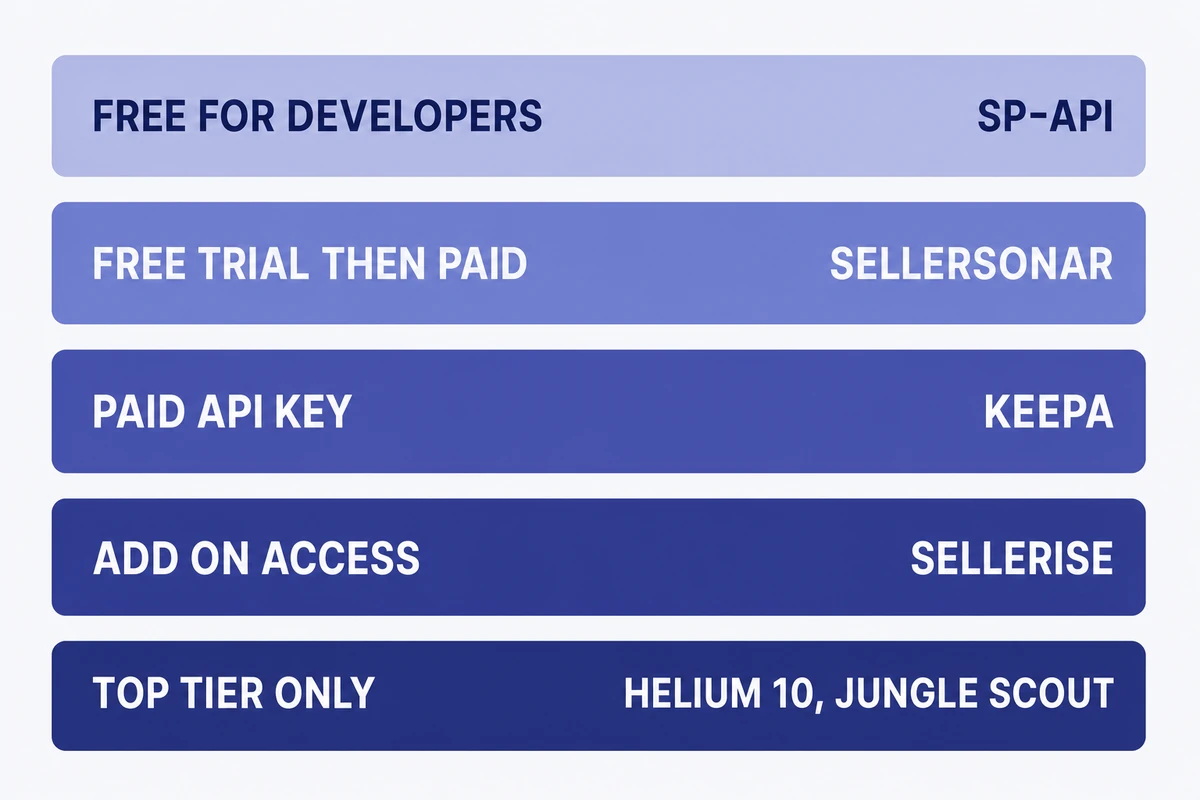
– Helium 10 MCP ships only with the Diamond plan and exposes 40+ tools across 24 marketplaces
– Jungle Scout MCP is gated to Cobalt (enterprise) customers
– Sellerise MCP is read-only and cannot modify listings, prices, inventory, campaigns, orders, payments, or settings
– SellerSonar MCP is the only option that reads public Amazon data, which means it works on any ASIN, including your competitors’, without Seller Central access
– The official Amazon SP-API MCP (@amazon-sp-api-release/sp-api-dev-mcp) is free but built for developers, not sellers
What is an Amazon seller MCP?
An Amazon seller MCP is a Model Context Protocol server that connects an Amazon data source (a seller tool, the SP-API, or public listing pages) to an AI assistant like Claude or ChatGPT, so the AI can answer questions using your live data instead of guessing.
MCP itself was introduced by Anthropic in late 2024 as an open standard. Think of it as a shared plug shape: any AI client that supports MCP can talk to any MCP server, the same way any USB-C laptop can talk to any USB-C monitor. The seller tool builds the server, you connect it once inside your AI client, and from then on the AI has permission to pull data on demand.
For an Amazon seller, that means you can type “Am I holding the Buy Box on B0BRXY8P4L today, and if I lost it, to whom?” into Claude and get an answer grounded in live Amazon data, instead of switching browser tabs to five different dashboards.
Different MCPs connect to different data. That’s where the choice gets interesting.
At a glance
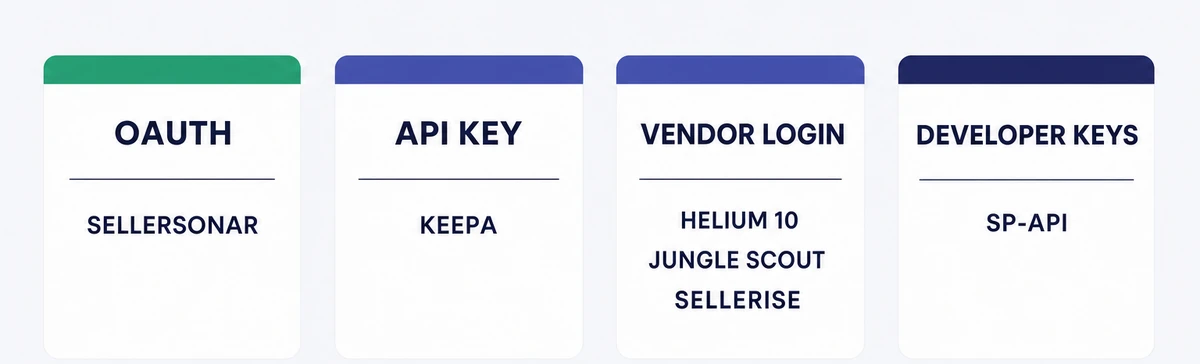
| MCP | Data type | Plan gate | Watches competitor ASINs? | AI clients | Auth |
|---|---|---|---|---|---|
| Helium 10 MCP | Keywords, ASINs, Brand Analytics, ads, P&L (40+ tools) | Diamond plan only | Only via H10’s dataset | Claude, ChatGPT, Cursor | OAuth (H10) |
| Jungle Scout MCP | Market share, keywords, share of voice, sales & ads | Cobalt (enterprise) only | Only via JS’s dataset | Claude, ChatGPT, Gemini, Copilot | Cobalt login |
| Sellerise MCP | Sales/profit, PPC, reviews, inventory, reimbursements | AI Connector access | No, your ASINs only | Claude and MCP-compatible clients | OAuth, read-only |
| SellerSonar MCP | Buy Box, suppression, rank, BSR, reviews, badges | Trial, then Business plan | Yes, any ASIN | Claude, ChatGPT, Cursor, Claude Code | OAuth |
| Keepa MCP (community) | Price history, sales rank, deals, best sellers | Paid Keepa API key | Yes (public data) | Claude | Keepa API key |
| Amazon SP-API MCP (official) | Raw SP-API: orders, inventory, catalog, finance | Free (developer) | No, your account only | Any MCP client | LWA / SP-API creds |
Now let’s go through each one honestly.
Helium 10 MCP
Best for: Diamond subscribers who already live in H10 dashboards.
If you’re already paying for Helium 10 Diamond, this is a genuinely useful upgrade. The Helium 10 MCP exposes 40+ tools across keywords, ASIN research, Amazon Brand Analytics, ads campaigns, and P&L breakdowns, working across 24 marketplaces from a single MCP connection.
What it does well. From what we see, the coverage is the most complete of any seller-tool MCP on the market right now. You can ask “Which of my top ten ASINs saw an ACoS spike last week and what drove it?” and get an answer that stitches together ad performance, keyword rank, and profitability. That’s a genuinely hard question to answer in a dashboard, and the MCP makes it feel easy.
Auth model. OAuth into your existing Helium 10 account. Standard and safe.
Honest limitation. You need Diamond or above. Helium 10’s entry tier is Platinum at $99 a month on annual billing, and it does not include the MCP. So if you’re on Platinum today and you like the sound of this, the math isn’t “Is the MCP worth it?” It’s “Is the jump to Diamond at $279 a month worth it?” That’s a much bigger question, and the vendor page doesn’t surface it.
The second limitation is scope: the MCP can only see what Helium 10 tracks for you. If a competitor ASIN isn’t already in your Helium 10 workspace, the MCP can’t help you watch it.
💡 Expert Tip: Before you upgrade to Diamond just for the MCP, list five questions you would ask Claude in a week. If four of them are “How is my own catalog performing?”, the MCP is a win. If most of them are “What is my competitor doing?”, the answer is different.
Verdict. If you’re already on Diamond, connect it today. If you’re not, the MCP alone isn’t a strong enough reason to upgrade.
Jungle Scout MCP
Best for: enterprise brands already on Cobalt.
Jungle Scout’s MCP is aimed at a different buyer than Helium 10’s. It hooks into Cobalt, Jungle Scout’s enterprise offering, and exposes market share, category growth, share of voice, brand performance, keywords, and connected sales and ad data. According to the Jungle Scout MCP product page, it works with Claude, ChatGPT, Gemini, and Microsoft Copilot.
What it does well. The dataset is broader than Helium 10’s on category-level intelligence. If your job is quarterly business reviews for a brand with 50 SKUs, and you already run Cobalt, being able to draft a QBR summary directly in ChatGPT (grounded in real market-share data) is genuinely useful.
Auth model. Cobalt credentials. Same as your existing dashboard.
Honest limitation. Cobalt is enterprise pricing and Jungle Scout doesn’t publish it. There’s no self-serve upgrade path. If you’re a solo seller or a small agency, this MCP isn’t for you, and there’s no “MCP-only” tier that gets you in.
The second thing worth noting: the Jungle Scout MCP page is candid that report creation depends on the AI platform’s capabilities. In plain English, you get data through the MCP, but “please draft a Slack notification and save the PDF to Drive” only works if the AI client you’re using has those integrations. Don’t expect the MCP itself to write to third-party tools.
Verdict. Great for enterprise brands and agencies already inside the Cobalt ecosystem. Not accessible to anyone else.
Sellerise MCP
Best for: detailed P&L and PPC drill-downs on your own account.
Meet Alex, a private label seller doing about $80K/month across 40 ASINs. Every Monday morning, Alex spent an hour in Sellerise pulling PPC reports, cross-referencing them against inventory, and manually flagging campaigns that leaked budget. When Sellerise shipped their MCP, that whole Monday hour became one Claude prompt: “Show me every campaign last week where ACoS exceeded 40% and I still had strong inventory position.” Answer in 12 seconds. That’s the use case Sellerise nails.
Per the Sellerise MCP integration announcement (page updated July 17, 2026), the MCP exposes sales, profit and payout data, PPC campaign and keyword performance, reviews, inventory, reimbursements, and search performance metrics. Setup is OAuth into your Sellerise account.
Honest limitation. The Sellerise vendor blog is unusually direct about this, which we appreciate: the connection is read-only. It can’t modify listings, prices, inventory, campaigns, orders, payments, or settings. Demo accounts can’t connect either.
That’s a feature if you’re nervous about handing an AI write access to your account (most sellers should be). It’s a bug if you were hoping to say “Pause every campaign where ACoS is too high” and have it just happen. You still have to go do the action yourself in the dashboard.
🎯 Pro Insight: Read-only isn’t a downside, it’s a design choice. Every MCP that lets AI take actions on your account also lets AI make mistakes on your account. In the current maturity level of these tools, read-only is the safer default.
Verdict. If your job-to-be-done is “understand what happened on my own account faster,” Sellerise MCP is one of the strongest options. If you want AI to take actions for you, look at custom SP-API builds.
SellerSonar MCP
Best for: watching any ASIN, yours or a competitor’s, without Seller Central.
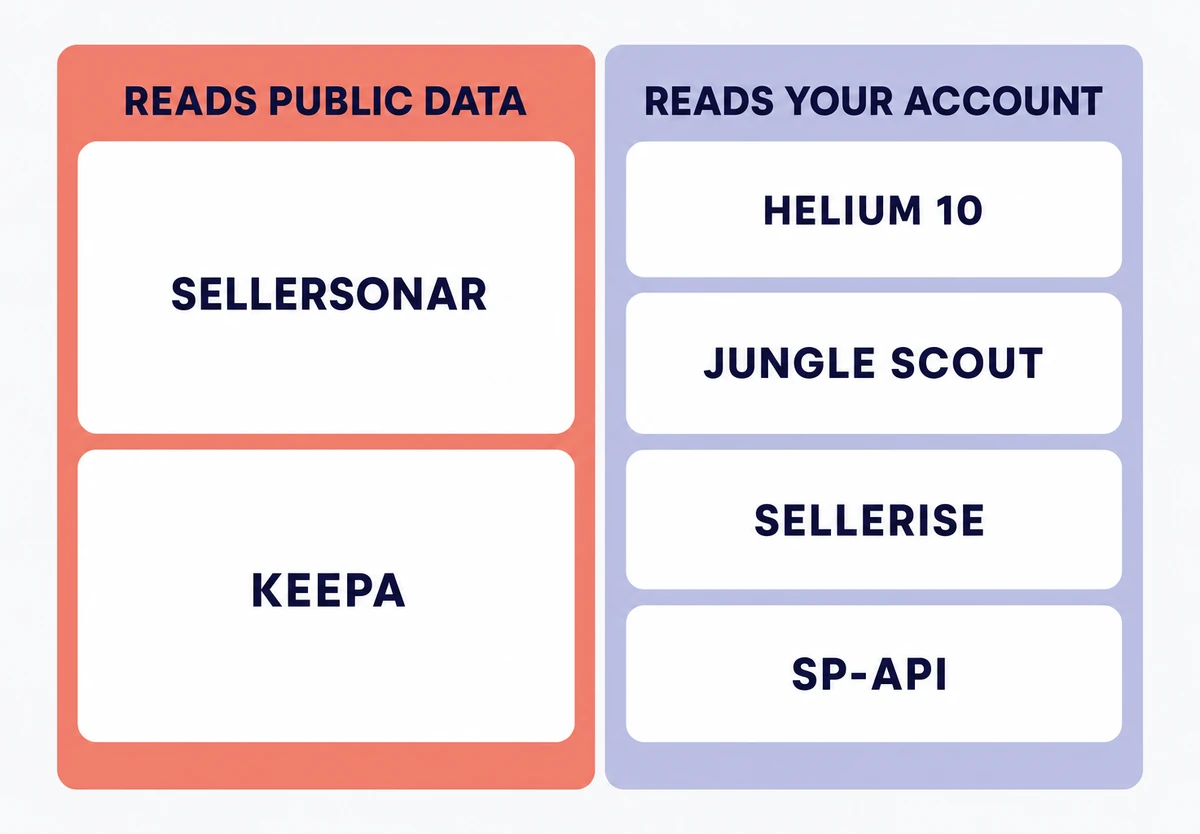
Every other MCP on this list has one thing in common: it reaches into your Amazon account data. Whether it’s Helium 10 OAuth, Sellerise OAuth, or SP-API keys, they all read a dataset that lives inside your Amazon account.
SellerSonar’s MCP does something structurally different. It reads the public side of Amazon, the same pages every shopper sees. That means the MCP answers competitor-ASIN questions the same way it answers questions about yours: by parsing the listing, the offer stack, and the Buy Box, in real time.
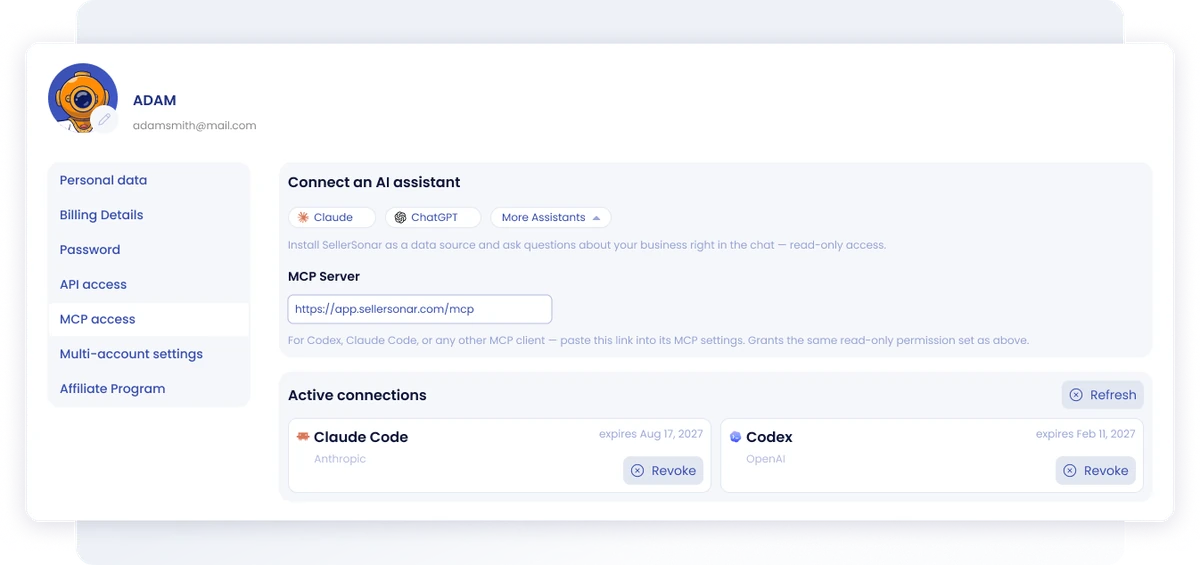
The six signals it covers are Buy Box status, listing suppression, keyword rank, BSR, reviews, and Amazon badges. All ask-in-plain-English from Claude, ChatGPT, Codex, Claude Code, Copilot, Cursor, Gemini, or Antigravity.
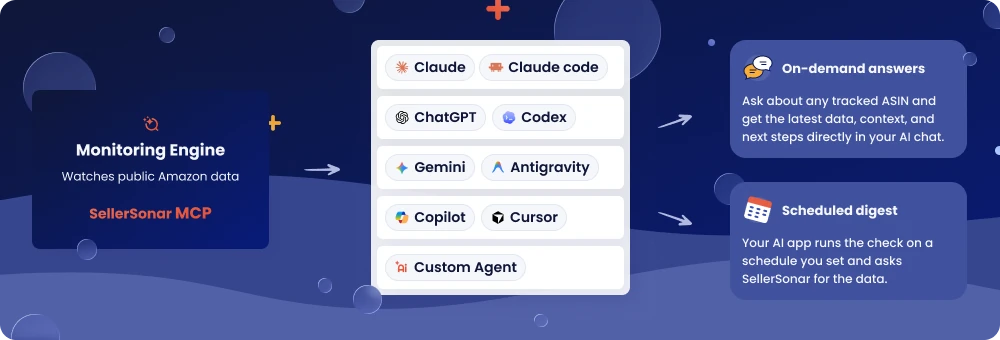
Three real prompts sellers ask on day one:
- “Am I holding the Buy Box on ASIN B0BRXY8P4L today, and if I lost it, to whom?”
- “Are there any new hijackers on my ASINs overnight, and what should I do?”
- “Track competitor ASIN B08N5WRWNW and alert me when they change price or lose the Buy Box.”
That third one is the moat. No other MCP in this list can answer it without you handing over the competitor’s Seller Central credentials, which you obviously don’t have.
Honest limitation. Because SellerSonar’s MCP doesn’t touch your Seller Central, it can’t answer questions about your private account data. It doesn’t know your PPC campaign spend, your COGS, your inventory position or your P&L. If those are the questions you care about, you want Sellerise or Helium 10 instead. This isn’t the MCP for financial drill-down.
The trade-off is real, and it goes both ways. You lose account-level analytics. You gain the ability to watch every listing on Amazon, including your competitors’, with zero permissions and zero risk of an AI making changes to your account.
📌 From Our Experience: The sellers who love SellerSonar MCP are usually the ones who’re already anxious about hijackers, Buy Box loss, or listing suppression. They already have a P&L system they trust. What they lacked was a fast way to check “what changed on this ASIN in the last hour,” across their own catalog and their competitors’, without opening five browser tabs. That’s exactly the gap this fills.
Verdict. The only MCP built for competitor-ASIN monitoring and for sellers who won’t (or can’t) grant Seller Central access. If that’s your situation, start a free 14-day trial and connect it to Claude in two minutes.
Keepa MCP
Best for: price history and deal hunting.
Keepa is the elephant in the room for anyone doing Amazon arbitrage or wholesale. The MCP layer is community-built rather than vendor-shipped. The most-starred version lives on the Keepa MCP community server on GitHub, and there is a hosted option through Marketplace Ad Pros as of July 2026.
What it does well. Historical price charts, sales-rank time series, category best sellers, and filtered deal lists. If your daily work is “should I buy this pallet at wholesale for Amazon resale?”, the ability to ask Claude to summarize Keepa’s price and rank history for a list of ASINs in one go is a real time saver.
Auth model. You supply your own Keepa API key, and that key is a paid subscription. Keepa has no free API tier. The API starts at €49 a month for 20 tokens per minute, and the €29 a month Keepa Pro plan includes just one token per minute. The MCP is free to self-host; the data behind it is not.
Honest limitation. This is a community MCP, not a vendor product. That means no vendor support, patchier documentation, and setup that assumes you’re comfortable running an MCP server locally (or trusting a third-party host). If you’re a non-technical seller, this one has a learning curve. Also, Keepa data is historical and public: you won’t get anything about your own Seller Central, PPC, or private account performance.
Verdict. Excellent for arbitrage and wholesale product research. Not for private label sellers who want account-level intelligence.
Amazon SP-API MCP
Best for: developers building custom AI workflows.
Amazon itself ships an official MCP server for the Selling Partner API. It’s published as the npm package @amazon-sp-api-release/sp-api-dev-mcp from the official amzn/selling-partner-api-samples repo on GitHub. It exposes the raw SP-API surface, which means orders, inventory, reports, catalog, finance, fulfillment, everything the Amazon SP-API itself supports. For ad accounts, Amazon runs a separate server; see how to use the Amazon Ads MCP.
What it does well. If you’re a developer or an agency building a bespoke AI workflow for a specific client, this is the closest to the metal you can get without writing your own MCP. You get every SP-API endpoint. There’s also a community-maintained version by Ailumia that provides a more polished five-tool surface backed by 353 SP-API operations, which some developers prefer.
Honest limitation. This is a developer tool. Setup requires an SP-API developer registration, LWA credentials, understanding of scopes and roles, and a comfortable relationship with the command line. If you’re a seller reading this article looking for a plug-and-play AI copilot, this isn’t the MCP for you. This is what your custom-agency team would build on top of.
Verdict. The right foundation for a custom build. Almost always the wrong choice for a self-serve seller.
Which one should you pick?
Here is the short version of the decision, by user profile:
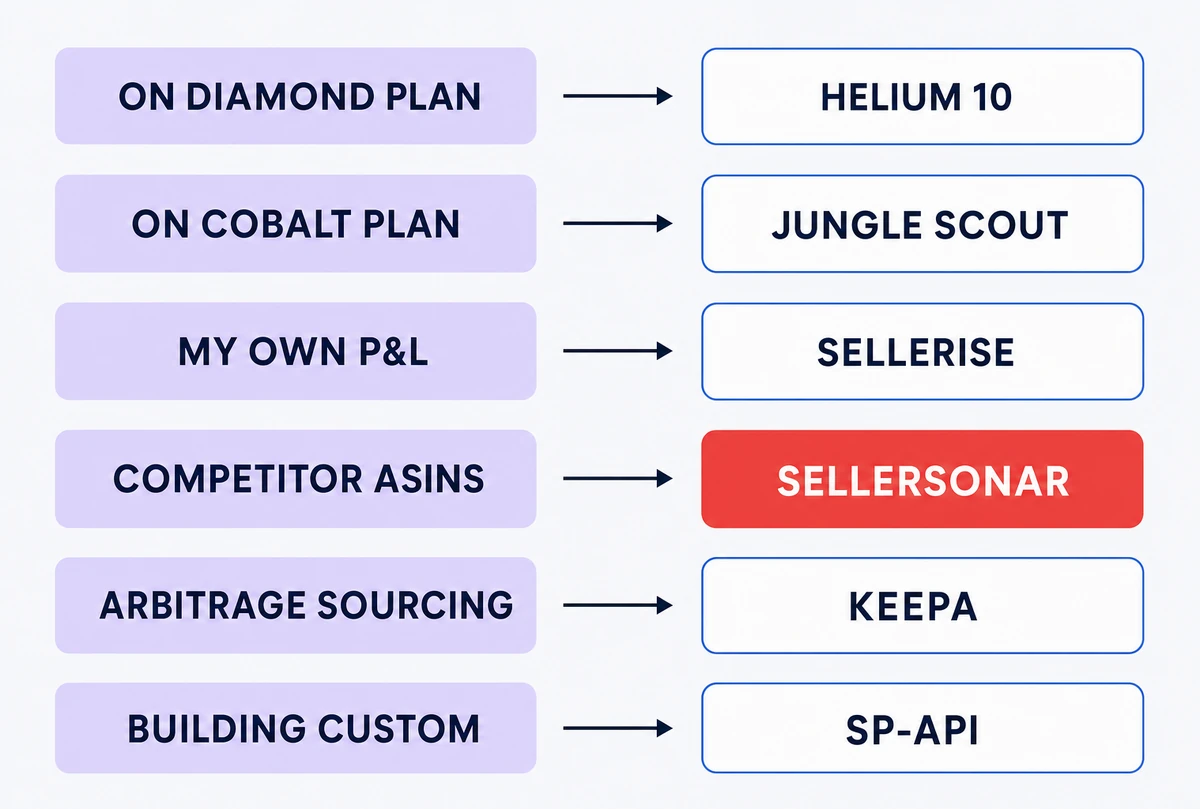
- If you already pay for Helium 10 Diamond, use the Helium 10 MCP. Don’t shop further.
- If you’re an enterprise brand or agency inside Cobalt, use the Jungle Scout MCP for the same reason.
- If your daily question is “what’s happening on my own account,” especially P&L and PPC, Sellerise is the strongest pick.
- If your daily question is “what changed on this ASIN,” especially competitor ASINs, or if you won’t grant OAuth to your Seller Central, use the SellerSonar MCP. It’s the only option in this space that watches public data at ASIN level.
- If you do arbitrage, wholesale, or online-arbitrage sourcing, Keepa MCP earns its keep on price history and deal filtering.
- If you’re a developer building custom AI automation for one specific account, the official Amazon SP-API MCP is your foundation.
You can also connect more than one MCP to the same AI client. Claude, ChatGPT, and Cursor all support multiple MCP servers simultaneously. Nothing stops you from running Helium 10 MCP for your own P&L and SellerSonar MCP for competitor watching in the same Claude window.
Recommendations
The mistake most sellers make with MCPs right now is treating them like a product category where the “best” tool wins. That framing is wrong. These are complements, not substitutes.
The right question isn’t “which Amazon seller MCP is best.” It’s “which two MCPs cover the questions I ask every day.” For most sellers, that’s one account-scoped MCP (Helium 10 or Sellerise, depending on your existing subscription) plus one public-data MCP (SellerSonar for competitor watch, or Keepa for arbitrage sourcing).
If you have to pick just one and you’re already inside Helium 10 Diamond or Jungle Scout Cobalt, use theirs and be done with it. If you’re not on either plan, and you want to start seeing value inside Claude or ChatGPT today, SellerSonar’s MCP has a free 14-day trial with no Seller Central connection and no credit card. It takes about two minutes to connect and it works on any ASIN you type into Claude, including the competitor whose Buy Box has been eating your lunch.
Ready to see what your competitors’ listings look like inside your own AI chat window? Start your free trial.

