





Quick Answer
The Amazon Great Indian Festival is amazon.in’s festive sale, and Amazon has confirmed that in 2026 it opens on October 8, with Prime members getting 24-hour early access from October 7.
- It is not Prime Big Deal Days. That event runs October 6 and 7 across 22 countries, and India is not one of them.
- Amazon has not published an end date. Past editions have run in waves for several weeks, into the Diwali period, which falls on November 8 this year.
- Most of the deal formats shoppers see are Amazon’s, not yours. What you control is coupons, ads, price and stock.
- The risk is not the first 48 hours. It is staying alert for a month while your listings carry festive traffic.
About the Author: Gloria Turner writes for the SellerSonar editorial team on Amazon monitoring and marketplace operations. She has watched enough festive seasons to know that the expensive problems rarely arrive on day one.
The Great Indian Festival is the biggest selling window on amazon.in, and 2026’s opens on October 8. Prime members get in a day early, on the 7th.
Almost everything written for sellers about this event is a preparation checklist, and most of it was published in August. That advice is sound and it is also, by now, mostly spent. Inventory is where it is. Deals are submitted or they are not.
This guide picks up where those leave off. It covers what you can still move before the 8th, and then the part nobody writes about: what happens to your listings over the weeks the sale actually runs.
Great Indian Festival vs Prime Big Deal Days
These two get confused every October, and the confusion costs people money.
Prime Big Deal Days runs October 6 and 7 in 22 countries. India is not among them. If you sell only on amazon.in, that event is not yours and its deadlines never applied to you.
The Great Indian Festival is amazon.in’s own event, it starts on October 8, and it runs far longer. Different formats, different timetable, different rules.
Both matter if you sell through Global Selling as well as at home. The October calendar then holds two separate events in the same week, each with its own submission history and its own peak.
What Amazon runs, and what you control
This is the distinction most festive guides blur. The headline formats belong to Amazon. You are not submitting an “8 PM Deal”, you are being selected for one.
Amazon lists the shopper-facing formats for 2026 as Blockbuster Deals, Top 100 Deals, Mega Deals, 8 PM Deals, Buy More Save More, Exchange Mela, Sample Mania and Amazon Combos, alongside a 10% instant discount on SBI cards and up to 10% extra for Prime members.
What sits in your hands is shorter, and it is what Amazon tells sellers to do:
| Lever | Who controls it | Still movable this week? |
|---|---|---|
| Seller Powered coupons | You | Yes. Quick to set up and visible in search. |
| Sponsored Products | You | Yes, though bids get expensive as the event nears. |
| Price | You | Yes, and it feeds deal eligibility. |
| Stock position | You, up to the FBA cut-off | Partly. Check your own cut-offs in Seller Central. |
| Blockbuster, Top 100, Mega, 8 PM Deals | Amazon | No. Selection, not submission. |
Amazon does not publish GIF deal submission windows or FBA cut-offs on a public page. They surface in your own Seller Central, and they vary by category and by seller. Treat any date you read in a blog post, this one included, as a prompt to go and check rather than as a fact about your account.
💡 Expert Tip: If you were not selected for a headline format, you have not lost the event. Shoppers who arrive for a Blockbuster Deal browse the category around it, and a well-priced listing with a coupon collects traffic that someone else’s discount paid to create.
What’s still open before October 8
Two weeks out, the useful work is short and unglamorous.
Set your coupons. They need no selection process, they show up in search results, and they are the fastest lever left.
Decide your advertising ceiling now. Festive bidding gets expensive and it stays expensive for weeks, not days. Deciding your limit during the sale is how budgets disappear.
Stop cutting price. Deal eligibility is measured against your own recent pricing, so a discount run right before the event can work against you.
Fix what is broken while it is quiet. A suppressed listing or a missing image costs little today and a great deal on October 10. Our seller holiday calendar covers the wider Q4 sequence this event opens.
A month is not a sprint
Here is the part that separates this event from every other sale you plan for.
Prime Big Deal Days is 48 hours. You can hold your breath for 48 hours. The Great Indian Festival opens on October 8 and, going by past editions, keeps going in waves toward Diwali on November 8. Amazon has not confirmed an end date, which is itself worth planning around.
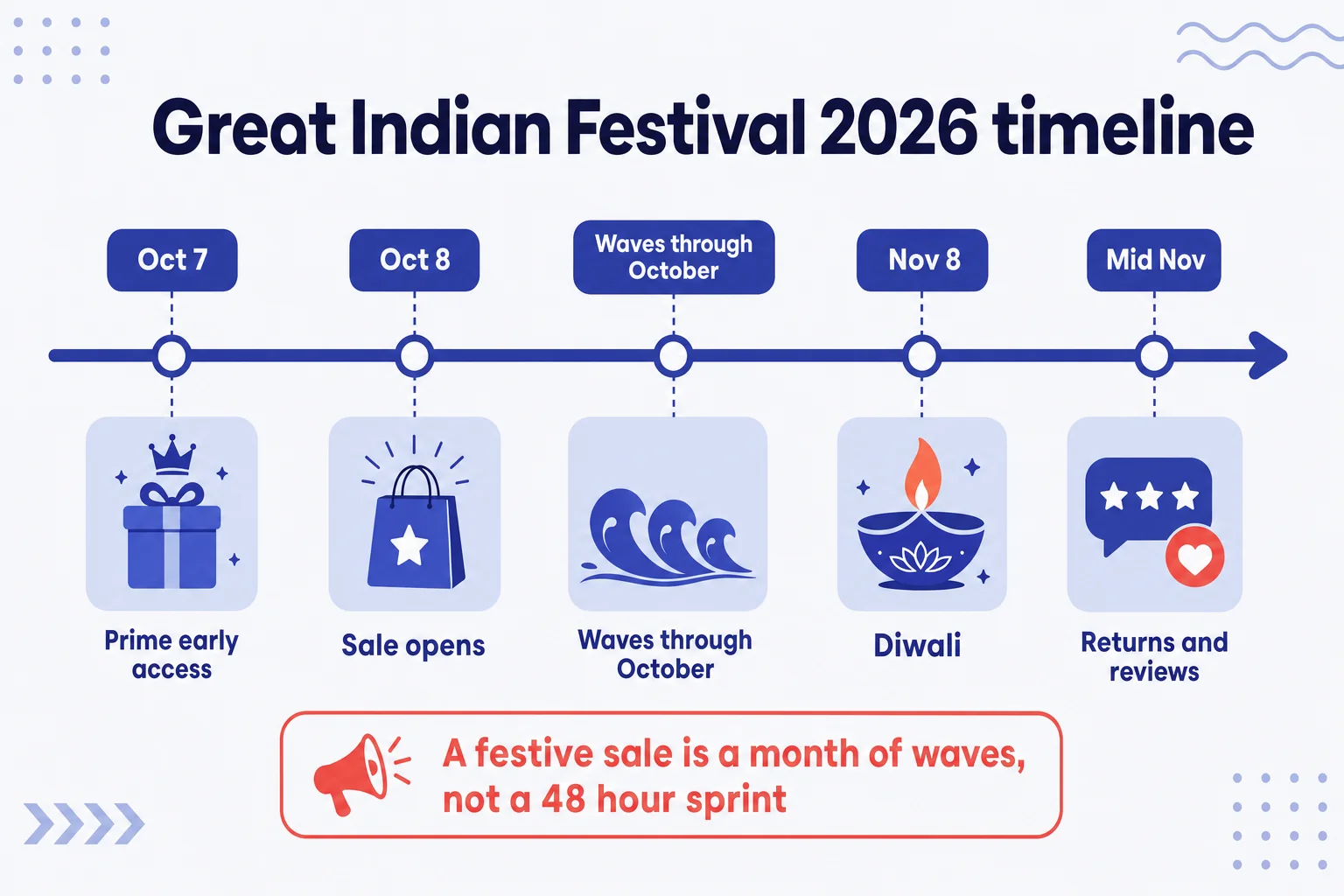
A month changes the problem in three ways.
Attention runs out before the sale does. Teams watch closely for the first few days, then drift back to normal work while traffic is still elevated. Week three is when things break unnoticed.
Competitors adjust repeatedly. In a two-day event a rival prices once. Across a month they reprice, run out of stock, come back, and undercut again. What you are tracking is a pattern, not a moment.
Small problems compound. Losing the Buy Box for an afternoon during a 48-hour event is a bad afternoon. Losing it quietly for nine days in a month-long festive period is a quarter.
🎯 Pro Insight: Decide now who is watching in week three. Almost every seller plans the first week of a festive sale in detail and the rest of it not at all.
The wave-by-wave watchlist
Five things move while a festive sale runs, and each one costs more during the event than it would in an ordinary week.
The Buy Box. Festive traffic is the traffic you paid for. If you lose the Buy Box mid-wave, a competitor collects it. Over a month this is the single most expensive thing to miss.
New sellers on your listings. High-traffic listings attract people who want a share of that traffic. An unauthorised seller arriving during a festive sale benefits from every impression your coupons and ads generate. Our removal playbook covers the response, but speed of detection decides the damage.
Listing suppression. The worst possible timing, and it gives no warning.
Price moves. Both your competitors’ and your own. The second category is more common than sellers like to admit, and a mispriced ASIN can run for days in a month-long event.
Badges. Deal badges appear and disappear as waves start and end, and Amazon’s own badges move with them.
How alerts cover a month-long event
Nobody checks listings by hand for four weeks. The changes land at odd hours, there are too many ASINs, and attention fades exactly when the sale is still running.
This is worth saying plainly because most monitoring tools do not cover India: SellerSonar supports 23 Amazon marketplaces, and amazon.in is one of them. The alerts below work on your Indian listings, not just your export ones.
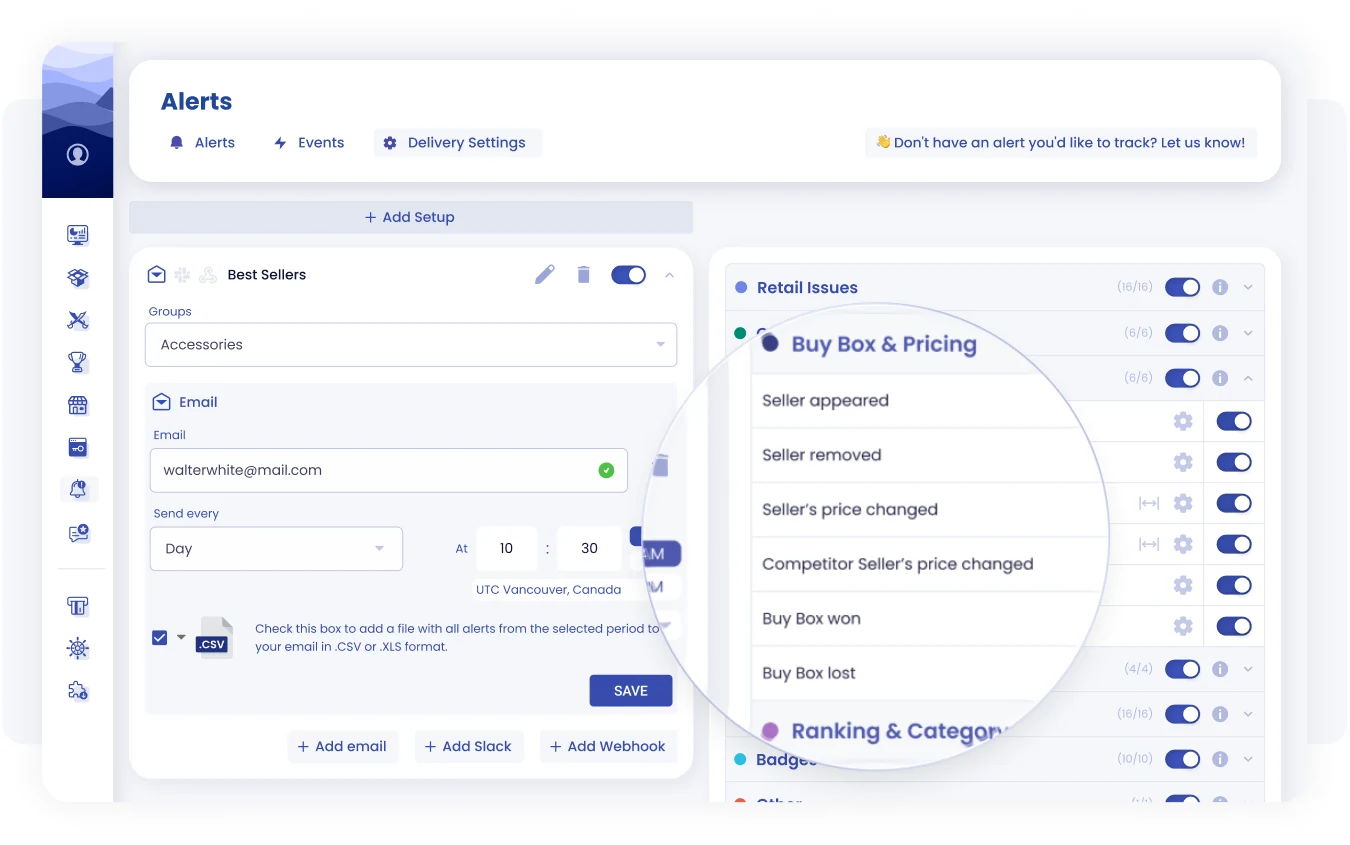
The ones worth switching on for the festive period:
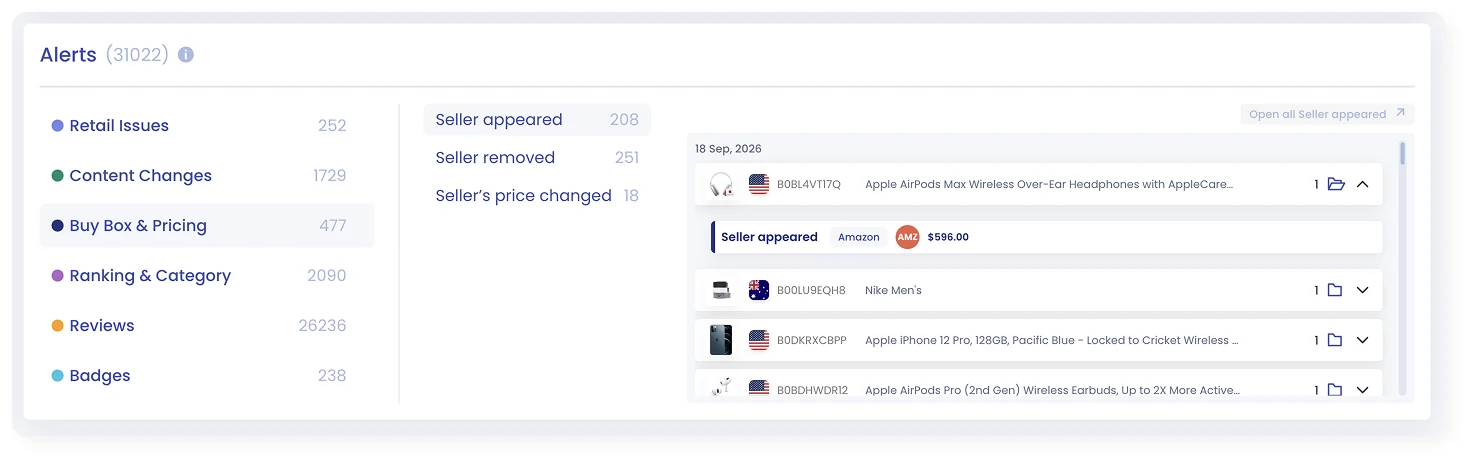
- Seller appeared. The highest-value alert during any sale event, because an unauthorised seller on a listing you are actively promoting takes the Buy Box and everything downstream of it.
- Buy Box lost or won. Tells you whether festive traffic is converting to you or past you.
- Price changed. Catches competitor repricing and your own errors equally well.
- Deal badge appeared or ended. Confirms a wave has started on your ASIN, and tells you when it stops.
- Listing suppressed. Rare. Ruinous. Especially in October.
Point them at the ASINs that actually carry your festive revenue. A handful of listings watched properly beats a whole catalogue watched in theory.
Want to know the moment something moves on your amazon.in listings? Start a free 14-day SellerSonar trial and track 5 ASINs, no credit card required.
Watching the Buy Box across the waves
During a month-long sale, Buy Box ownership is the number that tells you whether the rest of it worked.
Your coupons are set, your ads are running, your stock is where it is. What stays variable is whether the traffic those things generate converts to you, and that is decided by who holds the Buy Box when a shopper taps buy.
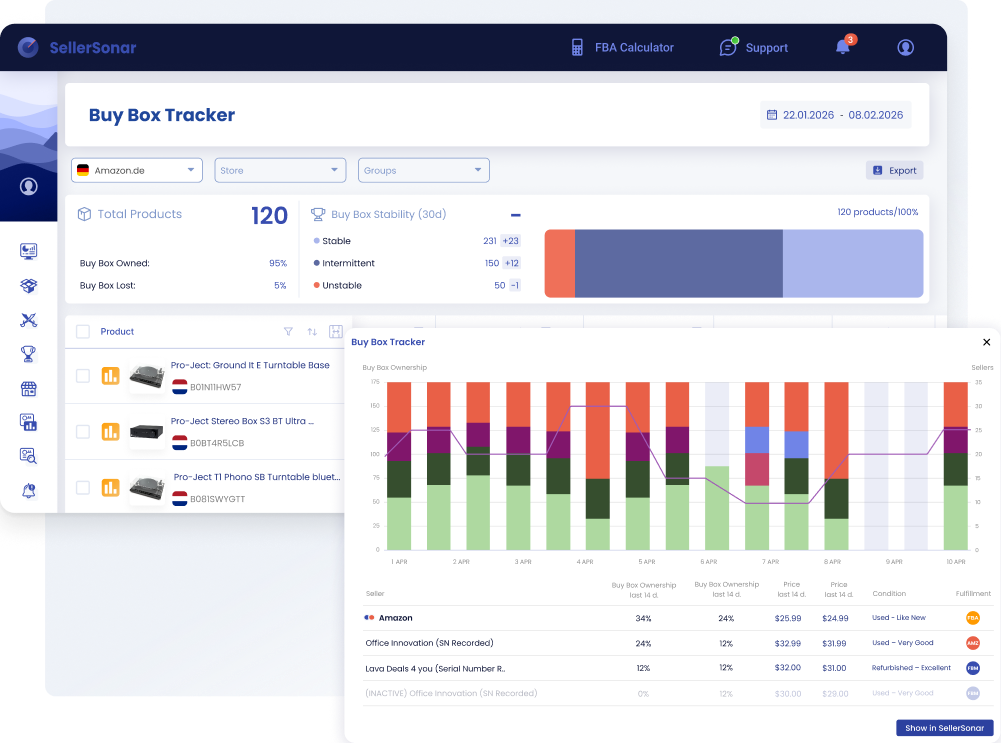
This is where a month differs from 48 hours. A single alert tells you the Buy Box moved. The Buy Box Tracker tells you what has been happening across the whole event: how much of the time you have held it, which ASINs are stable and which keep flipping, and which competing sellers are taking it and at what price.
Over four weeks that pattern is the difference between a rival who undercut you once and a rival who has settled in for the season.
The tail after Diwali
Festive sales have a delayed cost, and it lands after everyone has stopped paying attention.
Returns rise a few weeks after a big sale event. A high enough return rate can earn a listing the frequently returned item badge, on the ASIN that performed best during the festival. Reviews also arrive in volume once deliveries land, and they shape how the listing performs going into the rest of Q4 and Black Friday.
Neither shows up while you are still watching the sale. Both are worth a look in the second half of November.
What this comes down to
The Great Indian Festival 2026 opens on October 8, with Prime early access on October 7, and runs in waves toward Diwali on November 8. It is a separate event from Prime Big Deal Days, which does not run in India at all.
The preparation window has largely closed. Coupons, ads and pricing are still yours to move this week.
Final Expert Recommendations:
Plan the monitoring, not just the promotion. A month-long sale is an operations problem, and the sellers who do well in November are the ones who found out quickly in October when the Buy Box moved, a new seller appeared, or a listing went quiet.

