





 Updated Feb 2026
The first thing most shoppers do before purchasing on Amazon is scan the product reviews. Even a quick look at recent feedback can reveal whether a product meets expectations — and whether the listing matches what customers actually receive.
Unfortunately, review manipulation still exists across eCommerce. Some bad actors try to inflate ratings or bury competitors with unnatural feedback patterns, which can mislead shoppers and create an unfair playing field for brands that follow Amazon’s rules.
So how can you evaluate which Amazon reviews are likely trustworthy? How do you spot suspicious patterns — without wasting hours manually checking every listing?
With review integrity becoming increasingly important, Amazon sellers should monitor and analyze review activity on their own listings and key competitors. The challenge is that it’s not always obvious where the “signal” ends and the “noise” begins. This guide explains how an Amazon review checker works, how to validate its findings, and which tools are currently relevant.
What Is Amazon Review Checker?
Most Amazon reviews are genuine, but suspicious patterns can still appear — especially in competitive categories. An Amazon review checker is an external tool that analyzes review behavior and language patterns to highlight potential red flags.
It’s rarely worth trying to manually evaluate every review one-by-one. Instead, an Amazon fake review checker helps you triage faster by surfacing signals such as unusual review velocity, repetitive phrasing, rating distribution anomalies, or clusters of low-trust reviewer behavior.
Important: these tools do not “prove” a review is fake. Treat them as a starting point for investigation. Once a checker flags suspicious patterns, you should validate manually by sampling reviews, checking timelines, and comparing changes against listing events and performance metrics.
Why Sellers Use Amazon Fake Review Checkers
Beyond protecting buyer trust, sellers use review analysis to improve customer experience and defend performance. Reviews can influence conversion, return rates, and organic visibility — and negative themes often reveal product or listing issues you can actually fix.
Monitoring reviews helps you:
- Identify recurring complaints (quality, fit, packaging, missing parts) and prioritize fixes that reduce returns.
- Spot unusual changes early (rating drops, sudden spikes in volume, repetitive language) and investigate what triggered them.
- Protect your benchmarks by ensuring you’re not comparing your product to a competitor listing inflated by suspicious review activity.
Do You Really Need to Check Amazon Reviews with Additional Software?
If you want to perform due diligence, protect brand reputation, or simply move faster when reviews change, additional tools can be helpful. A good workflow combines (1) review-signal detection, (2) manual validation, and (3) an operational system to act on what you learn.
When a fake Amazon reviews checker is worth using:
- You are an Amazon seller: Whether you use an Individual or Professional plan, you’ll benefit from distinguishing review “signal” from noise. Review checkers can help you investigate negative feedback patterns, validate suspicious changes, and understand what shoppers dislike most — so you can improve your product and listing.
- You’re doing competitor research: When evaluating competitors, a review checker can help you sanity-check whether review trends look natural before you rely on their rating as a benchmark.
- You buy products for personal use: If a product has unusually repetitive reviews or an unnatural spike in ratings, a checker can help you spot red flags before you purchase.
When an Amazon reviews checker may not be for you:
- You don’t have time to validate results: Review checkers are most useful when you can follow up with manual sampling and basic performance checks. If you can’t validate, you may misinterpret signals.
- You’re not making decisions based on reviews: If reviews are not part of your product research, optimization, or competitive analysis workflow, a checker may add limited value.
How Sellers Can Use SellerSonar Alongside a Review Checker
A review checker can provide useful signals, but sellers usually need a broader workflow: detect unusual changes, validate what happened, and decide what to fix (listing, pricing, ads, or operations). SellerSonar supports that operational layer by helping you monitor review trends and the performance signals that often move alongside them.
- Track review and rating shifts over time: watch for sudden drops, unusual spikes, or repeated complaint themes — then prioritize actions based on impact.
- Connect reviews to visibility changes: if conversion or sales move with review sentiment, validate whether keyword visibility also changed using keyword monitoring tools (including Heatmap-style views for faster pattern recognition and keyword organization with Groups).
- Cross-check listing quality: review-driven performance issues often correlate with listing gaps (title, bullets, images, A+, or missing info). Use a structured listing-quality check to identify what needs improvement.
- Route critical changes into your workflow: when something significant happens, push alerts into your team process (for example, using Trello) so the follow-up action is assigned and not missed.
Turn review alerts into Trello tasks
For agencies, vendors, and larger Amazon teams, a review alert is often only the first step. A sudden rating drop, new negative review, coupon badge change, or seller activity update may need follow-up from a catalog manager, account manager, content specialist, or operations team.
Our Trello Integration helps move that follow-up into the workflow your team already uses. When a critical alert appears, open the alert and create a Trello task directly from the alert itself. The task keeps the alert context attached, so your team does not need to copy product details, ASIN information, review notes, or event data manually into a separate board.
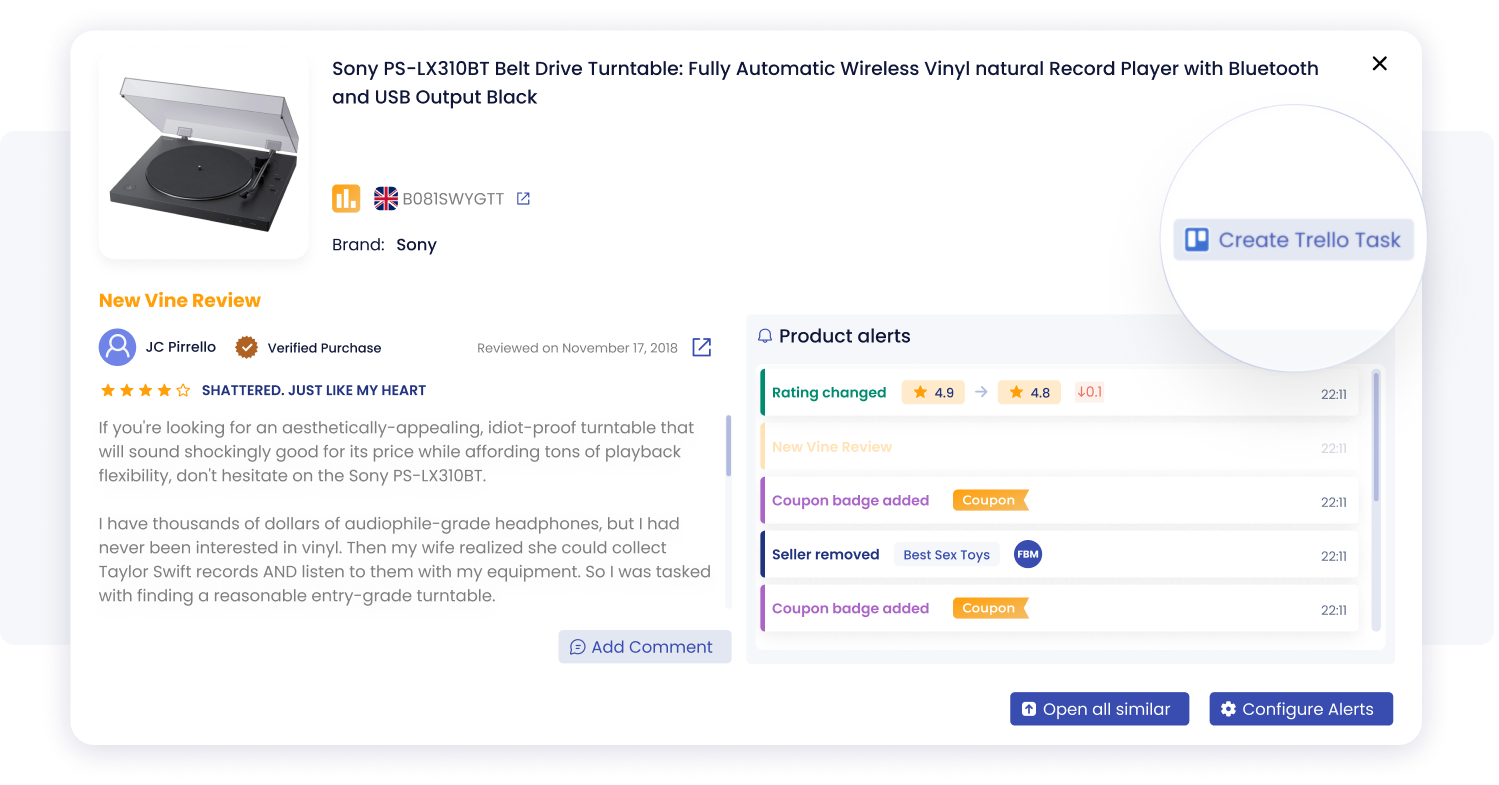
Track key listing events in one place with SellerSonar alerts, including rating changes, new reviews, coupon badges, and seller activity.
For review-monitoring workflows, this is useful when an alert needs more than a quick glance. Your team can assign the task, add comments, check whether the review issue connects to recent listing changes, and track the investigation until the next action is clear.
Example: If a product receives several negative reviews mentioning the same issue, create a Trello task for the content or product team to review the complaint pattern, check recent listing edits, and decide whether the next step is a product fix, PDP update, FAQ update, or support escalation.
Important: SellerSonar does not “verify” whether a review is fake or remove reviews. It helps you detect meaningful changes earlier and organize your next best action using evidence from reviews, listings, and visibility signals.
Best Amazon Review Checkers
ReviewMeta
ReviewMeta analyzes Amazon review patterns and generates an “Adjusted Rating” after filtering reviews it flags as unnatural or low-trust. It can help you spot red flags like unusual rating distribution, suspicious review velocity, and patterns that don’t match typical buyer behavior.
Use it as a signal tool — then validate by manually sampling flagged reviews and checking the timeline against listing changes and performance.
RateBud
RateBud is an AI-based Amazon review checker that provides a trust grade and highlights suspicious patterns. It’s positioned as a lightweight way to sanity-check review authenticity before relying on star rating as a decision input.
FakeFind
FakeFind is a free Amazon review checker that analyzes product review patterns and returns an authenticity-style signal without complex setup. It can be useful when a listing’s rating looks inflated, review language feels repetitive, or review timing seems unnatural.
TraceFuse
TraceFuse offers an Amazon review checker aimed at identifying suspicious review clusters and surfacing higher-risk patterns. It’s typically used as part of a broader brand-protection workflow rather than as a consumer-only tool.
What about Fakespot and TheReviewIndex?
Historically, Fakespot and TheReviewIndex were popular options, but Fakespot was shut down in 2025 and TheReviewIndex has announced it is permanently down due to Amazon policy changes. If you see older “Top tools” lists that still recommend them, double-check the publish date before you rely on the information.
What To Do If You Suspect Review Manipulation (Seller Checklist)
If a product’s review activity looks unusual, treat it like a diagnosis problem. Your goal is to document the pattern, validate it, and reduce business risk — without assuming every suspicious review is fake.
- Document the anomaly: note dates, review velocity (how many per day), star distribution, and repeated phrases or identical issue reports.
- Check for “self-inflicted” triggers: recent listing edits, variation changes, pricing changes, inventory stockouts, delivery delays, or quality changes often explain sudden sentiment shifts.
- Validate performance signals: compare review timing to conversion changes, keyword visibility shifts, and BSR movement to understand what likely drove the impact.
- Prioritize fixes that improve outcomes: clarify expectations in bullets/A+ and images, update FAQs, address top recurring complaints, and align PDP messaging with actual product experience.
- Escalate only with evidence: if you believe reviews violate Amazon policies, compile URLs, dates, and patterns first and use Amazon’s standard reporting routes from within your account.
A reliable workflow focuses on what you can control: product quality, listing clarity, and fast response to meaningful changes.
Amazon Fake Review Checker: Final Thoughts
Getting customers to leave genuine Amazon reviews is hard — and even when you follow the rules, you can’t control whether feedback will be positive. Amazon continues to tighten enforcement against review manipulation, but suspicious patterns can still appear across many categories. For sellers, the practical goal isn’t to “prove” every review is fake — it’s to monitor review activity, spot anomalies early (unexpected spikes, repeated phrasing, sudden rating swings), and use review insights to fix the issues that actually impact conversion, returns, and long-term brand trust.
If you want a more operational way to stay on top of review-driven risk (without relying on guesswork), SellerSonar helps you monitor the signals that typically move performance. It can notify you when meaningful listing or competitive changes happen, so you can investigate quickly and decide whether you need to adjust content, pricing, inventory, or advertising. In the same dashboard, you can track review trends over time, monitor keyword performance (including Heatmap-style views and faster keyword organization with Groups), follow BSR history, calculate profit margins, and monitor competitors — then send critical alerts into your workflow using integrations like Trello.
Important note: SellerSonar doesn’t “remove” reviews or guarantee that a review is fake. Instead, it helps you detect unusual changes earlier, understand what likely impacted performance, and prioritize the next best action based on evidence.
Register for a free 14-day trial with full Business features and streamline your Amazon monitoring workflow.

