




Quick Answer
The best products to sell on Amazon are the ones with steady demand in their subcategory, a price that leaves room for fees, a small and light package, beatable competition and no approval gate for your account. According to Amazon’s fee schedule, most categories pay a 15% referral fee, so very cheap items rarely work. There’s no universal list: find candidates in Amazon’s Best Sellers lists and Product Opportunity Explorer, then check each one against demand, fees, competition and seasonality before you buy stock.
Deciding what to sell on Amazon is the choice that shapes everything after it: your fees, your competition, how much cash you tie up in stock, and whether the business works at all. Most lists of “best products to sell” skip the part that matters, which is how to tell whether a product will work for you.
This guide covers how Amazon’s Best Sellers lists and Best Sellers Rank really work, eight checks to run on any product idea, what you can’t sell or need approval for, and a step-by-step way to find products using Amazon’s own tools. Every fee and rule was checked against Amazon’s help pages in October 2026.
About the Author: Diana Walsh writes for the SellerSonar editorial team about Amazon selling models, fees, and account health. The rank examples in this guide come from listings tracked in SellerSonar on amazon.com, and every policy detail was checked against Amazon’s Seller Central help pages on October 26, 2026.
What Are the Best Products to Sell on Amazon?
There isn’t one list that works for everyone. A product that’s perfect for a seller with a brand and a big budget can be a poor fit for someone starting with a few hundred dollars and no approvals. What the best products have in common is a set of traits: steady demand, a price that leaves room after fees, a package that’s cheap to store and ship, and competition you can realistically beat.
Categories are a useful starting point, because demand and fees differ a lot between them. Home and Kitchen, Beauty and Personal Care, Pet Supplies, Sports and Outdoors, Toys and Games and Office Products are all big Best Sellers departments, and most of them don’t need approval for new items.
Our guide to Amazon categories lists every department and what each one requires. The category only narrows the search, though. The checks below decide whether a specific product is worth it.
How Amazon Best Sellers and Best Sellers Rank Work
The Amazon Best Sellers page lists the most popular products in each department “based on sales”. According to Amazon’s Best Sellers Rank help page, the calculation is based on Amazon sales and “is updated frequently to reflect recent and historical sales of every item sold on Amazon.” Older guides say it updates hourly; Amazon no longer says that.
Every product page also shows its own Best Sellers Rank (BSR): a rank in the main category, plus a few subcategories where the item stands out. BSR is a sales rank, not a search position. A low number means the item sells more than most others in that category. It says nothing about where the product appears in search results, which is a separate measure.
The subcategory rank is the one to read. Amazon’s help page explains that the main list “doesn’t always indicate how well an item is selling in relation to similar items”, which is why it shows category and subcategory ranks. Here’s what that looks like for listings tracked in SellerSonar:
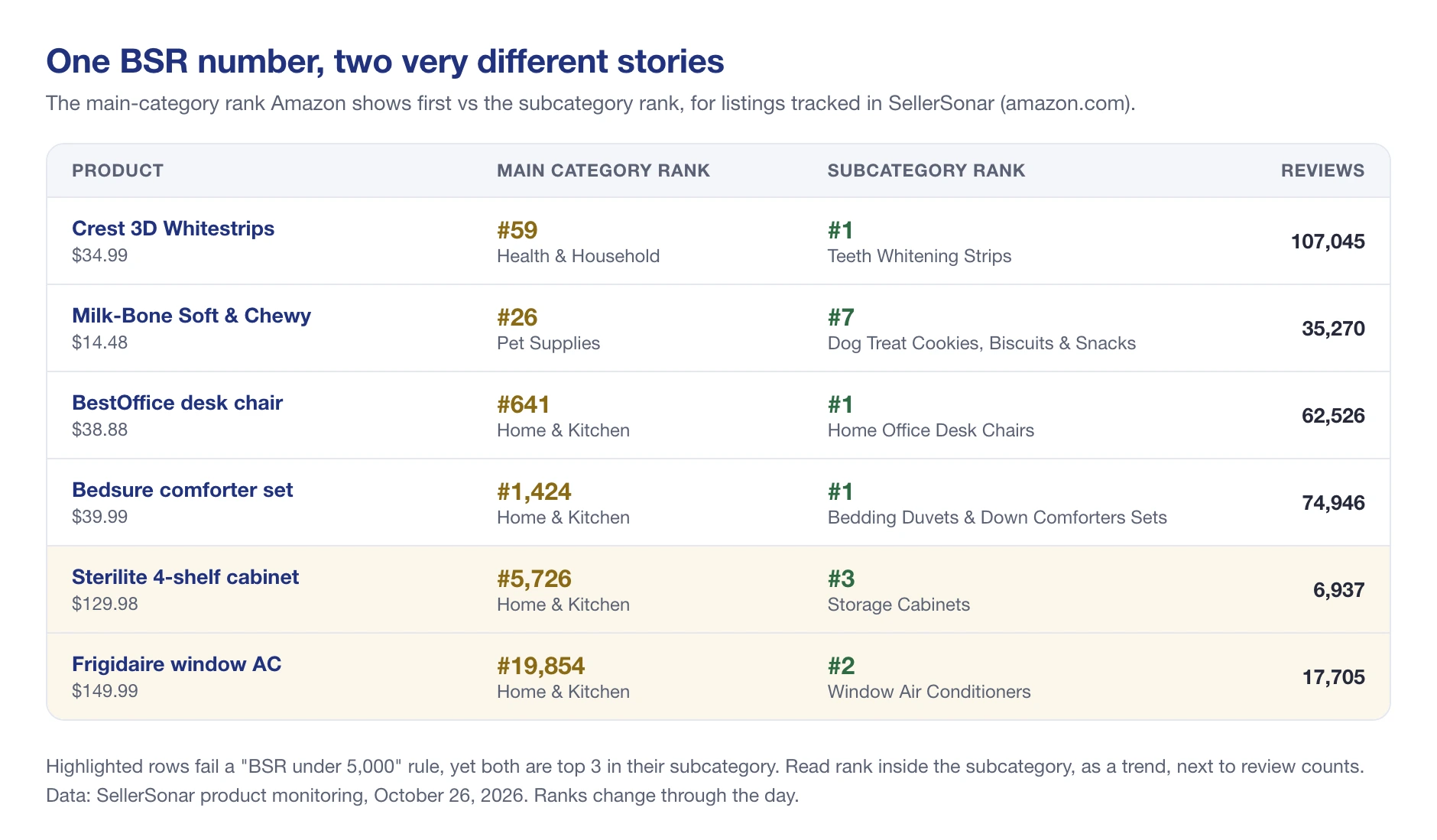
According to SellerSonar data from October 26, 2026, a Sterilite storage cabinet ranked #5,726 in Home and Kitchen but #3 in Storage Cabinets, and a Frigidaire window air conditioner ranked #19,854 in Home and Kitchen but #2 in Window Air Conditioners. A popular rule of thumb says to look for a BSR under 5,000 in the main category. It would reject both, even though each is one of the top sellers in its niche. Big categories like Home and Kitchen push good sellers far down the main list.
For more on reading the number, see our Amazon Best Sellers Rank guide.
What Makes a Good Product to Sell on Amazon?
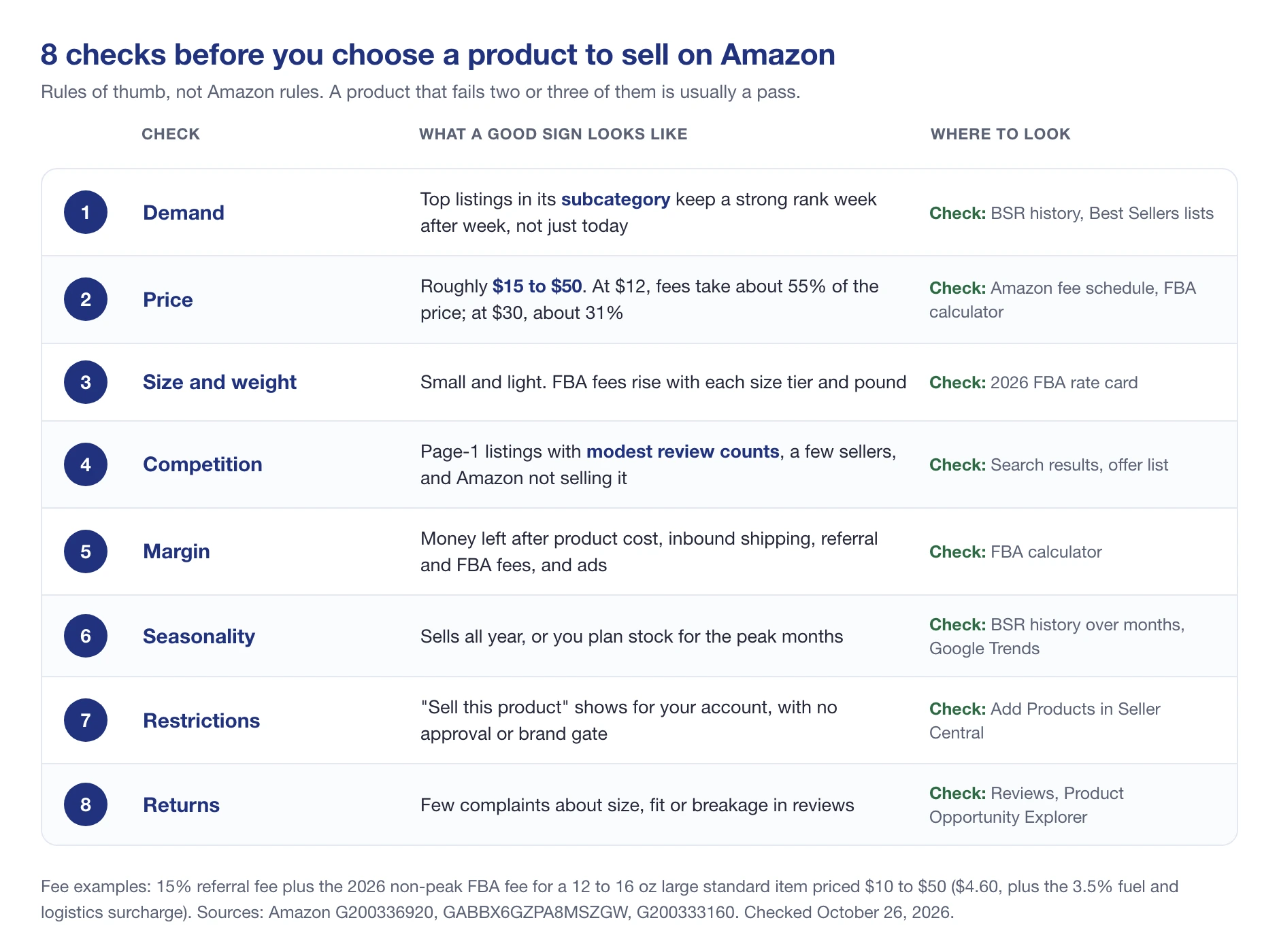
Run every idea through the same checks. None of these are Amazon rules; they’re the rules of thumb experienced sellers use, with the fee math behind them where it exists.
Demand that lasts
Look for products whose top listings hold a strong subcategory rank week after week. One day’s BSR can mislead you, because rank moves with every sale and every promotion. Look at the rank history over several weeks, and compare a few listings in the same subcategory rather than one.
A price with room for fees
Many sellers aim for roughly $15 to $50. The reason is the fees. According to Amazon’s fee schedule, most categories pay a 15% referral fee, with a $0.30 minimum.
FBA adds a fulfillment fee per unit: on the 2026 FBA rate card, a 12 to 16 oz large standard item priced $10 to $50 costs $4.60 outside the holiday peak, plus a 3.5% fuel and logistics surcharge. At a $12 price, those two fees take about 55% of what the buyer pays. At $30, they take about 31%.
Below $10, Amazon gives a discount. According to Amazon’s 2026 fee changes summary, products priced under $10 get a fulfillment fee discount of $0.86 per unit on average, but the margin is still thin. Our Amazon seller fees guide lists the rest of the fees.
Small, light and hard to break
FBA fees rise with each size tier and each extra pound, and storage is charged by volume. A product that fits in a small box and survives a drop costs less to store, ship and return. Oversized, fragile and heavy items aren’t off limits, but they need a bigger margin to work.
Competition you can beat
Search the main keyword and look at page one. Lots of listings with tens of thousands of reviews means the leaders are hard to move. In the SellerSonar table above, every subcategory leader has between 6,937 and 107,045 reviews.
Listings with modest review counts, a few sellers and no Amazon offer are a better sign. If Amazon sells the product itself, it often wins the Buy Box. Our Amazon competitor analysis guide shows how to size up a niche.
Margin after every cost
Work out what’s left after product cost, shipping to Amazon, the referral fee, the FBA fee, storage and the ads you’ll need to launch. Run real numbers in our free FBA calculator before you order stock.
Seasonality you can plan for
Seasonal products can be great, as long as you know it before you order. Here’s a product tracked in SellerSonar: a set of permanent outdoor holiday lights. Higher on the chart means a better rank.
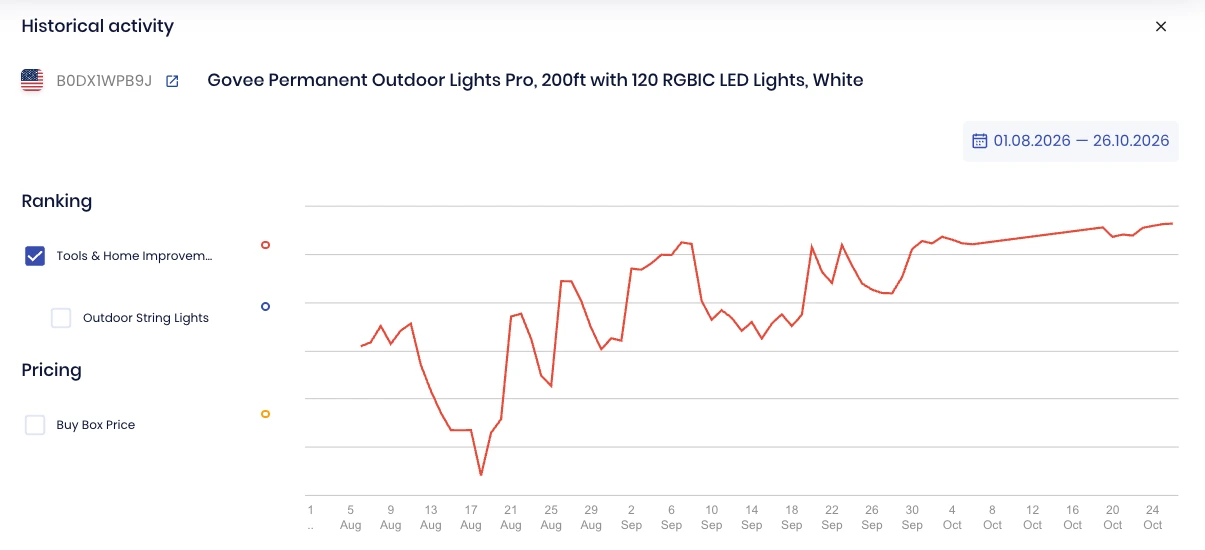
According to SellerSonar’s weekly rank history, it ranked #5,461 in Tools and Home Improvement in the week of August 4, 2026, and #882 in the week of October 13. Its Outdoor String Lights rank went from #83 to #24 over the same weeks.
A seller who judged it by its August rank would have missed the season. A seller who judged it by its October rank, without the history, might order stock just as the season ends. Our guide to Amazon trends covers how to read seasonal demand.
No approval gate, and few returns
Check that your account can list the product before you buy anything (the next section explains how). Then read the reviews of the top listings for size, fit and breakage complaints, because those turn into returns, and returns cost you fees and stock.
What Products You Can’t Sell on Amazon?
Amazon separates products into three groups, and mixing them up is a common mistake.
- Prohibited: you can’t list these at all. Counterfeits, products that infringe trademarks or copyrights, and recalled products are the obvious ones. According to Amazon’s restricted products policy pages, tobacco products and prescription drugs are prohibited too.
- Restricted, sellable with conditions: many products people assume are banned are allowed if you meet the rules. According to Amazon’s alcohol policy, alcoholic beverages can be sold by pre-approved selling partners, while corkscrews and decanters are open to anyone. Dietary supplements are sellable but have strict labeling and compliance requirements.
- Needs approval: some categories, brands and products need Amazon’s approval before you can list them, even when they’re perfectly legal.
According to Amazon’s page on categories and products that require approval, you check a product by searching for it in Add Products. If approval is needed, you’ll see “Apply to sell”. Applications usually need purchase invoices dated within 180 days, product photos and sometimes brand authorization or safety certificates, and the review takes 2 to 7 business days. If the answer is “Your account does not qualify”, Amazon says that decision can’t be appealed.
If you’ll use FBA, also check Amazon’s separate FBA prohibited products list. Some items that are fine to sell are not allowed in Amazon’s warehouses, so you’d have to ship them yourself. Our guide to Amazon restricted products goes through the main groups.
💡 Expert Tip: Check approval for the exact product, not just the category. A category can be open while a specific brand inside it is gated. Search the ASIN in Add Products before you place a supplier order; it takes a minute and can save you from a box of stock you can’t list.
How to Find Products to Sell on Amazon, Step by Step
Here’s a process that uses Amazon’s own data first and spends money last.
Step 1: Start with Amazon’s lists
Amazon publishes several free lists that show what’s selling, all of which say on the page how often they update:
- Best Sellers: the top sellers in every department and subcategory, “updated frequently”.
- Movers and Shakers: the biggest gainers in sales rank over the past 24 hours, useful for spotting products on the way up.
- New Releases: the best-selling new products, which shows what’s working for recent launches.
- Most Wished For: the products added to wish lists most often, “updated daily”, a hint at demand that hasn’t turned into sales yet.
Browse the subcategories, not just the department pages. That’s where products with real demand and less competition show up.
Step 2: Use Product Opportunity Explorer
If you have a seller account, Amazon’s Product Opportunity Explorer is the most useful free source you have. It groups search terms into niches based on what shoppers view and buy after searching, and shows demand, competition, search terms, reviews and return activity for each one.
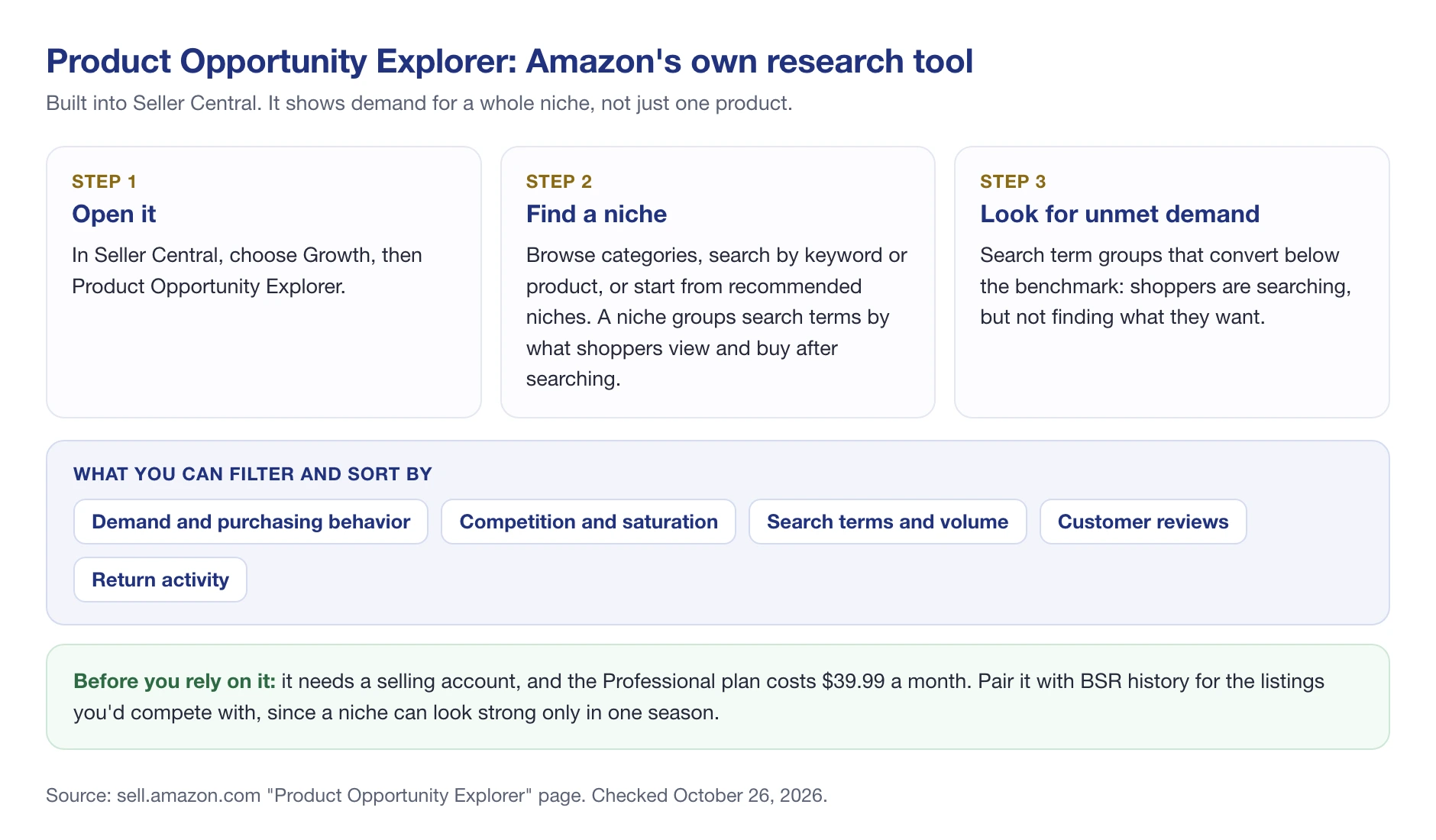
Its “unmet demand” view is the part to spend time on. According to Amazon’s tool page, these are groups of search terms that convert below the benchmark, which suggests shoppers are searching but not finding a product they want. Amazon also says products launched using the tool’s insights have 2.5x higher sales potential in their first three months, based on its own 2025 data.
Step 3: Check demand outside Amazon
Google Trends shows how interest in a search term changes over time. It scores interest from 0 to 100 relative to the highest point in the period you choose, so 100 is the peak and 50 is half that interest. It doesn’t tell you how many people search, and it isn’t Amazon data, but it’s a quick way to see whether a product is a fad, a steady seller or a seasonal one.
Step 4: Shortlist and run the eight checks
Take your best five to ten ideas and run each through the checks above. Write down the subcategory rank, the price, the size tier, the review counts on page one, and whether Amazon sells it. Most ideas fall out here, which is the point.
Step 5: Watch the leaders before you buy
Before you commit money, watch how the top listings in your target niche behave for a few weeks: how their rank moves, whether prices drop, whether new sellers pile in. You can do this by checking manually every few days, or with a tracking tool that records rank history for any ASIN, including listings you don’t own.
Step 6: Do the math and check approval
Run the numbers in an FBA calculator with your real product cost and the actual size and weight. Then search the product in Add Products to confirm your account can list it. Only then ask suppliers for samples. Our guide to Amazon product research tools compares the paid tools that can speed up steps 1 to 5.
How to Turn a Best Seller Into Your Own Product
Copying a best seller rarely works: you’d be the newest listing with no reviews, competing on price. Improving on it is different. Read the top listings’ 2 and 3-star reviews, because they tell you exactly what buyers wish were different. Then look for one of these angles:
- Fix the main complaint: a stronger hinge, a longer cable, a better seal, a clearer size chart.
- Add a variation: a size, color or capacity the leaders don’t offer.
- Sell the accessory: cases, refills, replacement parts and add-ons for products that already sell well.
- Bundle: combine items people buy together, which also makes your listing different from single-item offers.
- Improve the packaging: better protection means fewer damaged-item returns, and a gift-ready box can matter in Q4.
If you already sell, compare this against going deeper on what you have: a new variation of a proven product is usually less risky than a brand new product in a niche you don’t know.
Which Selling Model Fits Your Products?
What you sell also depends on how you plan to source it:
- Private label: your own brand, made by a manufacturer. Most control and margin, most upfront work. See our private label guide.
- Wholesale: buying branded products from the brand or a distributor. You share listings with other sellers and compete for the Buy Box. See our guide to wholesale suppliers.
- Retail and online arbitrage: buying discounted products in stores or online to resell. Low startup cost, but brand restrictions are common. See our Amazon arbitrage guide.
- Dropshipping: allowed only under Amazon’s rules, where you’re the seller of record. See our Amazon dropshipping guide.
- No inventory at all: books, print-on-demand and digital products. See how to sell on Amazon without inventory.
What to Sell on Amazon: Final Thoughts
The best products to sell on Amazon aren’t found on a list; they’re found by checking. Start from Amazon’s own data, read rank inside the subcategory and over time, run the fee math at your real price and size, and confirm you can list the product before you buy it.
Final Expert Recommendations: Shortlist ten ideas, cut them to two or three with the eight checks, and watch the leaders in those niches for a few weeks before you order. A product with steady demand, room for fees and beatable competition is worth more than one that looks exciting today. Once you’ve chosen, our guide on how to sell on Amazon covers the next steps.
SellerSonar can do the watching for you. It tracks BSR and subcategory rank for any ASIN, including competitors you don’t own, on all 23 Amazon marketplaces, with no Seller Central connection, and alerts you when rank moves by the threshold you set (20% by default). Our Ranking Tracker page shows how it works. Try it free for 14 days, with 5 ASINs and 10 keywords and no credit card.

