





Quick Answer
Amazon dropshipping means you list a product on Amazon and a supplier ships it straight to your customer, so you never hold stock. Amazon allows it only when you are the seller of record: your name is the only one on the packing slip, invoice and box, and you handle returns yourself. Buying from another retailer, or from Amazon itself, and having them ship to your buyer breaks the Drop Shipping Policy.
Dropshipping sounds like the easiest way into Amazon: no warehouse, no boxes in your living room, no money tied up in stock. And it can work. But it’s also the model that gets new sellers restricted fastest, usually because of a rule they never read.
This guide covers Amazon dropshipping as it works in 2026: what the policy actually says (it changed), what it costs, the numbers you have to hit on every order, how to find a supplier who won’t get you suspended, and when FBA is the better call.
About the Author: Diana Walsh writes for the SellerSonar editorial team about Amazon selling models, fees, and account health. She checks every rule in her articles against Amazon’s own help pages, and the listing examples against live Amazon listings we track in SellerSonar.
What Is Amazon Dropshipping?
Dropshipping is a fulfillment model where you sell a product you don’t keep in stock. When an order comes in, you buy the item from a supplier (usually a manufacturer or a wholesaler), and the supplier ships it directly to your customer.
On Amazon, there’s one twist that matters more than anything else in this guide. You don’t just pass orders along. Amazon’s own guide to dropshipping on Amazon says you need an agreement that makes you the seller of record, “meaning you own the products before customers purchase them.” You set the price, you record the sale as revenue, and you handle sales tax.
So you hold no inventory, but legally it’s still your product and your order. Every problem with it is yours too.
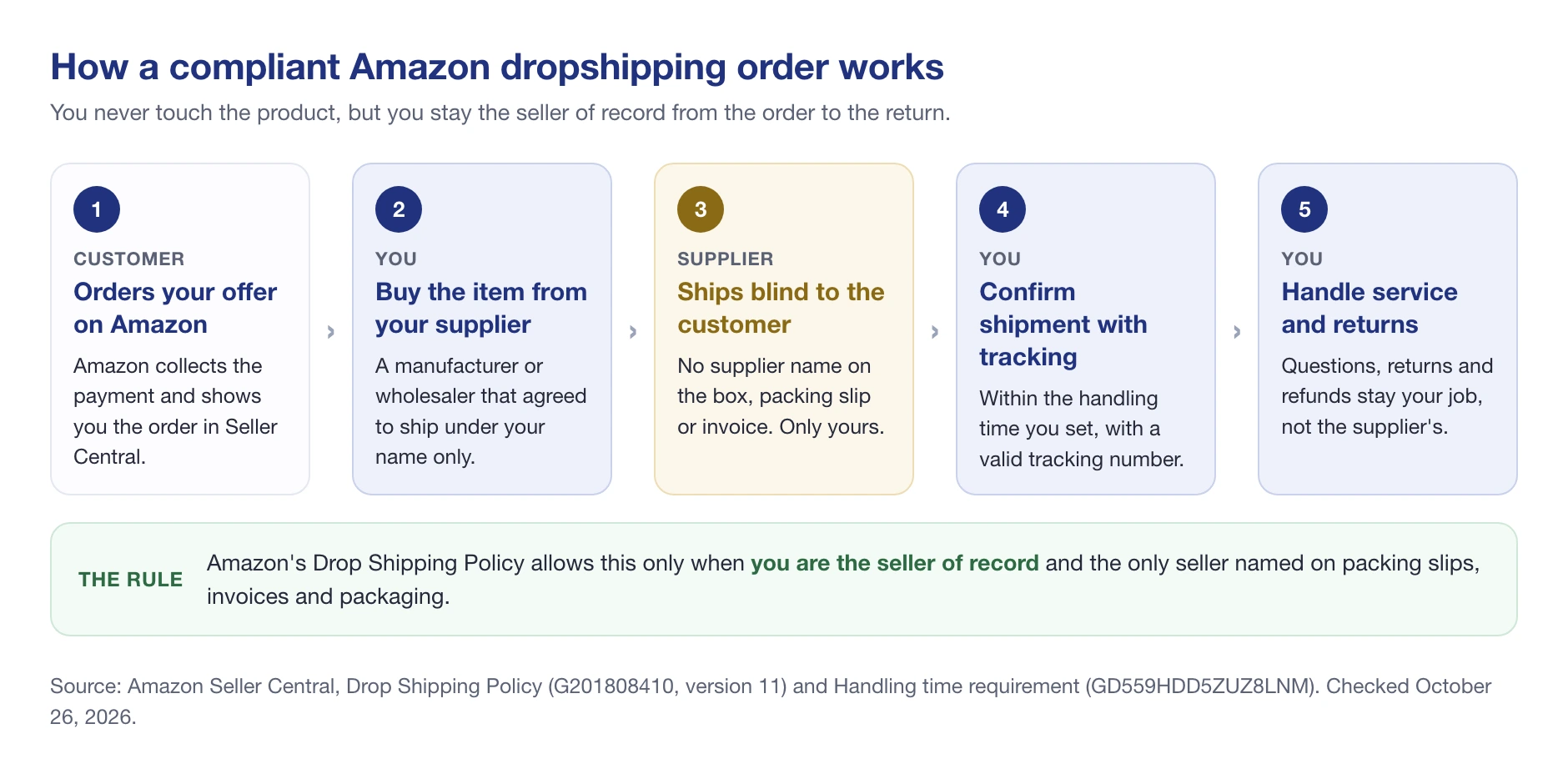
A compliant order runs like this:
- A customer buys your offer on Amazon.
- You place the order with your supplier.
- The supplier ships it to the customer in plain packaging, with nothing that names the supplier.
- You confirm the shipment in Seller Central with a valid tracking number, inside the handling time you promised.
- You answer the customer’s questions and process any return.
Dropshipping is a fulfillment method, not a business model by itself. It always runs through Fulfilled by Merchant (FBM), because you ship (through your supplier) instead of Amazon. If you’re new to the term, our dropshipping glossary entry has the short version.
Is Dropshipping Allowed on Amazon? The Drop Shipping Policy in 2026
Yes, dropshipping is allowed on Amazon, with conditions. Amazon’s answer to “Is Amazon dropshipping legal?” is a plain yes, as long as you follow the Drop Shipping Policy and the laws where you sell.
The policy itself is short. The current version (version 11 when we checked on October 26, 2026) opens with the rule that everything else follows from: dropshipping “is not acceptable unless it is clear to the customer that you are the seller of record.”
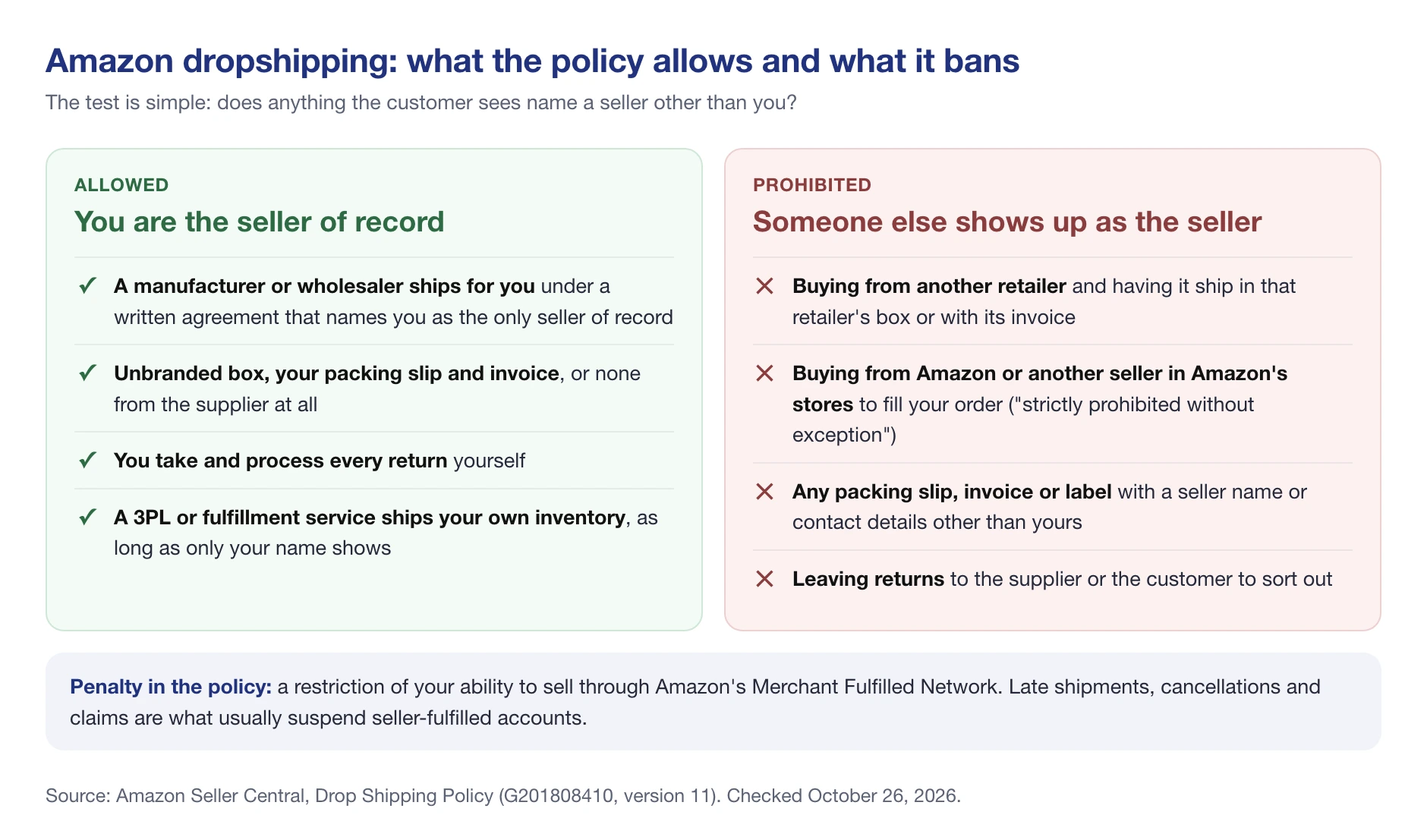
What the policy bans
Two practices are named as violations:
- Buying from a third party and having it ship to your customer when the shipment doesn’t identify you as the seller, or when anyone else appears on the packing slip, invoice or outside packaging. The policy now spells out that the third party includes “Amazon or another seller in Amazon’s stores,” and calls this “strictly prohibited without exception.”
- Shipping with someone else’s name or contact details on packing slips, invoices, packaging or anything else in the box.
Amazon explains why it cares: when a customer sees another seller’s paperwork, they don’t know who sold the item or whom to contact about a problem.
What the policy requires
If you use a drop shipper, a 3PL or another company’s fulfillment service, you must always:
- Have an agreement with your supplier that makes you the only seller of record and the only seller named on slips, invoices and packaging.
- Remove any paperwork or packaging that names a different seller or supplier before the order ships.
- Stay responsible for accepting and processing customer returns.
- Follow the Business Solutions Agreement and Amazon’s other policies.
You can read the full text in Amazon’s Drop Shipping Policy in Seller Central. One warning, though: if you search for the policy on Google, an older Seller Central link may come up first that now opens a completely different agreement (the Subscribe with Amazon terms). The link above is the current policy.
💡 Expert Tip: Put the seller-of-record clause in writing before your first order, and ask the supplier for a photo of a test shipment: the box, the packing slip and anything else inside. If their logo or invoice shows up anywhere, you’ve found your problem before Amazon does.
What happens if you break it
The policy’s own penalty is “a restriction of your ability to sell using Amazon’s Merchant Fulfilled Network (MFN).” In other words, you can lose the right to ship orders yourself, which for a dropshipper is the whole business.
In practice, though, most dropshipping accounts get into trouble a different way. Their supplier ships late, runs out of stock or sends the wrong thing, and the account’s performance metrics fall below Amazon’s limits. That’s the next section.
What Gets Dropshipping Accounts Restricted or Suspended
Here’s the thing nobody tells you when they pitch dropshipping as hands-off. Amazon measures every seller-fulfilled order against fixed targets, and as a dropshipper you control almost none of the inputs.
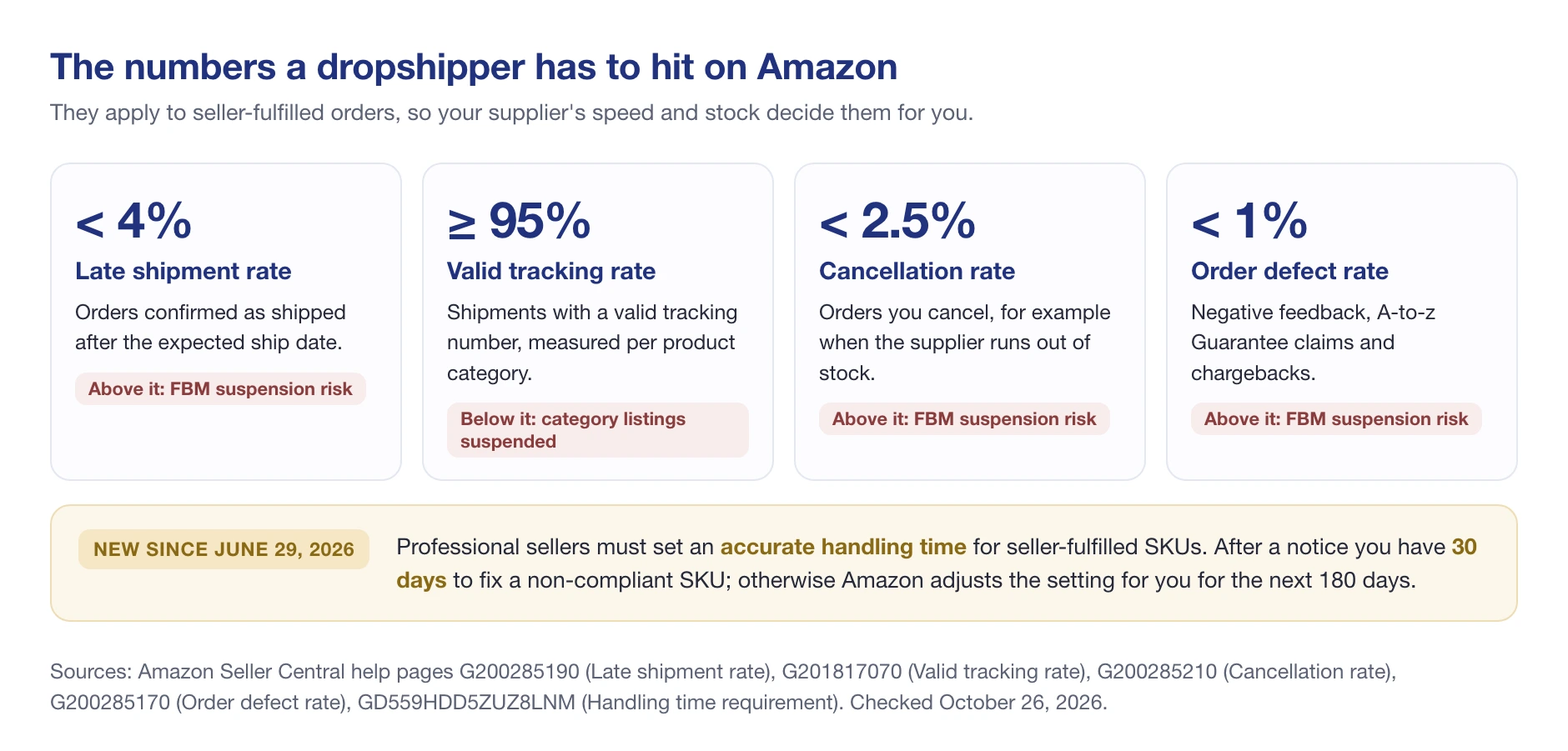
- Late shipment rate under 4%. Amazon’s late shipment rate page says a rate above 4% “may result in suspension of your Fulfilled by Merchant selling privileges.”
- Valid tracking rate of 95% or more, measured per product category, according to Amazon’s valid tracking rate policy. Below it, Amazon can suspend your seller-fulfilled listings in that category.
- Cancellation rate under 2.5%, per Amazon’s cancellation rate page. Every time a supplier runs out and you cancel an order, it counts here.
- Order defect rate under 1%, per Amazon’s order defect rate page. Negative feedback, A-to-z Guarantee claims and chargebacks all feed this one.
The 2026 handling-time rule
Since June 29, 2026, Amazon has a new handling time requirement for Professional sellers: the handling time you set for each seller-fulfilled SKU has to match how long you really take to hand orders to a carrier. If a SKU is flagged, you get a notice and 30 days to fix it. After that, Amazon adjusts the setting for you for the next 180 days, and you can’t change it during that period.
For a dropshipper this one hurts. Your real handling time is your supplier’s handling time plus however long it takes you to pass the order on. A two-day promise with a three-day supplier is now something Amazon checks.
The other ways it goes wrong
- The supplier’s name reaches the buyer. A branded box, a retail invoice or a return label with their address. One photo in a customer complaint is enough.
- You can’t produce invoices. When Amazon asks you to prove where your products came from, it wants supplier invoices with the supplier’s name, phone, address and website, dated within the past 365 days, covering the quantity you sold. Retail receipts from another store usually don’t qualify.
- You listed something you weren’t allowed to. Some product categories need pre-approval from Amazon, and some products are restricted outright. “You can sell any product” was never true.
📌 From Our Experience: The pattern we see with struggling dropshippers is almost always the same: one supplier, no backup, and a handling time copied from a competitor. The first stockout turns into a wave of cancellations, and the account is in trouble before anyone checks the metrics.
How Much Does It Cost to Dropship on Amazon?
Amazon itself is clear about one thing: “There are no Amazon costs or fees specifically for dropshipping.” You pay the same fees as any other seller. That’s not the same as “no costs,” which is what a lot of dropshipping content still promises.
Here’s what you actually pay, using Amazon’s selling plans and referral fees:
- Selling plan: according to Amazon’s pricing page, Individual costs $0.99 per item sold and Professional $39.99 a month. The math is simple: up to 40 sales a month, Individual costs less ($39.60); from 41 sales, Professional is cheaper. The handling-time rule above applies to Professional sellers.
- Referral fee on every sale: per the same pricing page, a percentage of the total sales price that depends on the category, with a $0.30 minimum in most categories. Home and Kitchen, Toys and Games, and Tools and Home Improvement are all 15%; a few categories are lower, and Amazon Device Accessories is 45%.
- Supplier costs: the wholesale price, plus any per-order dropship fee and the shipping to your customer. Ask about all three before you sign anything.
- Returns, refunds and advertising: they come out of your margin, not your supplier’s.
Let’s run one order. The supplier prices below are made up for the example; the Amazon fee is the real Home and Kitchen rate.
| One order, Home and Kitchen item | Amount |
|---|---|
| Your price on Amazon | $40.00 |
| Amazon referral fee (15%) | −$6.00 |
| Supplier price (example) | −$20.00 |
| Supplier shipping and dropship fee (example) | −$5.50 |
| Left before your plan, returns and ads | $8.50 |
In this example, $8.50 on a $40 sale looks fine. Now take out the Professional plan, a couple of returns you can’t resell, and a few dollars of ads per sale, and it gets thin fast. Run your own numbers through our FBA fee calculator to compare the same product sold through FBA, and see our breakdown of Amazon seller fees for the rest of the fee table.
How to Start Dropshipping on Amazon in 7 Steps
Amazon’s own guide lists five steps. We split two of them, because they’re where most new dropshippers slip.
- Create your seller account. You don’t need an LLC; Amazon’s FAQ says registering a business “could be beneficial as you scale.” Our guide to creating an Amazon seller account walks through registration and verification.
- Choose products you’re allowed to sell. Check category approval before you fall in love with a product. For ideas, see our list of dropshipping products for Amazon.
- Find a supplier and sign a seller-of-record agreement. More on vetting in the next section.
- Order samples. Amazon recommends it, and it’s the only way to see the packaging your customers will get.
- List the product and set an honest handling time. Supplier handling time plus your own order-passing time, not what your competitors show.
- Pass orders on fast and upload tracking. Every order needs a valid tracking number, confirmed inside your handling time.
- Handle customer service and returns yourself. Agree in advance where returns go and who pays for them.
Steps 4 and 5 are the ones people skip. They’re also the ones that keep your late shipment and defect rates where they need to be.
How to Find and Vet Amazon Dropshipping Suppliers
Amazon suggests the usual places to look: online research, supplier directories and trade shows, where you can meet manufacturers and wholesalers directly. Our guide to wholesale suppliers for Amazon covers where to find them in more detail.
Finding a supplier is the easy part. Finding one that won’t sink your metrics is harder. Before you list a single product, get a clear yes to each of these:
- Blind shipping: plain boxes, no supplier name, logo, invoice or marketing inserts.
- Your paperwork only: they’ll include your packing slip, or none at all.
- A written seller-of-record agreement.
- Proper invoices in your name, with their full business details, that you could hand to Amazon.
- Tracking fast enough for your handling time, ideally uploaded the day the order ships.
- A stock feed or daily stock report, so you can pause a listing before the cancellations start.
- A returns process: where returns go and who refunds what.
- A backup supplier for your best sellers. Probably the most skipped item on this list, and the one you’ll wish you had.
🎯 Pro Insight: A wholesaler that already works with Amazon sellers will usually know what “blind shipping” and “seller of record” mean without an explanation. If you have to explain both, treat that as a warning sign, not a negotiation.
Can You Dropship From Amazon to Amazon or eBay?
No, and this is where a lot of online advice is still wrong.
Amazon to Amazon: buying a product from Amazon (or from another Amazon seller) and having it shipped to your Amazon customer is exactly what the policy names as “strictly prohibited without exception.” The box, the invoice and the order details all come from someone else.
Amazon to eBay: this one is banned by eBay rather than Amazon. eBay’s drop shipping policy allows dropshipping from a wholesale supplier, but says that listing an item on eBay and then buying it from another retailer or marketplace that ships directly to your customer “is not allowed on eBay.” Some articles still describe it as merely unethical. It’s against eBay’s rules.
If you want to sell the same inventory on several channels, the compliant route is to own the stock. Amazon’s policy points sellers to Multi-Channel Fulfillment, an unbranded service that ships inventory you own to orders from other sales channels.
Amazon FBA vs Dropshipping
Sellers mix these up all the time. They’re opposites in one important way: with FBA you buy inventory first and Amazon ships it; with dropshipping you buy only after the sale and your supplier ships it.
| Dropshipping (FBM) | Fulfillment by Amazon (FBA) | |
|---|---|---|
| When you pay for stock | After the customer orders | Before, when you send it to Amazon |
| Who ships | Your supplier, under your name | Amazon |
| Prime badge | Only through Seller Fulfilled Prime, which has its own delivery standards | Yes, through FBA |
| Control over quality | Low: you never see most orders | Higher: you inspect stock before sending it |
| Your metrics | Late shipment, tracking and cancellation rates are on you | Amazon handles shipping and most customer service |
| Upfront cash | Low | Higher: inventory plus FBA fees |
You don’t have to pick one forever. Amazon itself suggests you “test a product idea with dropshipping, then scale up using FBA,” and some sellers keep slow movers on dropshipping and fast sellers in FBA. Our comparison of Amazon FBA vs FBM goes deeper on the trade-offs, and the guide to selling on Amazon without inventory compares dropshipping with print on demand and the other no-stock models.
And the other models?
- Retail arbitrage: you buy discounted products from stores and resell them, shipping them yourself or through FBA. It’s compliant because you own and ship the stock, but receipts from other retailers make poor invoices if Amazon ever asks. See retail arbitrage.
- Wholesale: you buy branded products in bulk from the brand or a distributor and hold the stock.
- Private label: you create your own brand and listing, usually with a manufacturer. More work up front, but nobody else sells on your listing.
Most dropshippers don’t create new products. They add an offer to a listing that already exists. That means sharing the page, and the Buy Box, with every other seller of the same item.
Here’s what that looks like on a real listing. Below is the Buy Box ownership for a Honeywell Home smart thermostat on Amazon.com, tracked in SellerSonar from October 17 to October 26, 2026.
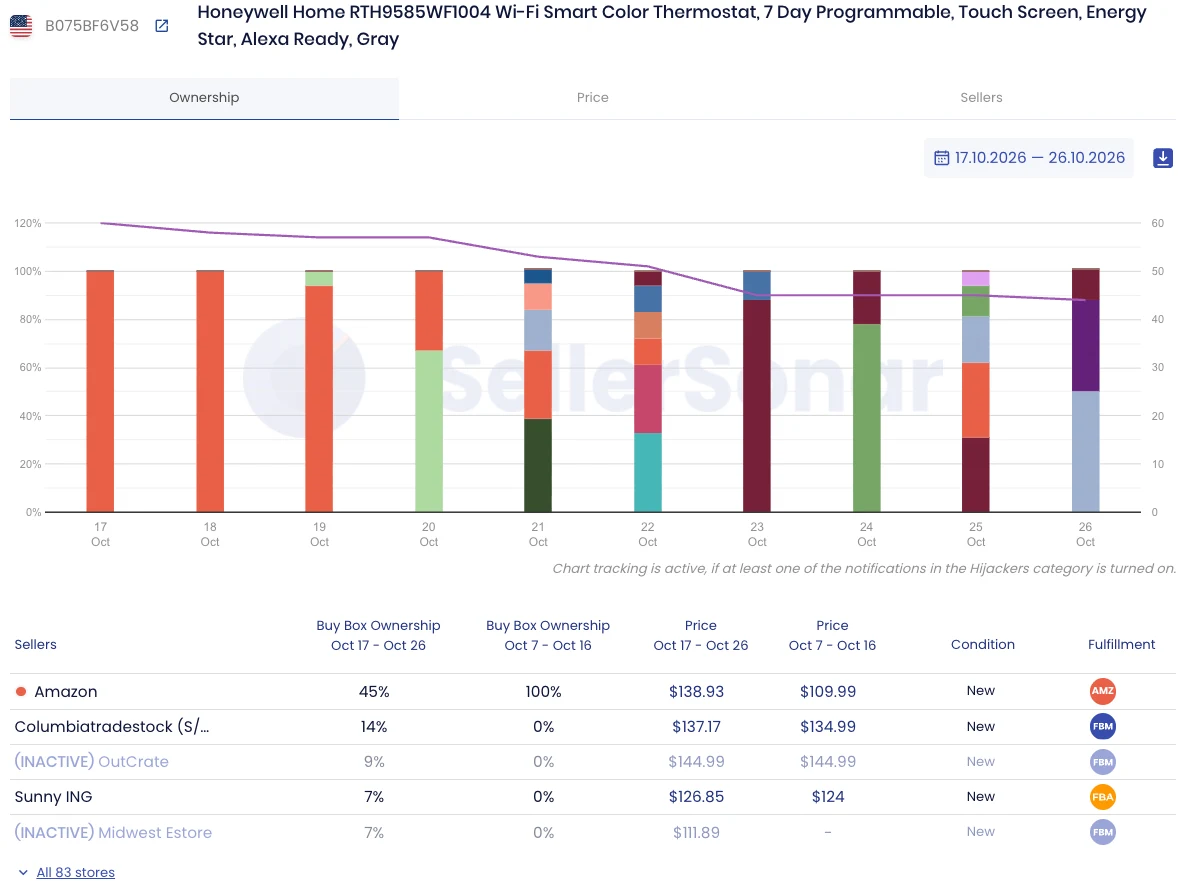
According to SellerSonar data, Amazon held the Buy Box 100% of the time in the 10 days before. In these 10 days it held it 45% of the time, and the rest rotated through other sellers almost every day: one merchant-fulfilled seller won 14%, three others won 7% to 9% each, and the remaining 18% was spread across other sellers. Two of those top five are now marked inactive. The tracker lists 83 stores on this one listing.
That’s the market a dropshipper walks into. Prices move daily, sellers appear and disappear, and the listing owner can change the title or images at any time, so the product your supplier ships may stop matching the page. If you want the strategy side of this, read our guide on how to win the Buy Box.
This is where SellerSonar is honestly useful to a dropshipper, and also where its limits are:
- Seller and price alerts: you hear when a new seller appears on your listing, when one leaves, and when a seller changes price. Buy Box Won and Lost alerts (Premium and up) tell you who took the Buy Box and at what price. All five of these alerts are off by default, so switch them on in Alerts, then Delivery Settings.
- Listing change alerts: title, bullet points, images or brand changed, with the before and after, so you notice when the page drifts away from what your supplier sends.
- Suppression alerts: listing suppressed, search suppressed or Buy Box suppressed.
- Check frequency: every 4 hours on Pro, every 2 hours on Premium, and as often as every hour on Business and Enterprise.
What it doesn’t do: it can’t see your supplier’s stock (stock alerts reflect the Amazon listing, not your supplier’s warehouse), it doesn’t place or forward orders, and it doesn’t track your late shipment or tracking rates. Those still live in Seller Central. Our Buy Box monitoring page shows the tracker above in more detail.
Pros and Cons of Amazon Dropshipping
The honest version, after everything above:
| Pros | Cons |
|---|---|
| Low upfront cash: you pay for stock only after a sale | Thin margins once referral fees, supplier fees and returns come out |
| Easy to test products before committing to inventory | Your metrics depend on a supplier’s speed and stock |
| No storage space and no packing | Prime is hard to get without FBA |
| Can run from anywhere | Shared listings mean constant Buy Box and price competition |
| Combines well with FBA for slow-moving items | Little control over quality, packaging and delivery |
Is Amazon Dropshipping Worth It in 2026?
It can be, if you treat it as a supplier-management business rather than a passive one. The sellers who make Amazon dropshipping work aren’t the ones with the cleverest product list. They’re the ones whose suppliers ship blind, upload tracking the same day and warn them before stock runs out.
Final Expert Recommendations: Based on what we see, the deciding factor is your supplier, not your product. Get the seller-of-record agreement in writing, order a sample to check the packaging, and set a handling time you can actually hit, because since June 29, 2026 Amazon checks it. If you’re just starting, test one or two products with a supplier you’ve vetted, then move the winners to FBA once the numbers prove themselves.
And if you’re selling on listings you share with other sellers, keep an eye on who else is there. SellerSonar tracks the sellers, prices and Buy Box on any listing you add. You can try it free for 14 days, with 5 ASINs and 10 keywords and no credit card.

