




Quick Answer
Amazon restricted products are items you either can’t list at all or can list only after Amazon approves you. Prohibited listings (illegal or unsafe items, prescription drugs, recalled products) are covered by Amazon’s Restricted Products policy, which has 42 policy pages in the US. Gated categories, brands and ASINs need approval through “Apply to sell” in Seller Central. Hazmat products may be allowed on Amazon but blocked from FBA until Amazon classifies them.
Few things hurt more than finding a great product, paying a supplier, and then seeing “Apply to sell” or “Not Available” when you try to list it. Worse is a listing that sells for weeks and then gets removed for a policy you never read.
This guide sorts Amazon’s rules into the three groups that actually matter: what you can never sell, what you can sell after approval (ungating), and what you can sell but not through FBA without hazmat paperwork. Every rule comes from Amazon’s own Seller Central help pages, with the version we checked.
About the Author: Diana Walsh writes for the SellerSonar editorial team about Amazon selling rules, fees, and account health. She checks every policy in her articles against Amazon’s own Seller Central help pages, and notes the page version so readers can see when a rule changes.
What Is an Amazon Seller Restricted Product?
An Amazon restricted product is any product Amazon limits for sellers. Either it can’t be listed at all, or it needs Amazon’s approval first, or it can be sold but not through every fulfillment method. Amazon’s Restricted products policy (version 6 when we checked on October 30, 2026) is blunt about the first group: “The sale of illegal, unsafe, or other restricted products listed on these pages, including products available only by prescription, is strictly prohibited.”
People use “restricted” for three different situations, and mixing them up is how sellers waste money:
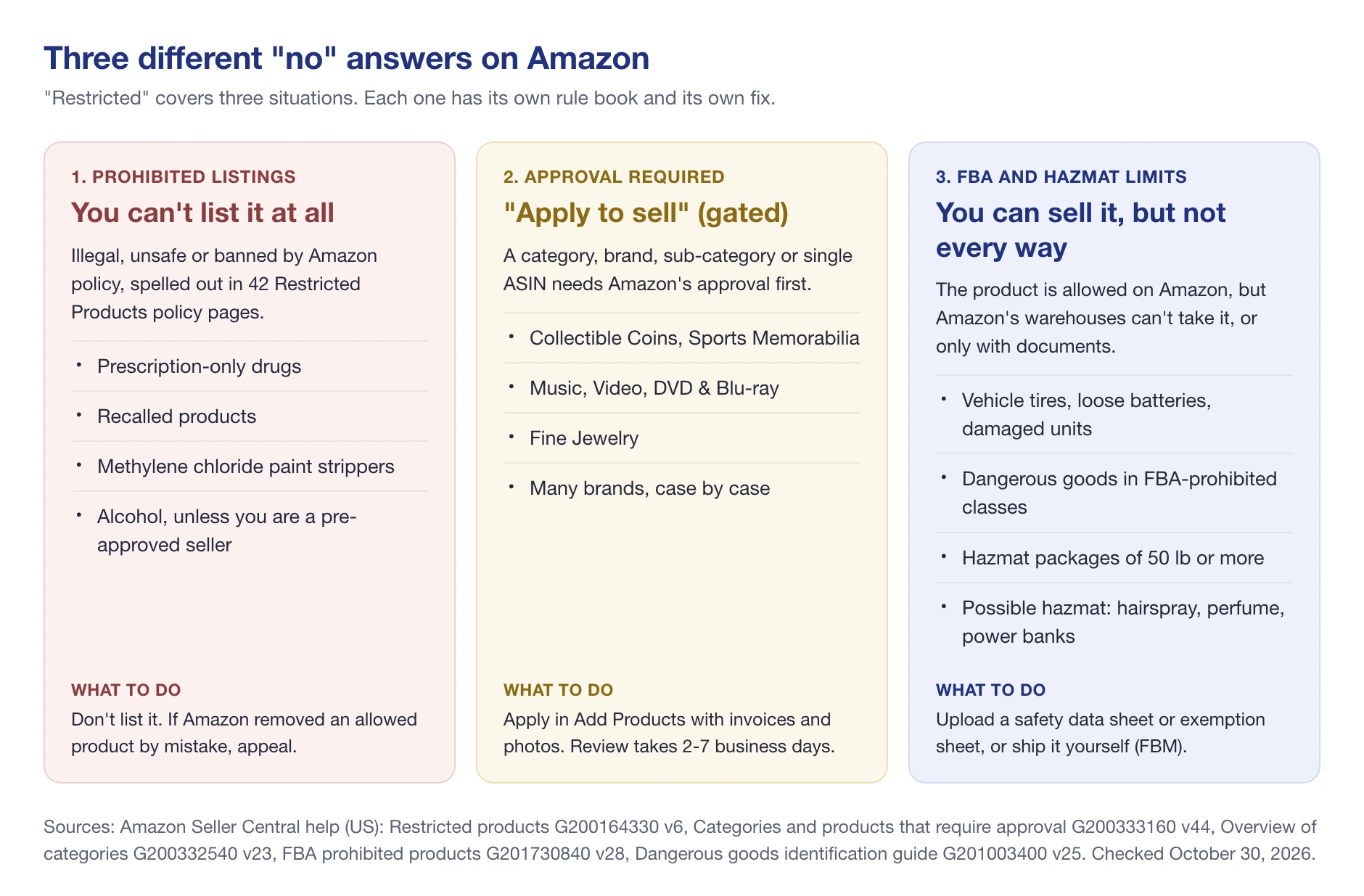
- Prohibited listings. Illegal, unsafe or banned by Amazon policy. No approval exists for these. Examples: prescription-only drugs, recalled products, paint strippers that contain methylene chloride.
- Approval required (gated). A category, a brand, a sub-category or a single ASIN needs Amazon’s OK before you can list it. This is what sellers call “ungating”.
- FBA and hazmat limits. The product is allowed on Amazon, but Amazon’s fulfillment centers won’t take it, or will take it only after a dangerous goods review.
Some products sit in two groups at once. Alcohol is the clearest case: Amazon’s alcohol policy permits alcoholic beverages only from “pre-approved selling partners”, and alcoholic beverages are also on the FBA prohibited list.
Why does Amazon have product restrictions?
Amazon explains the approval system in one sentence: “You need approval to ensure products sold in our store are safe, authentic, and meet regulations.” Restrictions come from three places: the law (prescription drugs, export controls), safety (recalls, hazardous chemicals), and Amazon’s own policies (Amazon’s example is crime scene photos).
Two points from Amazon’s guidance for sellers on the Restricted Products policy are worth remembering. Laws and rules “may vary by marketplace”, so a product that is fine on Amazon.com can be restricted on Amazon.de. And you shouldn’t “assume that a product is permitted because it is not listed” or because it already has an ASIN.
Amazon Prohibited Products: the Restricted Products Policy
The Restricted Products policy is not one list. It’s a hub with one help page per product area. Each page has “Examples of permitted listings” and “Examples of prohibited listings”, so a category can be partly allowed and partly banned.
Take alcohol. Corkscrews, decanters and alcohol-free memorabilia are permitted. Beverages over 0.0% alcohol by volume are prohibited unless you are a pre-approved seller, and so are liquor licenses and “any product marketed for customers over 21 years of age.”
The full list of restricted product policies (US, October 2026)
These are the 42 policy pages on Amazon’s US Restricted products hub as of October 30, 2026. If your product touches any of them, read that page before you buy stock.
| Area | Policy pages on the hub |
|---|---|
| Health and body | Cosmetics and skin and hair care; Dietary supplements; Drugs and drug paraphernalia; Medical devices and accessories; CPAP cleaning and disinfecting devices; Human parts and burial artifacts |
| Food, drink and tobacco | Alcohol; Food and beverage; Tobacco and tobacco-related products |
| Children’s products | Children’s apparel; Children’s footwear |
| Hazardous and chemical | Hazardous and prohibited items; Explosives, weapons, and related items; Pest control products and pesticides; Refrigerants (ozone-depleting substances and substitutes); Strike anywhere matches; Composite wood products; Washington State expanded polystyrene |
| Electronics and devices | Electronics; Laser products; Lighting; Surveillance equipment; Lock picking and theft devices; Recycling electronics |
| Vehicles | Automotive and powersports; Automotive tires, wheels, and rims; Federal emissions (products requiring an EPA Certificate of Conformity) |
| Money, art and collectibles | Currency, coins, cash equivalents, and gift cards; Gambling and lottery; Postage meters and stamps; Art (fine art); Art (home decor); Jewelry and precious gems |
| Animals and plants | Animals and animal-related products; Plant and seed products |
| Home | Upholstered furniture, bedding, and other quilted products |
| Legal and content | Export controls; Offensive and controversial materials; Prohibited product claims; Recalled products; Warranties, service plans, contracts, and guarantees; Other restricted products |
Compared with the list we published in 2022, Amazon has added pages for children’s apparel and footwear, tires and wheels, EPA emissions, product claims, Washington State expanded polystyrene and “other restricted products”, and dropped the separate subscriptions and periodicals page. That is exactly why a copied list from an old blog post is risky.
California has its own extra rules for some products, and the Restricted Products hub links to them separately.
💡 Expert Tip: Amazon’s Restricted Products FAQ says “Amazon will not pre-approve listings” and that you “should not assume a product is permitted simply because it is not on our Restricted Products policy pages.” Before you order samples, search the product in Add Products and read the policy page for its area. It takes five minutes and costs nothing.
Listing restrictions: claims that get products removed
A product can be legal and still be removed because of what the listing says. Amazon’s misleading and prohibited claims policy (version 11) covers claims “on all product detail pages, including images, descriptions, packaging and marketing materials”. The main claim types Amazon names:
- Disease claims. Saying a product can “diagnose, cure, mitigate, treat, or prevent” a disease without FDA approval.
- “FDA Approved” or certification claims that you can’t back up.
- Origin claims. Amazon prohibits Made in USA claims that don’t meet the Federal Trade Commission’s requirements. Its own example of a bad claim is “Made in Italy” when the product is “only assembled in Italy”.
- Environmental claims like “eco-friendly” or “carbon-neutral” without evidence. Amazon points sellers to the FTC’s Green Guides.
- Unqualified superlatives such as “best”, “100% pure” or “twice as effective” without proof.
Violations of listing policies can lead to canceled listings, limits on listing privileges, or their suspension or removal.
Amazon Restricted Categories: What Needs Approval
Gated categories are the ones where Amazon wants to check the seller before the product. Amazon’s overview of categories (version 23) shows which categories need approval and in which conditions. As of October 30, 2026:
| Category | Approval required |
|---|---|
| Fine Art | Yes (Amazon says it is “not accepting new applications” at present) |
| Fine Jewelry | Yes, any condition |
| Collectible Coins | Yes |
| Entertainment Collectibles | Yes |
| Sports Memorabilia | Yes |
| Music | Yes |
| Video, DVD & Blu-ray | Yes |
| Automotive | No for New, yes for “Used like new” |
| Personal Computers, Tools | No for New and Used, yes for Collectible |
| Software | No for New and Used, yes for Collectible and Refurbished |
| Gift Cards | Only Amazon can list in this category |
| Beauty, Grocery, Toys, Jewelry (non-fine), Home, Kitchen and most everyday categories | No category approval, but brands and individual products can still be gated |
That last row matters. Many lists online still show 2022 entries like Made in Italy, Streaming Media Players or holiday rules in Toys as gated categories. Amazon’s current overview doesn’t. It also notes that “Many brands have their own restrictions beyond these category requirements.” Amazon Renewed, for refurbished products, has its own application.
Some categories also limit the number of sellers on purpose. Amazon says it “limits the addition of sellers” in Video, DVD & Blu-ray, and the Fine Art page says Amazon “limits the number of sellers”. That’s one reason some sellers go after gated categories: fewer competitors on each listing.
Amazon restricted brands
Amazon doesn’t publish a list of restricted brands. Amazon’s page on categories and products that require approval (version 44) lists five levels of restriction: individual ASINs, brands, brands within a specific category, categories and sub-categories. It adds: “Some products require multiple approvals.”
So a brand can be open to you in one category and gated in another, and one ASIN of a brand can be gated while the rest are not. Third-party “restricted brands lists” can’t tell you which of these applies to your account. The only reliable check is to search each ASIN in Add Products while logged in to your own Seller Central account.
How to Get Ungated on Amazon in 2026
Ungating is the approval process for a gated product, brand or category. It has three steps: check the product’s status, prepare documents, then apply.
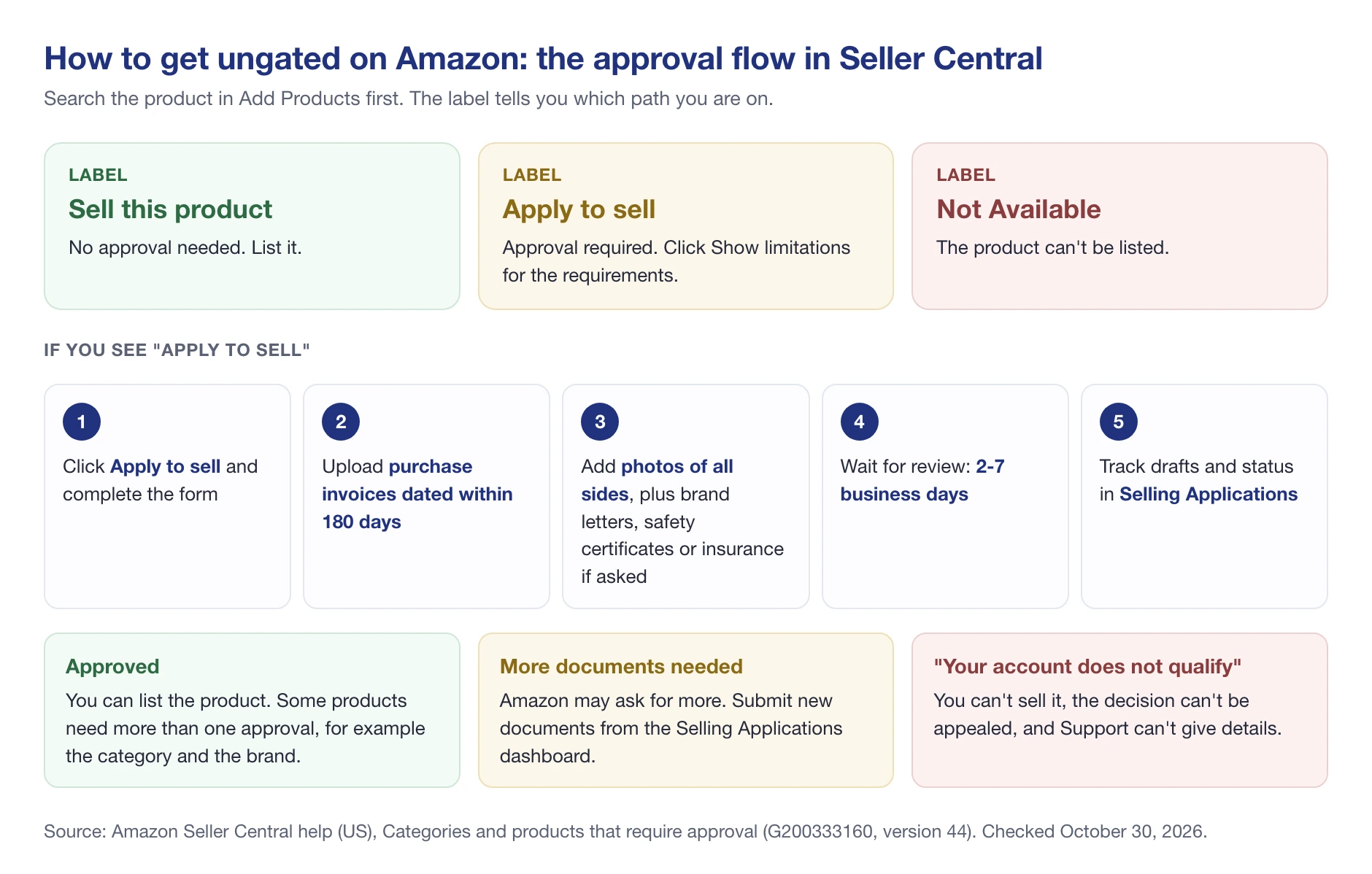
In the current version of Amazon’s help page (version 44), the whole flow starts in Add Products, and the steps below follow that page.
Step 1: check the product’s status
- In Seller Central, go to Add Products.
- Search for the product.
- Read the label next to it: “Sell this product” (no approval needed), “Apply to sell” (approval required) or “Not Available” (it can’t be listed).
- Click Show limitations to see the exact requirements.
If the product isn’t in Amazon’s catalog yet, Amazon suggests searching for similar items to see which restrictions they have.
Step 2: prepare the documents Amazon asks for
Amazon lists these items to prepare before you apply:
- Purchase invoices dated within 180 days, from a real supplier.
- Clear product photos showing all sides.
- Brand authorization letters, if applicable.
- Safety certifications, when required.
- Commercial liability insurance documents, for certain product categories.
📌 From Our Experience: Before you upload, read the invoice the way a reviewer would. Is it dated within 180 days? Is it clear and legible? Does it show the same product you’re applying for? An invoice from a distributor or the brand itself is much easier to defend than a retail receipt. Our guide to wholesale suppliers for Amazon FBA covers how to find suppliers whose invoices Amazon accepts.
Step 3: apply and wait for the review
Click Apply to sell, complete the form, upload the documents, and wait. Amazon gives a review time of 2-7 business days. You can review drafts, check status and send new documents from the Selling Applications dashboard.
If you see “Your account does not qualify”, stop there. Amazon says this means you can’t sell the product, “This decision cannot be appealed”, and Selling Partner Support can’t give more details.
Category-specific requirements
Some gated categories add their own rules on top of the general flow. Here is what Amazon’s US help pages ask for in the main gated categories:
| Category (help page version) | Seller requirements |
|---|---|
| Video, DVD & Blu-ray (v4) | Order defect rate 1% or less, cancellation rate 2.5% or less, late shipment rate 4% or less; at least 3 invoices or purchase orders from your largest sources; Professional plan within 30 days of approval |
| Collectible Coins (v7) | Professional plan; order defect rate below 0.75%; graded coins only from NGC or PCGS |
| Sports Collectibles (v7) | Professional plan; order defect rate lower than 0.75% |
| Entertainment Collectibles (v6) | Professional plan; provenance or proof of authenticity for autographed items |
| Fine Art (v3) | Not accepting new applications; existing sellers need a Professional plan and an order defect rate below 0.75% |
Two warnings. First, these thresholds belong to these categories only: there’s no single “ungating requirement” that applies everywhere. Second, the Video, DVD & Blu-ray page says Amazon will verify invoices and that sellers who provide fabricated documents “will lose your Amazon selling privileges.” Be careful with any ungating service that offers to supply invoices for you.
Approval isn’t permanent either. Amazon says your ability to sell can change when new restrictions are added, when your account receives performance notifications, when compliance requirements change, or when required insurance expires.
New From November 2, 2026: Insurance for Enhanced-Safety Categories
Amazon’s commercial liability insurance requirements (version 7) apply once you exceed USD 10,000 in gross proceeds in one month on Amazon.com: you then have 30 days to get a policy. A new rule takes effect on November 2, 2026.
From that date, if you sell products in categories with enhanced safety listing requirements, you need a policy of at least USD 1 million per occurrence and in aggregate “regardless of your gross sales proceeds.” The policy must be written on an occurrence basis and name “Amazon.com Services LLC and its affiliates and assignees” as additional insured.
The categories on Amazon’s list include children’s products (such as car seats, toys and infant sleep products), dietary supplements and ingestible OTC medication, fire extinguishers and smoke alarms, small kitchen appliances, lithium batteries and lithium-powered products, portable generators and pressure washers, climbing and safety gear, and sleep products. Amazon notes the list changes and “does not cover all products with these requirements”, so check Account Health for anything that applies to you.
Amazon Hazmat: FBA Restrictions and Dangerous Goods
Hazmat (dangerous goods) surprises a lot of new FBA sellers, because so many everyday products count. The product is often fine to sell on Amazon. The issue is storing and shipping it through Amazon’s network.
Products that are banned from FBA
Amazon’s FBA prohibited products page (version 28) lists items you can’t send to a fulfillment center, even if you can sell them yourself. They include alcoholic beverages (including non-alcoholic beer), vehicle tires, gift cards, loose packaged batteries, damaged or defective units, products with pre-priced labels or unauthorized stickers, and counterfeit goods. It also says: “Dangerous goods (hazmat) weighing 50 pounds or more per package are prohibited from FBA.”
What counts as hazmat on Amazon
Amazon’s dangerous goods identification guide (version 25) defines dangerous goods as products that “contain flammable, pressurized, corrosive or otherwise harmful substances.” Many ordinary products qualify. Amazon’s examples include power banks, phones, smartwatches, wireless earbuds, perfume, nail polish, hairspray, hand sanitizer, essential oils, whipped cream, markers, battery-operated toys and light-up shoes.
The key rule: “The physical and chemical properties of a unique, finished product define whether or not it’s a dangerous good.” There’s no list that classifies a product type for you. Two similar products can end up classified differently.
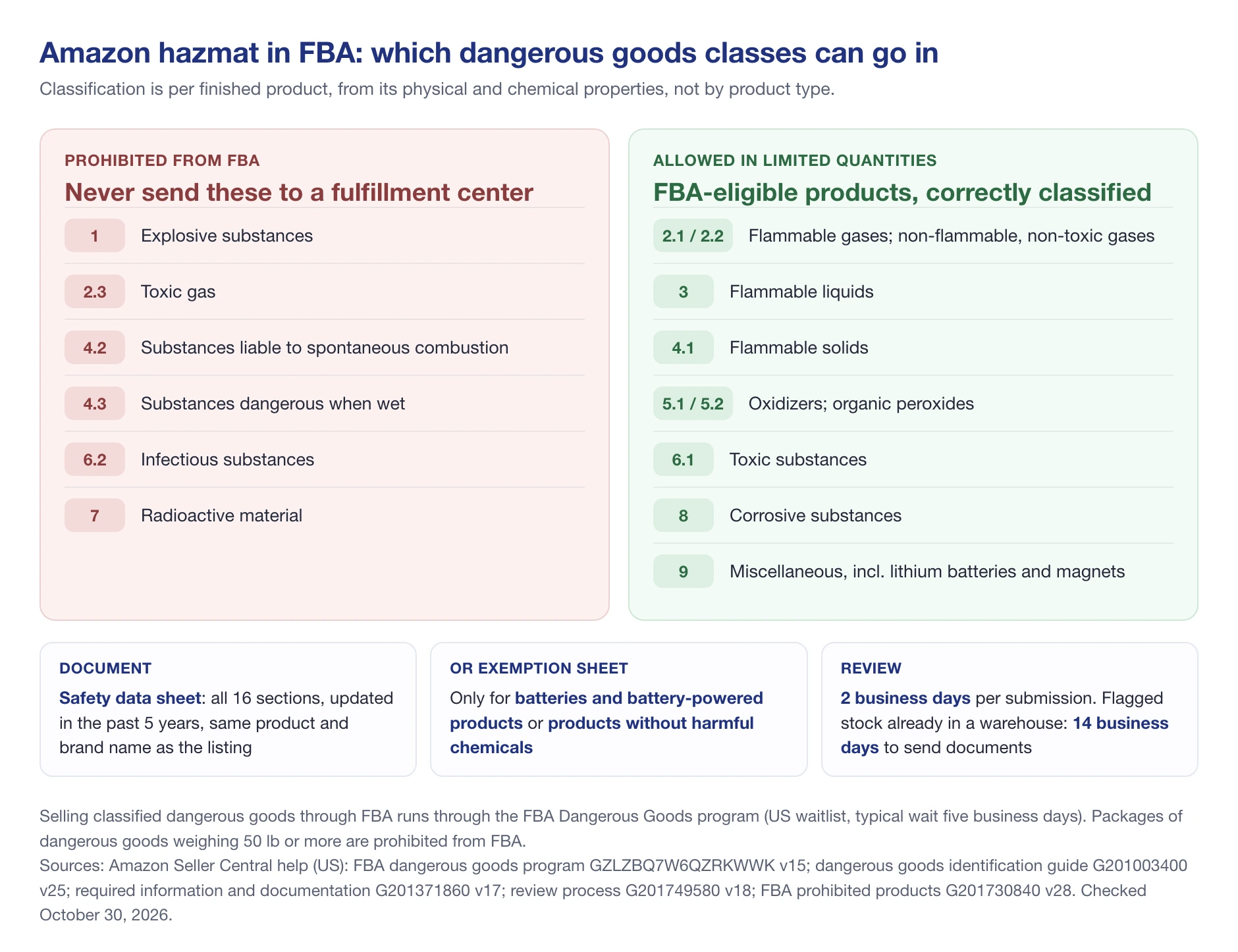
Dangerous goods are split into nine classes. Explosives (class 1), toxic gas (2.3), substances liable to spontaneous combustion (4.2), substances dangerous when wet (4.3), infectious substances (6.2) and radioactive material (7) are prohibited from FBA. The other classes, including flammable liquids (3), corrosives (8) and miscellaneous goods like lithium batteries and magnets (9), can go through FBA if the product is FBA-eligible and packed in limited quantities.
How the hazmat review works
When you create or convert a listing to FBA, you add dangerous goods information, including battery details. Amazon’s dangerous goods review process (version 18) says catalog information is the main way it spots possible hazmat, so bullet points, descriptions, images and even buyer reviews that mention batteries can trigger a review.
- Safety data sheet (SDS). Per Amazon’s documentation requirements (version 17), it must have all 16 standard sections, be created or updated within the past five years, and show the same product and brand name as your detail page. Bundles need an SDS for each chemical product inside.
- Exemption sheet. Accepted for only two kinds of product: batteries and battery-powered products, and products without harmful chemicals. Anything else gets rejected.
- Lithium batteries. Amazon also requires a UN 38.3 test summary at ASIN setup.
- Review time. Complete information is reviewed within two business days, and every resubmission takes another two.
- Stock already in a warehouse. If Amazon flags it as possible hazmat, you get an email and 14 business days to send documents. After that, the inventory is disposed of at your expense.
You can check where an ASIN stands with Amazon’s Look up an ASIN tool. If you disagree with the result, upload a new SDS or exemption sheet, or click Dispute classification.
The FBA Dangerous Goods program
To sell classified dangerous goods through FBA in the US, you need the FBA dangerous goods program (version 15). It has a waitlist; the typical wait for enrollment is five business days, and Amazon says there’s no way to expedite it. Sellers whose stored inventory is reclassified as hazmat are added to the waitlist automatically.
Hazmat products sold through the program are Prime eligible, but many can only travel by ground, so they get Prime four- to five-day shipping instead of two-day. Space is limited too: hazmat storage has separate flammable and aerosol capacity limits.
🎯 Pro Insight: Ask your supplier for the SDS before you place the first order, not after Amazon asks for it. A supplier who can’t produce a current, 16-section SDS for a cosmetic, cleaner or aerosol is a supplier who will cost you a blocked shipment later.
What to Do If You Violated Amazon’s Product Restrictions?
Amazon’s safety, compliance and product restrictions policy is clear that intent doesn’t matter: “Listing a restricted product, even unintentionally, may result in enforcement action, including listing removal, account suspension, or loss of selling privileges.”
Consequences of violating the restrictions
Depending on the violation and your account history, Amazon may:
- remove the listing or limit your listing privileges;
- suspend or terminate your selling privileges;
- destroy inventory in its fulfillment centers without reimbursement, or return it;
- withhold payments permanently.
The sale of illegal or unsafe products can also lead to civil and criminal penalties. The Restricted Products policy is also one of the policies counted in your Account Health Rating, and each violation costs points. Amazon’s Account Health Rating policy says repeat violations of the same policy within 180 days can put an account at immediate risk of deactivation, and the limit “can be as low as two violations for higher severity violations.” Our guide to Amazon account suspension covers the account side in more detail.
If Amazon removed a listing for a restricted product
- Close the listing. Amazon’s FAQ says moving a restricted listing to Out of Stock “does not make the listing compliant.” Close or delete it, even while you appeal.
- Check where the issue sits. In Account Health, look in the Product Policy Compliance tab, then in your inventory for inactive listings, then in Performance Notifications.
- If it was removed in error, contact Selling Partner Support with the ASIN and a detailed justification. Amazon admits its systems “may remove products that are permitted”, for example when product information is incomplete.
- If it was a real violation, fix the listing (remove the claim, add compliance documents) or delete it, then appeal.
How to write the appeal
Amazon’s guidance says a viable appeal for a restricted products violation must answer four questions:
- What was the violation, and which policy did which product break?
- What caused it?
- What reactive steps have you taken to fix it?
- What proactive steps have you taken to prevent it from happening again?
Be specific and factual. Amazon names an apology “without providing a specific explanation or identifying the product” as a generic plan that gets appeals denied, and “I did not create the ASIN” as an invalid root cause. It also rejects two common “prevention” steps: promising to ask Seller Support before listing (Amazon doesn’t pre-screen listings) and setting questionable listings to inactive. You can’t reuse an old appeal for a new, similar violation.
Submit the appeal by following the instructions at the top of your Account Health dashboard. For account deactivation appeals, Amazon says to expect a reply within two days.
How to Catch a Restricted or Suppressed Listing Early
Restrictions don’t only hit new listings. Amazon adds policy pages, reclassifies products as hazmat, and its systems sometimes remove products by mistake. Seller Central reports these in Account Health, in Performance Notifications and, for hazmat, by email. What it doesn’t do is watch the listing the way a buyer sees it.
That’s the gap SellerSonar covers. It checks the Amazon listings you add and sends Retail Issues alerts when it sees a change:
- Listing suppressed / Listing restored when a product is removed from the catalog or comes back.
- Search suppressed / Search restored when the ASIN no longer shows up in search by ASIN or title, even if the page still opens from a direct link.
- Buy Box suppressed / Buy Box reinstated when the listing is live but has no Buy Box.
Each search or Buy Box suppression alert comes with how long the issue has been active and a dated snapshot of the product page from the moment SellerSonar detected it. It doesn’t know why Amazon suppressed the listing. That reason lives in Seller Central, so the alert is your cue to go and look there. Checks run every 4 hours on Pro, every 2 hours on Premium, and as often as every hour on Business and Enterprise.
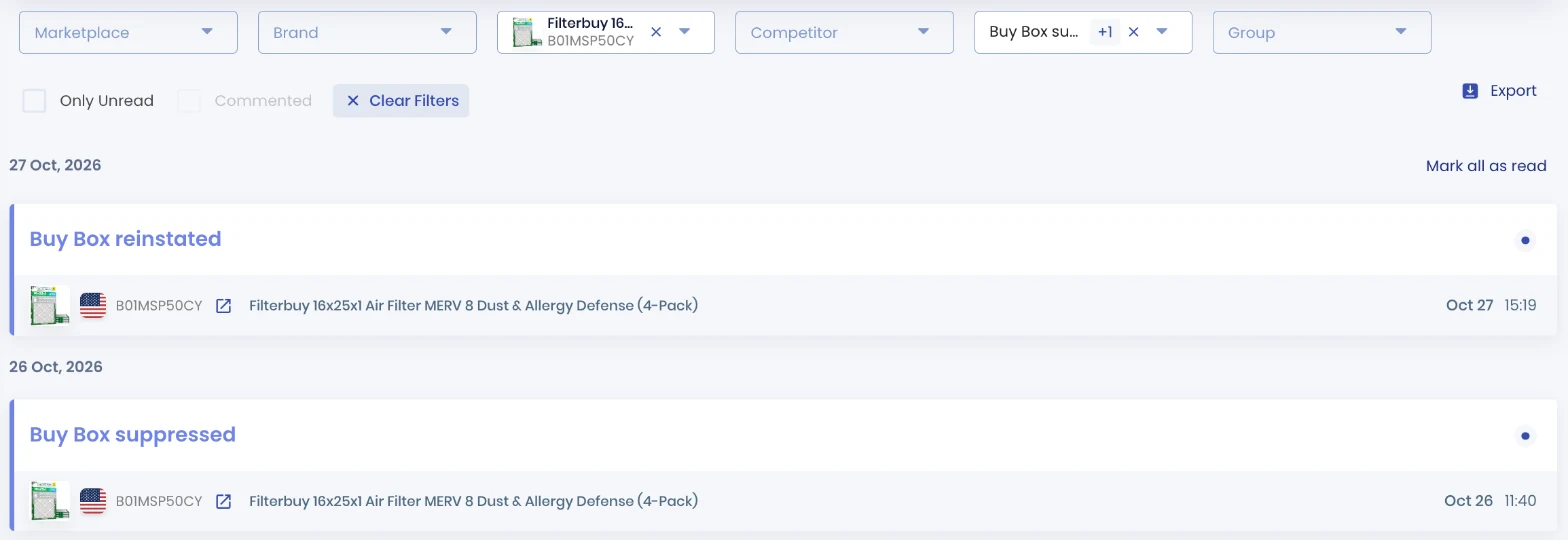
A real case from October 2026: on a Filterbuy air filter 4-pack we track on Amazon.com (ASIN B01MSP50CY), SellerSonar sent a “Buy Box suppressed” alert on October 26. The saved page snapshot showed “No featured offers available” and a “See All Buying Options” button. The “Buy Box reinstated” alert followed on October 27, about 27 hours later. SellerSonar can’t see why it happened (that reason sits in Seller Central), but it put a dated record in front of the seller while the problem was live. Our guide to suppressed Amazon listings walks through the usual causes and fixes.
Wrap Up
“Restricted” on Amazon means three different things, and each has a different fix. Prohibited products can’t be sold, so don’t buy them. Gated products, brands and categories need approval through “Apply to sell”, with clean invoices dated within 180 days and, in some categories, strong account metrics. Hazmat products can often be sold, but FBA needs a correct classification, an SDS or exemption sheet, and for many of them the FBA Dangerous Goods program.
Final Expert Recommendations: Check every product in Add Products before you pay a supplier, and read the policy page for its area, not a third-party list. Get the SDS and invoices in the supplier deal from day one. If you sell children’s products, supplements, lithium-powered items or other enhanced-safety categories, sort out the USD 1 million insurance policy before November 2, 2026. And if you’re still choosing a product, our guide on what you can and can’t sell on Amazon shows how to filter out restricted ideas early.
Once your products are live, keep an eye on them. SellerSonar can alert you when a tracked listing is suppressed, drops out of search or loses its Buy Box. You can try it free for 14 days, with 5 ASINs and 10 keywords and no credit card.

