





The best Amazon listing optimization tool depends on the problem you are trying to solve. Some tools help you find keywords. Some help you write or rebuild product listings. Some check listing quality. Some focus on competitor research. Others help sellers monitor live listings after publication, when titles, images, prices, reviews, Buy Box status, or suppression signals can change.
That distinction matters because Amazon listing optimization is not one task. A new product launch may need keyword research and listing creation. A weak existing ASIN may need a listing quality review. A sudden performance drop may require change history, pricing checks, Buy Box review, review monitoring, or catalog investigation.
This guide compares Amazon listing optimization tools by practical use case, so you can choose the right tool for your current workflow instead of treating every platform as if it solves the same problem.
Best Amazon Listing Optimization Tools
Before choosing a tool, it helps to separate the main listing optimization jobs:
- Keyword research: finding relevant search terms for titles, bullets, backend keywords, and ads.
- Listing creation: building titles, bullets, descriptions, and keyword coverage.
- Listing quality review: checking whether visible page elements such as images, title, bullets, description, reviews, and ratings support shopper confidence.
- Competitor analysis: reviewing how competing products position themselves, price their offers, and rank for important keywords.
- Ongoing monitoring: tracking what changes after the listing is live, including content changes, pricing movement, Buy Box activity, review changes, and suppression signals.
Here is a quick comparison of the tools covered in this article:
| Tool | Best for | Strong listing optimization angle | Main limitation |
| SellerSonar | Listing monitoring, alerts, competitor tracking, and listing quality review | Tracks listing changes, pricing, Buy Box activity, reviews, keyword rank movement, suppression visibility, and weak listing signals | Not a pure listing copy builder |
| Helium 10 | Keyword research, product research, and listing creation | Keyword-driven listing builder and broad Amazon seller toolkit | Can be complex and expensive for smaller teams |
| SellerApp | Listing quality checks, keyword tools, and analytics | Listing score, keyword research, and ranking workflows | Feature access depends on plan limits |
| SmartScout | Market intelligence, brand research, and AI-assisted listing work | Useful for understanding markets, competitors, and traffic patterns | Not mainly a listing quality checker |
| Jungle Scout | Product research, keyword research, and listing building | Keyword Scout and Listing Builder support keyword-led listing optimization | Broader seller suite may be more than some teams need |
| ZonGuru | Listing optimization, keyword tools, and product research | Keywords on Fire, Listing Optimizer, and Keyword Tracker | Some features may be less deep than specialized tools |
| Influencer Marketing Hub | External promotion and influencer discovery | Can support product visibility outside Amazon | Not a dedicated Amazon listing optimization platform |
Optimizing Amazon listings is essential because it can affect visibility, conversion rate, and how clearly shoppers understand the offer. Here are the main reasons sellers invest in listing optimization tools:
Increased visibility: By optimizing product listings, sellers can improve how well their products match relevant Amazon search queries. This means potential customers are more likely to see their products when they search for relevant keywords or browse related categories.
Higher conversion rates: Optimized listings can help improve conversion rates by giving customers clear and useful product information. This can include high-quality images, structured bullet points, detailed descriptions, A+ content where available, and relevant customer reviews.
Competitive edge: By optimizing Amazon listings, sellers can differentiate their products from similar offers and make the page easier to evaluate. This can support stronger sales, better shopper trust, and clearer brand positioning.
Better customer experience: Optimized listings help customers understand what they are buying, what is included, and why the product fits their needs. This can support higher satisfaction and, in many cases, reduce avoidable returns caused by unclear product information.
With so many products available on Amazon, it is important to make listings easier to find, easier to understand, and easier to monitor after publication. The tools below support different parts of that workflow.
SellerSonar Amazon Listing Tool
Best for: Amazon listing monitoring, competitor tracking, product alerts, and listing quality review.
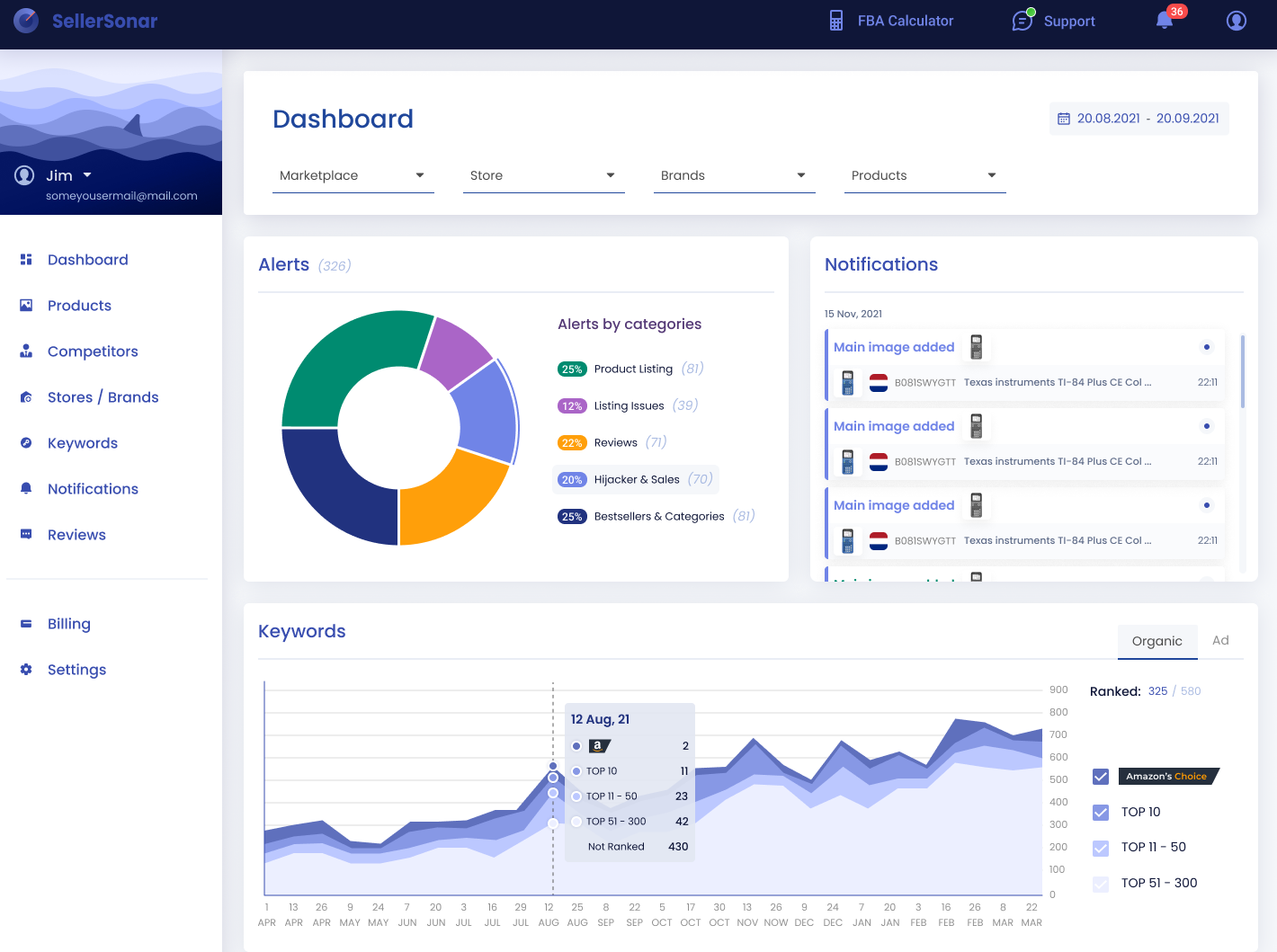
SellerSonar Dashboard
SellerSonar is built for sellers who need visibility into live Amazon listings after publication. The platform helps track product changes, competitor activity, keyword movement, Buy Box shifts, pricing changes, review updates, and catalog-status issues that can affect sales or listing health.
This makes SellerSonar useful for sellers, brands, agencies, and catalog teams that manage multiple ASINs and do not want to rely only on manual checks. Instead of reviewing product pages one by one, teams can monitor important listing events and investigate changes with more context.
For listing quality work, SellerSonar also offers an Amazon Listing Quality Checker. It helps sellers quickly review visible listing elements such as title, images, bullets, description, ratings, reviews, badges, and other page signals. This makes it easier to spot weak areas before updating a listing or deciding which ASINs need attention first.

The practical value is simple: use the checker to audit listing quality, then use SellerSonar monitoring to track what changes later. A one-time listing audit can show what needs improvement now, while alerts help your team catch future content changes, suppression issues, pricing shifts, or review changes without relying only on manual checks.
For teams already working in Claude or ChatGPT, the SellerSonar MCP server makes the same monitoring data readable from the assistant, so “what changed on these ASINs this week” is a question rather than a report to assemble. Access is read-only and needs no Seller Central connection.
Features:
Buy Box and pricing alerts: Track important Buy Box and pricing changes so your team can investigate ownership shifts, price movement, and competitive pressure faster.
Content change alerts: Monitor important listing content elements such as titles, bullets, descriptions, and images so you can detect unexpected changes before they go unnoticed for too long.
Competitor monitoring: Review competitor listings, pricing, keyword ranking, BSR, and other market signals to better understand how your products compare.

SellerSonar competitor monitoring
Product listing alerts: Stay informed about important listing changes and product page events that may affect sales, visibility, or catalog health.
Amazon Keyword Rank Tracker: Track keyword ranking changes and review how product visibility moves over time.
Retail issues and suppression visibility: Monitor listing suppression, retail issues, and other catalog-status signals so your team can investigate affected ASINs faster.
FBA calculator: Estimate Amazon fees and product margin before making listing, pricing, or catalog decisions. This is not a listing optimization feature by itself, but it can support decisions about which ASINs are worth improving first.
Amazon Listing Quality Checker: Review visible listing quality signals such as title, images, bullets, description, ratings, reviews, badges, and other page elements to understand what may need improvement.
Pros:
- Listing monitoring and change detection for Amazon sellers;
- Listing Quality Checker for faster product-page audits;
- Competitor monitoring and analysis;
- Alerts for listing changes, reviews, ratings, keyword ranking, pricing, Buy Box, BSR, and suppression visibility;
- Useful for sellers, agencies, brands, and catalog teams managing multiple ASINs.
Cons:
- No 24/7 live support, online support only.
Try SellerSonar now. Register for a 14-day trial and start monitoring listing changes, product alerts, and listing quality signals in one place.
Amazon Listing Optimization Tools Reviewed
Influencer Marketing Hub
Best for: external promotion, influencer discovery, and broader product visibility outside Amazon.

Influencer Marketing Hub
Influencer Marketing Hub is best treated as a supporting visibility tool, not a core Amazon listing optimization platform. It can help sellers explore influencer marketing, creator discovery, and external promotion opportunities that may bring more attention to a product.
For Amazon sellers, this can support awareness, but it does not replace tools for keyword research, listing quality checks, listing building, or Amazon-specific monitoring. Use it when external promotion is part of your broader growth plan, not when your main goal is to optimize listing content directly.
Pros:
- Access to influencer marketing resources;
- Useful for external product promotion;
- Can support brand awareness outside Amazon.
Cons:
- Not a dedicated Amazon listing optimization tool;
- Does not directly audit, build, or monitor Amazon listings.
Helium 10 Listing Optimization Tool
Best for: keyword research, product research, listing creation, and broader Amazon seller workflows.
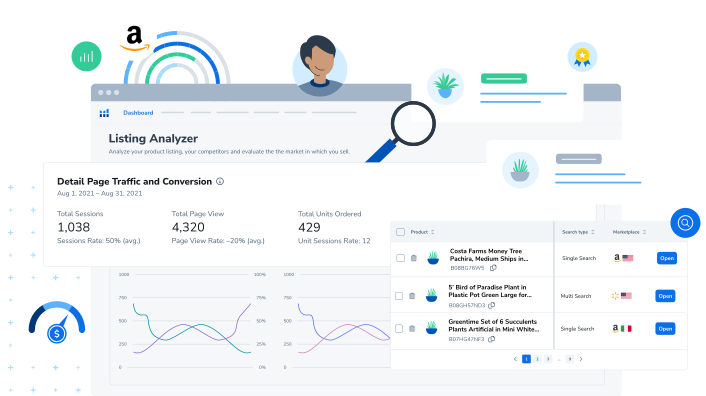
Helium 10 is best suited for sellers who want keyword research, product research, and listing creation tools in one broad Amazon seller platform. It can help sellers identify keyword opportunities, review product demand, build listings, and manage different parts of the Amazon workflow.
For listing optimization, Helium 10 is strongest when the main task is keyword-led content creation. Sellers can use keyword data to improve titles, bullet points, backend search terms, and listing structure before or during launch.
The main trade-off is complexity. Helium 10 includes many tools beyond listing optimization, so smaller teams or sellers focused only on monitoring may find the platform broader than they need.
Features:
- Insights Dashboard;
- Product Research;
- Keyword Research;
- Listing Optimization;
- Operations;
- Analytics;
- Marketing.
Pros:
- A comprehensive suite of tools;
- User-friendly interface;
- Strong keyword and product research workflows;
- Customer support resources.
Cons:
- High cost for some sellers;
- Steep learning curve;
- Can be overwhelming for teams that only need monitoring or listing issue detection.
See our Helium 10 review for full pricing and the limits worth knowing before you commit.
SellerApp Amazon Listing Quality Check
Best for: listing quality checks, keyword tools, PPC support, and Amazon analytics.
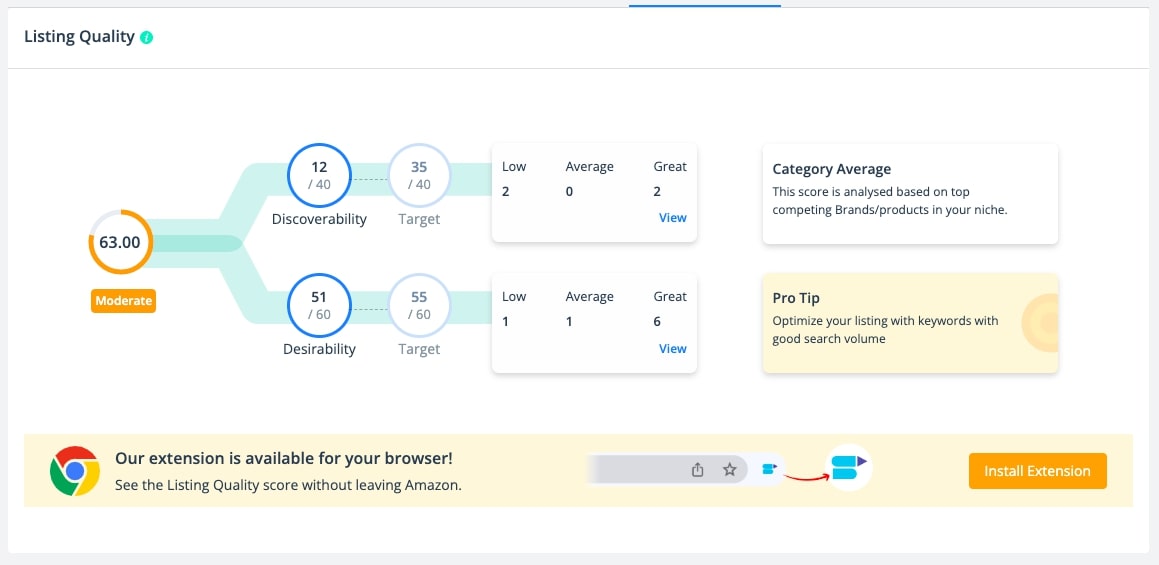
SellerApp Listing Quality Checker
SellerApp is a practical option for sellers who want listing quality checks alongside keyword research, PPC support, and Amazon analytics. It can help sellers review product listings, identify weak areas, and connect listing work with broader performance data.
Its Listing Quality Check tool is useful for sellers who want a structured review of listing elements such as keyword use, title length, image quality, and content completeness. This can help prioritize which listing details need attention before deeper optimization work.
SellerApp is also useful when sellers want keyword research and rank tracking in the same workflow. The main limitation is that access to specific features may depend on the selected plan.
Features:
- Amazon PPC Tool;
- Listing Optimization;
- Keyword Explorer;
- Business Alerts;
- Profit Checker;
- Product Research;
- Keyword Ranking Tracker.
Pros:
- Listing Quality Check tool for reviewing product listings;
- Keyword Research tool for finding keyword opportunities;
- Keyword Ranking Tracker.
Cons:
- Pricing can be expensive for some sellers;
- Feature limits on specific subscription plans.
SmartScout Amazon Listing Tool
Best for: market intelligence, brand research, product research, and AI-assisted listing workflows.
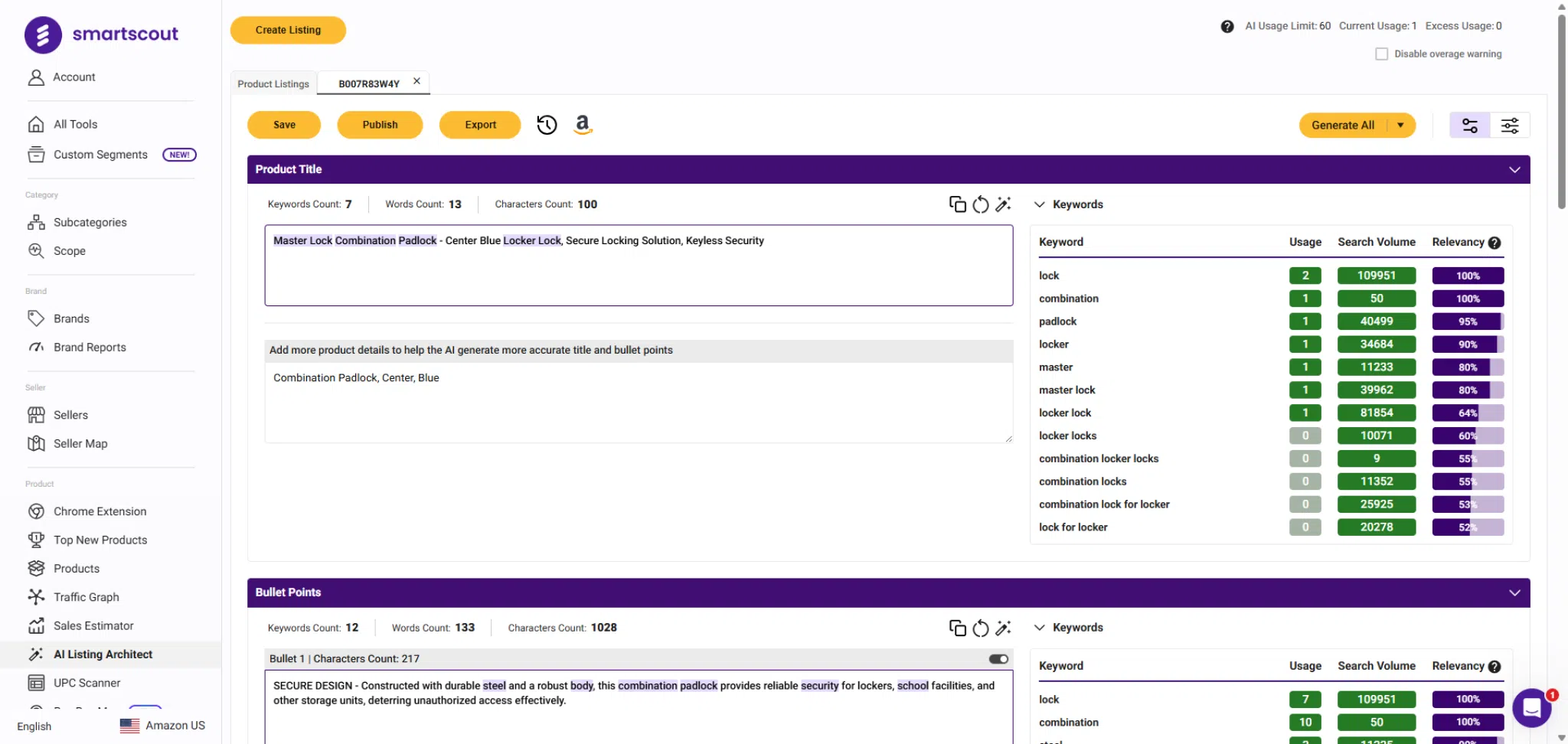
SmartScout AI-Listing Optimizer
SmartScout is strongest for sellers who want market intelligence before making listing or catalog decisions. It helps sellers research brands, subcategories, products, traffic patterns, and competitive positioning.
For listing optimization, SmartScout can support keyword and market research, and its AI-assisted listing workflows can help sellers create or improve listing content faster. It is most useful when optimization decisions need category context, not only keyword suggestions.
The main limitation is that SmartScout is not mainly a listing quality checker. It is better suited for market research and strategic listing work than for auditing every visible listing element.
Features:
- Brands;
- Subcategories;
- Traffic Graph;
- Products;
- Seller Tools;
- FBA Calculator;
- AdSpy;
- UPC Scanner.
Pros:
- Market and competitor research workflows;
- AI-assisted listing support;
- Useful for brand and category analysis.
Cons:
- Pricing can be expensive for some sellers;
- Less focused on detailed listing quality audits.
Jungle Scout Listing Builder
Best for: product research, keyword research, and listing building.
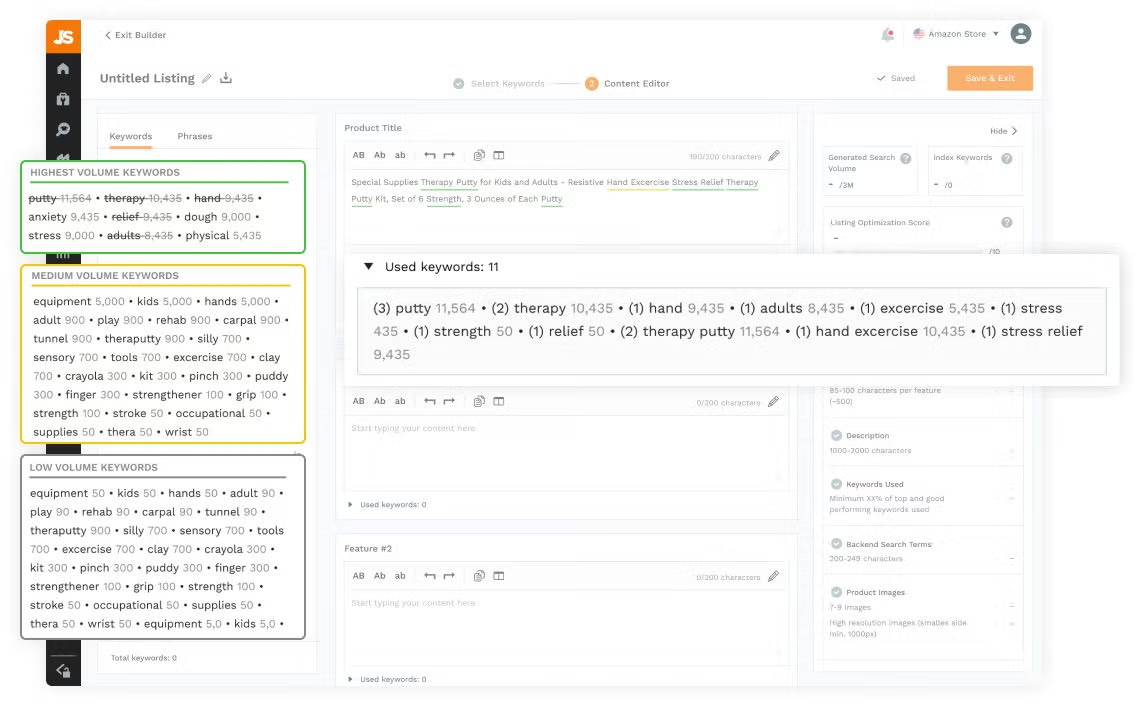
JungleScout Listing Optimizer
Jungle Scout is a strong option for sellers who want product research, keyword research, and listing building in one platform. It can help sellers identify product opportunities, research relevant keywords, analyze competitors, and create listings based on keyword data.
For listing optimization, Keyword Scout and Listing Builder are the most relevant features. Sellers can use keyword recommendations to improve titles, bullet points, descriptions, and overall listing structure.
Jungle Scout also includes a Listing Optimization Score that reviews factors such as product title, description, key features, keywords, and images. This gives sellers a practical way to evaluate listing content before publishing or updating a product page.
Features:
- Browser Extension;
- Product Tracker;
- Opportunity Finder;
- Product Database;
- Supplier Database;
- Inventory Manager;
- Promotions;
- Keyword Scout;
- Rank Tracker;
- Listing Builder;
- Review Automation;
- Sales Analytics;
- Alerts;
- Category Trends.
Pros:
- Comprehensive features for Amazon sellers;
- Keyword Scout tool for finding keyword opportunities;
- Listing Builder and listing optimization score.
Cons:
- Pricing can be expensive for some sellers;
- Some users may find the interface confusing.
ZonGuru Listing Optimizer
Best for: listing optimization, keyword research, and product research.
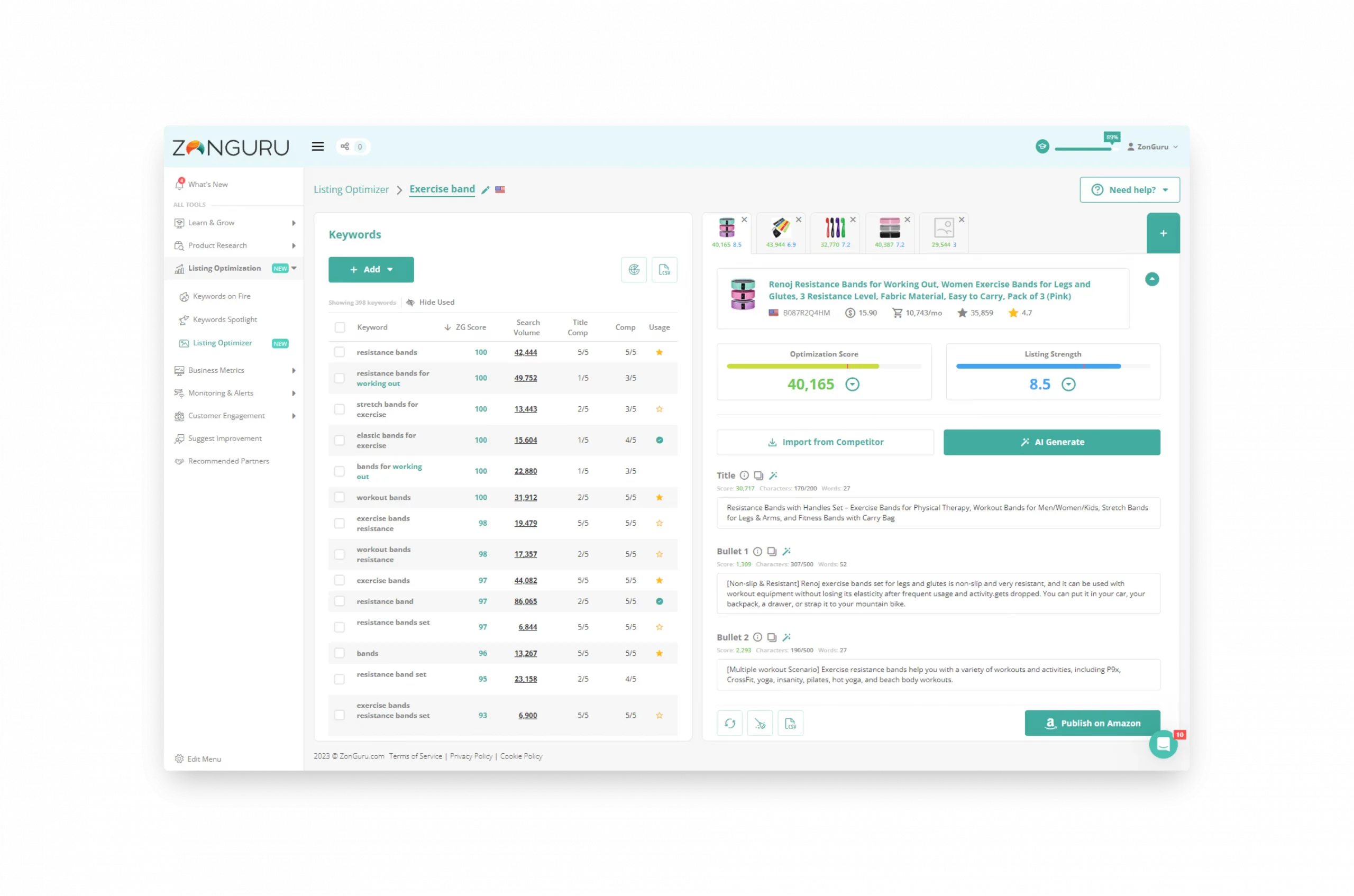
ZonGuru Listing Optimizer
ZonGuru is useful for sellers who want listing optimization, keyword research, product research, and business management tools in one platform. Its listing-related features can help sellers review keyword use, improve listing structure, and track keyword performance.
For listing work, Keywords on Fire, Listing Optimizer, and Keyword Tracker are the most relevant features. These tools can help sellers identify keyword opportunities, update listing content, and monitor ranking movement over time.
ZonGuru is a good fit for sellers who want an all-in-one Amazon seller toolkit, though some specialized workflows may not be as deep as dedicated tools focused only on listing audits or monitoring.
Features:
- Niche Finder;
- Chrome Extension;
- Sales Spy;
- Love-Hate Product Research;
- Easy Source;
- Keywords on Fire;
- Listing Optimizer;
- Business Dashboard;
- Keyword Tracker;
- IP Monitor;
- Email Automator;
- Review Automator.
Pros:
- All-in-one tool for sellers;
- Amazon FBA listing software for improving product listings;
- AI-powered listing support.
Cons:
- Pricing can be expensive for some sellers;
- Some features may not be as comprehensive as other tools.
How to Choose the Best Amazon Listing Optimization Tool
Choosing the best Amazon listing optimization tool can be difficult because different tools solve different parts of the workflow. When selecting tools to optimize Amazon product listings, consider your specific needs and goals as a seller. Here are some criteria to consider:
Features and benefits: Look for tools that offer the features you actually need. If your main issue is keyword coverage, prioritize keyword research and listing builder tools. If your main issue is weak page quality, use a listing quality checker. If your main issue is unexpected listing changes, suppression, or catalog monitoring, prioritize alerts and monitoring.
Listing quality review: If your main problem is weak page quality, look for a tool that reviews visible listing elements such as title, images, bullets, description, reviews, ratings, badges, and overall content completeness. This is where tools like SellerSonar’s Listing Quality Checker can help sellers quickly identify what may need improvement.
Monitoring after optimization: If your team already optimizes listings but struggles to catch later changes, prioritize monitoring. Amazon listings can change over time because of edits, contribution changes, retail issues, marketplace activity, or suppression-related problems. Ongoing alerts help sellers investigate faster. A newer form of the same question is whether you can reach that data from the AI assistant you already use: Helium 10, Jungle Scout and SellerSonar now expose theirs over MCP, so a status check can happen in a chat window rather than a dashboard visit.
Competitor visibility: If your category is competitive, choose a tool that helps you understand competing offers, pricing movement, keyword rankings, review changes, BSR shifts, and other market signals. Listing optimization works better when it is based on category context, not only internal assumptions.
Pricing: Consider your budget and the pricing of each tool. Some tools offer affordable pricing for small sellers, while others can be expensive for larger sellers. Look for tools that provide a good balance of features and pricing.
User interface: The tool should be easy to navigate, with a clear dashboard and practical workflows. This matters more as your catalog grows and more team members need to use the same data.
Integration: Check whether the tool fits your broader Amazon operations workflow. For some teams, this may include exports, Slack notifications, task management, reporting, or compatibility with existing processes.
Reviews: Read reviews and ratings from other Amazon sellers who have used the tool to understand its strengths, limitations, and user experience.
Customer support: Consider the level of customer support offered by each tool. Look for tools that provide responsive support and useful resources such as tutorials, help articles, and walkthroughs.
Conclusion
Optimizing Amazon listings is essential for improving product visibility, conversion, and page quality. The right Amazon listing optimization tool depends on the exact problem you need to solve.
Helium 10, SellerApp, SmartScout, Jungle Scout, and ZonGuru can help with keyword research, product research, listing creation, and optimization workflows. Influencer Marketing Hub can support external promotion, but it is not a dedicated Amazon listing optimization platform.
SellerSonar is strongest when sellers need listing monitoring, product alerts, competitor tracking, and visibility into changes that happen after a product page is live. Its Amazon Listing Quality Checker adds a useful audit layer by helping sellers review weak listing elements before deciding what to improve.
If you only need to create a new listing, a keyword-first listing builder may be enough. If you need to understand why a live product page looks weak, start with a listing quality review. If you need to know what changed after publication, use monitoring and alerts.
Try SellerSonar now. Register for a 14-day trial and start tracking listing changes, product alerts, and listing quality signals across your Amazon catalog.

