





Quick Answer
An Amazon keyword rank tracker is a tool that records where your ASIN sits in Amazon search results for a given keyword and keeps that history, which Amazon itself does not. Search manually and you see today’s position and nothing else.
- Check indexing first. A listing Amazon hasn’t indexed for a keyword cannot rank for it, and a tracker will only ever show a blank.
- Free spot checks: AMZDataStudio’s Chrome extension, which reports index status and organic position together.
- Cheapest paid entry: tool4seller at $16.58/mo billed yearly, though that plan reads 30 keywords once a day.
- Rank watched alongside hijackers and Buy Box: SellerSonar at $19.98/mo billed annually, 500 keywords across 150 ASINs every four hours, no Seller Central connection.
- Deepest keyword data: Helium 10 Platinum at $99/mo billed annually.
- Frequency beats allowance. A daily reading of 50 keywords beats a weekly reading of 5,000.
About the Author: Alex Harrison writes for the SellerSonar editorial team on Amazon search, monitoring and seller tooling. He tests these tools against the everyday question sellers actually have, which is not “what is my rank” but “what changed, and when”.
Keyword rank on Amazon is not a vanity metric. It’s the difference between page one for a term buyers actually use and page four, where nobody scrolls.
The catch is that you find out in arrears. Miss the week your main keyword slid from four to nineteen and you never see the drop, only the sales figure that followed.
Below are ten tools that record that history, what each costs, and which is worth paying for. First, though, the check that comes before any of them.
Check indexing before you check rank
Indexing and ranking are two different things, and sellers lose weeks by confusing them.
Indexed means Amazon has associated your listing with a keyword, so it is eligible to appear when someone searches that term. Ranked is the position it holds once it is eligible. You cannot rank for a term you are not indexed for, and the two failures look identical from the outside: your product does not appear.
A rank tracker reports the symptom. An index checker tells you which of the two problems you have. If you are not indexed, no amount of rank watching will explain why, and the fix is in your listing copy and backend search terms rather than in your advertising.
The quickest way to check by hand is to search Amazon for your exact ASIN plus the keyword, as one query. If your product comes back, you’re indexed for that term. If nothing comes back, you’re not.
Tools that check both
Several tools report index status alongside position, which saves running the check separately:
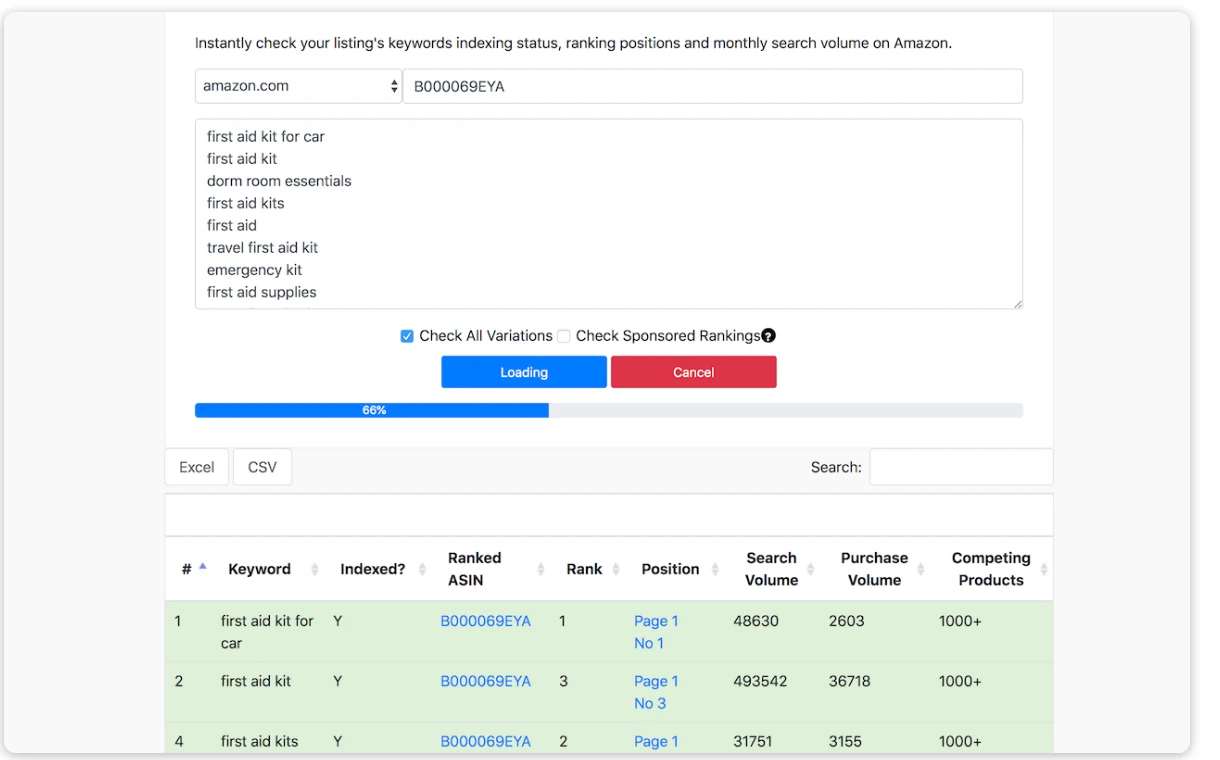
- AMZDataStudio’s Chrome extension shows index status and organic position side by side, for free.
- SellerSprite keeps an index checker in its permanently free tool set.
- SoldScope offers a free Index Checker and includes 200 checks a month on its entry plan.
- Helium 10 has an Index Checker inside its paid suite.
Worth saying plainly: SellerSonar does not include an index checker. It tracks organic and sponsored position for keywords you choose. If you need the indexation check too, run one of the free tools above alongside it.
How a tracker gets the number
This is the part most comparisons skip, and it explains nearly every complaint sellers have about rank tools.
No third-party tool can read your rank from Amazon’s systems. What they do instead is run the search themselves, as an automated browser, and record which position your ASIN came back in. The number is an observation of one search at one moment from one location, not a figure Amazon handed over.
Three consequences follow, and they’re worth internalizing before you pay for anything.
Two tools will disagree. They sampled at different times, possibly from different locations, and Amazon personalizes results. A three-position gap between two trackers is normal and is not evidence that either is broken.
Sampling frequency is the whole product. A tool that checks once a day gives you 30 readings a month. One that checks hourly gives you 720. The second will show you a slide as it happens; the first may show you a flat line through a drop and a recovery that both happened inside the same 24 hours.
Location matters more than it sounds. Results differ by marketplace and, for some categories, by delivery address. A tracker checking amazon.com from one default location is not measuring what a shopper in another state sees.
Amazon’s own data works differently
If your brand is enrolled in Brand Registry, Amazon gives you measured data through Brand Analytics, and it is measured rather than sampled. The catch is that none of it is a rank report.
Per Amazon’s own keyword research guidance, the Search Query Performance dashboard reports impressions, clicks, add-to-carts and purchases for the search terms associated with your brand. Search Catalog Performance shows the same funnel per product. Top Search Terms shows the most popular search terms in a given period along with the top three products customers clicked after searching them.
So Amazon tells you, exactly, how many people searched a term and what they did next. It does not tell you what position you held while they did it. A third-party tracker estimates the position but cannot see the funnel. Reading them together is the honest answer, and the reason sellers who rely on one alone end up confused by the other.
What separates good trackers from bad
Five things, roughly in order of how much they matter.
How often it checks. Daily is the useful baseline. Weekly checks miss the movement that matters, and a tracker that samples too rarely is just an expensive screenshot.
Whether it separates organic from sponsored. If it doesn’t, your paid placement can quietly mask an organic slide for weeks, and you’ll only find out when you pause the campaign.
Whether it tells you when something changes. Most tools skip this. Recording rank and telling you rank moved are different features, and a dashboard only helps on the days you remember to open it. A newer version of the same question: whether you can reach the data from somewhere you already work. Helium 10, Jungle Scout and SellerSonar all expose theirs to AI assistants over MCP, so the answer can arrive in a chat window instead of a tab you forgot to open.
How many keywords you get. Most sellers need dozens per ASIN, not thousands. Plans that headline enormous keyword ceilings are usually selling you a number you’ll never reach.
Whether it needs your Seller Central account. Rank is visible in public search results, so a tool reading public data doesn’t need access to your account. Several of the tools below do ask for an SP-API connection, which is worth knowing before you sign up rather than after.
The ten tools compared
| Tool | Entry price | Keywords at entry | Check frequency | Free option | Seller Central needed |
| AMZDataStudio | Free | On demand | When you click | Yes, the whole extension | No |
| tool4seller | $16.58/mo yearly | 30 | 1× per day | 14-day trial, no card | Yes, SP-API |
| SellerSonar | $19.98/mo annual | 500 across 150 ASINs | Every 4 hours | Free 14-day trial | No |
| SoldScope | $24/mo yearly | 500 across 10 products | Daily, plus manual boosts | Free tier and free tools | Optional, unlocks a free plan |
| Jungle Scout | ~$29/mo annual | Plan-dependent | Daily | No trial, 7-day refund | Optional |
| AMZScout | ~$33/mo annual | Plan-dependent | Daily | No-card trial, limited searches | No |
| SellerSprite | $39/mo monthly | Plan-dependent | Daily | 3-day trial, free index checker | Optional |
| SellerApp | $99/mo (Pro) | Plan-dependent | Daily | Forever-free tier, no keyword tracking | Optional |
| Helium 10 | $99/mo annual | Plan-dependent | Daily | Permanent free account, limited | Optional |
| Perpetua | From ~$695/mo | Top 50 ASINs per term, on Growth | Sampled through the day | No | Yes |
Prices are each vendor’s own published rates, checked on 1 October 2026, except AMZScout, whose site blocks automated checks; its figures come from its published offer page and were last confirmed in August 2026. Several vendors change prices often, so check before you buy.
Free ways to check rank and indexing
The free end of this market is better than it was, and for a seller with one or two products it may be all you need. Here is what it actually covers.
AMZDataStudio’s Chrome extension
The most visible free option, and the one Google puts at the top of these searches. You give it a marketplace, an ASIN and a list of keywords, and it returns index status and organic position for each.
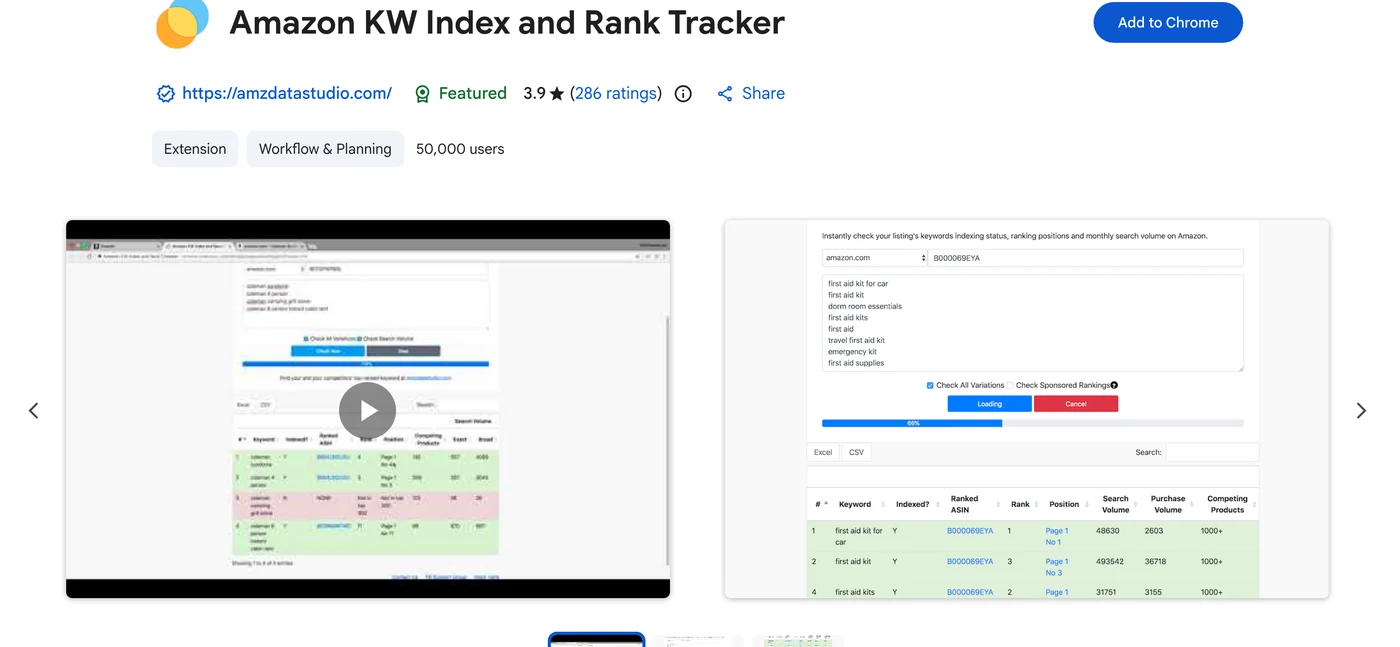
Its Chrome Web Store listing records 50,000 users and a 3.9 average from 286 ratings as of 5 October 2026, and lists support for eleven marketplaces: the US, UK, Canada, Japan, Germany, France, Italy, Spain, India, Mexico and Australia. The core checks are free, with an optional paid upgrade for advanced features.
SoldScope’s free tier
SoldScope publishes a free Rank Tracker, Index Checker and keyword tools that need no account to start. It also runs an unusual offer: connect your Seller Central API and you get its Starter features, including 50 tracked keywords, free for as long as you stay connected.
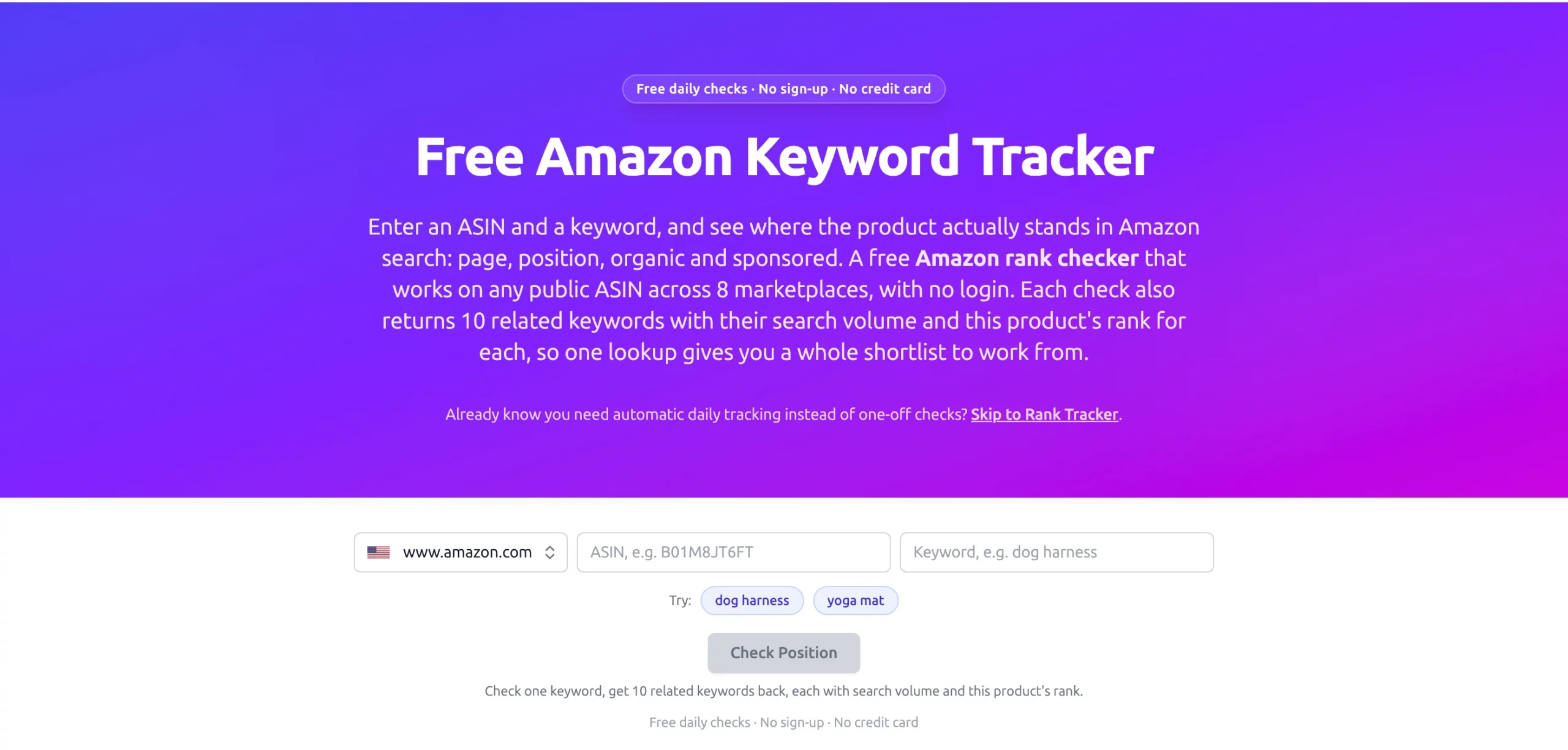
That is a real free tracker rather than a free lookup, with the obvious trade that you are granting API access to get it.
SellerSprite’s free tools
SellerSprite keeps its index checker, listing builder, sales estimator and browser extension free permanently, with the paid plans starting at $39/mo per its pricing page. If all you need is to confirm indexation, you never have to reach the paid tier.
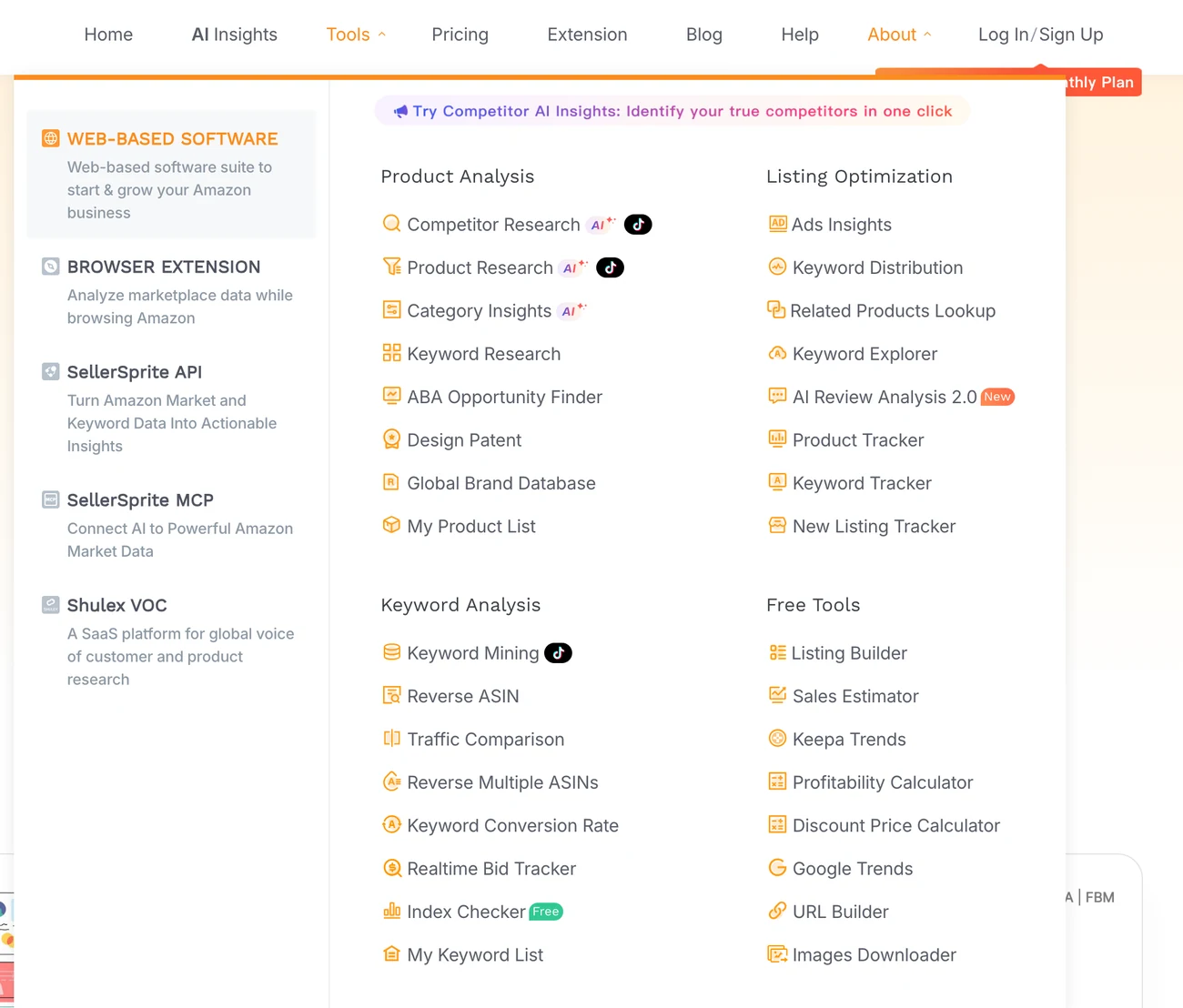
One practical change worth knowing: the Index Checker no longer runs on the website. Its page now says the feature has moved into the browser extension, so you install the extension and click the S icon on an Amazon page to use it. Still free, just not where it used to be.
Amazon’s own dashboards
Free, measured, and the ones most sellers underuse. Brand Registry enrollment unlocks Search Query Performance, Search Catalog Performance and Top Search Terms in Brand Analytics, plus Product Opportunity Explorer for category search trends.
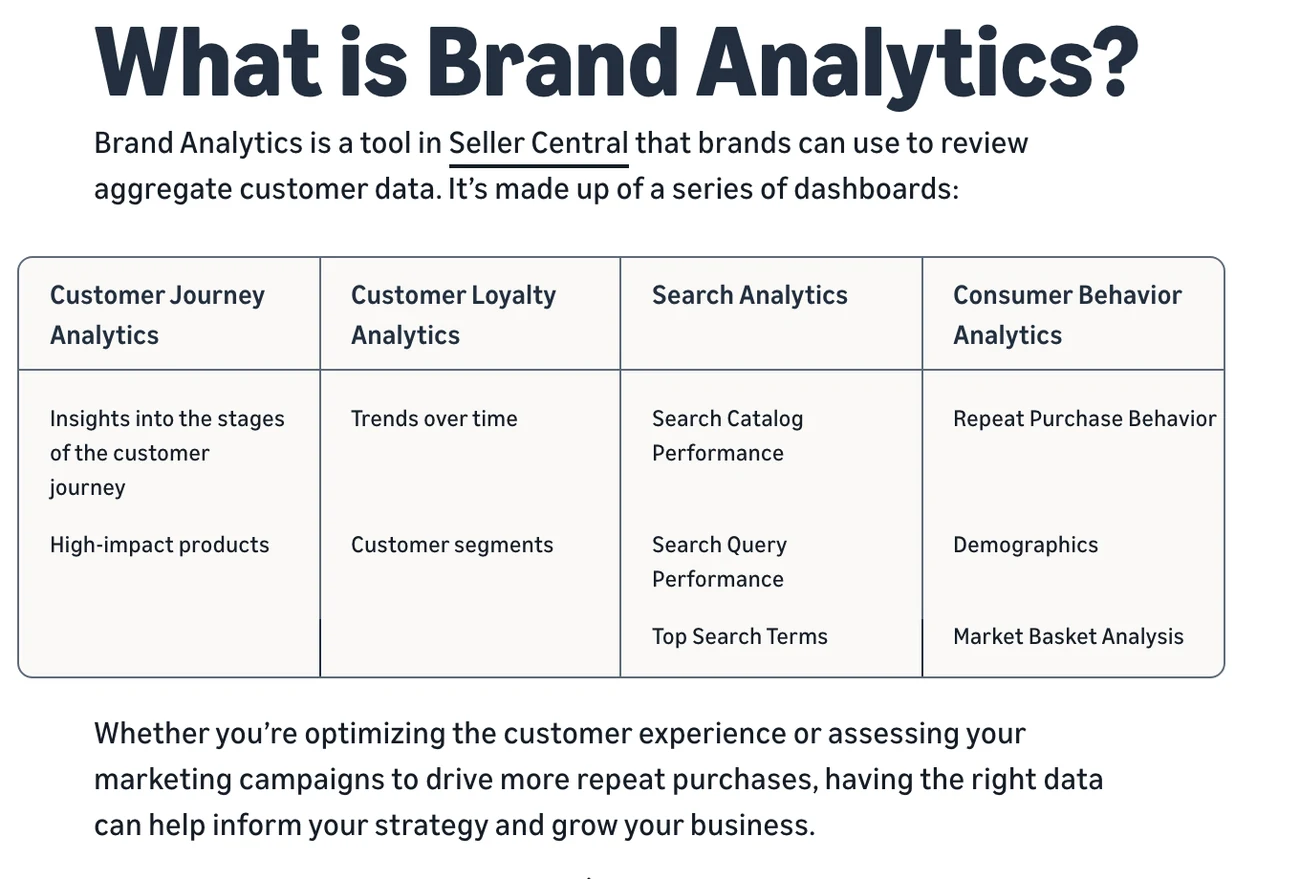
They will not give you a position. They will tell you which terms actually brought impressions, clicks and purchases, which is often the better question.
What free can’t do
The limitation is structural rather than a knock on quality. An on-demand checker tells you where you are right now, on the days you remember to look. It builds no history, so it can’t show you that a keyword slid three weeks ago, and it says nothing while you sleep.
Free tools answer “where am I?”. Paid trackers answer “what changed?”.
The paid trackers, one by one
1. tool4seller
The cheapest paid entry here at $16.58/mo billed yearly ($199 a year), which looks like a bargain until you read the keyword allowance. The Startup plan tracks 30 keywords, refreshed once a day. The published plan matrix scales that to 500 keywords at twice a day on Standard ($66.58/mo yearly), 1,000 at six times a day on Professional, and 2,000 at twelve times a day on Premium.
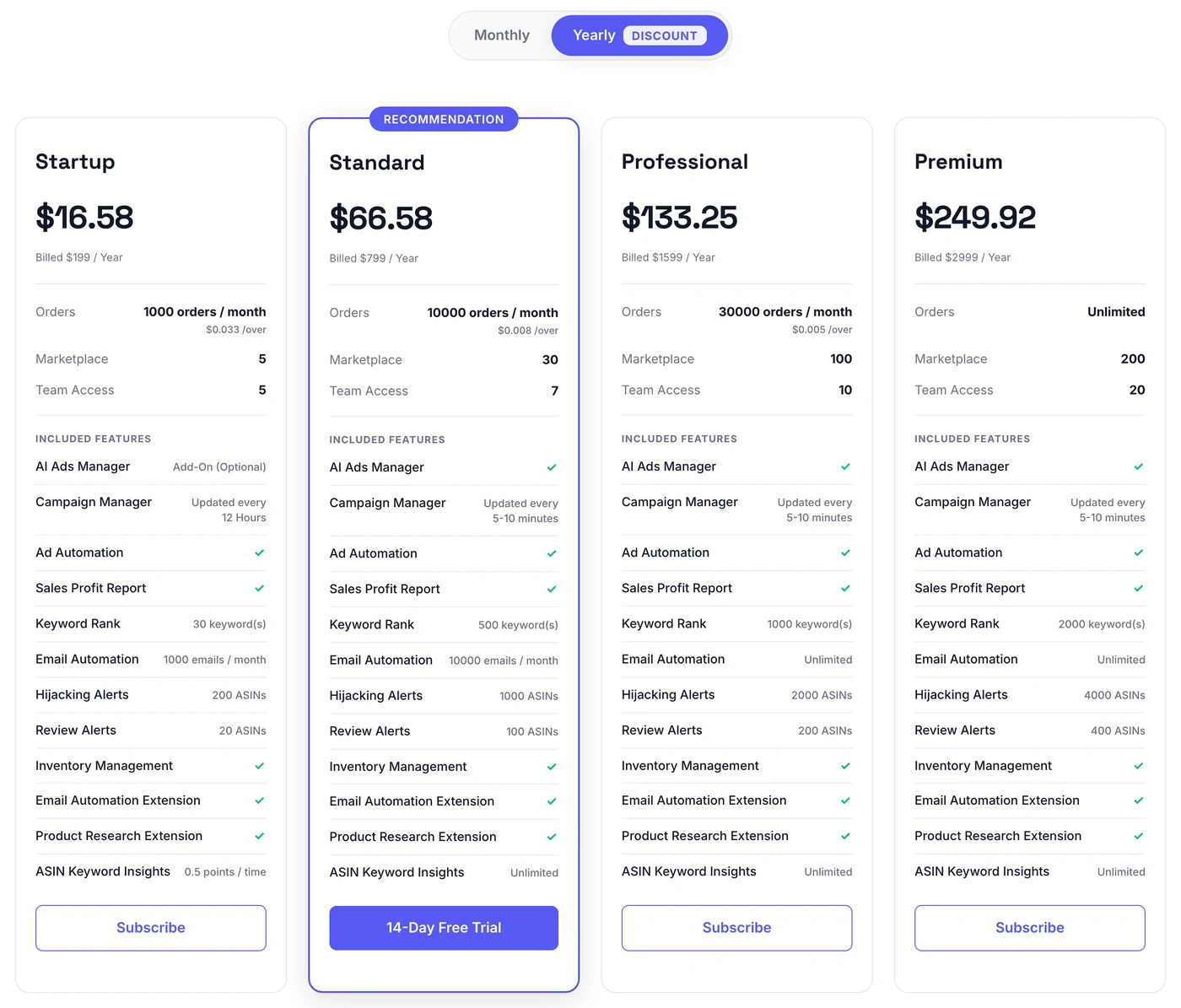
That table is the clearest disclosure of check frequency any vendor on this list publishes, and it makes the trade explicit: you are buying readings per day, not just keyword slots. tool4seller connects through Amazon’s SP-API, so a Seller Central authorization is required, and the 14-day free trial runs on the Standard plan with no card.
Pick it if you want profit and PPC reporting in the same tool and rank is one report among many. Skip it if 30 keywords at one reading a day is the plan you’d actually be on, because that is a thinner tracker than several free options.
2. SellerSonar
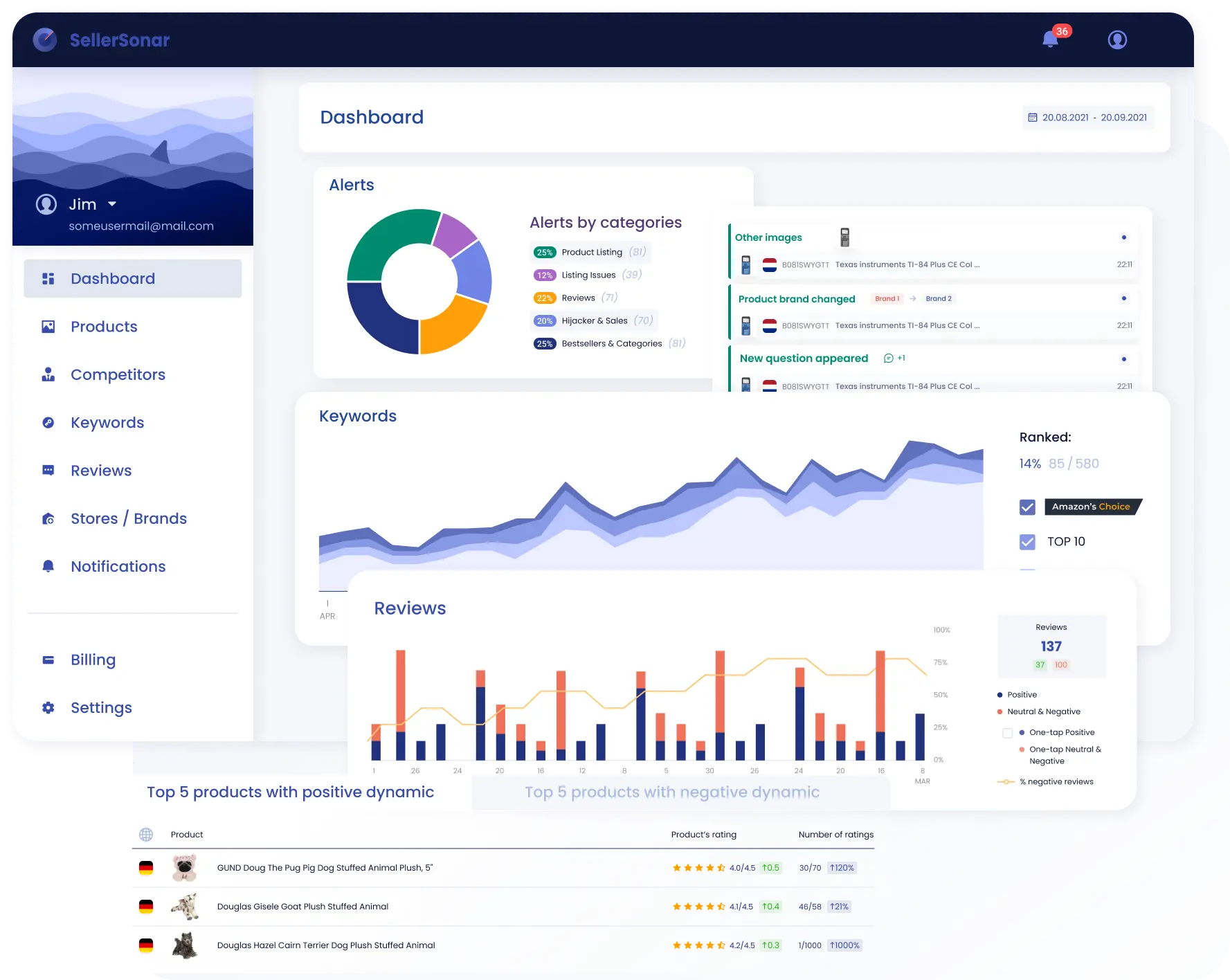
SellerSonar tracks keyword rank as one signal among several. The same account watches for hijackers, Buy Box loss, listing edits, rating changes and suppression, and alerts you when any of them move.
Per SellerSonar’s plans, Pro is $19.98/mo billed annually and covers 150 ASINs and 500 keywords with alerts every four hours. Premium at $39.98 raises that to 300 ASINs and 2,000 keywords on a two-hour cycle, and Business at $74.98 covers 500 ASINs and 3,000 keywords hourly. There’s a free 14-day trial for 5 ASINs and 10 keywords with no card, and a $5 option that opens the full Business feature set for the same fortnight. Review tracking sits on Premium and above rather than on every plan.
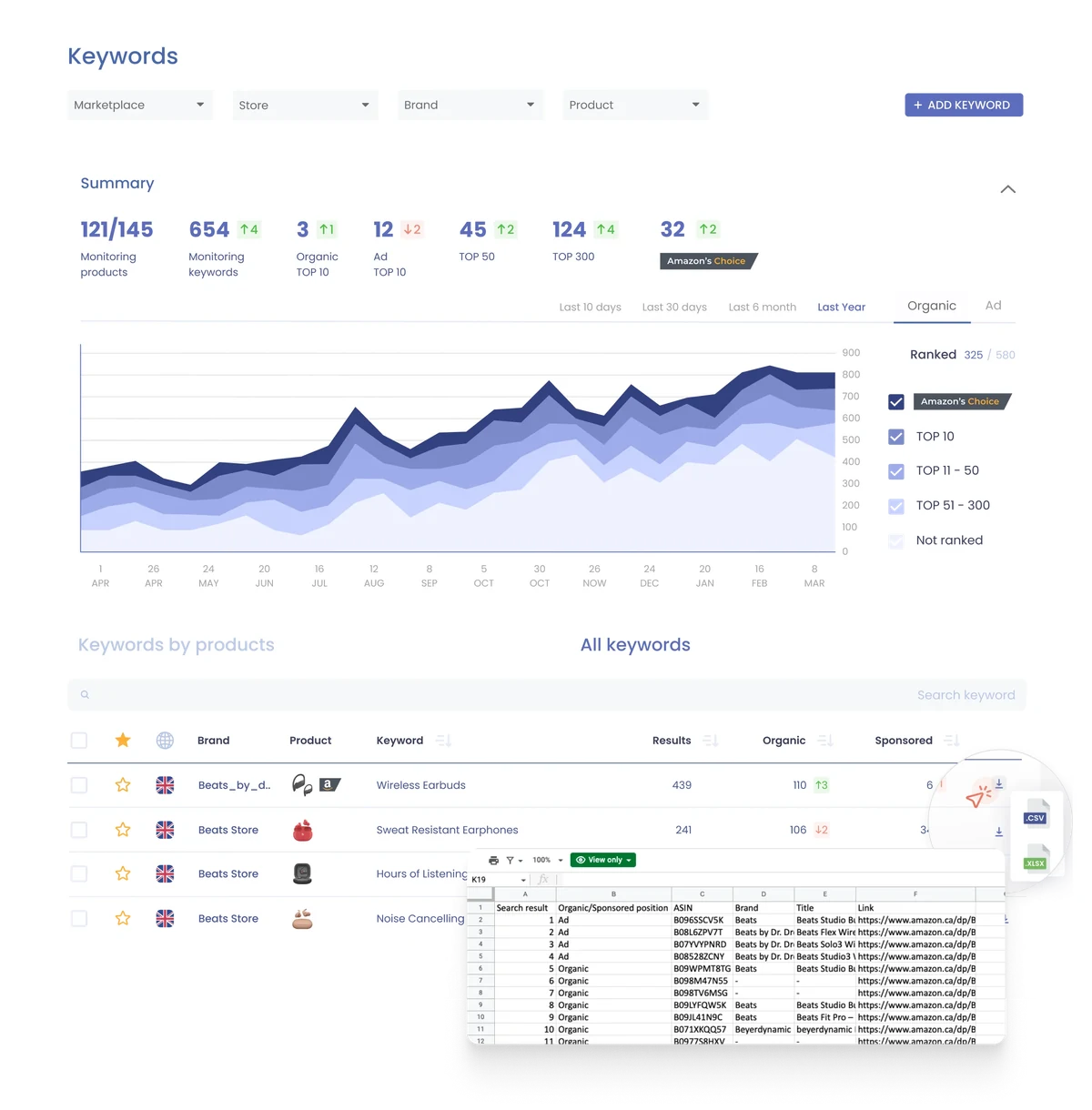
The keyword tracker records organic and sponsored position separately and charts your history against named competitor ASINs on the same keyword, which is how you tell a category-wide shift from a problem with your listing. If you also run ads, pair it with the Amazon Ads MCP and an AI assistant can line up your organic rank against your ad spend on the same keyword. Two features go past a plain position number. The Heatmap lays every tracked keyword against every date as a grid of color, so a block of terms sliding together reads at a glance instead of one chart at a time, and keyword groups let you watch a launch or a whole category as a unit.
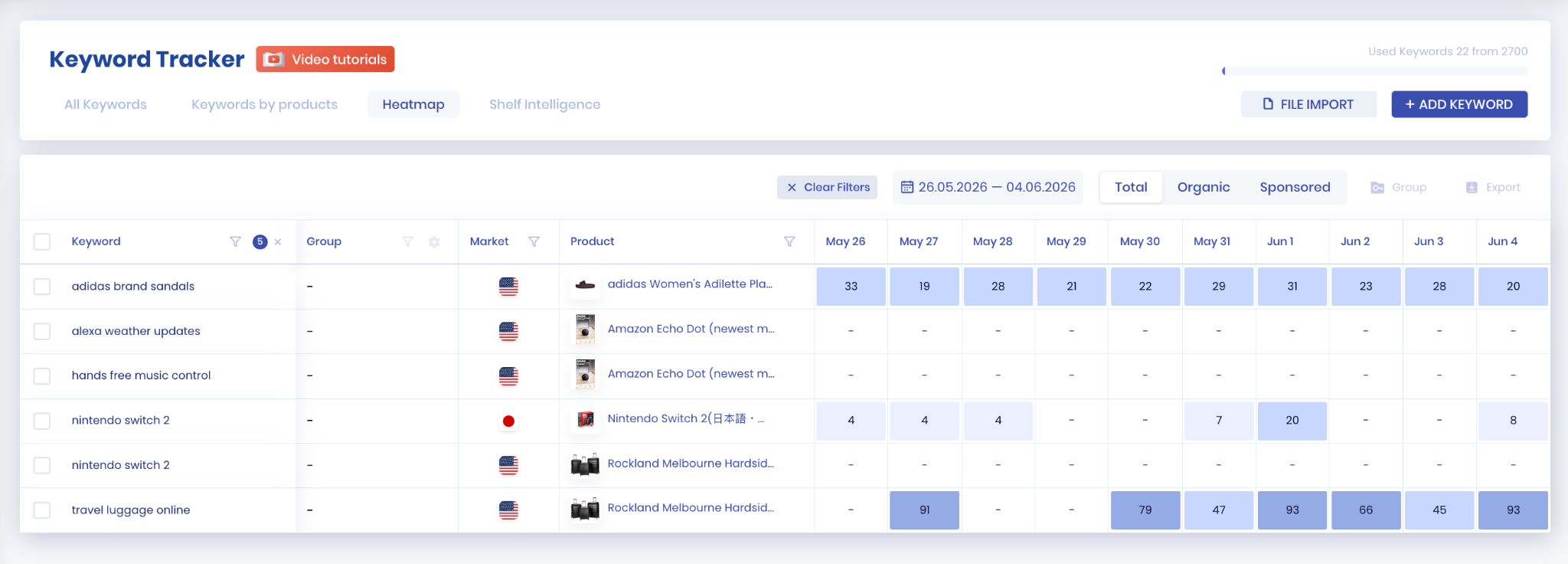
Shelf Intelligence answers the question rank alone can’t: how much of the first page your brand actually holds. It reports share of voice across organic and sponsored results, and share of shelf against named competitors, which is the difference between knowing you sit at position four and knowing a rival owns six of the ten slots around you. Shelf Intelligence sits on the Business plan.
The same tracked data is readable from an AI assistant through the SellerSonar MCP server, so “which of my keywords slipped this week” can be a question rather than a dashboard visit. Access is read-only, authorized over OAuth, and reads public Amazon pages, which is consistent with how the rest of the tool works.
Pick it if a rank drop is one of several things you need to hear about quickly, and you’d rather not connect Seller Central. Don’t pick it for keyword research or indexation: there’s no reverse-ASIN database and no index checker here, so pair it with one of the free tools above or with Helium 10 for the discovery half of the job.
3. SoldScope
A newer research and analytics suite that treats rank tracking as a first-class product rather than a bundled extra. Per its pricing page, Starter is $24/mo billed yearly ($288 a year) or $29 monthly, and covers 10 products and 500 tracked keywords, with 200 index checks and 150 Buy Box map searches a month. Standard at $49/mo yearly takes that to 50 products and 2,500 keywords, Professional at $99 to 100 products and 5,000 keywords.
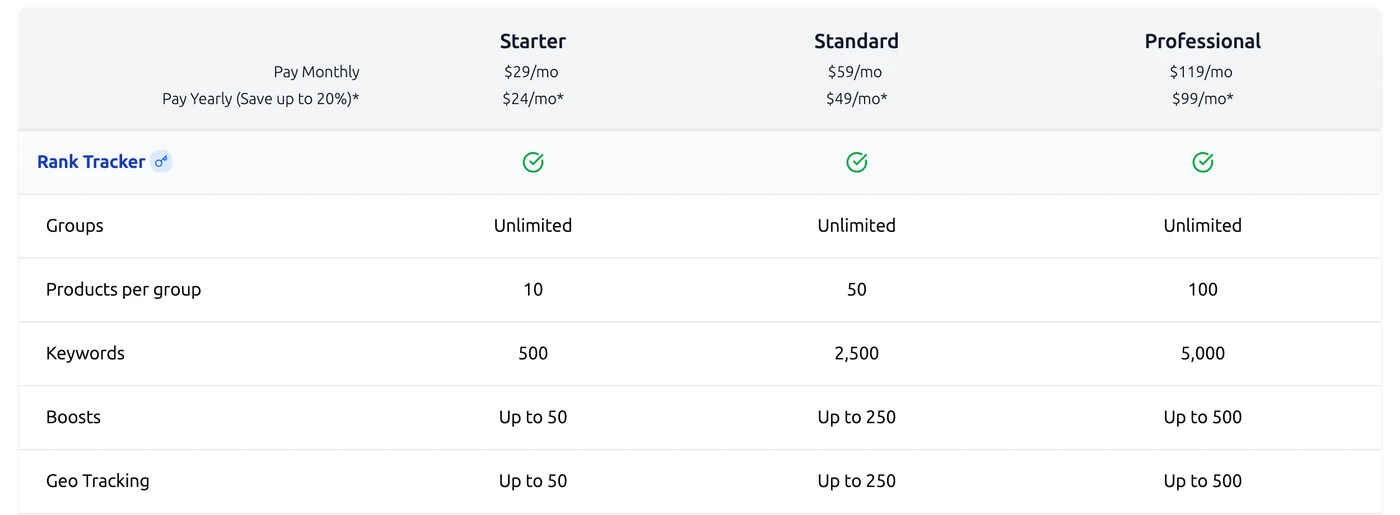
Two details stand out. The plans include boosts, which are manual on-demand refreshes between scheduled checks, and geo tracking, which is the location problem handled rather than ignored. There’s also a free plan for anyone who connects their Amazon API, which includes 50 tracked keywords indefinitely.
Pick it if you want geo-aware tracking and a generous free route in. Treat it as the less established name here, with the shorter track record that implies.
4. Jungle Scout
Jungle Scout built its name on product research and sales estimation, and its rank tracker is a competent part of a larger platform rather than the reason to buy it.
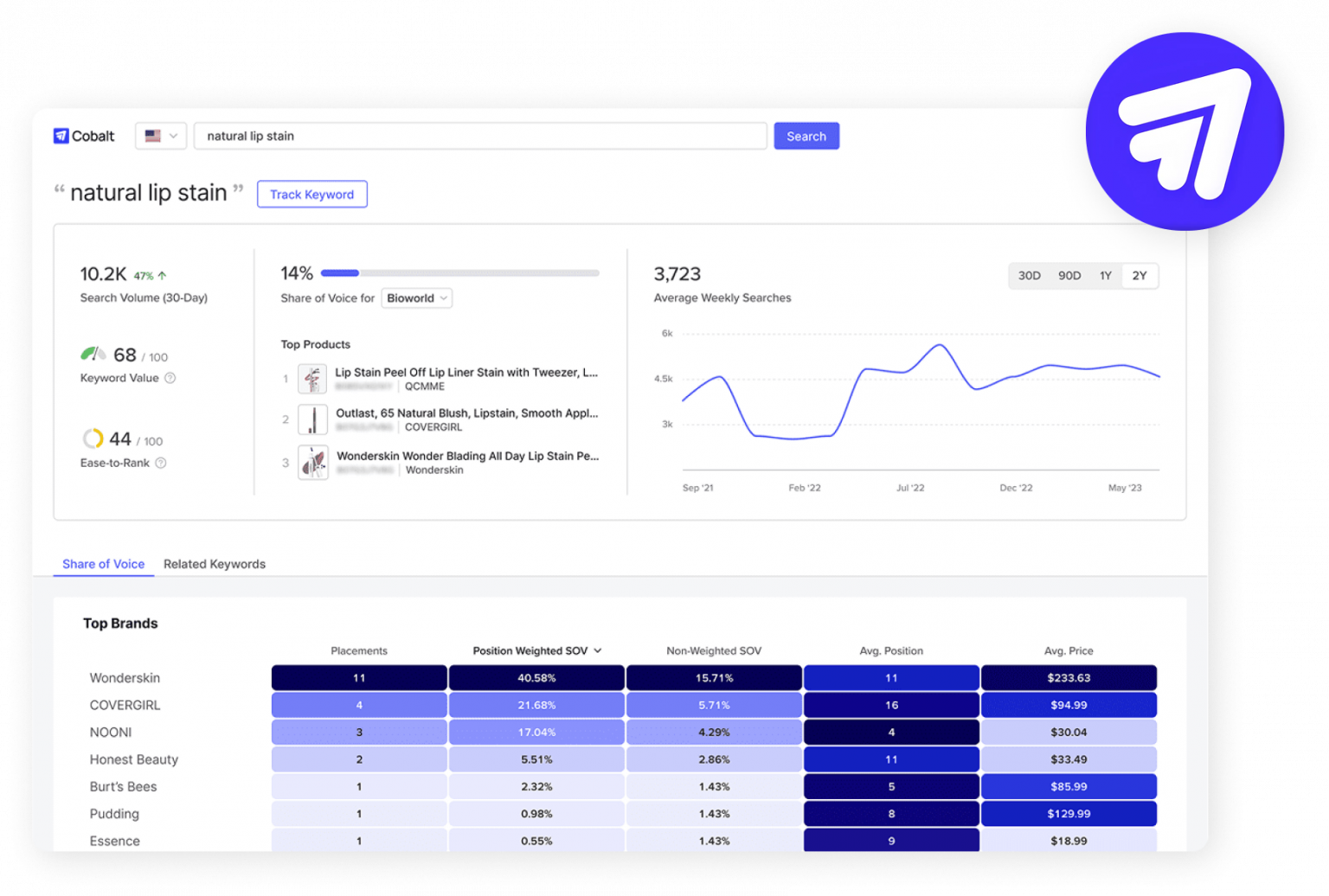
Per Jungle Scout’s pricing page, Starter runs about $29/mo billed annually, $49 monthly. Growth Accelerator is roughly $49/mo annual, $79 monthly. There’s no free trial, only a 7-day money-back guarantee, which makes it harder to evaluate before committing.
Pick it if you’re researching products and validating demand, and rank tracking is a useful extra rather than the point.
5. AMZScout
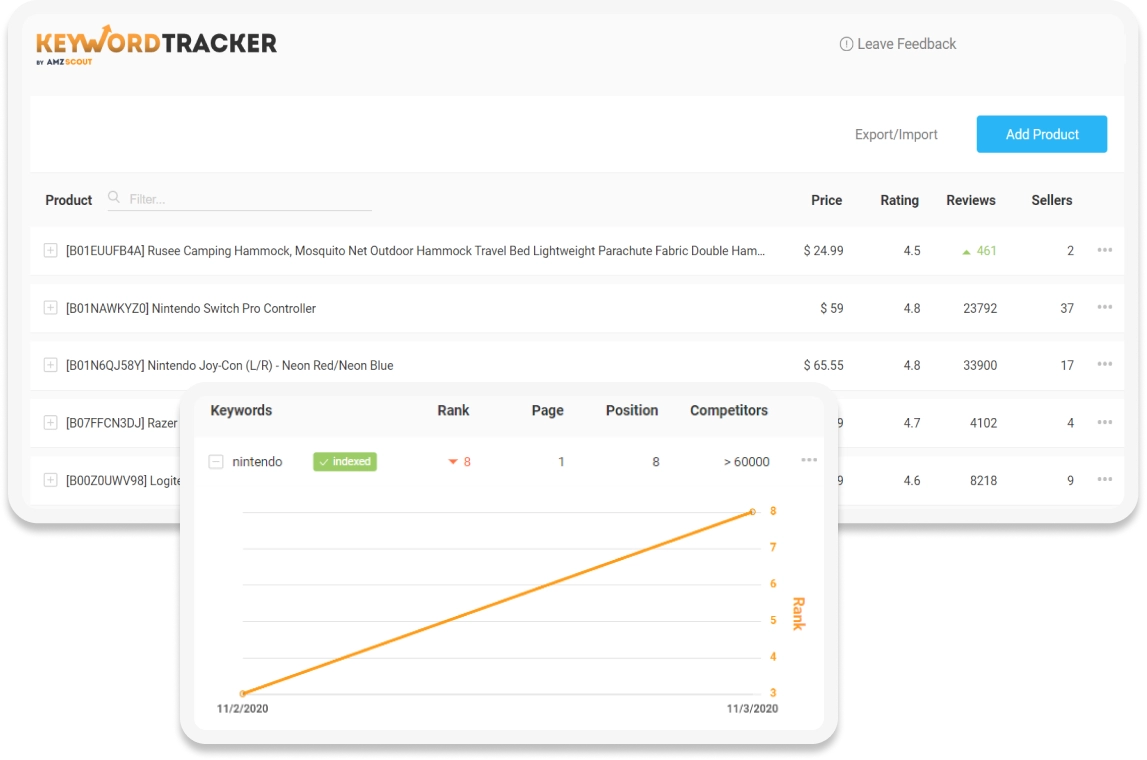
AMZScout is a research toolset with a tracker inside it rather than a dedicated tracker. Its Keyword Tracker follows the positions your ASIN holds for the terms you feed it and tells you when one drops.
The standard subscription runs $59.99/mo, or $399.99 a year, which works out around $33/mo, per AMZScout’s published offer page. You can test it without a card on an open-ended trial that caps how many searches you run, and paid plans carry a 10-day money-back guarantee. Worth knowing that AMZScout runs several offer pages at different prices, so check the figure at checkout.
Pick it if budget is the binding constraint and you want product research alongside rank. Don’t pick it for listing protection: rank-drop alerts are the only alerts here, so hijackers, Buy Box loss and content edits go unwatched.
6. SellerSprite
Stronger on keyword and market data than Jungle Scout, and considerably cheaper than Helium 10, which is the gap it deliberately sits in.
Per SellerSprite’s pricing page, Basic is $39/mo ($49 list), Standard $79, Advanced $129 and VIP $189, with roughly two months free on annual billing and a 3-day trial of the monthly plan. Its index checker, listing builder, sales estimator and Chrome extension stay free permanently.
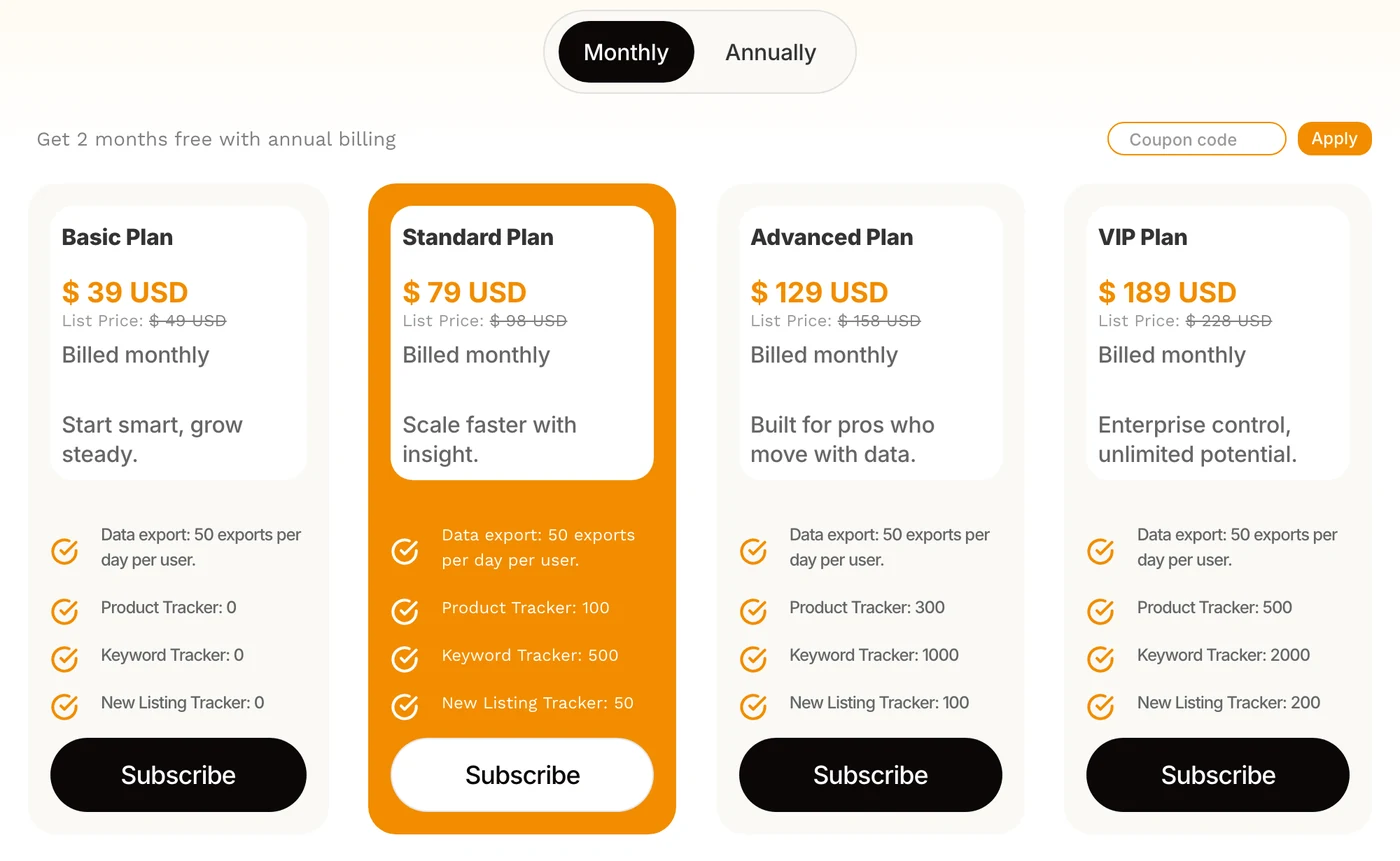
One catch that same pricing page only shows once you switch it to monthly billing: the $39 Basic plan carries Keyword Tracker: 0. Keyword tracking appears on Basic only if you pay annually, at $390 a year, and on monthly terms the real entry point for rank tracking is Standard at $79/mo with 500 keywords. Advanced covers 1,000 and VIP 2,000.
Pick it if you want reverse-ASIN depth without Helium 10 pricing. Its monitoring and alerting coverage is less clearly documented than its research tools, so confirm what you’d actually get alerted about before you rely on it for that.
7. SellerApp
SellerApp combines research, rank tracking and PPC automation, and it’s the only tool here with a genuinely forever-free tier.
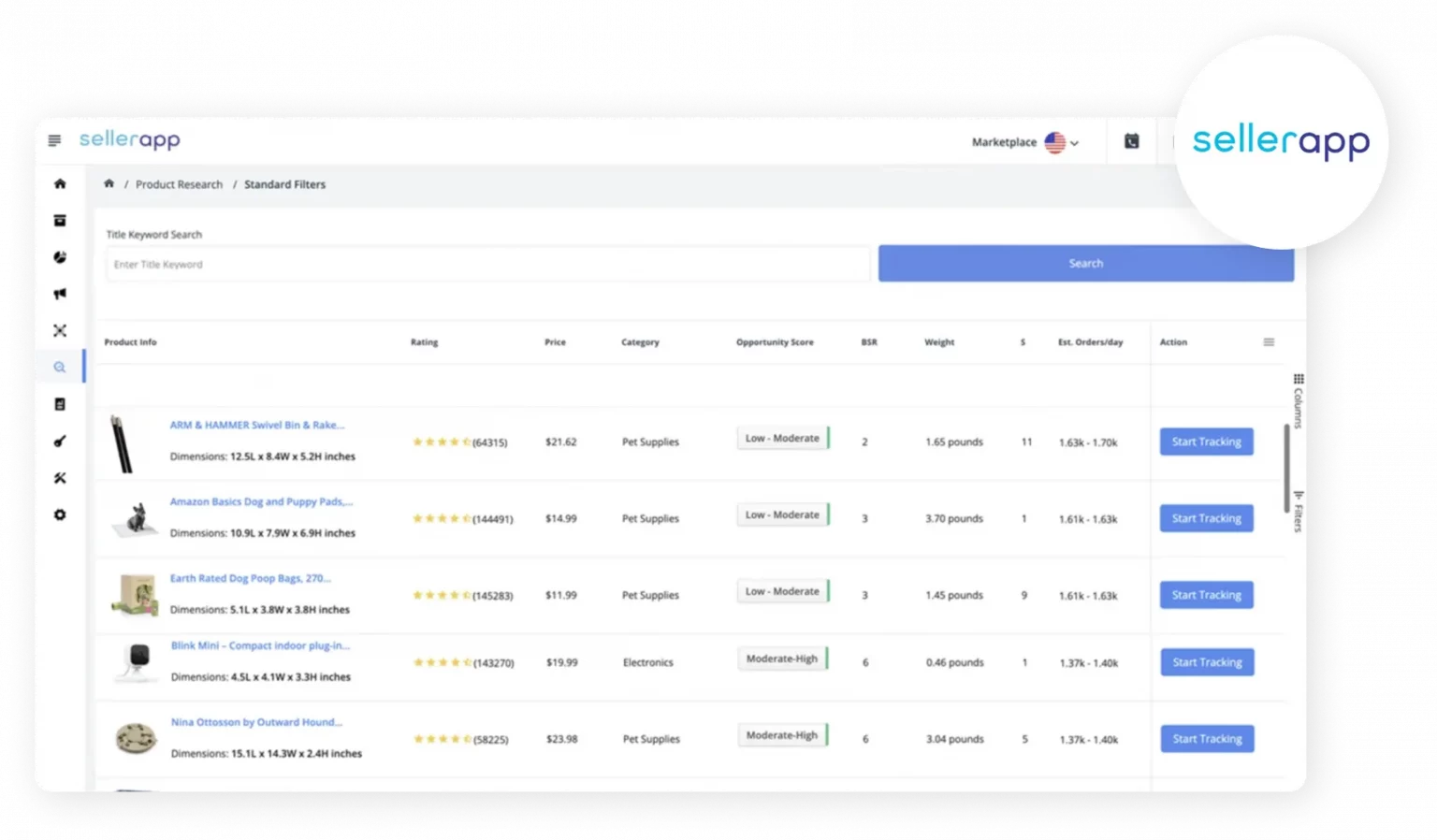
Checked on 5 October 2026, SellerApp’s pricing page lists a $0 Freemium tier with no card, Pro from $99/mo and Smart from $149/mo (shown against $250 and discounted for the first three months), with a custom tier above that. Older comparisons still quote a $39 plan; there isn’t one.
The detail that matters here: Keyword Tracking sits on the Pro plan, not the free one. The forever-free tier covers product research, advertising overview and listing quality, so if rank is what you came for, SellerApp starts at $99.
Pick it if you’re managing ads and organic rank together and want them in one place.
8. Helium 10
Helium 10 has the deepest keyword data of anything here. Cerebro and Magnet are genuinely best in class for reverse-ASIN lookups and keyword discovery, its Keyword Tracker sits on top of that database, and an Index Checker comes with it.
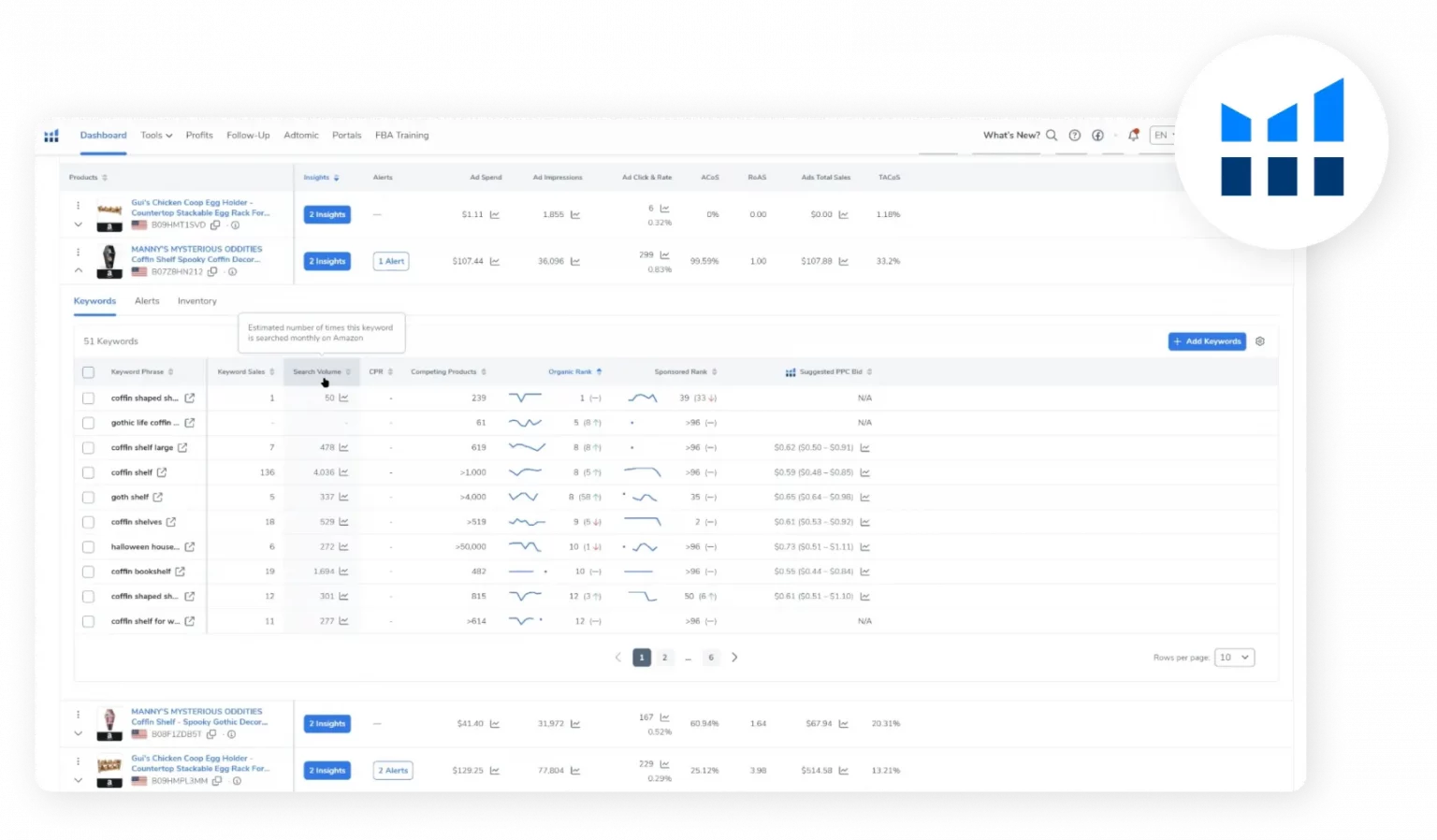
It’s also the most expensive mainstream option. The April 2026 price rise removed the old $39/mo Starter plan, so per Helium 10’s pricing page the cheapest paid entry is now Platinum at $99/mo billed annually, or $129 month to month, with Diamond at $279/$359. The free account is not a trial: Helium 10’s own pricing FAQ describes it as free to use forever, with usage limits on each tool.
Pick it if keyword research depth is worth the price to you. Skip it if you only want to watch rank, because you’d be buying a research suite to use one module.
9. Perpetua
An advertising platform that absorbed Sellics in 2022 and inherited its rank tracking with it. Per Perpetua’s SEO tool page, it tracks organic rank for the top 50 ASINs on every search term, sampling through the day for a daily average, and reports brand share of voice on daily and weekly trends. That pairing is the point: you see the organic movement next to the ad spend that caused it.
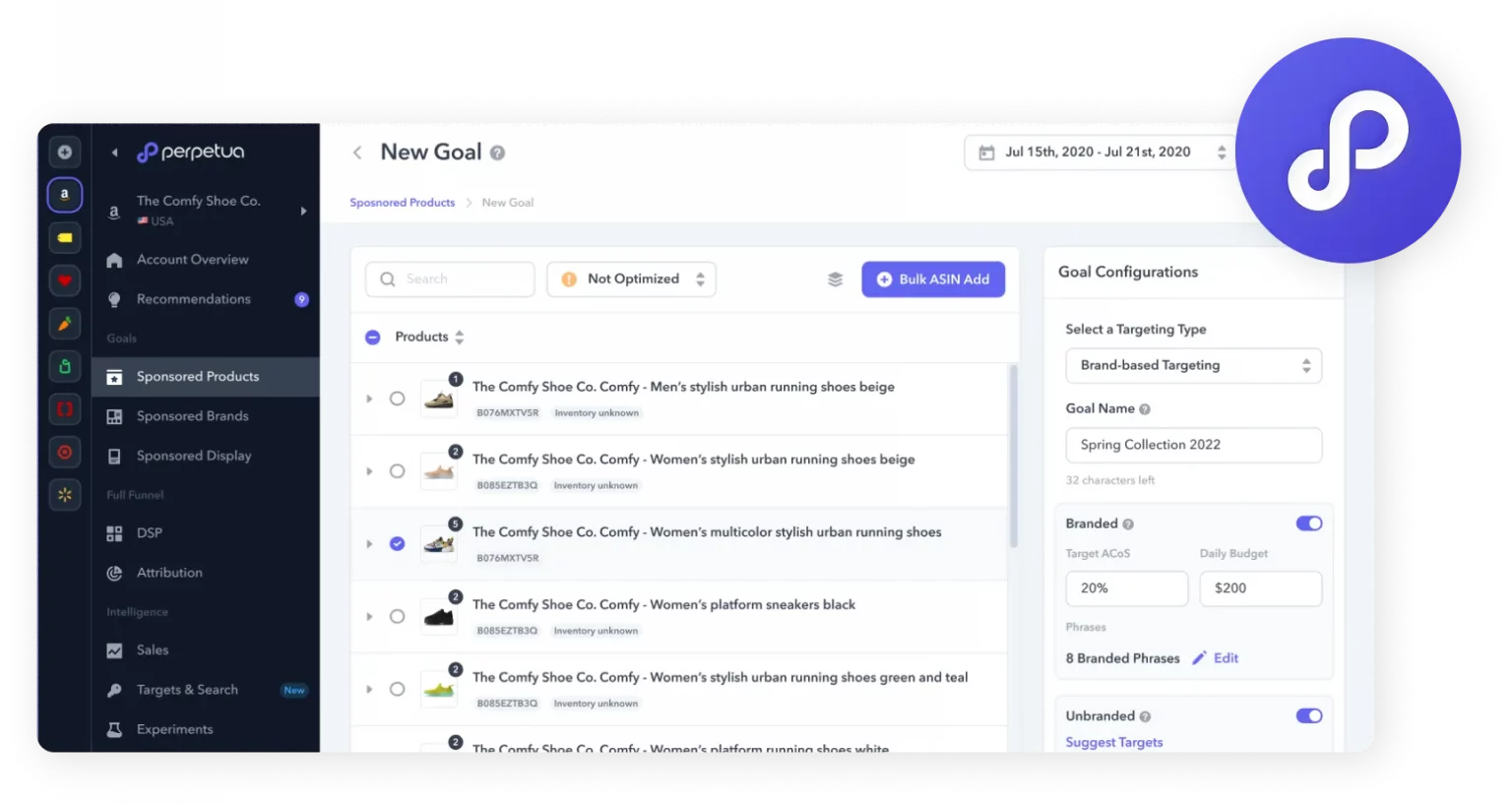
Per Perpetua’s pricing page, Essentials is $695/mo for up to $10k of monthly ad spend, Growth is $695/mo plus a percentage of spend above that, and Premium is custom. There is no free trial.
Read the tiers before you budget, because the part this article cares about is not in the entry plan: hourly Share-of-Voice and Organic Rank insights are listed under Growth, not Essentials.
One correction worth making, because it is repeated across the web and an earlier version of this article repeated it too: Sonar, the free keyword tool Sellics ran, is gone. As of 1 October 2026 sonar-tool.com no longer resolves and Perpetua’s own Sonar page returns a 404. If a listicle still recommends it, that listicle has not been checked.
Pick Perpetua if you’re already spending heavily on Amazon Ads and want organic rank in the same view as the campaigns moving it. Skip it if you just want to know where your keywords sit.
And two that left the category
ZonGuru appears on most comparisons like this one as a roughly $29/mo research suite with rank tracking included, and that is no longer what it is. As of 1 October 2026 the company sells Helix, an AI listing engineering platform priced from $149/mo for up to 15 managed listings, rising to $299 and $699, per its pricing page. Every plan requires an SP-API Seller Central connection, and the product is currently available for the US and UK marketplaces only. Keyword rank tracking is no longer presented as a feature.
GeoRanker is the second, and it left more quietly. It was a general SEO rank-tracking platform that carried Amazon as one of its search engines, and most comparisons still describe it that way. As of 5 October 2026 its rank tracker page never mentions Amazon, its SERP API engine list runs to twelve engines (Google, Maps, Images, YouTube, Bing, Yahoo, Baidu, Naver, Sogou, Google AI Mode, ChatGPT and Perplexity) with Amazon not among them, and both the old /amazon-rank-tracker page and the free Amazon Products Checker now redirect to its general SEO tools page.
Its prices have moved as well, to Starter $49/mo, Pro $99, Agency $249 and Enterprise by quote, per the same pricing page that used to carry the Amazon tiers. If you wanted one place to watch Google and Amazon together, this is no longer the tool that does it.
We’ve dropped both from the comparison above rather than quote products and prices that no longer exist.
When rank tracking isn’t worth it
It’s a fair question, and it comes up on seller forums more often than vendors would like. Three cases where the honest answer is to skip it.
You have one product and a handful of keywords. A free extension and a reminder in your calendar will do. You’ll see a real slide at your scale, and you won’t miss much between checks.
You’re not going to act on the number. Rank is a diagnostic, not a lever. If a drop wouldn’t change your pricing, your copy, your ad spend or your inventory, watching it more closely produces anxiety rather than revenue.
You have Brand Registry and only want to know what’s working. Search Query Performance answers that with measured data. Position is a proxy for the thing Amazon is already telling you directly.
The case for tracking is narrower and stronger than “know your rank”. It’s worth paying for when you have enough keywords that you can’t eyeball them, when a slide costs you real money before you’d otherwise notice, and when somebody will actually do something about it.
How to choose
- You want to check indexation and position, occasionally. Use a free extension. AMZDataStudio’s covers both and costs nothing.
- You want rank watched alongside hijackers, Buy Box and listing edits. SellerSonar, which puts all of them in one alert feed and doesn’t need your Seller Central login.
- You need to find keywords, not just track them. Helium 10 if the budget allows, SellerSprite if it doesn’t.
- You’re running PPC alongside organic. SellerApp or tool4seller. SellerApp’s free tier lets you try the combined view, but keyword tracking itself starts on its $99 Pro plan.
- Location-level results are the question. SoldScope, which prices geo tracking as its own allowance rather than treating location as an afterthought.
- You spend heavily on Amazon Ads. Perpetua, for organic rank sitting next to the campaigns moving it. Budget accordingly.
- You’re not sure yet. Start where it costs nothing: AMZDataStudio, SoldScope, SellerApp and SellerSonar all let you test without handing over a card.
💡 Expert Tip: Track fewer keywords than your plan allows. Twenty keywords per ASIN that you actually review beats two thousand you never open, and every tool here prices on a ceiling most sellers never reach.
Bottom line
Rank tracking is cheap. According to the vendor pricing pages linked above, every tool here except Perpetua starts under $100/mo, three start under $25, and the free tier is now good enough to answer the occasional question outright.
What separates them is what happens around the number. A dedicated tracker records it well. A research suite helps you pick better keywords to track. A monitoring tool tells you the moment the number moves, which is the version that matters if you are not checking dashboards daily.
Work out which question you’re answering before you pay for anything. “Which keywords should I target?” buys research depth. “Am I even indexed?” is free. “Did anything change on my listing today?” is alerting, and most sellers who end up disappointed by a rank tracker bought the first kind when the third was the thing keeping them up at night.
Want rank changes to find you instead of the other way round? Start a free 14-day SellerSonar trial and track 5 ASINs and 10 keywords, no credit card required.

